
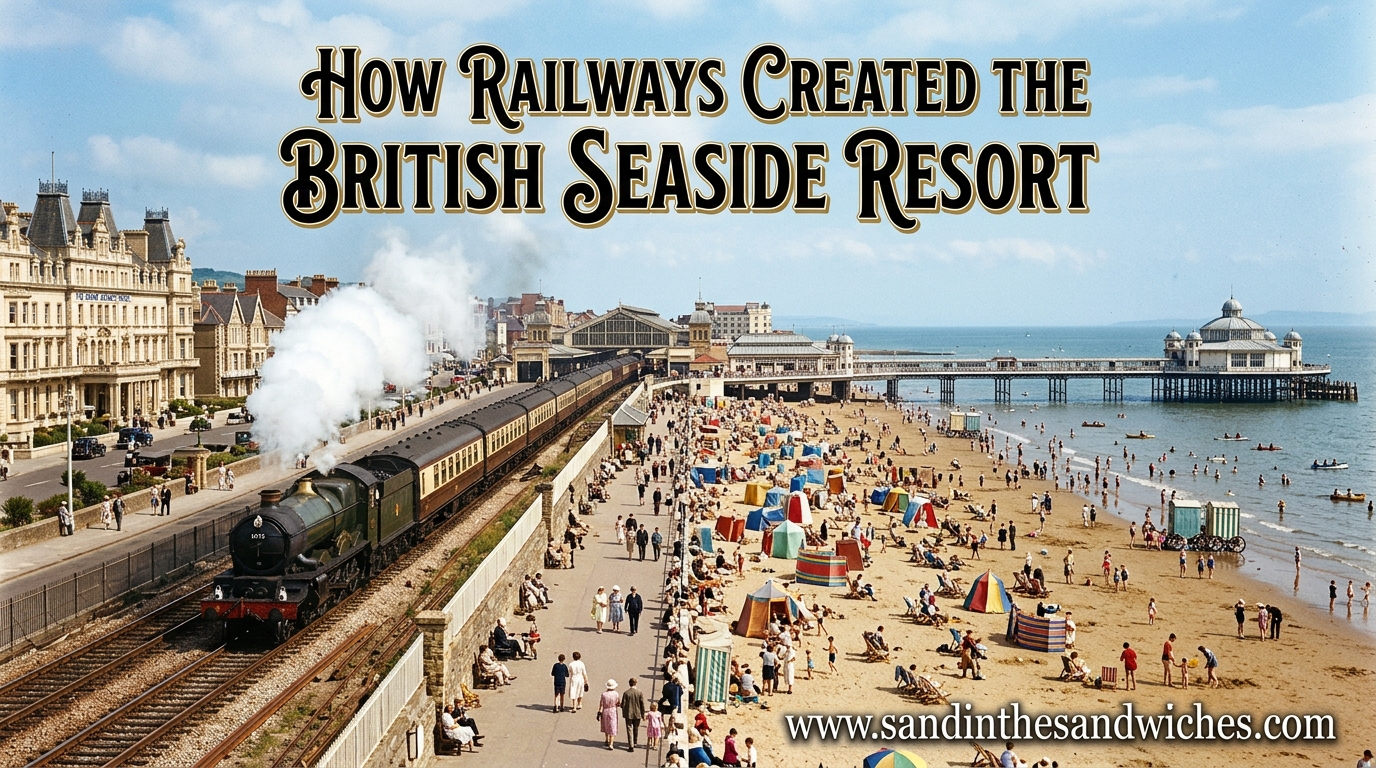
Picture a Bank Holiday morning in August 1895. At London’s Liverpool Street station, a packed excursion train groans under the weight of three thousand cotton-mill workers from Manchester, weavers from Blackburn, and clerks from the City, all bound for the Essex coast at Clacton. Similar scenes unfolded at Waterloo, Paddington, and Victoria, as the great railway termini emptied the industrial cities and poured their populations onto the sands at Margate, Brighton, Bournemouth, and Blackpool. None of this would have been possible even fifty years earlier. The question of how railways created the British seaside resort is one of the most striking stories in modern social history, a story of iron rails, cheap tickets, and a wholly new idea: that ordinary working people were entitled to leisure.
Before the 1840s, the British seaside was the preserve of aristocrats, health-seekers, and the very wealthy. Within a single generation, the railway network changed that completely. Branch lines pushed out to remote fishing villages and turned them into thriving resorts. Excursion tickets priced at a few shillings put the coast within reach of factory hands and shop assistants. The day tripper was born, mass tourism was invented, and a string of coastal towns from Scarborough to Skegness grew into the holiday destinations we still recognise today.
This article traces that transformation. It explores the pre-railway seaside, the 1840s railway boom, the cheap excursion trains that opened the coast to the working class, the resort towns most transformed by the iron road, the railway companies’ role in building hotels and piers, and the long legacy that still shapes how the British think about the seaside.
Table of Contents
Before the Railway: The Aristocratic Seaside
The British seaside resort did not begin with the railway. It began with a medical fashion. In the early eighteenth century, doctors began prescribing immersion in cold seawater as a cure for everything from gout to melancholy, building on the same logic that had made inland spa towns like Bath fashionable. Sea bathing was believed to carry restorative, even prophylactic, powers. The first true seaside resort, Scarborough, emerged in the 1720s when a acidic spa water source was discovered near the shore and a fashionable set began arriving each summer to drink and bathe.
By the late eighteenth century, sea bathing had spread to a handful of coastal towns. Brighton became the most famous when the Prince of Wales, later George IV, made it his favoured retreat in the 1780s. His presence drew the aristocracy and the rich merchant class, who built the cream-painted Regency terraces and squares that still define the town. Margate, Weymouth, and Hastings developed smaller but similar trade as watering places for the polite classes. These were not holiday destinations in the modern sense. They were seasonal health resorts for people who could afford to spend weeks or months away from home, lodged in expensive boarding houses, attended by servants, and entertained by assembly rooms and circulating libraries.
Travel to these early resorts was slow, expensive, and uncomfortable. A coach journey from London to Brighton took the best part of a day over poor roads. A trip to Scarborough from London could take three or four days. Fares were beyond the reach of all but the comfortable middle class and above. The working poor, the mill hands of Lancashire, the factory workers of the West Riding, the dockers of east London, had no realistic access to the sea at all. Their only contact with the coast might be a single childhood memory or a song.
This is the world the railways destroyed. By the 1840s, the old social geography of the seaside was about to be swept away by a transport revolution that would put the coast within reach of almost every household in industrial Britain.
How Railways Created the British Seaside Resort: The 1840s Boom
The story of how railways created the British seaside resort begins in earnest with the railway mania of the 1840s. The first great trunk lines had been built to move coal, freight, and business travellers between major cities. The London and Birmingham Railway opened in 1838, the Great Western Railway reached Bristol in 1841. But the railway companies quickly noticed something unexpected. Ordinary people wanted to travel for pleasure. The first excursion trains ran in the late 1830s, and by the early 1840s the railway companies were scrambling to lay branch lines to the coast.
The London and Brighton Railway, opened in 1841, is often cited as the moment the modern seaside resort was born. Brighton was already a fashionable resort, but the railway slashed travel time from London to under two hours and crashed the fare. Within a few years, day trippers from the capital were arriving in their thousands. The Great Western Railway reached the West Country, opening up Exmouth, Torquay, and Paignton. The South Eastern Railway pushed down to Folkestone and Hastings. The Great Northern Railway reached the Yorkshire coast at Scarborough and Whitby.
The construction work itself was staggering. Navvies, the tough, nomadic labourers who dug cuttings and built embankments by hand, moved from line to line in their thousands. They lived in rough camps along the route, drank hard, and worked in conditions that killed many of them. Their labour carved a network of coastal branch lines through some of the most difficult terrain in Britain, often against the wishes of local landowners. The Scarborough and Whitby Railway, for instance, threaded along a cliff-edge route that defied engineering sense, but it brought the railways to two of the most important East Coast resorts.
Some of the most famous seaside resorts were effectively created by the railway. Skegness, on the Lincolnshire coast, was a sleepy village until the Great Northern Railway arrived in 1873. The railway company actively promoted the town, billing it as a healthy family resort and even adopting the Jolly Fisherman as a marketing logo. Bournemouth, now a major city, was barely a village in 1840. The railway arrived in 1870 and the population exploded. Llandudno, in north Wales, was developed in the 1840s and 1850s by a planned resort company, but it was the railway from Chester in 1858 that made it a mass destination.
The railway companies understood what they were doing. They did not merely build lines and wait for traffic. They actively created resorts, often financing the hotels, piers, and promenades that turned a coastal hamlet into a holiday town. The Great Eastern Railway developed Clacton-on-Sea almost from nothing after its line arrived in 1882. The Great Northern Railway did the same at Skegness. This was not passive transport infrastructure. It was a deliberate act of resort creation, and it remade the British coastline within a generation.
Cheap Tickets and the Excursion Train
The branch lines alone were not enough. The railways could not have created mass seaside tourism if ordinary people could not afford the fare. The decisive innovation was the excursion ticket, a cheap return fare offered on special holiday trains. The first excursion trains ran in the late 1830s, often organised by temperance societies, Sunday schools, and trade associations. Thomas Cook ran his first seaside excursion in 1846, taking workers from Leicester to the coast. By the 1850s, the railway companies themselves were running regular excursion services on every bank holiday and throughout the summer.
The prices were astonishing by earlier standards. A day return from London to Margate or Ramsgate in the 1860s could be had for as little as three shillings. Adjusted for modern values, that is roughly equivalent to between fifteen and twenty pounds today. A skilled labourer on thirty shillings a week could take his whole family to the seaside for a day for less than a single day’s wages. Third-class carriages, basic but cheap, carried the bulk of the excursion traffic. The Saturday half-holiday, a reform of the 1850s and 1860s that gave shop assistants and clerks Saturday afternoon off, created a regular weekend leisure class with the means and time to travel.
Newspaper advertisements of the period give a vivid sense of the trade. The British Newspaper Archive preserves hundreds of such notices, often headed with bold capital letters announcing emergency excursions, cheap trips to the sea, and bank holiday specials. One typical advertisement from the 1880s, reproduced in the British Newspaper Archive blog, advertised return tickets from Liverpool Street to Clacton, Walton, and Dovercourt at three shillings each, with trains running throughout the day. Another, from the Illustrated London News, promised trippers trains to Margate on Whit Monday at fares so low that, as the advertisement put it, no excuse remained for staying at home.
The Bank Holidays Act of 1871 was the final piece of the jigsaw. Drafted by Sir John Lubbock, it created four statutory public holidays, including the August bank holiday. Combined with the Ten Hours Act of 1847, which limited the working day in textile mills, and the gradual spread of the Saturday half-holiday, the Act gave the industrial workforce something they had never had before: guaranteed paid days off. The railway companies met this demand with a flood of excursion trains. On a single August bank holiday in the 1890s, Blackpool could receive over a hundred thousand trippers by rail in a single day.
The Day Tripper: A New Social Type
The cheap excursion train produced something entirely new in British life: the day tripper. The day tripper was a working-class or lower-middle-class visitor who came to the seaside for a few hours, spent a little money on food, donkey rides, and amusements, and went home the same evening. They did not stay in boarding houses. They did not patronise the assembly rooms. They arrived in crowds, brought their own sandwiches and tea, and transformed the character of the seaside towns they descended upon.
The day tripper was a subject of intense contemporary commentary, much of it satirical. The Pall Mall Gazette in the 1880s and 1890s ran pieces lamenting the rough crowds on bank holiday excursion platforms. Punch cartoons mocked the cockney tripper at Margate, the Lancashire mill hand at Blackpool. Middle-class commentators worried about the manners of the excursionists, their noise, their litter, and their tendency to crowd the promenades and piers. There were frequent complaints from regular, longer-stay visitors that the day tripper was ruining the once-exclusive character of the watering place.
For the residents of the resort towns themselves, however, the day tripper was a goldmine. Each bank holiday brought tens of thousands of paying customers through the railway termini. The trippers bought fish and chips, paid a penny to walk the pier, hired deck chairs, dropped coins in the slot machines of the amusement arcades, and queued for donkey rides on the sands. The whole seaside entertainment industry, from the bandstands to the bathing machines, was built around extracting small sums from a vast and steady flow of day trippers.
The excursion train also transformed the geography of working-class leisure in northern England. The Wakes week, a staggered summer holiday observed by the textile towns of Lancashire and Yorkshire, sent entire industrial populations to the coast at different weeks through July and August. Blackpool was the great beneficiary. Railway specials brought trainloads of weavers, spinners, and their families from Blackburn, Burnley, Accrington, and Preston, often for a full week’s stay in cheap boarding houses. The Wakes week traffic was so important to Blackpool that the railway companies laid on extra excursion platforms at the town’s three stations, each capable of handling dozens of special trains a day.
The table below sets out, in brief, just how dramatically the railway changed access to the seaside.
- London to Brighton before 1841: Coach journey of around eight hours, fare of roughly one pound or more. Effectively inaccessible to the working class.
- London to Brighton after 1841: Rail journey of under two hours, excursion fare of around three shillings. Within reach of almost any employed person.
- Manchester to Blackpool before 1846: Two days by coach and ferry, fare beyond the reach of mill workers.
- Manchester to Blackpool after 1846: Around ninety minutes by rail, excursion fare of a few shillings on Wakes week specials.
- London to Margate before 1850: Long coach journey or steamer from London Bridge, fare of well over a pound.
- London to Margate after 1850: Rail excursion of around two hours, fare as low as three shillings on bank holiday specials.
The effect was revolutionary. The seaside, once the private playground of the aristocracy and the wealthy middle class, became the great shared leisure space of industrial Britain.
Resort Towns the Railways Built
No two resorts followed exactly the same trajectory, but the railway was decisive in almost every case. A few examples show the pattern.
Scarborough is widely regarded as the first true British seaside resort, predating the railway by more than a century. But it was the railway, arriving in 1845 via York, that turned it from a fashionable watering place into a mass destination. The town’s population roughly tripled in the second half of the nineteenth century, and the famous Grand Hotel, opened in 1867, was built to serve a railway-borne clientele.
Brighton was already famous as the Regency resort of George IV when the London and Brighton Railway arrived in 1841. The railway did not create Brighton from nothing. It transformed it. The fashionable season was supplemented, and eventually dwarfed, by a year-round trade in day trippers and short-stay visitors from London. Brighton’s palace pier, its aquarium, and its later entertainment industry all rested on the constant flow of railway passengers from the capital.
Blackpool is the most dramatic example of how railways created the British seaside resort. Before the railway, Blackpool was a string of hamlets on the Lancashire coast with a few lodging houses. The railway arrived in 1846, and within fifty years the town had grown into the most visited resort in the world, with three railway stations, two piers, the Blackpool Tower, and the famous illuminations. The whole apparatus of the Blackpool holiday, from the boarding houses to the Tower Ballroom, was built to serve railway-borne crowds from the Lancashire and Yorkshire mill towns.
Bournemouth is a town that arguably owes its entire existence to the railway. In 1840 it was a tiny settlement on the Hampshire coast. The railway arrived in 1870, and the population grew from around six thousand to nearly sixty thousand by 1900. The Great Western Railway and the London and South Western Railway both promoted the town heavily, billing it as a refined family resort with pine-scented air and a healthy climate.
Llandudno, on the north Wales coast, was developed from the 1840s onwards as a planned resort by the Mostyn family. But it was the railway, arriving from Chester in 1858, that turned the plan into reality. Llandudno became the resort of choice for the industrial populations of the Welsh borders, the Potteries, and the northern Midlands, and its broad promenade and Victorian pier were built to serve a railway-borne clientele.
Other towns tell the same story. Morecambe served the Lancashire mill towns. Great Yarmouth and Lowestoft served the industrial east. Eastbourne and Hastings drew on London via the South Eastern Railway. Torquay and Paignton served the Midlands and the North via the Great Western Railway. Each of these resorts, in its own way, was a creature of the iron road.
Railway Posters, Piers and the Seaside Industry
The railway companies did not see themselves as passive carriers. They saw themselves as resort developers. From the 1880s onwards, the great railway companies, the Great Western Railway, the London and North Western Railway, the Great Eastern Railway, the South Eastern and Chatham Railway, and later the L.M.S., L.N.E.R., and Southern Railways, ran aggressive advertising campaigns promoting the seaside. The railway poster became one of the most distinctive art forms of the early twentieth century.
These posters, often designed by leading commercial artists, presented an idealised vision of the British seaside. They showed golden sands, blue seas, smiling families on the promenade, and elegant bathers descending to the beach. They were pasted on every station platform and printed in every newspaper. The Skegness Jolly Fisherman poster of 1908, with its slogan Skegness is SO bracing, is perhaps the most famous railway advertisement ever produced. It sold the very idea of the seaside holiday to a national audience.
The railway companies also invested directly in the built fabric of the resorts. Many of the grandest seaside hotels were built or backed by railway money. The Cruden Bay Hotel in Aberdeenshire, opened by the Great North of Scotland Railway in 1899, was a planned railway-owned resort in miniature. The Great Eastern Railway owned and operated the Clacton Pier for a time. The London and North Western Railway built the Royal E Hotel at Bournemouth. Railway capital underpinned much of the promenade, pier, and pleasure-garden construction that defined the late-Victorian and Edwardian seaside.
The architecture of the resort stations themselves was part of the experience. Stations like Blackpool Tower, Scarborough, Brighton, and Bournemouth were designed to handle enormous crowds and to impress. Their iron-and-glass train sheds, their excursion platforms, and their grand booking halls were the gateways through which the holidaymakers passed. The station was the first thing a tripper saw on arrival and the last thing they saw on departure. It was, in effect, the proscenium arch of the seaside theatre.
Peak and Decline: From Wakes Weeks to Car Ownership
The peak era of the railway-built seaside resort ran from the 1890s to the 1930s. The inter-war years, in particular, were a golden age. The spread of paid holidays, formalised by the Holidays with Pay Act of 1938, gave millions of industrial workers a guaranteed week off each summer. The railway companies responded with a vast programme of holiday specials. Billy Butlin opened his first holiday camp at Skegness in 1936, built beside the railway line and explicitly designed to receive its customers by train. Pontin’s followed, and the holiday camp became the great institutional expression of the railway-created seaside industry.
The First World War disrupted the trade but did not destroy it. Some East Coast resorts, like Scarborough and Hartlepool, were bombarded by German warships in 1914, and wartime restrictions on travel cut the excursion traffic sharply. But the trade recovered quickly after 1918. The seaside was firmly established as a national institution.
The long decline began after the Second World War. The first great blow was the rise of car ownership in the 1950s and 1960s. The car offered a freedom the railway could not match. Families could travel on their own schedule, choose their own destination, and avoid the crush of the excursion platform. Resorts that had grown up around railway termini, with their boarding houses clustered near the station, suddenly found that their visitors were arriving by road and wanted car parks and motels instead. Blackpool, Brighton, and Bournemouth all adapted, but many smaller railway-built resorts did not.
The second blow was the cheap package holiday abroad. The rise of the Spanish costas from the 1960s onwards offered British holidaymakers guaranteed sunshine at prices that undercut the domestic boarding house. The package tour, advertised in every newspaper and travel agency window, did to the British seaside resort what the railway excursion had done to the coaching inn a century earlier.
The third blow was the Beeching cuts of the 1960s. Dr Richard Beeching’s restructuring of the railway network closed thousands of miles of branch lines, many of them serving coastal resorts. Lines to places like Cleethorpes, Minehead, and many smaller resorts were axed. The railway network that had created the seaside resort was systematically dismantled, and many coastal towns lost the very thing that had brought them into existence.
Today the legacy is mixed. Some resorts, like Brighton, Bournemouth, and St Ives, have reinvented themselves as commuter towns, cultural destinations, or upmarket second-home hotspots. Others, especially the smaller railway-built resorts of the east and north coasts, have struggled with decline, seasonal unemployment, and an ageing population. The relationship between railways and the seaside remains visible in the surviving coastal branch lines, the grand resort stations, and the Victorian promenades that still line the British coast.
FAQs
What is the history of the British seaside resort?
The British seaside resort began in the early eighteenth century as a health destination for the wealthy, inspired by spa culture and the belief in the restorative powers of cold seawater. Scarborough, then Brighton under the patronage of the Prince of Wales, became the first fashionable watering places. From the 1840s onwards, the railway network opened the coast to mass tourism, and towns like Blackpool, Bournemouth, and Skegness grew from villages into major resorts within a generation.
Why did the British build railways?
The first British railways were built in the 1830s and 1840s to move coal, freight, and business travellers between industrial cities more cheaply than canals or roads. The railway mania of the 1840s saw a vast speculative boom, with lines pushed out to almost every sizeable town. Branch lines to the coast were built both to carry freight, such as fish and coal, and to capture the fast-growing leisure traffic of excursion trains and day trippers.
Why are British seaside towns so run down?
Many British seaside towns declined after the 1960s due to three main factors: the rise of car ownership, which freed holidaymakers from the railway timetable; the growth of cheap package holidays abroad, especially to Spain; and the Beeching cuts of the 1960s, which closed many coastal branch lines. Resorts that depended almost entirely on railway-borne day trippers and Wakes week visitors were left with seasonal unemployment, an ageing population, and limited alternative industry.
Who built the British Railways?
The early British railways were built by private companies, often backed by local merchants, industrialists, and speculators, under Acts of Parliament. The physical construction work was done by navvies, itinerant labourers who dug cuttings, built embankments, and laid track by hand in dangerous conditions. Engineers such as George Stephenson, Isambard Kingdom Brunel, and Joseph Locke designed the routes and supervised the works. By the 1920s the many small companies had been grouped into the Big Four, and in 1948 the network was nationalised as British Railways.
Conclusion: The Enduring Railway Legacy
The story of how railways created the British seaside resort is the story of one of the most far-reaching social transformations of the nineteenth century. In less than fifty years, an exclusive aristocratic pleasure ground became a mass leisure industry, a string of fishing villages became national institutions, and a working population that had never seen the sea became a nation of holidaymakers. The excursion train, the day tripper, the bank holiday rush to the coast, the pier, the promenade, the fish and chips on the front: all of these are the legacies of the iron road.
That legacy is still visible today. The surviving coastal branch lines, the great resort stations, the Victorian terraces that line the front at Llandudno and Eastbourne, the very shape of Blackpool’s seafront: all were laid out for a railway-borne clientele. Even the modern revival of the staycation, and the renewed interest in slow travel and heritage railways, draws on the inheritance of the 1840s.
The next time you stand on a British promenade, looking out at the grey water and the distant horizon, it is worth remembering that almost everything around you, the pier, the deck chairs, the boarding houses turned into holiday flats, the very idea that this is a place to come and enjoy yourself, exists because a generation of Victorian engineers, navvies, and railway company shareholders decided to lay a line to the coast and sell a cheap ticket to the sea.