
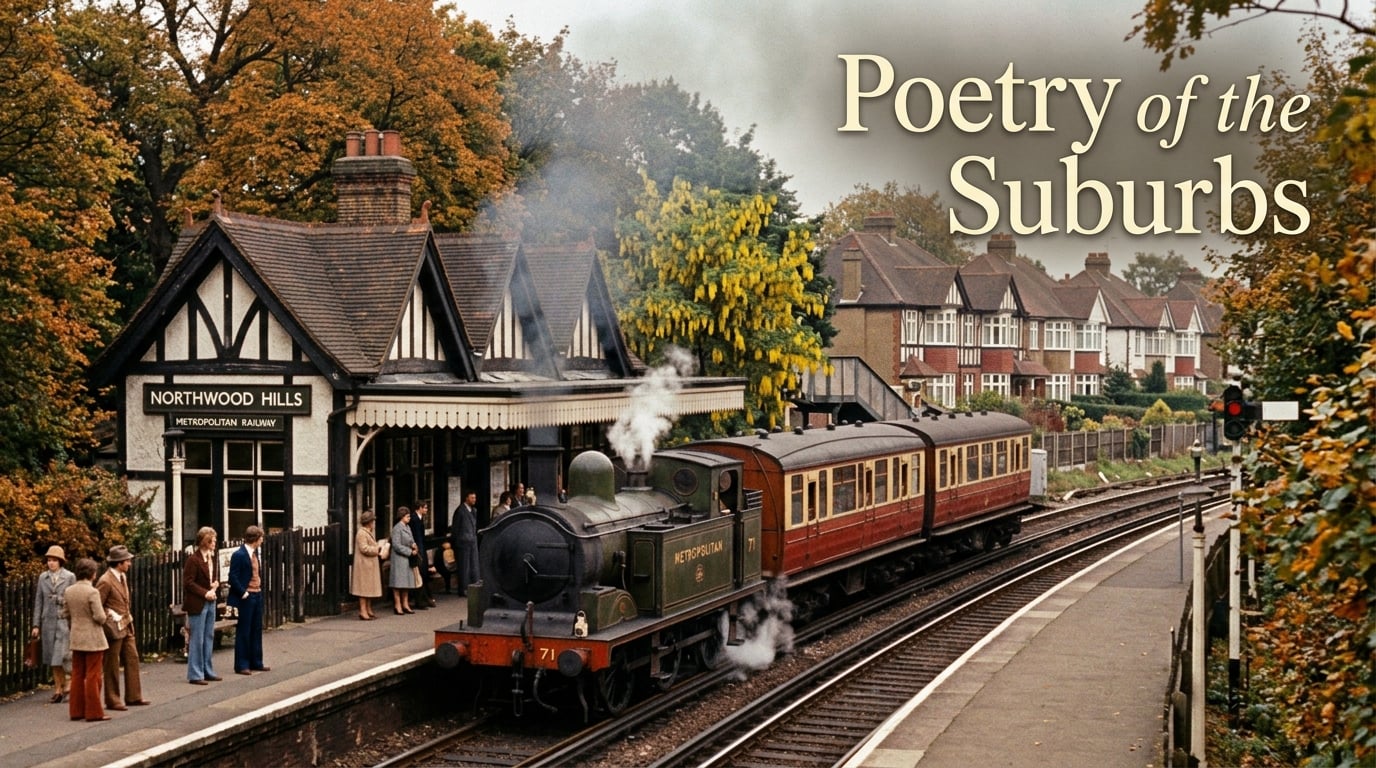
Most twentieth-century poets looked to myth, war, or inner turmoil for their subjects. John Betjeman looked out of a train window. Across six decades of work, he turned terraced semis, mock-Tudor semis, peeling railway posters, and wet suburban platforms into some of the most loved English verse of the modern era.
This is the story of how John Betjeman turned suburbia and trains into poetry. It is part biography, part craft analysis, and part travelogue through a half-forgotten England that Betjeman spent his life insisting was worth saving.
Table of Contents
Who was John Betjeman and why did he write about ordinary places?
John Betjeman was born in 1906 in a London rectory and died in 1984, two years after being made Poet Laureate. Long before the laureateship, he had built a reputation as the poet of the overlooked. Where his contemporaries pursued modernism’s blank verse and classical allusions, Betjeman wrote about golf clubs, seaside guesthouses, and the disused Great Western station at Newton Abbot.
He was, in his own description, “a poet of place rather than ideas.” He believed that affection for a particular brick wall, a particular bus route, or a particular stretch of railway could be as spiritually serious as any metaphysical inquiry. Critics in the 1940s dismissed him as lightweight. The reading public disagreed, and so, eventually, did the literary establishment.
How a childhood of train rides shaped John Betjeman’s suburbia and trains poetry
Betjeman’s lifelong devotion to railways began early. Family holidays to Cornwall meant long journeys from Paddington, and the boy learned to read the rhythm of a Great Western express before he learned to read poetry in school. He kept a battered copy of a Bradshaw’s guide on his bedside table into his seventies.
The Metropolitan Railway made an even deeper impression. Its chain of mock-Tudor stations running northwest out of Baker Street framed a kind of countryside that was not quite country and not quite city. To Betjeman, this in-between landscape was where modern England actually lived, and where the truest poetry of the twentieth century was being unconsciously composed by the railway companies themselves.
Trains gave him two things he would use for the rest of his career. They gave him a moving frame for observation, and they gave him sound. The wheel-on-rail rhythm, the distant two-tone horn, the clatter of points, the rush of air at a platform – all of these would later surface in his verse.
What was the Metro-land documentary and why does it matter?
In 1973 the BBC broadcast a documentary called Metro-land, written and presented by Betjeman himself. It traced the Metropolitan line from Baker Street to its furthest reaches in Buckinghamshire, pausing at Harrow-on-the-Hill, Moor Park, Chorleywood, and Amersham. The film is half travelogue, half elegy.
What makes the documentary essential to understanding how John Betjeman turned suburbia and trains into poetry is its voiceover. Betjeman reads his own lines as the camera glides past semis, parades, and cricket greens. The spoken verse and the moving image lock together, and the result is something neither could achieve alone: a hymn to commuter-belt England that has never quite been replicated.
Metro-land also gave Betjeman a vocabulary. The word itself, originally a railway marketing term from the 1910s, became, through his film, a literary category. It now describes not just a region but a mood – a particular blend of bay windows, laburnums, and quiet weekday afternoons that English readers recognise instantly.
How did John Betjeman use dactylic meter to mimic the rhythm of trains?
Betjeman’s signature technical choice was the dactyl: a metrical foot of one stressed syllable followed by two unstressed. Read aloud, a line of dactyls has a galloping, falling cadence, rather like the rocking of a railway carriage over jointed track.
Take the opening of “Middlesex”:
“Dear old, godly, suburban, multi-million-peopled Middlesex!”
The line trips forward, gathers speed, and lands on the emphatic “Middlesex” at the end. The accumulation of short, ordinary, affectionate adjectives – dear, old, godly, suburban – mirrors the procession of semis seen from a train window. Read it at the pace of a stopping service, and the meter itself becomes the journey.
Compare this with a line of iambic pentameter from an earlier poet: “Shall I compare thee to a summer’s day.” Steady, level, contemplative. Betjeman’s dactyls do something different. They make the train move. They are, in a real sense, a sound recording of Edwardian Britain in motion.
This is the central technical fact behind how John Betjeman turned suburbia and trains into poetry: he did not write about the railway, he wrote in its rhythms.
Why did Betjeman see suburban architecture as poetry?
Betjeman’s other great subject was brick. He revered Victorian railway architecture, the Tudorbethan semis of the Metro-land estates, and the glass-roofed cathedrals of Victorian travel like St Pancras. He wrote a famous Shell Guide to Cornwall that was really a defence of unfashionable buildings, and he campaigned for years to save St Pancras from demolition.
For Betjeman, suburban architecture was poetry for three reasons. First, it was the built expression of ordinary lives lived with quiet dignity. Second, it was disappearing fast in the 1960s, when brutalist redevelopment was wiping out terraces and chapels by the week. Third, and most importantly, it was beautiful on its own terms, if you took the trouble to look.
His architectural writing and his poetry are really the same project. A line of Betjeman verse about a gabled villa in Harrow and a paragraph of his prose guide to a Wiltshire church are both acts of patient, affectionate looking. The bronze statue of him that now stands in St Pancras station, installed in 2007, marks that project at its most literal. The man who saved the building is now part of it.
How does John Betjeman’s suburbia and trains poetry still resonate today?
Betjeman’s reputation has only grown since his death. Carol Ann Duffy, his successor as Laureate, has written explicitly about Underground stations in poems that owe him an obvious debt. Contemporary poets like Don Paterson and Sean O’Brien have followed his lead in finding subjects in motorway service stations, retail parks, and suburban gardens.
Architectural preservation movements, from the Victorian Society to local amenity societies across the commuter belt, regularly cite Betjeman as a founding voice. His Metro-land documentary is still broadcast, still taught, and still, half a century on, capable of stopping a viewer in their tracks.
More broadly, his work speaks to a modern hunger for rootedness. In a country where high streets are vanishing and new housing rises without character, Betjeman’s patient, tender inventory of the ordinary feels less like nostalgia and more like a survival manual.
Frequently asked questions about John Betjeman and his poetry
What is the most famous poem by John Betjeman?
‘Middlesex’ is often cited as Betjeman’s signature poem, alongside ‘A Subaltern’s Love Song’ and ‘Summoned by Bells’. ‘Middlesex’ is the most direct celebration of the suburban landscape that defined his career.
What is the famous poem about a train station by Betjeman?
Several Betjeman poems focus on specific stations, including the Great Western stations of Cornwall and the Metropolitan line stops in ‘Middlesex’ and ‘Metro-land’. The documentary Metro-land of 1973, narrated by Betjeman himself, is also a key work in this category.
Who wrote the verse autobiography that shaped his suburbia and trains poetry?
‘Summoned by Bells’ (1960) is Betjeman’s verse autobiography, covering his Edwardian childhood, schooldays, and early encounters with the Metropolitan Railway. It is essential reading for understanding how those early experiences became his lifelong subject matter.
Why is John Betjeman important in English poetry?
Betjeman widened the territory of English poetry to include the suburban, the commercial, and the everyday. By finding serious lyrical material in train stations, semis, and seaside hotels, he opened the door for later poets writing about ordinary modern life.
Final thoughts on John Betjeman and the poetry of the everyday
How John Betjeman turned suburbia and trains into poetry is, finally, a story about attention. He paid close, affectionate attention to a kind of England that other writers passed by. The dactyls carried the rhythm. The Metropolitan Railway supplied the route. The semis and stations provided the sights. What he added, and what no railway company could supply, was the look itself.
Read “Middlesex” on a slow train out of Baker Street this September, and you will hear exactly what he heard.