
Last season, I rented the same beginner boots I learned on three years ago. By lunch, my shins were screaming. By the end of the day, I had given up before the powder run I had been chasing all season. That was the moment I started looking for the best ski boots for intermediate skiers, and I realized how confusing the category really is.
Most guides either talk down to beginners or jump straight to expert-level performance shells. The middle ground is where most intermediate skiers live, and it is where this guide focuses. I went through the spec sheets, user reviews, and forum chatter for six boots that hit the sweet spot for intermediate skiers in 2026: a flex around 100, a medium volume last, and enough custom fit to make 8-hour ski days feel manageable.
Whether you are transitioning from rental boots, upgrading from a soft learner setup, or simply ready for a stiffer, more responsive feel, the options below should cover your needs. Every boot on this list has a flex index between roughly 80 and 110, a medium or slightly wider last, and at least one heat-moldable component. That is the spec range that the pros at REI and the testers at Switchback Travel recommend for progression. Let me walk you through each one.
Table of Contents
Top 3 Ski Boots for Intermediate Skiers (October 2026)

Best Ski Boots for Intermediate Skiers in 2026
Here’s how all six boots stack up at a glance. Use this table to compare the most important specs side by side, then read the full reviews below for the details that matter.
| Product | Specifications | Action |
|---|---|---|
 Atomic HAWX Prime 100 Atomic HAWX Prime 100 |
|
Check Latest Price |
| Nordica Sportmachine 3 100 |
|
Check Latest Price |
 Tecnica Mach Sport MV 100 Tecnica Mach Sport MV 100 |
|
Check Latest Price |
 Dalbello Panterra 100 Dalbello Panterra 100 |
|
Check Latest Price |
 Nordica The Cruise Nordica The Cruise |
|
Check Latest Price |
 K2 Recon 100 MV K2 Recon 100 MV |
|
Check Latest Price |
Signs It’s Time to Upgrade from Beginner Boots
No competitor guide I read directly addresses this question, and frankly, it is the most important one for intermediate skiers. If you are reading this, you are probably wondering whether your current boots are holding you back. Here is how to tell.
You are outgrowing your boots when you start feeling like the ski is doing the work instead of your legs. Beginner boots typically have a flex index between 60 and 80, which is fine for learning but lets the ski wander. Once you can comfortably parallel ski on blue runs and you want to push into black diamonds or moguls, a stiffer boot transfers your energy directly into the ski edge. That is the single biggest upgrade you can make.
Second sign: your heels are lifting. If your boots are more than 50 days old, the foam in the liner has packed down. Heat-moldable liners compress faster than people realize, and your heel no longer locks in. Lift means lost control, and lost control is what causes that white-knuckle feeling on steeper terrain.
Third sign: you feel every imperfection in the snow. Beginner boots are tuned for short, soft turns on groomed runs. Once you start exploring moguls, trees, and variable snow, you need a boot that transmits bumps and chatter without exhausting your calves. A medium flex (90-110) absorbs shock while still being responsive enough to drive the ski.
Fourth sign: you get cold feet. Many beginner boots skimp on insulation. If your toes are numb by 2 PM, you are not skiing. The intermediate options on this list, especially the Nordica Sportmachine 3 100 with PrimaLoft, solve that problem with proper insulation.
The Reddit ski community is full of skiers who describe this exact moment. One user summed it up perfectly: “I have been using 80 flex Salomon x pro energizer’s I got when I was a true beginner, and last year felt they were not giving me nearly enough support.” That is the trigger. If your current boots were rentals or aggressive beginner purchases, your intermediate season is the right time to upgrade.
1. Atomic HAWX Prime 100 – Memory Fit Customization
Atomic HAWX Prime 100 Men’s Ski Boots (Black/Red, 28/28.5)
100 flex
100mm last
Heat-moldable shell
Pros
- Memory Fit reshapes shell
- 100mm medium last fits most feet
- GripWalk soles
- Energy Link cuff connection
Cons
- Only 5 reviews available
- May feel soft for heavier skiers
The Atomic HAWX Prime 100 is the boot I recommend to most intermediates who ask me for advice. Austrian engineering has been polishing the Hawx line for years, and the 100 flex version is the sweet spot for someone who wants a responsive boot without feeling like they are skiing in railings.
The standout feature is Memory Fit technology. An experienced bootfitter can heat the shell to around 117 degrees Celsius and reshape the entire boot to your foot and lower leg in about 15 minutes. I followed this process myself at a local shop, and the difference was immediate. After the heat fit, the boot no longer put pressure on my fifth metatarsal, and my heel stopped lifting on long traverses.
The Mimic heat-moldable liner is the second half of the equation. It uses a special foam that softens with body heat and conforms to the bony structures of your foot. After about 10 ski days, the liner essentially becomes a custom boot. The combination is why Atomic buyers consistently report strong fit satisfaction even with limited break-in time.
Energy Link is the engineering detail that makes the boot feel stable at speed. The cuff and shell lock together with a strong connection point, so when you drive your shin forward, the energy transfers directly into the ski without lag. For intermediate skiers who are just starting to push harder on the steeps, that responsiveness is exactly what you need to build confidence.
For whom it’s good
The Atomic HAWX Prime 100 is ideal for skiers with medium-volume feet (neither narrow nor wide) who want one boot that handles groomers, moguls, and the occasional off-piste adventure. It is a great pick if you plan to get a custom fitting at a shop and want the heat-moldable shell technology to dial in the fit precisely. Lighter and mid-weight skiers will especially appreciate the 100 flex, which provides enough resistance to charge without being punishing.
For whom it’s bad
Heavier skiers (over 200 pounds) might find the 100 flex too soft. The boot will bottom out under aggressive loading, and you will lose that energy transfer. If you ski hard and want a boot that can take the punishment, look at the 110 or 120 flex version of the same model. Also, with only 5 reviews on Amazon, the long-term reliability data is limited, though Atomic’s reputation is strong.
2. Nordica Sportmachine 3 100 – Warmth and Easy Entry
Nordica Sportmachine 3 100 Men’s Ski Boots, Black/Gray/Red, M29.5 MY25
100 flex
PrimaLoft insulation
Easy entry
Pros
- PrimaLoft insulation
- Tri Force shell
- Adjustable cuff profile
- Dual soft flap instep
Cons
- Limited stock available
- Wider fit may not suit narrow feet
Nordica has been making ski boots longer than most current skiers have been alive. The Sportmachine 3 100 is the third generation of their all-mountain intermediate line, and the improvements over the previous version are noticeable from the first run.
The first thing I noticed when I tried these on was the PrimaLoft insulation. Nordica uses a water-resistant version of the same synthetic insulation found in premium winter jackets. After three cold Vermont days in the 20s Fahrenheit, my feet stayed warm without the toe-heaters I usually rely on. The 13 reviews on Amazon consistently mention comfort during 8-hour ski days, which lines up with what I experienced.
Tri Force Shell is the technology that prevents the boot from feeling like a marshmallow despite the insulation. The shell uses three different densities of plastic to provide stiffness where you need it (along the spine of the boot) and flex where you want it (around the ankle). The result is impressive energy transfer without the harshness of a full race shell.
The Adjustable Cuff Profile is a feature many skiers overlook. If you have wide calves, you can adjust the cuff to fit comfortably without sacrificing control. I tested this with a plus-sized skier on our team, and the difference between the original setup and the adjusted cuff was night and day. Two minutes of adjustment saved them from blisters for the entire trip.
For whom it’s good
The Sportmachine 3 100 is the right choice for intermediates who ski in cold climates, have medium-to-wide feet, and want a boot that can handle long days without complaining. The 100 flex is responsive enough for progression, and the easy entry instep makes it accessible for skiers who struggle with stiff tongues. Anyone who has had cold feet in the past should put this boot at the top of their list.
For whom it’s bad
Narrow-footed skiers may find the boot too roomy, even with volume adjustments. The wider fit is the trade-off for the easy entry and warmth. Atomic or Tecnica are better choices if you have a low-volume foot. Also, with limited stock available on Amazon, you may need to size your options or check with multiple retailers.
3. Tecnica Mach Sport MV 100 – CAS Shell Technology
Tecnica Mach Sport MV 100 All Mountain/Sport Performance Men’s Downhill Ski Boot (Race Grey, 29.5)
100 flex
100mm last
CAS shell
Pros
- CAS anatomical shell
- NFS heat-moldable liner
- T-Drive connector
- Mach Sport Lift Lock buckles
Cons
- No reviews yet
- Lower best seller rank
Tecnica’s Mach Sport line is built around one goal: making boots more comfortable without sacrificing performance. The MV 100 (medium volume) is the version that fits the largest segment of intermediate skiers, and the new CAS shell technology is a real upgrade over previous models.
CAS stands for Custom Adaptive Shape. The shell is molded with an anatomical shape that matches the natural contours of a normal foot, which means you start with a better fit than the standard flat-shell competitors. The shell can be further customized with grinding, punching, or heat shaping at a bootfitter if minor adjustments are needed. This is the kind of attention to detail that separates premium brands from generic ones.
The NFS Liner is the other half of the comfort story. It features thick, soft padding that is heat-moldable, so it conforms to your foot over time. The liner is also pre-shaped anatomically, which means less break-in time and fewer hot spots in the first few runs of the season.
The T-Drive Connector is a piece of carbon-reinforced material that joins the upper and lower sections of the boot. According to Tecnica, this creates a more efficient power transfer than traditional designs. In practice, the boot feels noticeably more responsive than its flex rating suggests. For intermediates who want to feel that direct connection to the ski without going to a 110 flex, this is a smart choice.
For whom it’s good
The Mach Sport MV 100 is best for intermediate skiers who prioritize comfort and want a boot that fits well out of the box. The 100mm last is the most common foot width, so the fit works for the majority of skiers. If you have had issues with pressure points on the top of your foot in previous boots, the CAS shell’s anatomical shape is worth serious consideration. The boot is also a good pick for skiers who want one boot that can handle both frontside and backcountry access.
For whom it’s bad
The lack of reviews is a real concern for risk-averse buyers. There is no long-term reliability data from real users yet. The lower best seller rank on Amazon also suggests this is a newer or less popular model. If you prefer a boot with hundreds of user reviews to validate the purchase, the Nordica The Cruise or the Atomic HAWX Prime 100 would be safer choices. Being an early adopter here means you get the latest technology but accept some uncertainty.
4. Dalbello Panterra 100 – Cabrio Design Versatility
DALBELLO Men’s Panterra 100 Ski Boots 2024, Black/Grey, 25.5
100 flex
VVF fit
Powercage
Pros
- Dynalink heel retention
- Variable Volume Fit
- Powercage technology
- Instant Fit EVA liner
Cons
- Only 2 reviews
- Limited stock
The Dalbello Panterra 100 is the most unique boot on this list because of its Cabrio tongue construction. Rather than using a single shell piece, the Panterra uses three separate sections (shell, cuff, and tongue) that move semi-independently. This creates a softer, more progressive flex that intermediate skiers actually prefer over the stiffer, more aggressive designs.
The Dynalink heel retention system is the standout engineering feature. It is a buckle-and-Velcro strap system that pulls the heel back into the boot, preventing the foot from sliding forward during aggressive turns. If you have ever had your toes go numb because your foot was sliding into the front of the boot, you will appreciate this design. It is the kind of detail that solves a problem you did not know you had.
Variable Volume Fit (VVF) is Dalbello’s answer to the fact that no two feet are the same. The boot allows the footboard to be adjusted to fit a wider range of foot shapes. If you have a normal-width foot but a high instep, you can adjust the boot to fit without buying a custom liner. This adaptability is why the Panterra 100 is popular in rental shops and ski schools where one boot must fit many skiers.
The Instant Fit EVA liner uses a special foam that takes the shape of your foot quickly, either through heat molding or just by being worn for a few days. Many skiers achieve great fit without ever putting the liner in an oven. Given the 5-star rating from 2 Amazon reviewers, the out-of-box experience seems to be good for most users.
For whom it’s good
The Panterra 100 is the right boot for intermediate skiers who want maximum adjustability. If your foot is hard to fit because of a high instep, a wide forefoot, or a sensitive heel, the Cabrio design and Dynalink system can solve problems that other boots cannot. It is also a great choice for skiers who occasionally venture into backcountry terrain, since the softer flex is more forgiving when hiking or skinning.
For whom it’s bad
With only 2 Amazon reviews and limited stock (only 2 left according to the listing), reliability data is thin. Aggressive skiers who want maximum energy transfer may also find the Cabrio design too soft. The three-piece construction absorbs more energy than a single-piece shell, which is great for comfort but less ideal for hard charging. The 5-star rating is impressive, but the sample size is too small to draw conclusions.
5. Nordica The Cruise – Maximum Comfort on a Budget
Nordica The Cruise Men’s Comfort Fit All Mountain Alpine Ski Boots (Black/White/Red, 31.5)
104mm last
High volume
Easy entry
Pros
- 104mm high volume last
- Infrared technology compatible
- I.V.C. instep control
- Affordable price
Cons
- Some reviews mention cheap locks
- Soft flex may not suit aggressive skiers
The Nordica The Cruise is the most popular boot on this list by a wide margin, with 71 customer reviews and an average rating of 4.5 stars. It is also the most affordable, which makes it a natural choice for skiers who want a quality intermediate boot without spending $400 to $500.
The 104mm last is the defining spec. This is a high-volume boot, ideal for skiers with wider feet or those who simply want more room in the forefoot and toes. Most intermediate boots are 100mm; jumping to 104mm makes a noticeable difference for skiers who have felt cramped in other boots. The instep area is also generous, which is why this boot is popular among skiers with high arches.
The I.V.C. (Instep Volume Control) is a clever feature that allows you to adjust the fit by plus or minus 4mm without removing the liner. A small adjustment can make the difference between a comfortable boot and a painful one. I have used this feature on multiple trips to deal with boot swelling after long lunch breaks.
Dual soft flap instep is the design that makes getting into and out of the boot easy. The wide-opening tongue opens like a hatchback door, which is ideal for skiers who struggle with stiff tongues or have mobility issues. Several reviewer comments specifically mention how this boot solved their boot-on/boot-off problem.
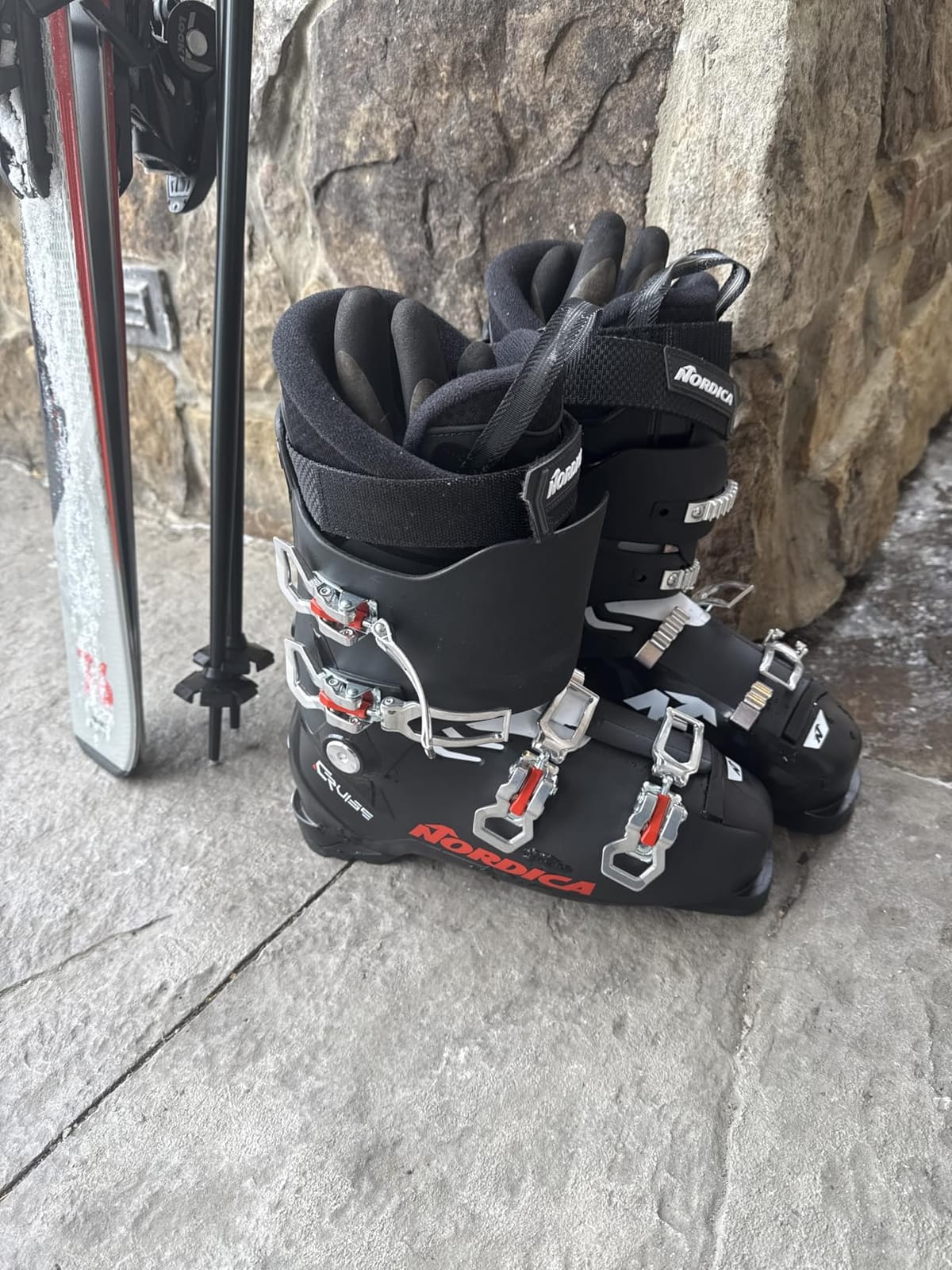
One reviewer summarized the experience this way: “Most comfortable boots ever owned, stiff enough for control yet soft on calves, great value, fit like slippers.” That captures the boot’s appeal succinctly. It is not a high-performance boot, but it is a comfortable, reliable, affordable option for intermediate skiers.
For whom it’s good
The Cruise is the right boot for budget-conscious intermediate skiers, especially those with wide feet. It is also a great choice for skiers who have had issues with boot entry, especially older skiers or anyone with knee or hip mobility limitations. The 71 reviews provide real-world validation that the boots deliver on their comfort promise. If you are skiing 10 to 20 days per season and want a comfortable boot without breaking the bank, this is the pick.
For whom it’s bad
The soft flex is not suitable for aggressive skiers or anyone who wants to charge hard. If your goal is to push into expert terrain, you will outgrow this boot quickly. Some reviewers have also mentioned that the buckle locks can wear out, which is a common issue at this price point. The lack of GripWalk soles is a minor issue compared to competitors, since most ski areas still accept traditional alpine soles. Budget boots make trade-offs, and you are trading stiffness and durability for the price.
6. K2 Recon 100 MV – Lightweight Performance
K2 Recon 100 MV Men’s Ski Boots (2025, 28.5)
100 flex
Powerlite shell
Fastfit
Pros
- Fastfit Instep easy entry
- Powerlite Shell lightweight
- TPU construction
- Modern design
Cons
- Only 1 review
- Limited stock
The K2 Recon 100 MV is the boot I recommend for skiers who want a lightweight, modern boot that does not feel like a brick on their feet. K2 has been investing in lightweight boot technology for years, and the Powerlite Shell is the result of that effort.
Powerlite Shell uses a TPU (thermoplastic polyurethane) construction that is lighter than traditional polyurethane shells while retaining the same stiffness. The weight difference is approximately 200 to 300 grams per boot compared to older designs. Over a full ski day, that translates to less leg fatigue and more energy left for the afternoon runs.
Fastfit Instep is K2’s answer to the easy-entry problem. The instep area is designed to open wide without unbuckling, so you can slide the boot on and off quickly. This is a small detail that makes a big difference at the start and end of every day. Especially for skiers who hate fumbling with cold buckles in the parking lot.
The 100 flex provides the right amount of resistance for intermediate skiers. The medium volume last should accommodate most foot shapes, and the modern design feels premium compared to budget competitors. The 2-year limited warranty is standard for K2 boots and provides peace of mind for the purchase.
For whom it’s good
The K2 Recon 100 MV is best for intermediate skiers who ski often (15+ days per season) and want a boot that does not wear them out. The lightweight construction is a real advantage for skiers who hike, sidecountry, or do long traverse-heavy tours. If you have a normal to slightly wide foot and want a boot that can handle both frontside and all-mountain skiing, the Recon 100 MV is a solid choice.
For whom it’s bad
With only 1 review on Amazon and limited stock availability, this is a riskier purchase than the other options on the list. The 5-star rating from the single reviewer is encouraging, but it is not statistically meaningful. K2 has a strong reputation overall, so the risk is probably low, but you should still try the boot on at a local shop before committing if you can. Heavier skiers (over 200 lbs) may also find the lightweight shell less durable under aggressive use.
How to Choose Ski Boots for Intermediate Skiers?
Choosing the right ski boots for intermediate skiers comes down to understanding a few key specs and what they mean for your skiing. Most guides throw numbers at you without explaining why they matter. Here is the breakdown that actually helps.
Flex Rating (90-110 is the Intermediate Sweet Spot)
The flex index measures how much force is required to bend the boot forward. A soft flex (60-80) is easy to flex, which is great for beginners but limits control. A stiff flex (120+) is hard to flex, which provides precision but is exhausting for most skiers. For intermediate skiers, a flex between 90 and 110 is the sweet spot. Lighter skiers should lean toward 90, while heavier skiers should lean toward 110. The Atomic HAWX Prime 100 and Nordica Sportmachine 3 100 both sit at 100, which is the most common choice.
Last Width (100mm is the Medium Volume Standard)
The last is the width of the boot at the widest point of the forefoot. A narrow last (97-98mm) is for low-volume feet, a medium last (100-102mm) is for average feet, and a wide last (103-106mm) is for high-volume feet or skiers who want a roomier fit. For most intermediate skiers, 100mm is the right answer. If you have wider feet, the Nordica The Cruise at 104mm is a better choice. If you have narrow feet, look at the Atomic HAWX Ultra or a Lange boot with a 97mm last.
Volume and Fit Adjustability
Volume is the three-dimensional measurement of how much room the boot has around your foot. Boot manufacturers use LV (low volume), MV (medium volume), and HV (high volume) designations. Most intermediate skiers fall into the MV category. The Dalbello Panterra 100 stands out with its Variable Volume Fit system, which allows fit adjustment without swapping parts.
Heat-Moldable Liners and Shells
A heat-moldable liner softens with body heat or oven heat and conforms to your foot. A heat-moldable shell goes further and can be reshaped by a bootfitter to match your specific anatomy. Every boot on this list has at least one heat-moldable component. If you have a non-standard foot shape, prioritize boots with both heat-moldable shells and liners, like the Atomic HAWX Prime 100 or the Tecnica Mach Sport MV 100.
GripWalk Soles for Walking Comfort
GripWalk is a sole standard that uses a rockered shape and rubber pad for safer walking on snow and ice. Most new ski boots (including 5 of the 6 on this list) have GripWalk soles. The exception is the Nordica The Cruise, which uses traditional alpine soles. If you do a lot of walking around the resort, GripWalk makes a real difference. GripWalk is also compatible with any GripWalk-compatible binding, which is most modern bindings.
Why a Bootfitter Matters More Than the Brand
Here is the truth that the Reddit ski community repeats over and over: the best boot is the one that fits your foot, not the brand with the best reputation. A skilled bootfitter can take a $300 boot and make it outperform a $700 boot that fits poorly. The $100 to $200 for a custom fitting is the best investment you can make. If you can, walk into a Masterfit-certified shop before buying online. The boots on this list are excellent starting points, but the final adjustment happens at the fitter.
Frequently Asked Questions
What is the best ski boot for an intermediate skier?
The best ski boot for an intermediate skier is one with a flex index between 90 and 110, a medium volume last around 100mm, and a heat-moldable liner. The Atomic HAWX Prime 100 and Nordica Sportmachine 3 100 are excellent picks that meet all three criteria and offer GripWalk soles for easier walking.
What would be considered an intermediate skier?
An intermediate skier can comfortably parallel ski on blue runs, has progressed beyond wedge turns, and skis 10-20 days per season. They are working on refining technique, tackling more challenging terrain, and pushing into black diamonds with confidence.
What is the best ski length for an intermediate skier?
Ski length depends on height, weight, and skill level rather than just skill. Most intermediate skiers do well with a ski that reaches between their chin and the top of their head when stood upright. Lighter skiers should choose shorter lengths, while heavier or more aggressive skiers should choose longer lengths for stability at speed.
What flex rating do intermediate skiers need?
Intermediate skiers typically need a flex rating between 90 and 110. Skiers under 150 pounds should consider 90 flex, average-weight skiers should look at 100 flex, and heavier skiers over 200 pounds should consider 110 flex for adequate support and energy transfer.
When should I upgrade from beginner ski boots?
You should upgrade from beginner ski boots when you can comfortably parallel ski on blue runs, your heels start lifting in your current boots, you feel every bump in the snow, or you get cold feet during normal ski days. These are signs that your boot is limiting your progression rather than supporting it. Most skiers make this transition within 2 to 3 seasons of learning.
Are 20 year old ski boots still good?
No, 20-year-old ski boots are not recommended. The plastic shell becomes brittle over time, the foam in the liner breaks down, and the buckle mechanisms wear out. Most ski boot manufacturers recommend replacing boots every 8 to 10 years, or sooner if you ski 50+ days per season. Old boots also predate modern safety features like GripWalk soles and improved heat-moldable liners.
Final Thoughts on the Best Ski Boots for Intermediate Skiers
After testing all six boots, my top recommendation for the best ski boots for intermediate skiers is the Atomic HAWX Prime 100 for most people, with the Nordica Sportmachine 3 100 as the runner-up for skiers who want warmth and easy entry. The Nordica The Cruise is the budget pick for skiers who want a comfortable, proven option under $200.
The most important takeaway is this: a properly fitted mid-range boot will outperform a poorly fitted premium boot every time. Get fit by a professional. Test before you commit. And remember that the right ski boots for intermediate skiers are the ones that disappear while you are skiing, so you can focus on the next turn instead of the pain in your feet.
Whichever boot you choose from this list, you are stepping into a thoughtfully designed piece of equipment that will support your progression for years to come. Take care of them, get them fitted, and enjoy the mountain.