
A scuba regulator is the only piece of gear on a dive rig that can kill you. It takes the roughly 3000 PSI of compressed air in your cylinder and steps it down twice: the first stage drops that to about 140 PSI of intermediate pressure, and the second stage, the part in your mouth, reduces it to the exact pressure of the water around you. If the best scuba regulators for recreational divers were chosen on one criterion alone, it would be whether a competent technician can service them near where you dive.
I have put these twelve sets through the same routine: read the flow-through and diaphragm literature until the jargon stopped mattering, then check which of them a local dive shop can strip, clean and rebuild without sending parts overseas.
Here is how the picks break down. The Cressi AC2 kit leads because it does the three things that matter most for a recreational diver, steady intermediate pressure, a second stage you can tune, and a serviceable, widely supported design, and it does them as a complete set with an octopus in the box. Below it you will find a warm-water budget option, a cold-water value pick, a set built for travel, and several that solve specific routing or instrument problems.
Table of Contents
Our Top 3 Picks: Scuba Regulator Picks for 2026
These are the three sets I would put a diver in first, whatever their experience level. Each one has a published spec sheet, a repair network most countries can reach, and a second stage that a recreational diver can breathe comfortably from the surface to 130 ft.
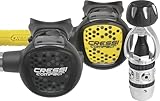
Cressi AC2 + Compact Octopus
- Balanced piston first stage
- Adjustable Venturi
- 4 LP ports and 1 HP port
- 100 cm octopus hose
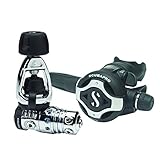
Scubapro MK25 EVO / S620 Ti
- Air-balanced piston first stage
- Full titanium second stage
- 7-port swivel turret
- Inhalation knob and VIVA lever

Cressi Ideal AC2 / XS2
- Entry-level warm-water set
- Conical filter
- Adjustable downstream second stage
- 994 g in INT version
Best Scuba Regulators (October 2026)
The table below lists every set in the roundup with the configuration detail that actually changes how a recreational diver uses it. Read across the connection and first stage columns first, because those two decide whether a set fits your cylinders and your water.
| Product | Specifications | Action |
|---|---|---|
| Cressi AC2 + Compact Octopus Kit |
|
Check Latest Price |
| Scubapro MK25 EVO / S620 Ti |
|
Check Latest Price |
| Cressi Ideal AC2 / XS2 |
|
Check Latest Price |
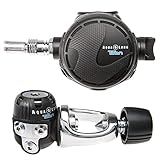 Aqualung Titan Yoke Aqualung Titan Yoke |
|
Check Latest Price |
 Mares SXS 62X Set Mares SXS 62X Set |
|
Check Latest Price |
 Oceanic Delta 5 + EDX Yoke Oceanic Delta 5 + EDX Yoke |
|
Check Latest Price |
 Mares Dual 15X Set Mares Dual 15X Set |
|
Check Latest Price |
 Mares Ultra ADJ 82X Mares Ultra ADJ 82X |
|
Check Latest Price |
 Scubapro MK11 EVO / C370 Scubapro MK11 EVO / C370 |
|
Check Latest Price |
 Cressi MC9SC + Compact Pro Cressi MC9SC + Compact Pro |
|
Check Latest Price |
 Aqualung Leg3nd Aqualung Leg3nd |
|
Check Latest Price |
 Apeks XTX 200 Yoke Apeks XTX 200 Yoke |
|
Check Latest Price |
1. Cressi AC2 + Compact Octopus – The Most Complete Recreational Kit
CRESSI Scuba Regulator Kit, AC2 / Compact + Octopus Compact, Black
Balanced piston AC2 first stage
Adjustable Venturi second stage
4 LP ports and 1 HP port
100 cm octopus hose
Pros
- Balanced piston holds airflow steady as tank pressure falls
- Verified 1.2 joules per liter breathing effort
- Adjustable Venturi lets you tune airflow to the dive
- Four low-pressure ports and one high-pressure port
- Complete kit ships with a 100 cm octopus hose
- 2-year limited warranty
Cons
- No diver-adjustable inhalation effort knob listed
- Technopolymer construction is a weak match for very cold water
This is the set I keep coming back to for a recreational diver buying a first personal regulator, and the reason is boring rather than exciting. The AC2 first stage is a balanced piston, so intermediate pressure barely shifts as your cylinder empties, which is the single biggest reason breathing feels the same at 20 ft and at 120 ft. Reviewers put the effort at 1.2 joules per liter, and Cressi publishes that figure rather than leaving it out.
The Compact second stage has an adjustable Venturi, so you can stiffen or soften airflow depending on whether you are relaxed on a wall or working against current. It is not a breathing-resistance knob, which is the one adjustment I would trade for on a cold-water set, but for tropical and temperate recreational diving it covers the range most people breathe in.
What makes it the easiest recommendation is what arrives in the box. You get four low-pressure ports, one high-pressure port, and a 100 cm octopus hose long enough to route over your shoulder to a buddy without the hose snagging on your cylinder. Cressi is an Italian brand with a large Italian-made serviceable range, and the set carries a 2-year limited warranty.
Who It Suits
A diver on their first or second season who wants one purchase that covers a primary second stage, an octopus, and hose routing without hunting for parts separately. It is also the set I suggest to anyone who dives mostly in water above 15 C and does not plan to add a drysuit.
Who Should Skip It
Divers heading into water below 10 C should look further down this list, because the technopolymer body and lack of a sealed chamber make this a temperate-water design. Heavy breathers who want to dial in inhalation effort at depth will find the Cressi MC9SC or the Scubapro MK25 a better fit.
2. Scubapro MK25 EVO / S620 Ti – The Best Breathability in the Roundup
SCUBAPRO MK25 EVO/S620 Ti Diving Regulator System for Scuba Diving, INT
Air-balanced flow-through piston
Titanium S620 Ti second stage
7-port swivel turret
Inhalation knob and VIVA lever
Pros
- Highest rated set here at 4.9 across 26 reviews
- Full titanium second stage resists corrosion and stays light
- Diver-adjustable inhalation effort knob
- VIVA lever stops free-flows on entry
- Seven-port swivel turret simplifies routing
- Owners report steady breathing at 140 ft
Cons
- Most expensive set in this roundup
- One owner preferred airflow from the older S600
Put a breathing simulator aside and read the owner reviews for this one, because they are unusually consistent. Divers with decades of experience describe effortless breathing that does not change with depth, a purge button that stays smooth after months, and adjustment knobs they can still find in cold-water gloves. Several report more than 30 logged dives with no faults and no loss of breathability at 140 ft.
The S620 Ti second stage is a full titanium barrel, which is why it stays light and resists corrosion in saltwater. The first stage is an air-balanced flow-through piston in chrome-plated brass with thermal insulation that delays ice formation, and the swivel turret carries two opposing high-pressure ports plus five low-pressure ports including a super high-flow axial one.
The VIVA lever is worth understanding before you buy. It is a Venturi-Initiated Vacuum Assist control that you rotate into the dive position once the regulator is in your mouth, which stops the second stage from free-flowing while you enter the water or deal with surface chop. It is the feature recreational divers underrate most and cold-water divers underrate least.
Who It Suits
A diver who already knows they will be in cold or temperate water, or who wants the widest adjustability range available in this roundup and plans to keep one regulator for decades. It is also the set I would buy before a long liveaboard trip where a mid-trip servicing problem would be costly.
Who Should Skip It
Anyone buying their very first setup on a tight budget, and anyone who cannot get it serviced locally. This is the priciest set here, and the titanium second stage does not fix a service network problem, it just makes the invoice worse when one appears.
3. Cressi Ideal AC2 / XS2 – The Warm-Water Budget Pick
Cressi AC2 / XS2, INT
Conical filter first stage
XS2 downstream second stage
EN250 rated above 10 C
994 g in INT version
Pros
- Lowest entry point in this roundup
- Conical filter supports 2100 l/min supplied airflow
- External LP adjustment by hex key simplifies servicing
- Light at 994 g in the INT version
- 2-year limited warranty
Cons
- Downstream valve freezes more readily in cold water
- Certified for water above 10 C
- No breathing effort adjustment
This is the rental-shop and first-season regulator, and the honest way to describe it is that it does one job without drama. The conical filter is good at holding particles back, the external intermediate pressure adjustment is reachable with a hex key so a technician does not have to strip the whole first stage, and routine service parts are inexpensive and easy to source.
Buyers and dive operators consistently rate it as simple, strong and cheap to maintain, with 68 percent of reviews at five stars and none at one star. At 994 g for the INT version it is one of the lighter complete sets here, which matters if you are carrying it on a liveaboard where every kilogram is counted.
The one thing to be clear about is the second stage. It uses a downstream valve, and the set is certified to EN250 2014 for water above 10 C. That is a genuine limitation rather than a defect, and it makes this the right pick for a Caribbean or Red Sea season and the wrong pick for a North Sea crossing.
Who It Suits
A new diver in warm water who wants a set that a rental operator or small shop can service in an afternoon, and who has no plans to add a drysuit. It is also a sensible backup to own alongside a nicer set, since it is the one most likely to sit in a bag ready for a trip.
Who Should Skip It
Cold and temperate water divers, and anyone who likes to fine-tune their regulator while breathing. A downstream valve can ice up, and the 10 C certification means you are outside its rating from the first cold dive of the season.
4. Aqualung Titan Yoke – Best If You Run Two Instruments
Aqualung Titan Regulator – Yoke
Balanced diaphragm first stage
Forged body using less brass
T-shape for hose routing
Polyurethane outer skin
Pros
- Balanced diaphragm breathes easily and consistently
- Owners report no free-flows across multiple logs
- Two high-pressure ports for an SPG and a transmitter
- Forged body is compact and lighter than typical brass
- Comfortable bite at the mouthpiece
Cons
- Mouthpiece can free-flow when snorkelling on the surface
- One buyer received a manual in another language
The Titan is the set I recommend when a diver tells me they want to run a pressure gauge and a wireless transmitter rather than a console. Its two opposing high-pressure ports mean you can feed both from the first stage without a splitter, which is the simplest possible instrument arrangement and one fewer failure point.
Underneath, it is a balanced diaphragm first stage, which means the moving parts sit in a dry chamber protected from silt and cold water, and that is why owners report a regulator with no free-flow problems after multiple logged dives. The forged body uses less brass than a typical casting, so the whole thing is smaller and lighter than the size suggests, and the T-shape makes hose routing tidy.
Two caveats from owners are worth repeating. One reported the mouthpiece free-flowing when switched to snorkel on the surface unless it is pointed face-down, which is a habit worth forming early. Another found the manual in the box was not in English.
Who It Suits
A diver who wants a dual high-pressure port setup, prefers a balanced diaphragm for cold or silty water, and wants a straightforward regulator without a long list of adjustment knobs to learn. It is a comfortable default first personal regulator.
Who Should Skip It
Divers who want to adjust breathing resistance themselves, and anyone who buys on internal weight alone. The titanium second stage on the MK25 is lighter, and adjustable sets like the Aqualung Leg3nd give you more control at depth.
5. Mares SXS 62X – The Smallest and Lightest Second Stage
Mares SXS 62X Scuba Diving Regulator Set – First (INT) and Second Stage
62X INT first stage with pearl finish
SXS second stage with VAD bypass
Fits either side of the head
Auto-Sealing Technology
Pros
- Smallest and lightest second stage in this range
- Auto-Sealing Technology guards against flood damage
- Dynamic Flow Control holds airflow steady at depth
- Second stage can be mounted on either side
- 2.9 lb total weight suits travel kits
Cons
- Only 12 reviews so field history is thin
- Technopolymer second stage is a poor match for ice water
- Switching sides requires reconfiguration
This is the travel pick. The SXS second stage is the smallest and lightest in the Mares range, and at 2.9 lb for the whole set it packs flat into a carry-on bag in a way that a titanium set does not. For a diver who flies with two sets of gear or moves between destinations mid-season, that matters more than any spec line.
The engineering underneath is solid for the price band. The 62X INT first stage has a chrome pearl finish for abrasion resistance, Auto-Sealing Technology to keep water out of the chamber, and Dynamic Flow Control ports for consistent airflow at depth. The second stage uses the Vortex Assisted Design curved bypass tube, and the lateral exhaust tube is positioned so bubbles move out of your sightline rather than into it.
The 4.8 average comes with an asterisk. Twelve reviews, all four stars or better, is encouraging but thin, so I would treat the engineering spec as the reason to buy it and the rating as confirmation rather than proof.
Who It Suits
A frequent traveller who wants the smallest complete set from a brand with a wide service network, and anyone who likes to wear their second stage on either side of the head. It is also a good match for a diver moving up from rented gear who wants a personal set that is not a burden to carry.
Who Should Skip It
Cold-water divers, because a technopolymer second stage is the wrong material near ice. Anyone buying it as their only regulator in a temperate sea should also weigh the thin review history against a set with a longer track record.
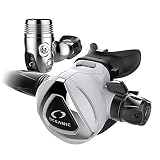
6. Oceanic Delta 5 + EDX – Nitrox Ready and Built for Cold Water
Oceanic Delta 5 (2nd Stage) + EDX (1st Stage) | Breathing Regulator for Scuba Diving | Strong Cold-Water Performance | Available in Yoke or DIN Version | Yoke, White
Heat exchanger at hose connection
Dive and pre-dive switch
Nitrox to 40 percent
Yoke or DIN available
Pros
- Consistent airflow quoted from 30 ft to 130 ft
- Heat exchanger supports cold-water performance
- Dive and pre-dive switch gives real control
- Nitrox to 40 percent without special components
- About 1 lb listed item weight
Cons
- Only 10 reviews so the track record is thin
- No written customer review text was captured
The Delta 5 solves a specific problem cleanly: nitrox. It is certified for up to 40 percent oxygen as supplied, with no special components and no oxygen-clean service needed at purchase. If your dive shop runs an EAN32 or EAN36 program, that removes a step and a recurring cost that catches a lot of new owners out.
Cold water is the other headline. The heat exchanger sits at the second stage hose connection, which is where a conventional second stage loses most of its heat, and the manufacturer quotes consistent airflow from 30 ft to 130 ft. The dive and pre-dive switch plus dynamic airflow adjustment let you stop surface free-flows without changing mouthpiece position.
The set is available in yoke or DIN, which matters if you are still deciding on your connection type or if you dive a mix of rented cylinders. I would want more owner feedback before recommending it as a sole regulator, since only 10 reviews were captured and none of them had written text.
Who It Suits
Nitrox divers who do not want to pay for an oxygen-clean service at purchase, and temperate-water divers who want a heat exchanger without moving to a metal second stage. It is also a good fit if you split your year between a warm destination and a cooler one.
Who Should Skip It
Divers who want a diver-adjustable breathing resistance knob, since the adjustment here is airflow speed rather than effort. Given the thin feedback, I would also keep it as a second set rather than a first one.
7. Mares Dual 15X – The Fleet and Rental Workhorse
Mares Dual 15X Scuba Diving Regulator Set – First Stage & Second Stage Dive Regulator – Int (Yoke) Connector
15X first stage with one DFC port
VAD curved bypass second stage
Oversized purge button
Superflex hose
Pros
- Simple and inexpensive for first-season divers
- One DFC port lowers the pressure drop for strong delivery
- VAD bypass keeps airflow unobstructed
- Oversized purge button works in thick gloves
- Superflex hose is light and flexible
Cons
- Second stage has no breathing effort adjustment
- Built for warm and moderate water only
- Lowest average here at 4.3 across 8 reviews
Dive operators buy these by the case, and the reason is repair economics rather than performance. The first stage is simple brass with a single Dynamic Flow Control port, the second stage is a lightweight technopolymer, and the service parts are cheap and widely stocked. When you own twelve of something, the overhaul cost per unit is what decides whether a trip makes money.
For a recreational diver buying one, the honest read is that this is a capable warm-water regulator with no adjustability. The Vortex Assisted Design curved bypass supports easy breathing at depth, the Superflex hose is light and flexible enough to route without dragging, and the oversized purge button is genuinely usable in thick gloves, which many smaller buttons are not.
The 4.3 average across 8 reviews is the lowest here and includes 22 percent three-star ratings, so treat the number as noise rather than signal. The spec sheet is the more useful document for this set.
Who It Suits
A first-season diver on a strict budget in warm or moderate water, or a dive shop looking for a set that turns around fast on the service bench. It is a reasonable first purchase if you plan to keep the same regulator for a while and do not want to keep upgrading.
Who Should Skip It
Cold-water divers, and anyone who likes to adjust their regulator while breathing. If you know you will add a drysuit or a second cylinder stage in a year, buy up instead of planning to replace this in 18 months.
8. Mares Ultra ADJ 82X – Most Adjustable, Most Polarizing
Mares Ultra ADJ 82X Scuba Diving Regulator Set – First & Second Stage, INT
Chrome-plated brass 82X first stage
360-degree turret with 5 LP ports
Twin Power System adjustment
Pneumatic Assisted Design
Pros
- Breathing effort adjustable via the Twin Power System
- Pneumatic Assisted Design makes each breath feel light
- 360-degree turret and OPD ports give clean routing
- Balanced diaphragm with Auto-Sealing Technology
- Rated for cold water and technical diving
Cons
- One diver could not reduce effort and stopped diving with it
- Second stage free-flows on entry for some owners
- Several adjustment knobs confuse new divers
This is the most feature-dense Mares set here and the one with the widest range of owner reactions. Experienced UK divers report it as a big step up from a Mares Proton, with genuinely excellent hose routing from the 360-degree turret and Optimized Port Design, and they rate it for cold water and technical work. The chrome-plated brass first stage is also the most solidly built of the Mares options in this roundup.
Others are unimpressed. One diver found the breathing effort too high no matter how far they adjusted it and stopped diving with the set, and several owners mention a free-flow on entry that an older, cheaper Mares never produced. A first stage this robust can feel over-built for warm-water recreational diving, where 130 ft is the practical limit.
The number to weigh carefully is 4.1, the lowest average in the roundup, with 17 percent one-star ratings. Adjustability cuts both ways, and a diver who cannot find a comfortable setting has bought complexity instead of comfort.
Who It Suits
An experienced diver who already understands intermediate pressure and wants to tune the second stage, and someone whose hose routing on a sidemount or long-hose setup is genuinely difficult. If you like control and can dial it in, the feature set is genuinely class-leading for the money.
Who Should Skip It
New divers, and anyone sensitive to adjustability. If you cannot tell whether a free-flow on entry is a service issue or a habit issue, this is the wrong set to learn on. The Cressi AC2 kit at number one is a far calmer introduction.
9. Scubapro MK11 EVO / C370 – Best Lightweight Complete Set
SCUBAPRO MK11 EVO/C370 Dive Regulator System, INT
Air-balanced diaphragm first stage
Metal fins for thermal exchange
16 ounce listed weight
Super-flow oversized bore hose
Pros
- Perfect 5.0 average from all seven reviewers
- Metal fins on the brass body aid thermal exchange
- Lightest complete set here at 16 ounces
- Inhalation knob plus coaxial dive and pre-dive lever
- Large purge button works in thick gloves
Cons
- Only 7 reviews so the sample is very small
- No written customer review text was captured
This is the set to buy if you want most of what the MK25 offers at a lower tier, and the 16 ounce listed weight is the headline. A complete first and second stage under a pound means a full personal kit, octopus and hoses included, that is genuinely easy to carry, and that is an underrated reason to like it.
The engineering is sensible rather than exotic. A compact air-balanced diaphragm first stage in forged brass with metal fins for thermal exchange, two high-pressure ports set on a 15 degree angle so the SPG hose and transmitter hose both route cleanly, four high-flow low-pressure ports, and a double spring layout that keeps the profile compact. The C370 second stage has a diver-adjustable inhalation knob and a coaxial dive and pre-dive lever.
Every one of the seven reviewers gave five stars, which reads as a perfect score and is statistically almost meaningless. No written review text was captured, so I am weighting the spec and the Scubapro service network rather than the rating.
Who It Suits
A diver who wants adjustability and a light pack without paying for a titanium second stage, and anyone who wants one reliable brand across first stage, second stage and octopus. The large purge button and oversized bore hose are good in gloves and at depth.
Who Should Skip It
Anyone who wants titanium for saltwater longevity, and anyone who needs a long review history before committing. This listing is too new to have one, so treat it as a well-specified set rather than a proven one.
10. Cressi MC9SC + Compact Pro – The Cold-Water Value Pick
CRESSI MC9-SC/Compact Pro + Octopus Compact Pro Complete Regulator Set, INT
Sealed chamber cold-water first stage
Chrome-plated brass and steel internals
Hypercompensation mechanism
Includes Compact Pro octopus
Pros
- Rated for water below 10 C where budget sets stop
- Hypercompensation holds pressure as the cylinder empties
- Chrome-plated brass and stainless internals
- Includes a Compact Pro octopus with 2 HP and 4 LP ports
- Thermoconductive second stage dissipates heat
Cons
- Heavy at 1600 g with the octopus in the box
- Only 4 reviews with 40 percent at three stars
- No written customer reviews were captured
Most entry-level sets stop working well once the water drops below about 15 C, and this one is explicitly rated for water below 10 C. The sealed chamber system in the first stage is the reason, and the hypercompensation mechanism raises intermediate pressure as cylinder pressure falls so the last part of the dive breathes as well as the first.
Materials are the ones I want to see in cold water: a chrome-plated brass first stage with stainless steel and thermoplastic internals, and a thermoconductive neoprene second stage that dissipates heat rather than holding it. The service figures are published too, at 232 bar service pressure and 10 bar calibration pressure, which tells you this is a design intended to be rebuilt repeatedly.
The trade-off is weight at 1600 g, most of it the Compact Pro octopus that ships in the box, and thin feedback with only 4 reviews split 60 percent five-star and 40 percent three-star. It is the right budget answer for cold water, not a substitute for a titanium set.
Who It Suits
A temperate or cold-water diver on a budget who wants one purchase that includes an octopus and is rated for the temperatures they actually dive. It also makes sense for a resort operator keeping a small number of personal-quality sets rather than pure rental gear.
Who Should Skip It
Travel divers who count grams, and divers who want adjustability. There is no inhalation effort knob here, and the weight is real if you are carrying a full kit on a liveaboard.
11. Aqualung Leg3nd – The Most Protected Internals
Aqualung Leg3nd Dive Regulator | High-Performance ACD Scuba Regulator with Ergonomic Venturi Switch, Comfobite Mouthpiece, & Aqua Flex Hose | Effortless Breathing at Depth, w/Yoke Connector
Auto Closure Device at the inlet
Permanent Dry Chamber
Deep-ribbed heat exchanger
Over-balanced first stage
Pros
- Auto Closure Device protects internals off the tank
- Dry chamber and ribbed exchanger suit ice and cold water
- Over-balanced flow stays easy at depth
- Comfobite mouthpiece reduces jaw fatigue
- Aqua Flex hose keeps regulator pull low
Cons
- Only one review so there is almost no owner feedback
- Heaviest complete set here at 3.3 lb
The Auto Closure Device is the reason to look at this set. It seals the first stage inlet when the regulator is detached from the tank, which keeps water out of the chamber between dives and protects the lubricant inside from corrosion. It is standard on working-life regulators and increasingly common on recreational ones, and it is the feature that most reduces how often a reg needs opening.
For cold water, the permanent dry chamber isolates the internal parts and the deep ribs on the heat exchanger delay ice formation. The first stage is over-balanced, meaning it holds intermediate pressure above ambient as depth increases, and the second stage is pneumatically balanced with a soft-touch elastomer Venturi switch that toggles easily with one hand in current.
The Comfobite mouthpiece has an orthodontic palate bridge in hypoallergenic silicone, which is a real comfort difference on a full-day boat trip, and the Aqua Flex hose is light and low in drag. The 3.3 lb weight is the usual cost of this architecture, and with a single review there is effectively no owner evidence to weigh here.
Who It Suits
A diver who leaves gear assembled on a boat, dives cold or silty water, or wants maximum mouthpiece comfort on long repetitive days. The Venturi switch is also the easiest one here to operate in gloves.
Who Should Skip It
Anyone counting grams for travel, and divers who need social proof before a purchase. With one review, this is a spec-sheet decision, so go into a shop and breathe it if you can.
12. Apeks XTX 200 Yoke – Most Flexible Hose Setup
Apeks XTX 200 Yoke Scuba Diving Regulator
Diver Changeable Exhaust system
Converts to one-handed routing
Braided flexi hoses
Rated for water below 10 C
Pros
- Exhaust tee size can be swapped by the diver
- Converts to one-handed routing in the field
- Braided flexi hoses are lighter and more durable than rubber
- Rated for cold water below 10 C
- EAN40 compatible as supplied
Cons
- Only 2 reviews so the sample is tiny
- Yoke only in this variant so DIN needs an adapter
- Listed dimensions look like placeholder data
The Diver Changeable Exhaust system is genuinely unusual. It lets the diver swap between a small and a large exhaust tee, which is a solution to a real problem: bubble interference that obscures a mask on shallow dives and in low visibility. Fitting a small tee for reef work and a large one for deeper, higher-flow dives is a field adjustment rather than a second purchase.
It also converts from right-handed to left-handed hose configuration in the field, which matters for divers who alternate between a back-mounted and a sidemount rig. The braided flexi hoses are lighter and more flexible than the rubber standard and resist kinking, and the set is rated for cold water below 10 C and EAN40 nitrox as supplied.
Two things temper this. There are only two reviews, both five stars, which is not evidence of anything. And this listing is the yoke version, so it will not thread onto a DIN cylinder without an adapter, so check your valve type before you commit.
Who It Suits
A diver who is fussy about bubble interference, who switches handedness between rigs, or who wants braided hoses as standard. The cold-water rating and EAN40 readiness make it a good all-rounder for a European or North Sea season.
Who Should Skip It
Divers on DIN cylinders, and anyone unwilling to test it in a shop first. Two reviews is not a service history, and the exhaust swap only makes sense once you have felt the difference in a mask.
Scuba Regulator Buying Guide: What Actually Changes How It Feels
What a Scuba Regulator Actually Does
A regulator is a two-step pressure reducer. The first stage bolts to the cylinder valve and drops roughly 3000 PSI down to about 140 PSI intermediate pressure, which is the pressure the hoses run at. The second stage hangs on the end of a low-pressure hose and reduces that intermediate pressure to exactly ambient pressure at your depth, so the air you breathe matches the water pressure around you and your lungs do not have to fight the water column.
The octopus, or backup second stage, is a second second stage fed from another low-pressure port on the same first stage. Your buddy breathes from it in an out-of-air emergency, which is why hose length and routing matter as much as the second stage itself.
Balanced vs Unbalanced, and Piston vs Diaphragm
Balanced means the first stage holds intermediate pressure slightly above ambient at all times, regardless of how much gas you pull or how far the cylinder has emptied. An unbalanced first stage only holds that pressure when you are breathing from it, so intermediate pressure swings with each inhale. For a recreational diver, balanced is the default you want and unbalanced is a design you should have to argue yourself into.
Piston versus diaphragm is a different axis. A piston first stage pulls its moving parts out of the water into a dry environment for lubrication and cold protection, and it is efficient but sensitive to silt entering the mechanism. A diaphragm first stage keeps the mechanism behind a sealed environmental seal, so it tolerates salt, sand and cold water but is marginally less efficient. Both are fine choices today; the cheap unbalanced piston is the one to walk away from.
Yoke vs DIN for Recreational Divers
Yoke is the screw-on clamp that grips the outside of a cylinder valve, and it is what almost all rental cylinders worldwide still use. DIN is the threaded insert that screws directly into the valve, is smaller, cannot rotate on the valve, and is the standard on European cylinders and an increasing share of American ones.
The practical rule: buy a yoke first stage if you want the widest possible cylinder compatibility and you mostly dive on rented tanks. Buy DIN if you own your cylinders, dive cold or technical, or want the smaller profile and the security of a threaded connection. A DIN can be adapted to a yoke valve with a screw-on adapter, but a yoke cannot be made DIN, so the mistake is only ever made in one direction.
Cold Water vs Warm Water: When Sealing Type Matters
Below about 15 C, water can freeze inside the exhaust valve, and a frozen regulator can free-flow in a way that drains a cylinder fast. Three things reduce the risk: a sealed chamber around the first stage internals, a heat exchanger on the second stage, and a thermoconductive or metal second stage body. Look for an explicit temperature rating rather than inferring it from the brand.
Cold water also brings silt and sand. A diaphragm first stage with an environmental seal, or a piston with a filter, shrugs off particles that would jam an exposed mechanism. Divers who think a frozen regulator or a sand-jammed second stage sounds far-fetched should read what happens in places like Norway in January.
Service Intervals and Total Cost of Ownership
Manufacturers and training agencies call for a full annual service of a regulator, and the honest reason is that the second stage is a spring-loaded valve held open by water pressure with a small orifice upstream of it. Salt water gets into that space, seals swell, and hoses degrade from the inside where you cannot see it. A yearly teardown, clean, seal kit and re-test is what keeps it working, and a reg that has skipped a few years needs that service before any other problem.
This is the part nobody puts in the marketing. A mid-range regulator plus annual servicing over five years costs meaningfully more than the purchase alone, and the gap between servicing a cheap set properly and servicing it badly is often wider than the gap between a cheap set and a titanium one. Buy a regulator you can have serviced near you, because that factor dominates the ownership maths more than any material in the second stage.
What a New Diver Really Needs
You need a balanced first stage, a second stage that breathes easily, an octopus, and a brand a technician near you already works on. You do not need a titanium second stage, a dry chamber, an auto-closure device, or a second-stage bore upgrade. Those features matter at 140 ft in a drysuit, not at 60 ft on a reef, and spending on them as a first purchase leaves money unspent on instruction, which is where the real risk lives.
If you are upgrading from rented gear, replace the first stage and second stage as a matched pair from the same range, and buy a serviceable brand rather than a bundle. Buying a cheap first stage and a good second stage from unrelated ranges saves money up front and creates a mismatch you will troubleshoot for years.
Regulator Care: Rinsing, Soaking and Storage
The single most important habit is a fresh water soak after every dive. Salt deposits left in a second stage are what turn a smooth purge button into a sticky one over a season.
1. Breathe from the second stage to clear the moving parts before you disconnect it, and never press the purge button while the regulator is off the cylinder. Purging against no pressure pulls the diaphragm out of shape, and owners cause more damage with aggressive purging than with the fault they were trying to clear.
2. Disconnect the hoses, then soak the first stage, second stage and octopus in a container of fresh water for 15 to 30 minutes. Do not use a hose nozzle to blast water into the ports, since pressure can force water past seals that are only meant to be rinsed by immersion.
3. Shake out the water, wipe the exterior, and let the parts air dry away from direct sun and out of a hot car. Then cap the first stage inlet with a dust cap, because a grit particle is the fastest route to a second stage that will not open at depth.
4. Store hoses relaxed rather than coiled tightly, and lay the set flat rather than hanging it by one hose. Put the annual service in the calendar rather than in a reminder you will dismiss in March.
Frequently Asked Questions
Should I get a DIN or yoke regulator?
Buy a yoke first stage if you want the widest cylinder compatibility and mostly dive rented tanks, since nearly every rental cylinder worldwide uses a yoke valve. Buy DIN if you own your cylinders, dive in cold water, or want the smaller profile and a connection that cannot rotate. A DIN can be adapted to a yoke valve with a screw-on adapter, but a yoke cannot be converted to DIN.
Can a DIN regulator be used on a yoke cylinder valve?
Yes, with an adapter. A DIN first stage screws into the cylinder valve threads, and a bolt-on or screw-on adapter converts a yoke valve so the DIN regulator can clamp onto it. The reverse is impossible, because a yoke first stage cannot be threaded into a DIN valve. Check the maximum working pressure on the adapter before using one, especially with higher pressure cylinders.
What is the recommended service interval for a scuba regulator?
A full annual service is the recommended interval. Manufacturers and training agencies both call for it because the second stage is a spring-loaded valve held by water pressure, and salt water, swollen seals and hose degradation all happen out of sight. A regulator that has gone several years without service should be overhauled before it is used again, not after it starts misbehaving.
What type of scuba regulator is better for cold water performance?
A regulator with a sealed or dry chamber around the first stage internals, a heat exchanger on the second stage, and a metal or thermoconductive second stage body performs best in cold water. Balanced piston and balanced diaphragm designs both help, since they hold intermediate pressure steadily. Look for an explicit temperature rating below 15 C rather than inferring cold-water capability from the brand name.
What is the best cold water scuba regulator in this roundup?
For cold water on a budget, the Cressi MC9SC is rated for water below 10 C with a sealed chamber and stainless internals. For the best breathability in cold conditions, the Scubapro MK25 EVO with the titanium S620 Ti second stage has thermal insulation in the first stage and holds airflow at depth. The Cressi MC9SC is heavier, while the MK25 costs considerably more.
Is Cressi or Scubapro better for recreational divers?
Cressi makes better value complete kits for warm and temperate water, and the AC2 kit at number one is a strong first purchase with a balanced piston first stage and an included octopus. Scubapro has the stronger service network and the better adjustability, with the MK25 offering a diver-adjustable inhalation knob and a titanium second stage. Choose Cressi for kit value, Scubapro for cold water and tuning.
Should I buy a used scuba regulator?
Only with documentation. Ask for the service history, the date of the last overhaul, and proof of oxygen cleanliness if you intend to dive nitrox above 32 percent. Check that the purge button springs back fully, the mouthpiece is not chewed, the hoses are not stiff or cracked, and the first stage spins freely on its swivel. If a seller cannot answer those questions, buy a new one instead.
What scuba regulators do navy SEALs use?
Military divers use their own specified and approved configurations, which are a different procurement category from recreational gear and are not the products on this list. The useful takeaway is the design direction rather than the model: environmental dry chambers, over-balanced flow, metal second stages and low-profile DIN connections are all traits of military-spec regulators, and several recreational sets here borrow the same ideas.
Conclusion
For most recreational divers, the Cressi AC2 kit is the right first regulator: a balanced piston first stage, a second stage you can tune, and a 100 cm octopus in the box. If you are diving cold or under a drysuit, step up to the Scubapro MK25 EVO with the titanium second stage, and if you are on a tight budget in warm water, the Cressi Ideal is the sensible floor rather than a compromise.
Whatever you pick, buy it from a brand a technician near you already services, and get it into a service schedule the year you buy it. If you are still assembling the rest of your kit, our scuba diving gear package guide covers the supporting equipment, and our wetsuit guide is worth reading before your first cold-water trip.