
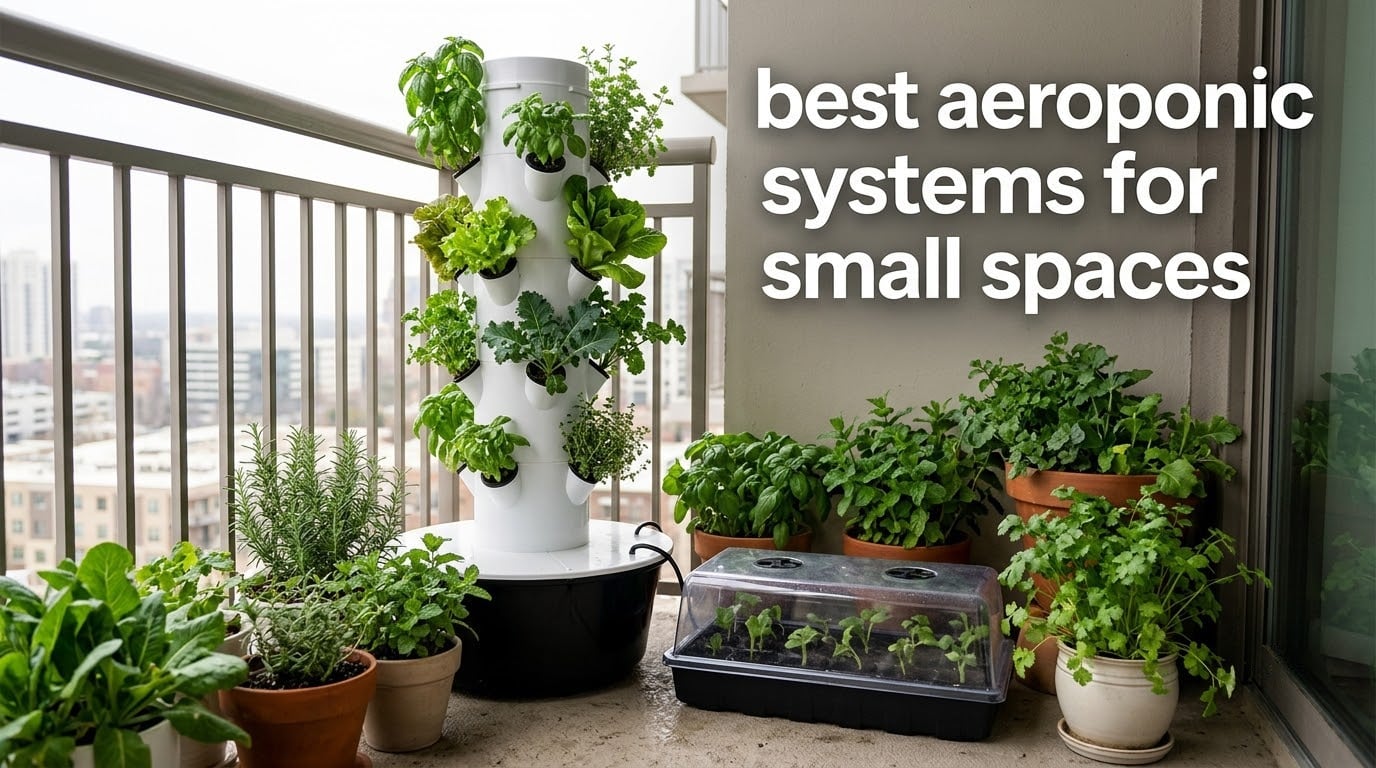
Most people searching for the best aeroponic systems for small spaces picture a tall vertical tower of herbs glowing under a grow light. What they usually end up with, if they are lucky, is a plastic box that mists cuttings on a timer. Both are sold as aeroponics, they are built very differently, and only one of them fits under a 7 foot ceiling or on a 3 by 3 foot balcony. I spent weeks reading specs, owner reports, and failure complaints across every small-space unit on the market so you can skip the guesswork.
Here is the short version: an aeroponic system grows plants without soil by suspending their roots and spraying them with a nutrient solution on a timed cycle, so roots get heavy oxygen and the setup uses a fraction of the water a soil bed needs. For a confined space the practical winner is a compact misting cloner under about 15 inches tall, not a six-tier tower, unless you genuinely want one tower that grows herbs for the whole kitchen.
The eight systems below all sit in the same category on paper, and they separate quickly once you read the customer reviews instead of the product pages. Three of them run a pump quietly enough for a bedroom, two carry leak complaints that show up within weeks, and one arrives with a grow light already in the box. I sorted all eight on the only measures that matter in a small room: footprint, total height, plant sites, how many separate components you have to keep alive, and what owners report breaking.
If your space problem is not really about plants at all, our guide to storage beds for small spaces covers the other half of the square footage fight. A tower garden lives on the floor, and every inch of floor you free up is an inch of tower you can add later.
Table of Contents
Top 3 Best Aeroponic Picks for Small Spaces in 2026
These three cover the realistic use cases. The first is the one most buyers should end up with, the second is the better-built machine if the build quality matters more than capacity, and the third is the smallest footprint option on the list.
CLONE KING 36 Site Aeroponic Cloner
- 36 sites
- 13 spray heads
- 317 GPH submersible pump
- 13.75 in square footprint

Hydrofarm Oxyclone OX20SYS
- 20 sites
- 1.75 gallon reservoir
- Venturi valve aeration
- recirculating design

All 8 Aeroponic Systems Side by Side in 2026
Every unit below occupies about one square foot or less of floor space, which is the entire point of this roundup. Read the plant site column as a per-batch count, not a permanent plant count. You clone, transplant, and reuse the tray.
| Product | Specifications | Action |
|---|---|---|
| CLONE KING 36 Site Aeroponic Cloner |
|
Check Latest Price |
| Hydrofarm Oxyclone OX20SYS |
|
Check Latest Price |
 HORTIPOTS 35 Site Aeroponic Cloner HORTIPOTS 35 Site Aeroponic Cloner |
|
Check Latest Price |
 HORTIPOTS 24 Site Aeroponic Cloner HORTIPOTS 24 Site Aeroponic Cloner |
|
Check Latest Price |
 Psycloner Pro 35 Site Clone Machine Psycloner Pro 35 Site Clone Machine |
|
Check Latest Price |
| EZ Clone 16 Cutting System |
|
Check Latest Price |
 Viagrow Clone Machine 24 Site Kit Viagrow Clone Machine 24 Site Kit |
|
Check Latest Price |
 LYCereal 30 Plant Vertical Tower LYCereal 30 Plant Vertical Tower |
|
Check Latest Price |
What Aeroponic Actually Means (and Why Most Buyers Misread It)
A true aeroponic system mists the root zone directly. A submersible pump pushes nutrient solution up a manifold, spray heads atomise it across bare roots hanging in net pots, and everything drains back into the reservoir for reuse. Roots never touch a solid medium at all. That is what the eight machines reviewed here do, and it is why rooting times cluster around 4 to 10 days.
A vertical tower garden is a different machine wearing the same marketing name. Water is pumped to the top and dripped or sprayed down the column of planting holes, wetting the root zone as it passes. The plants sit in a foam or net pot, and a solid medium holds the roots in place. Seven of the eight systems below are true misting cloners. The eighth, the LYCereal tower, is a drip-irrigated vertical unit and belongs in a different comparison entirely.
This distinction matters in a small space because the two categories fail differently. A misting cloner is a short, wide, replaceable batch tool that roots cuttings and then gets cleaned out. A tower is a tall, permanent fixture that grows food for months and needs a light source, a reservoir, and a permanent floor square. Buyers who expect a tower from a cloner get confused results; buyers who expect a cloner from a tower get thirsty stems and rotted roots.
One more clarification before the reviews. A low-pressure fogger that mists into a sealed dome and a full-pressure cloner that sprays a manifold are both aeroponic, but they are not interchangeable. Foggers are built for cuttings and seedlings only. Every machine here sprays a manifold across open net pots, so all eight will handle larger plants once they are established, provided you move them to a bigger system before they outgrow the tray.
1. CLONE KING 36 Site Aeroponic Cloner – Best Overall
CLONE KING 36 Site Aeroponic Cloning Machine. Expect 100% Success Rates!
36 sites
13 spray heads
317 GPH submersible pump
13.75 in square base
5 lb
Pros
- Highest site count in a flat tray
- 13 spray heads give even coverage
- Complete kit with reservoir lid manifold pump and inserts
- Owners report consistent rooting in 4-10 days
- UL-listed pump
Cons
- Inserts currently offered in blue and red only
- Some owners report audible pump noise
- Unit runs as tall as it is wide so plan counter depth
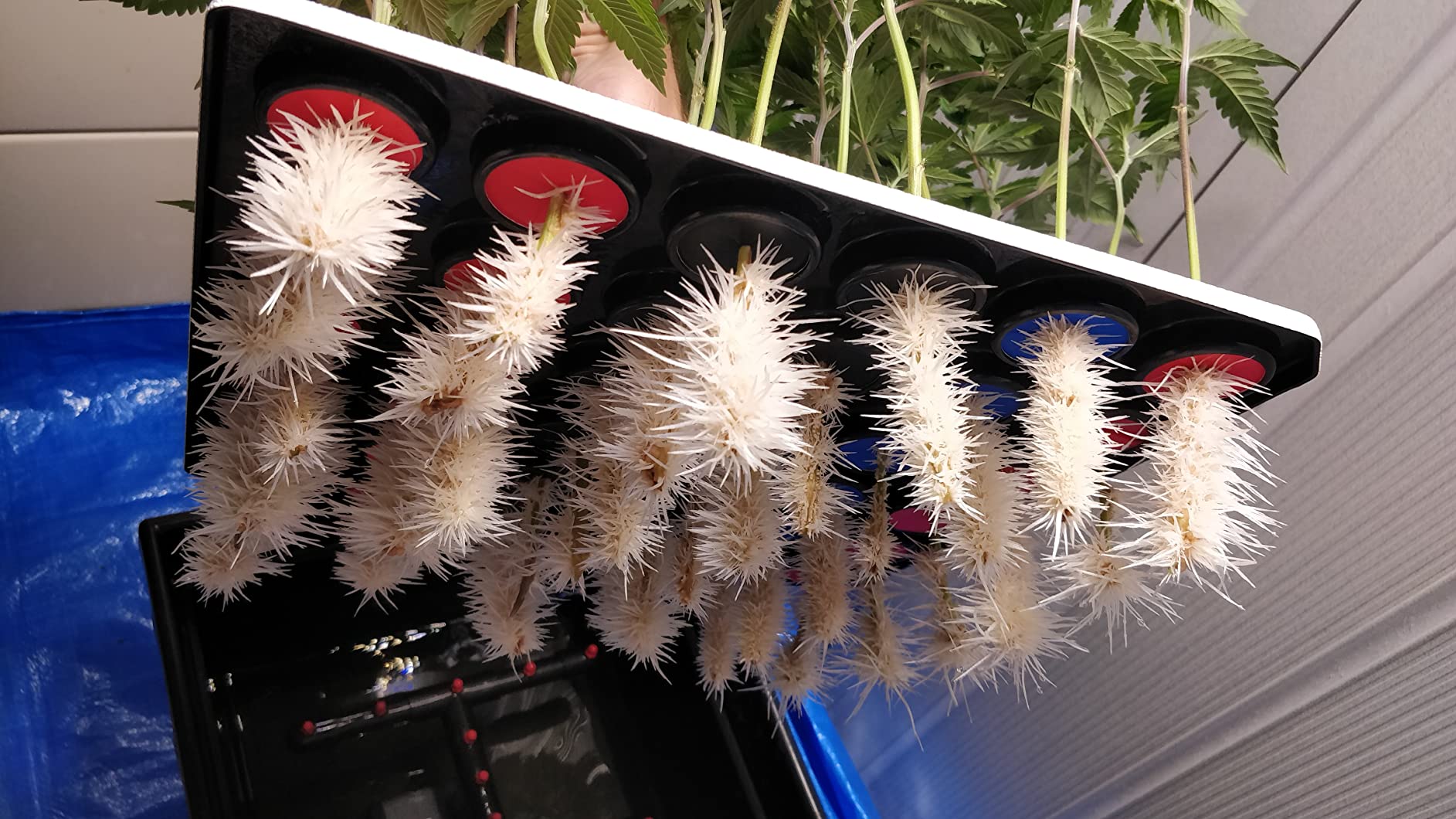
This is the machine I keep coming back to, because 36 plant sites in a tray that measures 13.75 inches on each side is a genuinely dense batch without turning into a tower. The footprint is roughly 1.3 square feet including working room, and the whole unit weighs 5 pounds, so it moves between a counter and a shelf without a second person.
The spray manifold is the reason it outperforms bigger, cheaper trays. Thirteen spray heads across the lid mean no corner of the tray sits in a dead zone where the cuttings take a day longer to callus. Owners on hydroponics forums consistently report rooting inside the 4 to 10 day window the manufacturer quotes, and the review summary across 1.8k ratings reflects the same pattern.
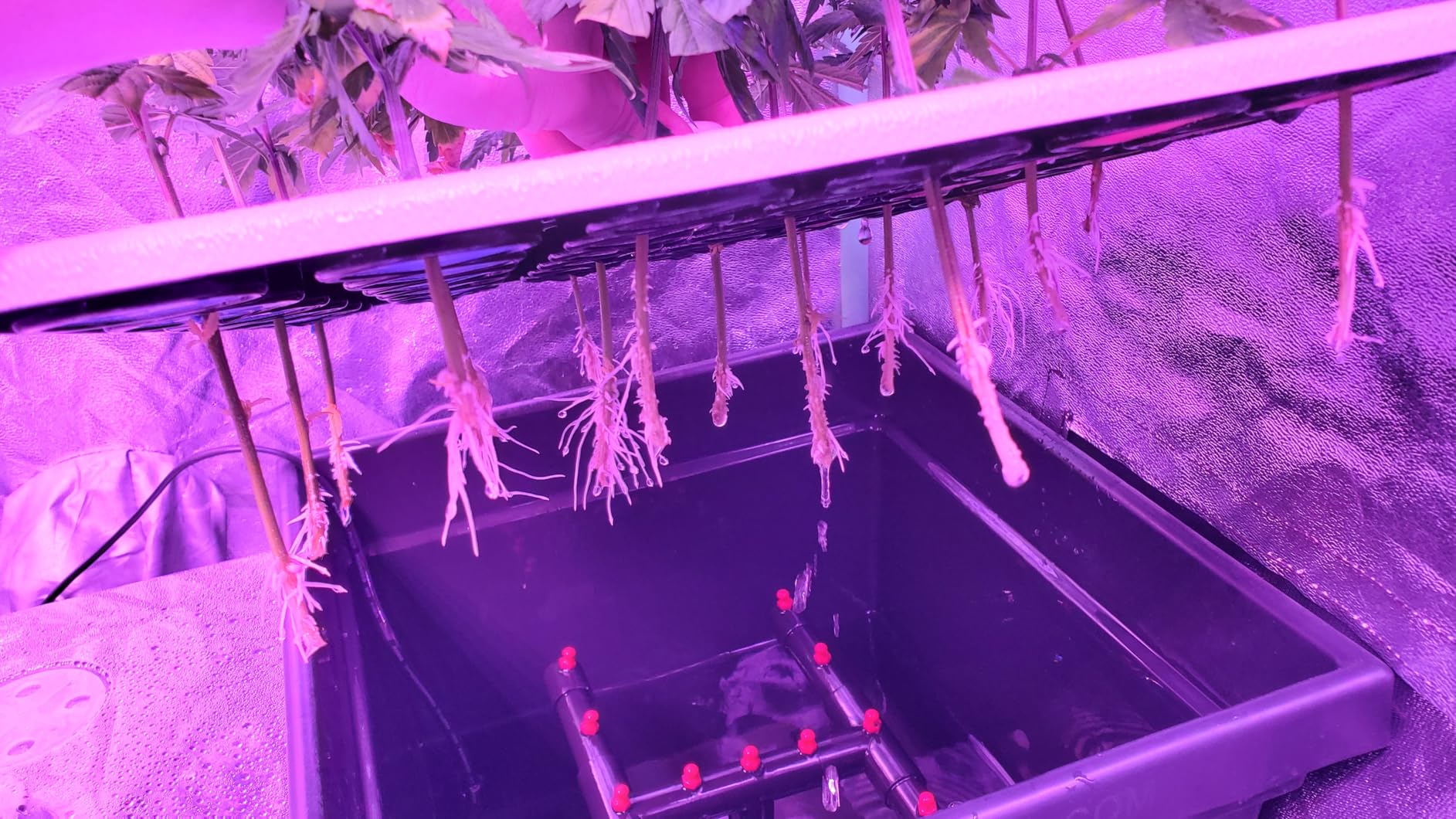
The 317 GPH submersible pump is powerful enough to keep the mist consistent across all 36 ports rather than trickling into a few. That pump is also the main complaint. A small number of owners describe a running hum that is noticeable in a quiet room, so I would not plan on placing this one on a nightstand next to a bed.
The rest of the box is genuinely complete: reservoir, lid, spray manifold, pump, and neoprene inserts, with detailed instructions in the box. The one thing you cannot choose is insert colour, since only blue and red are being supplied. Functionally that means nothing, but if you are tracking several plant varieties through a batch, you are back to labelling by hand.
What makes this the best pick for tight rooms
It stacks flat when empty and holds more cuttings per square foot than anything else here. Thirty-six sites at 13.75 inches square beats a 20-site unit on the same shelf by a wide margin, and the flat profile leaves your wall space free.
Where it falls short
The tray is as deep as it is wide, which matters more than it sounds. On a shallow shelf you will need to angle it slightly for drainage, and the pump noise rules out a bedroom.
2. Hydrofarm Oxyclone OX20SYS – Budget Pick
Oxyclone OX20SYS Recirculating Cloning System, 20 Sites, Compact
20 sites
1.75 gallon reservoir
160 GPH submersible pump plus air pump
13.75 by 10.75 in
one year warranty
Pros
- Compact design built for small spaces
- Recirculating Venturi valve pulls bubbles into the flow
- Complete kit with pumps tubing and air stone
- BPA-free pumps and plastic construction
- Backed by a one year manufacturer warranty
Cons
- Air pump is an extra powered component to run and maintain
- Smaller reservoir refills more often than larger trays
- 20 sites is fewer cuttings per batch than the top pick
Hydrofarm built this one around oxygenation rather than just spray coverage, and you can see the difference in the plumbing. A Venturi valve mounted on the pump outlet pulls air into the water stream, while a 3.2 L/min air pump and a 4 inch round air stone add a second layer of dissolved oxygen underneath. For cuttings that spend their first two weeks with no roots at all, that extra aeration is the whole point.
At 13.75 by 10.75 inches and 6.25 inches tall, this is one of the flattest units in the roundup. It slides under a shelf or onto a windowsill that cannot take a deep tray, and at 5.3 pounds it is still easy to carry with one hand. That footprint advantage is why it earns the premium slot over larger kits.
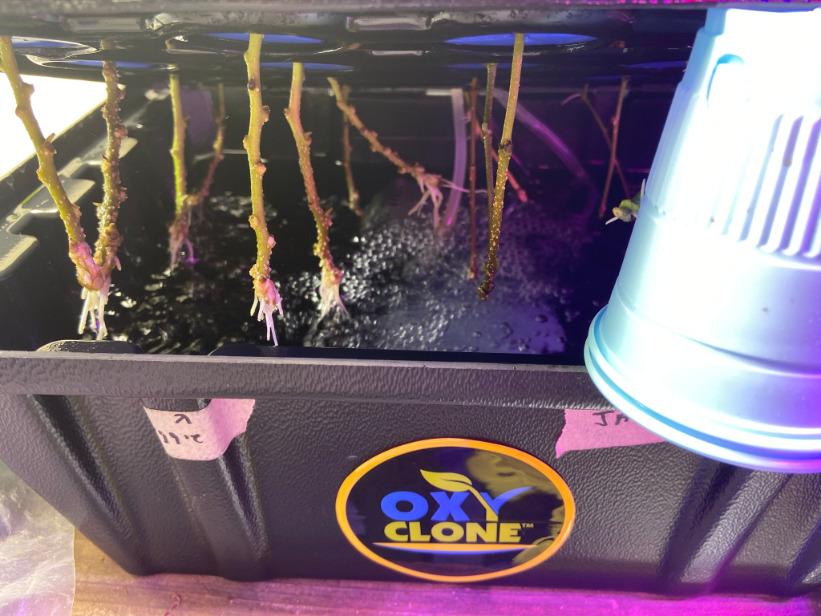
The recirculating design is a genuine space and water saver, since solution returns to the reservoir rather than being discarded. Reviewers rate it at 4.3 across more than 1.2k ratings and repeatedly single out the compact footprint and effective aeration as the reasons it works in tight setups.
The catch is component count. You now run two powered pumps instead of one, and the air stone needs rinsing every week or it becomes a biofilm factory. In a small apartment that means two extension leads and one more thing that can wake you up if it fails overnight.
Why this one earns a premium slot
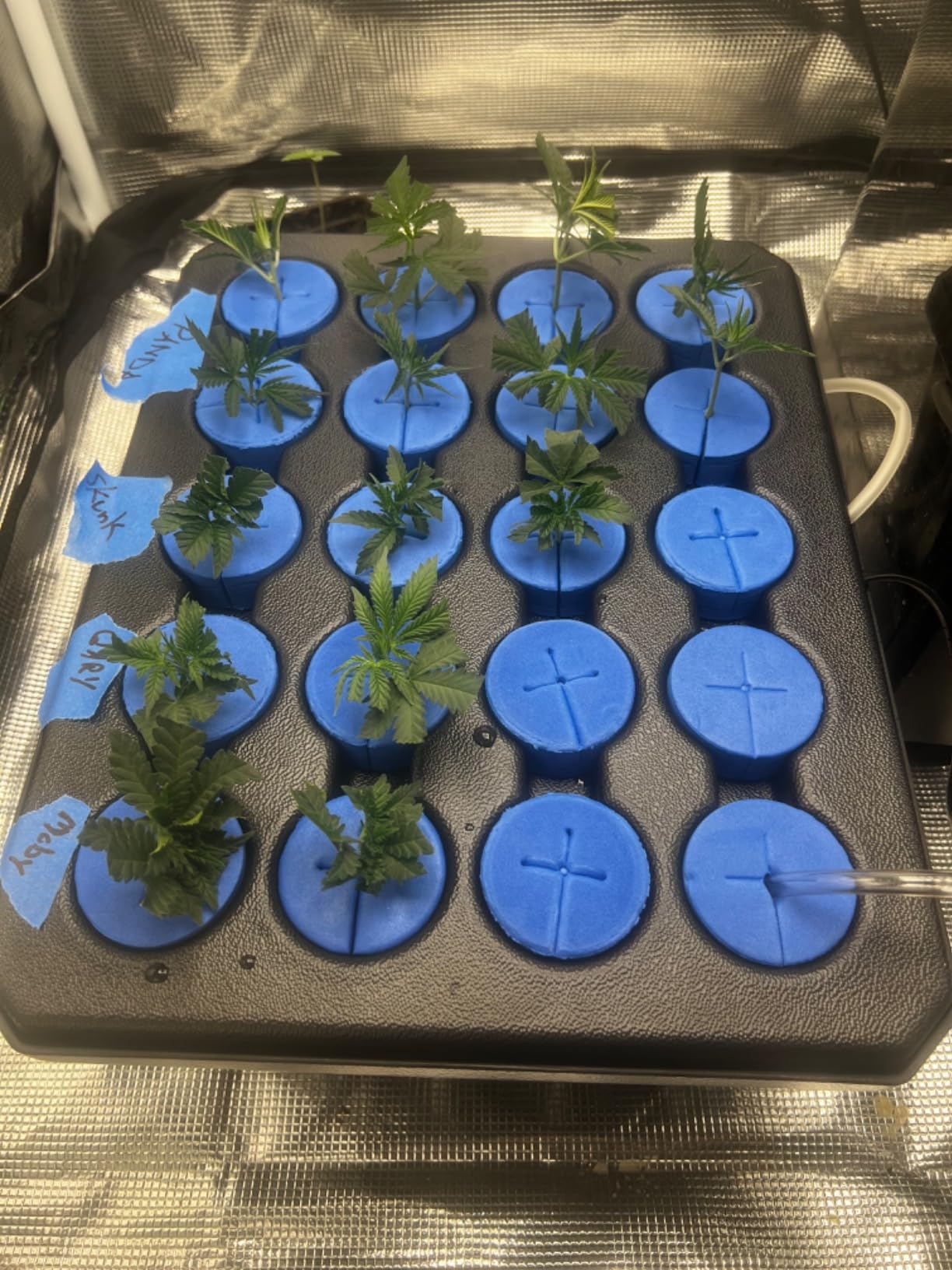
The double aeration approach roots delicate cuttings faster than a single-spray tray and the flat body fits spaces nothing else will. If you can accept a second pump, the plant site count is the only compromise.
Why you might skip it
Buyers who want maximum cuttings per shelf inch will feel the 20-site limit immediately. Doubling the batch means buying two units and finding a second outlet.
3. HORTIPOTS 35 Site Aeroponic Cloner – Best for High-Volume Batches
Aeroponic Cloner Machine, Cloning Machine 35 Site for Cutting Rooting Germination Kit Using 1.625 inch Neoprene Clone Inserts
35 sites
1.625 inch neoprene inserts
foldable humidity dome included
UL-listed pump with pre-filter
Pros
- 35 site capacity in a compact tray
- Foldable humidity dome included at no extra cost
- Vented lid removes the need for a separate air pump
- UL-listed pump with pre-filter housing cuts clogging
- All new ABS and PP construction
Cons
- 1.625 inch inserts are less common than the 2 inch standard
- Some owners question the plastic quality
- Manufacturer has produced these designs since 2016
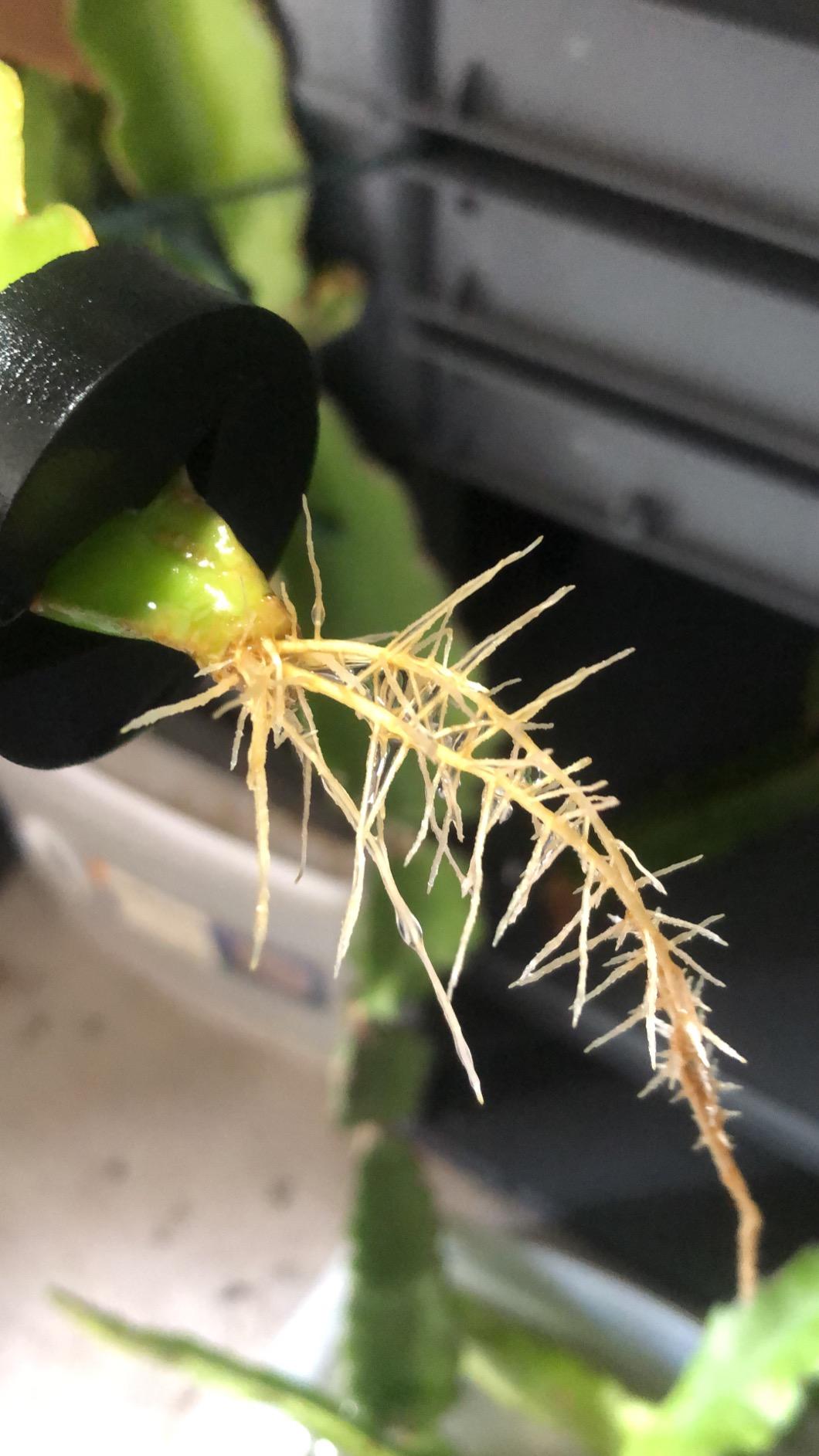
This cloner takes a different approach from the two above it. The lid is vented and the unit has multiple cord outlets, so you can run it without a separate air pump at all. One powered component instead of two is a meaningful saving in a studio or a dorm where outlets and noise both matter.
The 35 sites come with 1.625 inch neoprene inserts, and the foldable clear humidity dome is included in the box. That dome is what stops leaf transpiration and transplant shock while cuttings callus over, so a unit that ships with one saves you from buying a third accessory.
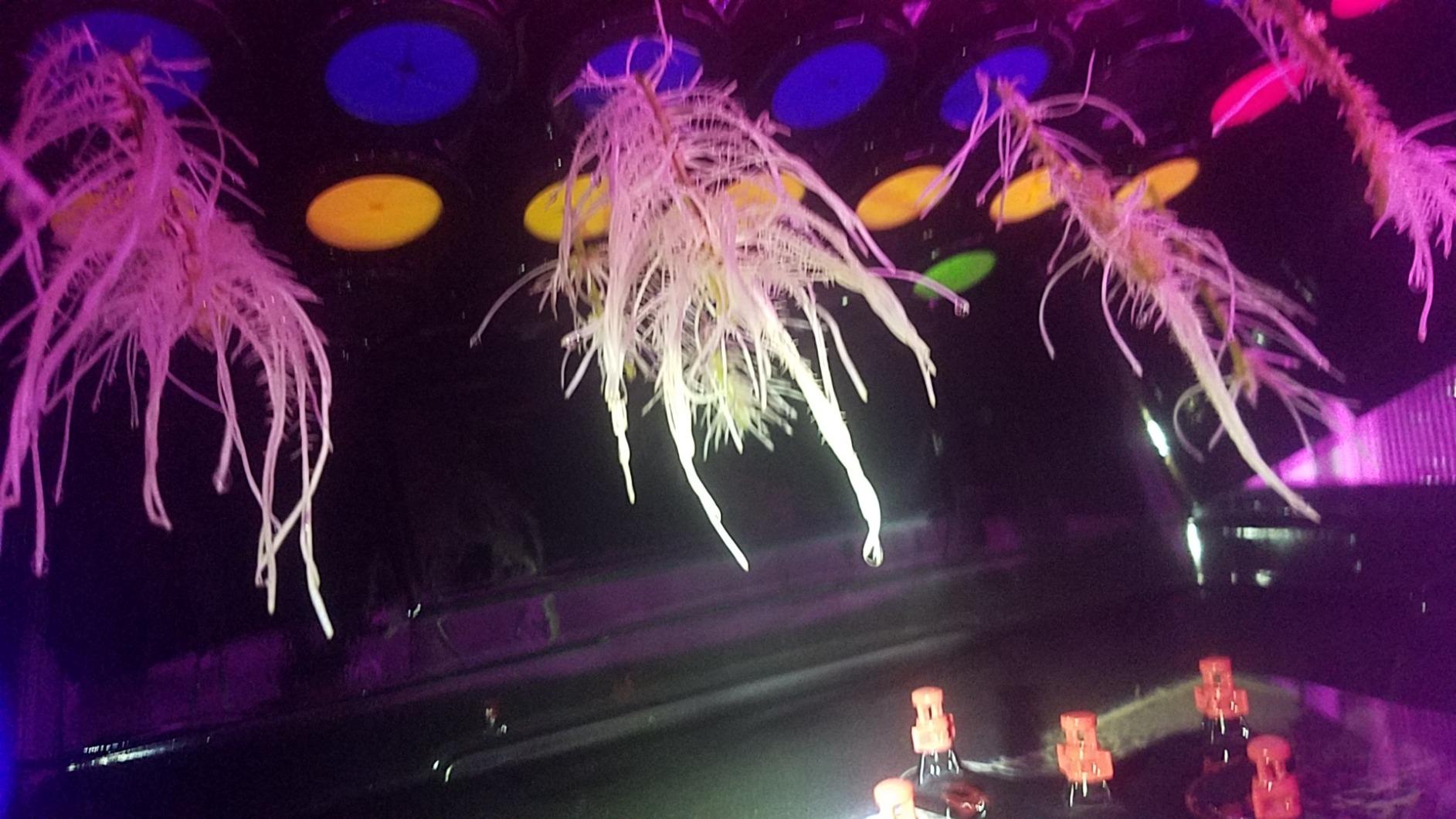
Owners report the same 4 to 10 day rooting window the other cloners achieve, with a 4.2 average across 614 ratings. The pre-filter housing on the UL-listed pump is the detail I would point at hardest in a small apartment, because a pump that clogs stops feeding roots within hours and that is the single most common failure in cheap trays.
The insert size is the trade-off. A 1.625 inch collar is not the 2 inch standard most growers already own in bulk, so if you are cloning in batches year-round, your insert spend goes up. A few owners also flag the plastic quality as thinner than expected, which matters if you plan to move the unit around.
Best reasons to pick it
It gives you near-maximum site count, a dome, and a single-pump design in one box. Nothing else here ships with the humidity cover already fitted.
Watch out for
The narrower collar size is the practical snag for repeat growers, and the vented lid means you will want the dome on for the first week to protect fresh cuttings.
4. HORTIPOTS 24 Site Aeroponic Cloner – Best for Standard Collars
Aeroponic Cloner Machine 24 Site for Cuttings Rooting Using 2 inch Neoprene Inserts or 2 inch Clone Collars
24 sites
standard 2 inch neoprene collars
foldable humidity dome
UL-listed pump with pre-filter
BPA-free ABS and PP
Pros
- Uses the standard 2 inch collars most growers already own
- Foldable humidity dome included
- Vented lid means no air pump to buy
- UL-listed pump with pre-filter housing
- BPA-free ABS and PP construction
Cons
- Multiple owners report leakage from the dome and side ports
- Some report the plugs sit loosely in the ports
- Pump is 120V only and not rated for continuous duty
- pH in the reservoir climbs quickly and needs checking
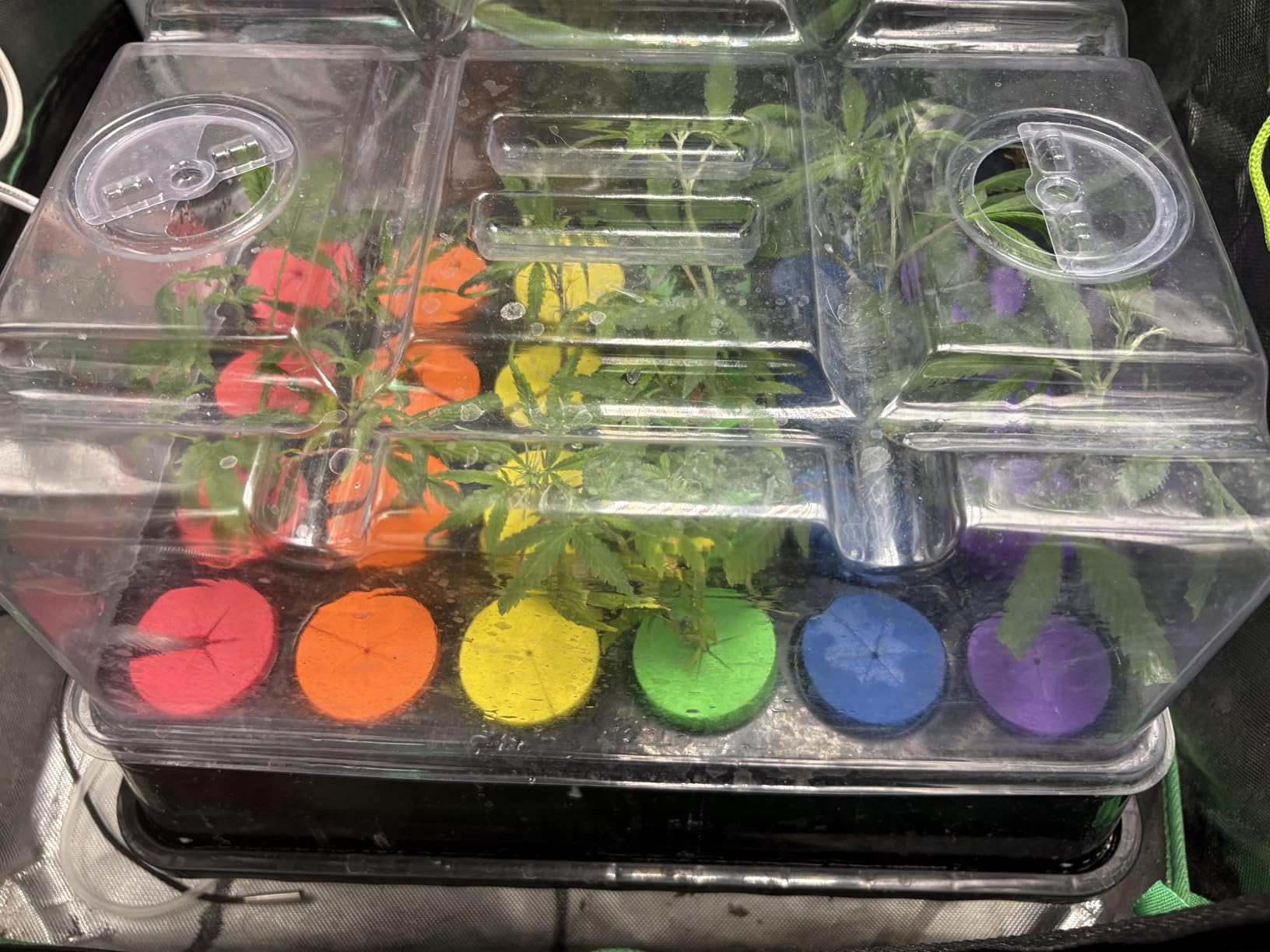
This is the same design as the 35-site unit, scaled to 24 sites and switched to the 2 inch collar that dominates the hobby cloning market. If you already have a drawer full of 2 inch neoprene inserts and clone collars, that compatibility alone justifies choosing this over its larger sibling. The collars fit holes sized 48 to 48.3 mm.
The dome, the vented lid, the pre-filter housing, and the BPA-free ABS and PP body all carry over. What does not carry over is the confidence. Reviewers raise leak complaints more often on this model than on the 35-site version, with several describing fluid tracking down the sides of the clear cover.
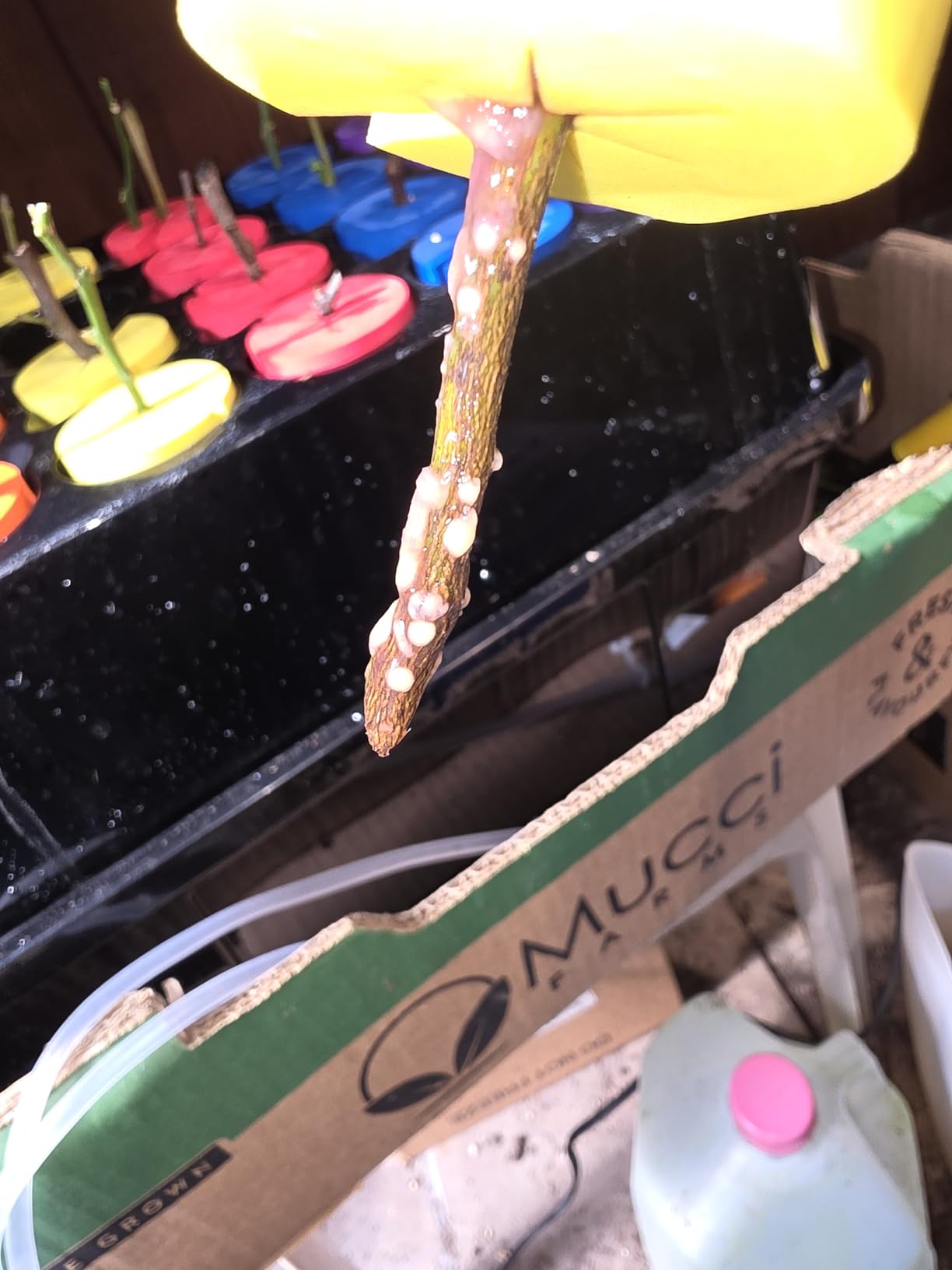
There is also a fit complaint worth knowing: some owners say the 2 inch plugs sit loosely in their ports, which reduces mist contact with the cutting base. That is a small problem to fix with a dab of silicone and a big problem if you never notice it mid-batch.
The pump carries two practical limits that show up in owner reports. It is 120V only, which rules it out for anyone on a 220V supply, and several users state it is not built for continuous duty, recommending an interval timer instead of a permanent on setting.
Why owners still pick it
Standard collar compatibility is worth real money over a few seasons, and the accessory bundle here is the most complete in the roundup at this capacity. For a grower who already owns 2 inch collars, this is the least friction option.
Where the complaints concentrate
Seal integrity and loose plugs, both fixable, and the 120V-only pump, which is not fixable. Check your supply voltage before this one goes in the cart.
5. Psycloner Pro 35 Site Clone Machine – Best for Size Range
Psycloner Pro Clone Machine, Aeroponics System, Cloner for Plant Cuttings, Propagation + Bonus (35 Site)
35 sites with 70 and 140 site variants
ABS plastic sprayer manifold
humidity dome included
2.12 kg
Pros
- Three capacities available from the same design
- Collar and cloning gel included in the box
- Compact vertical form fits more plants in less space
- ABS plastic blocks light from the root zone
- Setup described as minutes rather than an afternoon
Cons
- Humidity dome bows out and leaks in owner reports
- Thin plastic that warps and cracks near the pump cord
- Pump failures reported including a seized impeller
- 120V only so not usable on 220V supplies
This is the only unit here where you choose your size at purchase rather than living with a fixed site count. Thirty-five, 70, and 140 site versions use the same design language, so if you outgrow a flat tray you move up a size instead of starting over with a different system. The vertical form factor also stacks more plant sites into a small footprint than the flat trays above it.
The sprayer manifold is engineered for even water delivery, and the ABS body is described as light-blocking, which keeps the root zone dark and encourages evaporation cooling. Rooting results are excellent when owners report 99 to 100 percent success, and the box includes extra collars plus cloning gel.
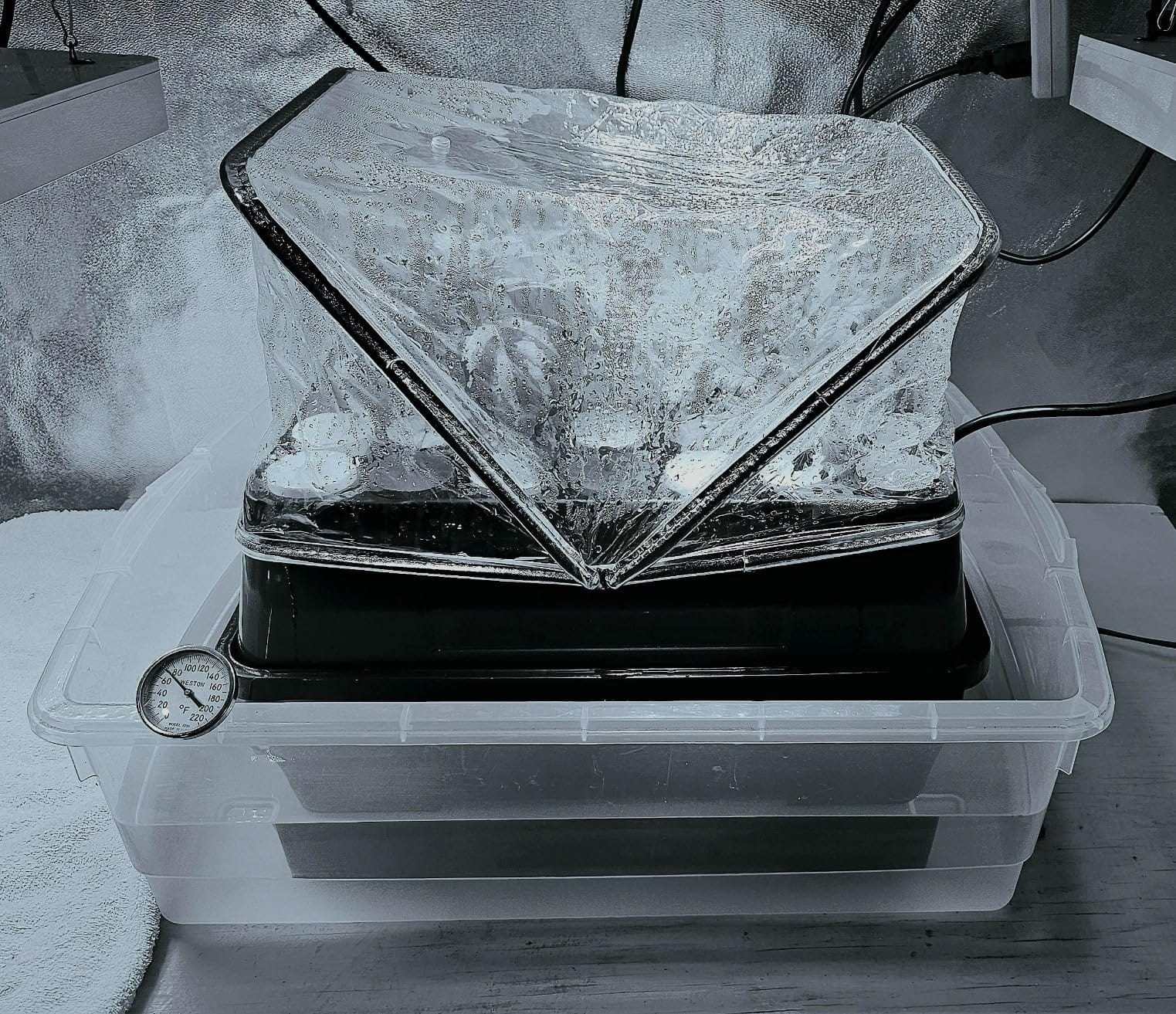
Now the honest part. This model carries the most concentrated leak complaints of anything in the roundup. Multiple owners describe the humidity dome bowing out in the middle and escaping water, and a few have improvised tape repairs. Others report hairline cracks appearing in the corners near the pump cord after weeks of use, plus a pump impeller that seized on one unit.
The 4.0 average across 372 ratings reflects an odd split. Owners with a working unit report near-perfect cloning, while owners with a leaking or cracked unit rate it hard. Put it on a tray, not a bare countertop, and check the dome seal before you walk away from it.
What justifies the size range
Being able to step from 35 to 70 or 140 sites on the same platform is genuinely useful for anyone who clones on a schedule. The vertical shape also frees wall-adjacent floor space.
Why we would not fill a small room with it
The dome and plastic integrity problems are real and repeatable, not one-off complaints. If you have never used an aeroponic cloner, this is a poor first machine to learn on.
6. EZ Clone 16 Cutting System – Best for Tight Corners
EZ Clone 16 Cutting Cloning System
16 sites
low profile design
14.3 by 14.7 by 12.3 inch body
made in USA
8 lb
Pros
- Lowest profile unit in the roundup for the tightest shelves
- Made in the United States with heavier build quality
- Professional grade aeroponic system at 4.5 stars
- Flat body wastes no vertical space when stored
Cons
- Only 16 sites means the smallest batch here
- Higher cost per single site than the 35 and 36 site units
- Listing gives few technical details beyond size and capacity
Everything else on this list is built around batch size. This one is built around the shelf you have. Sixteen sites is the smallest count here, but the 14.3 by 14.7 by 12.3 inch body is genuinely low profile, which is the dimension that runs out first in a studio or a narrow balcony cupboard.
It is also the only made-in-USA unit here, and the 8 pound weight is the give-away that it is built from heavier material than the 2 to 5 pound plastic trays. That weight is a good sign in a machine that lives next to water. Reviewers rate it 4.5 across 273 ratings, which is the joint second-highest average in the roundup.
The trade is arithmetic. Sixteen sites at roughly this cost means a higher cost per single plant than the 35 and 36 site units, and a full batch of sixteen cuttings is a small batch if you are propagating on a schedule. It suits a home grower who clones a handful of plants at a time rather than a propagator filling a tray weekly.
There is also very little to plan around on the listing itself, with capacity, profile, and build origin as the main details. If you want to know the pump size or manifold layout before buying, you are guessing.
Best reasons to pick it
It fits where nothing else will and the build feels a step above the imported plastic trays. For a spare shelf or a cupboard converted into a grow station, it is the cleanest install.
When it is the wrong call
Anyone propagating in quantity will feel the 16-site ceiling almost immediately. Sixteen cuttings per run is a hobby batch, not a production batch.
7. Viagrow Clone Machine 24 Site Kit – Best All-in-One Box
Viagrow® Clone Machine 24-Site Plastic Aeroponic Hydroponic System with 1020 Grow Light and 7 in. Humidity Dome/A Product of The Harvest Company™
24 sites
1020 grow light included
7 inch humidity dome included
internal pump filter
4 lb
Pros
- Grow light and humidity dome both included in one box
- Pretested manifolds and misters designed to run clog-free
- Multicolored neoprene collars make batch tracking easy
- UL-listed clone pump with an internal filter
- Extra collar and two spare misters in the box
Cons
- Only 36 reviews so long term reliability is largely unknown
- No nutrient solution or starter media in the box
- Rated lower in its category than the other cloners
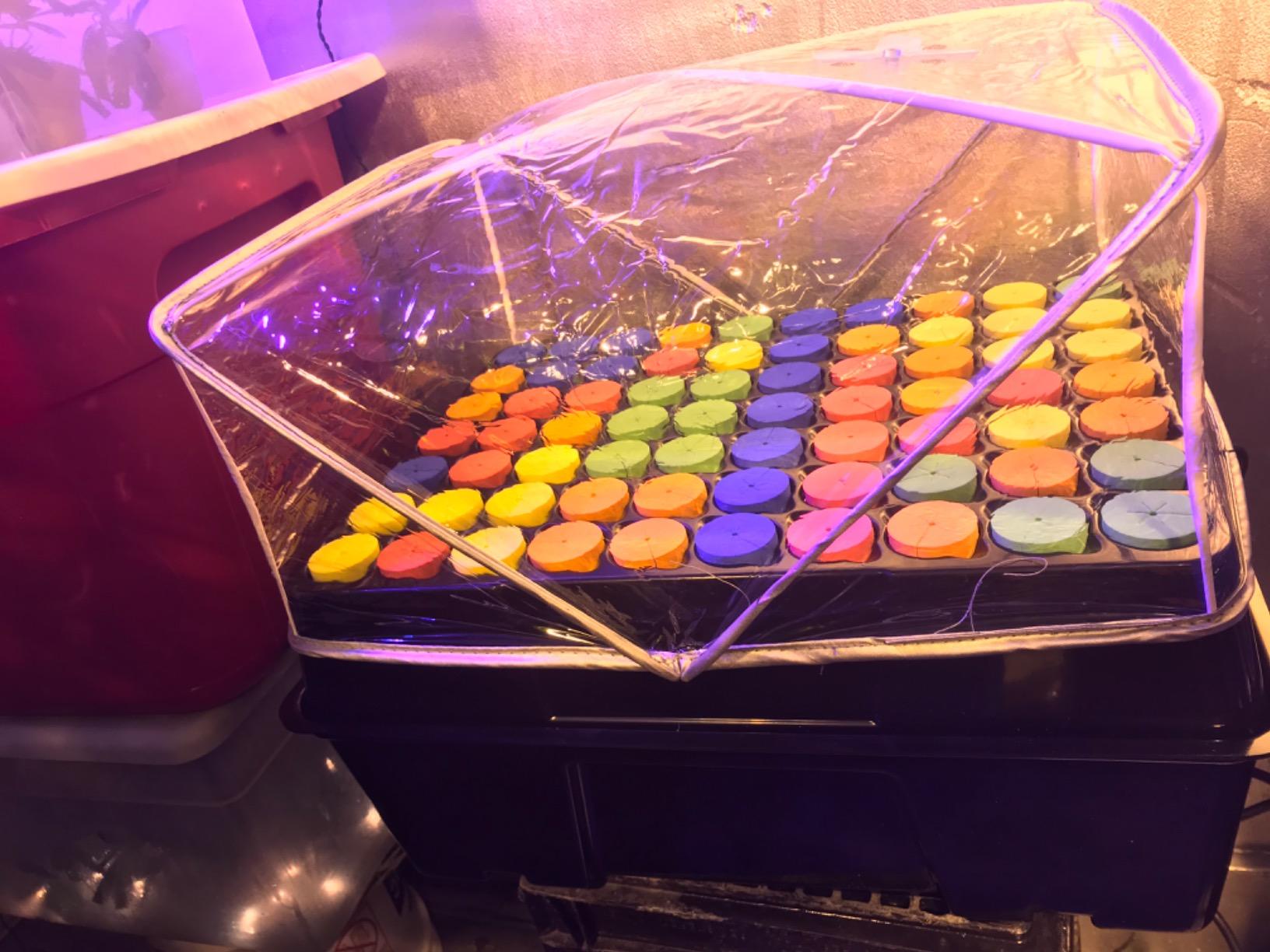
This is the only box on the list that gets you from opening the packaging to rooting cuttings without a second shopping trip. A 1020 grow light and a 7 inch humidity dome are both inside, along with the 24-site tray, pump, filter, timer, water level gauge, tools, tray, hose, shower cap, funnel, growth sponges, and a manual. In a small apartment, not needing to source a light separately is worth more than the light itself.
The engineering notes are the strongest of any budget tray here. Manifolds and misters are pretested, the pump has an internal filter for clog-free running, and the unit is designed to hold water at 65 to 75 degrees, which is the range root development depends on. Multicolored collars let you track plant varieties through a batch without writing on them.
The confidence problem is the review count. At 36 ratings, the 4.2 average is based on very few owners, and a 4 pound build with BPA-free plastic gives you no read on how it performs after a year of daily use. Every other machine here has thousands of ratings behind it except the tower, which means you are buying on design rather than on evidence.
Best reasons to pick it
Everything in one box, pretested misting hardware, and an internal filter are exactly what a first-time buyer needs. It is also the fastest path from unpacking to a rooting tray on day one.
What you give up
You give up the review history. With 36 ratings, a design flaw that shows up at month six would not yet appear in the feedback you can read.
8. LYCereal 30 Plant Vertical Tower – Best for Herbs and Greens
LYCereal Hydroponics Growing System, 30-Plant Indoor Hydroponic Tower with Pump System, Plants Germination Kit, Smart Aeroponic Herb Garden, Vertical Hydroponic System for Gardening Lover (No Seed)
30 plants across 6 tiers
9.84 by 9.84 by 33.86 inch
10L tank
timer controlled pump
Pros
- Thirty plants in under one square foot of floor space
- Six tier vertical design stacks capacity upward
- Timer controlled pump with adjustable run duration
- Water level gauge on the tank for quick checks
- 64 growth sponges and most parts pre-assembled
Cons
- No grow light included and no nutrients in the box
- Food grade plastic status of the material is unconfirmed
- Tower becomes top-heavy with fully grown plants
This is the unit people actually picture when they search for a small-space aeroponic system, and it is the only one here built to feed a person rather than a propagator. Thirty plants across six tiers, measuring 9.84 inches square and 33.86 inches tall, is the highest plant-site density per square foot of anything in this roundup. The 33.86 inch height is the number that matters: it clears under a normal counter overhang and under a low balcony rail.
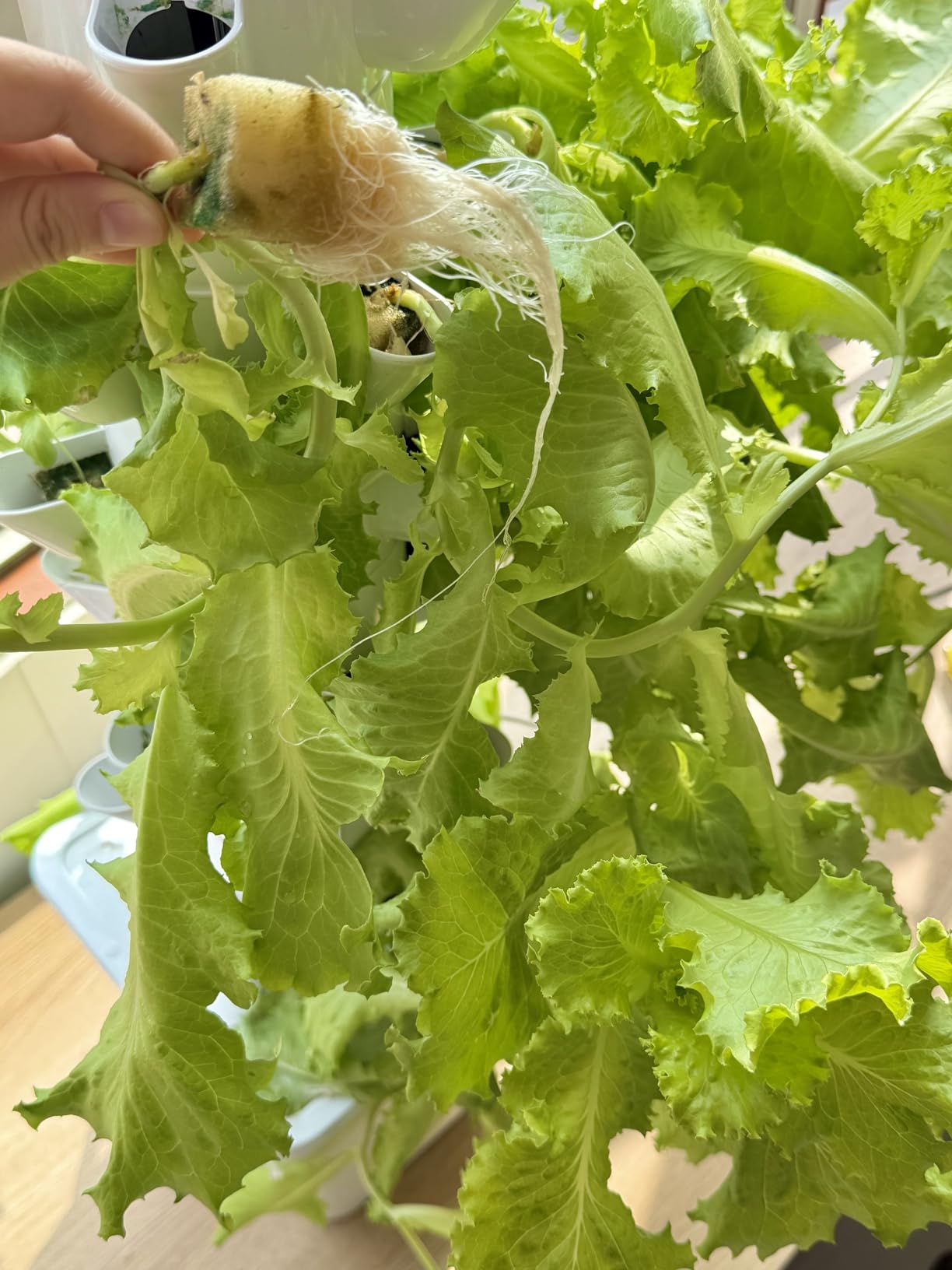
It is also not a true aeroponic system despite the name. The timer-controlled pump circulates water up and down the column, wetting the root zone as it passes rather than misting bare roots, so the plants sit in growth sponges rather than net pots of air. Buyers who come from a real cloner will notice the difference in how fast callusing happens.
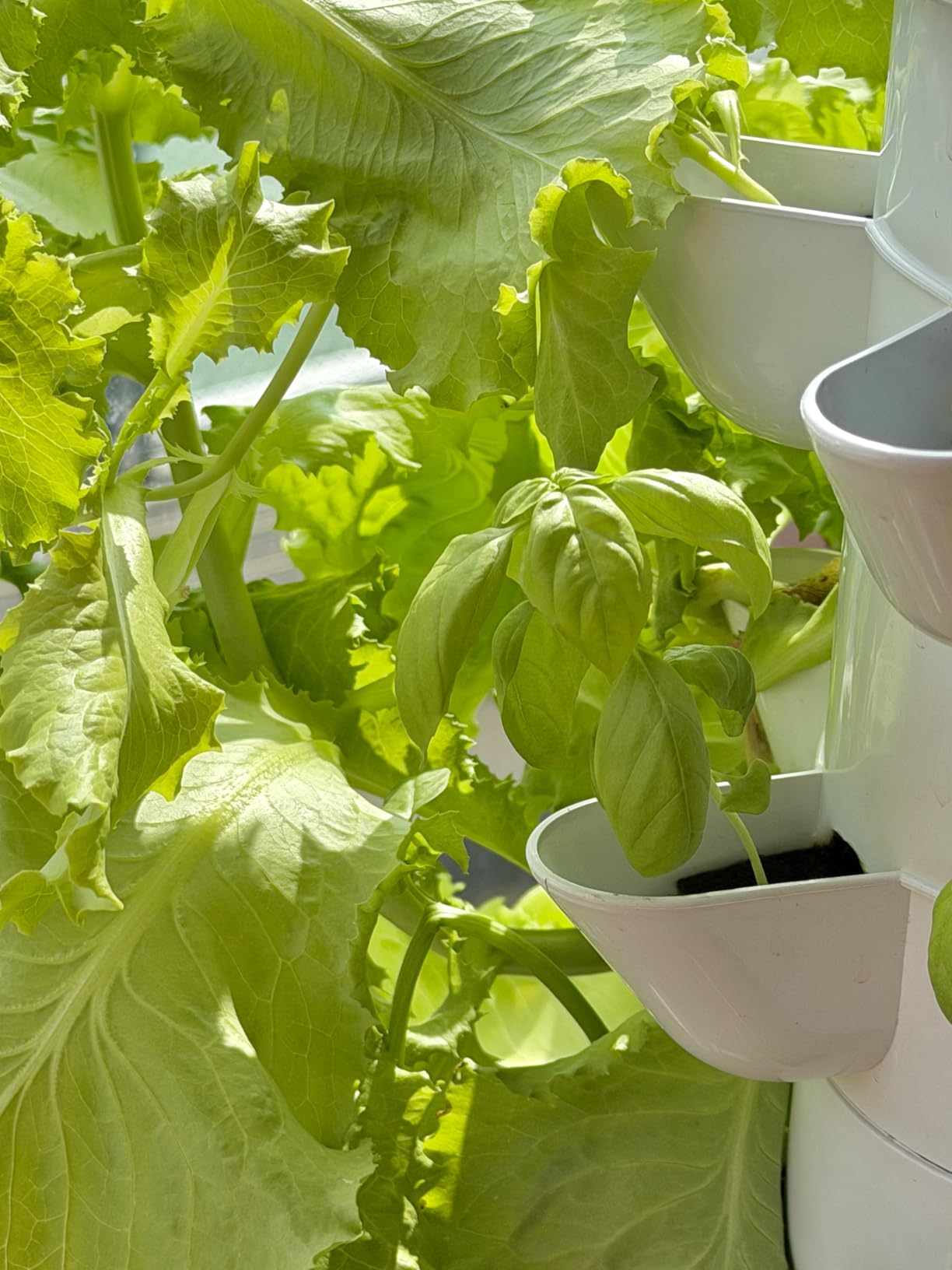
Owners rate it 4.1 across 48 ratings and consistently praise two things: the footprint and the fact that most of the tower arrives pre-assembled. The manufacturer claims the water circulation system grows plants three times faster than soil. The water level gauge on the tank is a small touch that saves you lifting the lid to check the water line every morning.
What is missing matters more in a small space than it would in a large one. There is no grow light, which means you need a ceiling or shelf fixture to hit basil and lettuce, and no nutrients. Reviewers also flag that the tower gets top-heavy once plants are mature, a stability concern on a balcony where wind can catch foliage.
Where this tower wins
A kitchen or home office where you want fresh basil, mint, and lettuce within arm’s reach. Thirty sites under one square foot is unmatched here, and it arrives mostly assembled.
Where it does not
Anywhere without a light you control, and anywhere the material matters to you, since the food grade status is unconfirmed. It also needs its own permanent floor square.
How Much Floor Space Do You Actually Need?
Start from the tray, not the tower. Six of the eight units here are flat trays that measure between 13.75 and 14.7 inches square, so a 2 by 2 foot section of counter or floor holds one of them with room to lift the lid and pour a reservoir. The tray needs more than its own footprint in one direction, since growers on hydroponics forums consistently report needing about a foot of working space in front to set cuttings without splashing.
Ceiling clearance matters more for the tower. At 33.86 inches tall, the LYCereal unit needs a shelf or surface at least that high and a wall it will not be walked into, because mature basil spreads well beyond the column footprint. Standard counter overhangs are typically 24 inches, so the tower will not tuck underneath one without losing vertical clearance for the plants.
Mature plant spread is the number nobody publishes. A column of lettuce stays close to the tower. A column of basil spreads outward at the top tiers, and any vining crop will reach a foot past the column in every direction. If your space is a 3 by 3 foot balcony corner, budget the tray plus about a foot of growth room on the open sides.
If the space fight is really about the room rather than the growing, the same square footage logic shows up in our secretary desks for small spaces guide. Both problems come down to the same thing: protect the floor square you have before you plan what goes on it.
What to Grow and What to Skip?
Cloners and towers have different crop lists because they work at different scales. In a misting tray you are working with cuttings and young plants: herbs such as basil, mint, and rosemary root fastest here, and so do most houseplant cuttings, which is the practical reason people buy a cloner in the first place.
In the tower, the reliable crops are leafy greens and herbs. Basil, cilantro, parsley, lettuce, kale, and compact greens all hold their size at the column and get harvested from the outside leaves without removing the whole plant. Compact fruiters such as small peppers and cherry tomatoes can work on the upper tiers where the light is strongest.
Skip the crops that outgrow the footprint. Cucumbers, squash, melons, and large-fruited tomatoes are vining or sprawling plants that will reach a foot or more past the column in every direction, which is exactly what a small balcony cannot absorb. Root-heavy crops like potatoes and beets need depth and volume that a net pot in a tower does not provide.
Setup Basics: Level Floor, Timer Cycles, and pH
The single hardest part of assembly is not the assembly. Water and nutrient solution move by gravity, so the unit has to sit level or the low end drains faster than the pump can refill it. Levelling the surface takes five minutes with a phone level app and saves you from uneven root zone moisture for the life of the machine.
Timer cycles are where owner experience and manufacturer defaults diverge. The working recipe that circulates from growers is roughly 15 minutes on and 15 minutes off in summer, stretching to 15 on and 30 to 45 off in winter when evaporation slows. Several unit owners in this roundup recommend a mechanical interval timer regardless of whether the machine includes one, because it lets you run cycles rather than leaving a pump on continuously.
pH needs checking from the first week. Reviewers on more than one model here report that the reservoir pH climbs quickly and needs regular adjustment, so keep inexpensive pH strips on hand rather than a probe. Reservoir volume dictates the refill rhythm too: the 1.75 gallon reservoir on the Oxyclone needs topping up more often than a larger tray.
The Real Maintenance Schedule
Daily takes two to three minutes: check the water level against the gauge or sight glass, look for a mist at the spray heads while the pump runs, and wipe condensation off the dome. If the mist looks weak on one side, the pre-filter housing is usually the place to look first.
Weekly covers the parts people skip and then regret. Rinse the air stone if you have one, wipe the lid and spray manifold of biofilm, check pH, and confirm that collars are still seated in their ports. Drain and rinse the reservoir rather than topping it off indefinitely, which is the main route to algae and mineral buildup.
Monthly is the deep clean: strip the tank, soak the manifold nozzles, replace the pump if flow has dropped noticeably, and sanitise between batches. Emptying and storing the tray between runs also solves the storage problem, since a flat tray stores flat and a tower does not.
Noise, Light Spill, and Apartment Living
Submersible pumps hum. Nobody in this roundup is silent, and the honest differentiator is how audible they are in a quiet room. Owners of the high-capacity 36-site unit describe a running hum; the flat trays are generally less noticeable than a tower pump pushing solution up a column. If a machine shares a room with a bed, put it in a room with a door.
Light spill is the issue nobody in this category addresses, and it is the one that gets you a noise complaint from a neighbour. A full-spectrum grow light on a timer in an apartment throws visible light through curtains after dark. Blackout curtains solve it, and so does positioning the fixture where the beam points at a wall rather than out a window.
Humidity is the quieter problem. A running reservoir plus transpiration raises the local moisture load, and a tower with six tiers of leafy greens can push the reading in a sealed studio past what feels comfortable. A small room benefits from a cheap hygrometer on the shelf next to the unit.
For anyone fitting this into a rental, the plant site limit can actually be a feature. If you want the same approach for something less space-hungry, our upholstered beds for small spaces guide covers making a compact room work around one piece.
When the Pump Stops: Power Outages and Root Dry-Out
Bare-root cuttings in an aeroponic tray are more exposed to a pump failure than plants in a tower are. A suspended cutting has no medium holding water against its tissue, so when the mist stops, dehydration starts immediately. Guide after guide covers the happy path and skips the failure path, which is why this section exists.
The realistic response is a backup timer with a battery or a plug-in transfer switch, plus keeping a spray bottle and a small bottle of nutrient solution near the tray. Misting the roots by hand every hour or so through a short outage is enough to save a batch; the same neglect in a drip tower is survivable for far longer.
Longer term, treat any pump as a consumable and keep a spare of the same model. Every unit in this roundup uses a standard UL-listed submersible pump, and none of the designs gives you a parts list. The pump is the component that will end the machine’s life, not the plastic.
Five Disadvantages of Aeroponics to Know Before You Buy
Aeroponic systems get marketed on speed and water savings, and both are real. These are the five costs nobody puts on the box.
1. The pump is a hard dependency. A stopped pump means bare roots drying within hours, and no medium to buffer the loss.
2. Power and noise become part of your room. Every unit runs a submersible pump on a timer, and the hum is audible in a quiet space.
3. You are buying a propagation tool, not a growing system. Cloners root cuttings in 4 to 10 days and then need transplanting into soil or a larger hydroponic setup. There is no finish line where the tray feeds you.
4. Reservoir chemistry is on you. pH rises quickly, nutrient solution must be mixed and refreshed, and an unattended batch can drift past the range roots tolerate.
5. Real units cost more per site than a basic drip tray. Site counts and site sizes vary between models, so a 2 inch collar tray and a 1.625 inch collar tray are not interchangeable, and consumables do not always cross over.
Aeroponic, Drip Tower, NFT, or DWC: Which Method Fits Your Space
Aeroponics and drip towers want vertical space and light. NFT channels send a thin film of solution along a sloped pipe and want horizontal run plus a reservoir at the low end, which suits a windowsill but not a balcony wall. DWC puts each plant in its own net pot in a bucket of aerated solution, using the least vertical space of all and the most floor space per plant.
For a countertop, the honest answer is that a small countertop herb garden or a wick system beats an aeroponic tray, because a tray is a propagation tool and a countertop unit is a growing tool. For a balcony or a spare wall, a drip tower like the LYCereal unit is the only one here that produces food rather than new plants.
If your constraint is floor space rather than light, DWC in a single bucket wins on plant count per square foot in every honest comparison we found. If your constraint is light, none of them work without a fixture you control, and no method changes that. Water use stays low across all of these methods compared with soil, so that is not a deciding factor.
Frequently Asked Questions
What is the best hydroponic system for small spaces?
For a genuine aeroponic buy, the CLONE KING 36 Site Cloner is the strongest small-space choice: 36 plant sites in a 13.75 inch square tray with 13 spray heads and a 317 GPH pump. For food production rather than propagation, the LYCereal 30 Plant tower grows 30 plants in under one square foot but needs a grow light you provide.
What are the downsides of aeroponic farming?
The pump is a hard dependency, so a failure or power cut dries bare roots within hours. Pump noise becomes part of your room. The machines are propagation tools that root cuttings and then need transplanting. Reservoir pH rises quickly and must be managed. And site counts, collar sizes, and pumps differ between models, so consumables often do not cross over.
Are aeroponic towers worth it?
For a small number of herbs and leafy greens in a kitchen or home office, yes, when a vertical tower puts 30 plant sites into under one square foot of floor space. Expect to add your own grow light and nutrients, and to plan for the tower needing a permanent floor square and regular reservoir cleaning.
Which is better, NFT or DWC?
NFT needs a sloped channel and a reservoir at the low end, so it suits a windowsill with horizontal run. DWC needs one bucket and net pot per plant, using the least vertical space and more floor space per plant. For a confined room, DWC wins on floor efficiency; for a long sunny sill, NFT uses the space better.
What can I grow in an aeroponic tower indoors?
Herbs and leafy greens are the reliable indoor tower crops: basil, cilantro, parsley, mint, lettuce, and kale. Compact fruiters such as small peppers and cherry tomatoes can sit on upper tiers where the light is strongest. Skip vining and sprawling crops like cucumbers, squash, and large-fruited tomatoes, plus root-heavy crops that need more depth than a tower net pot provides.
How much space do I need for a tower garden?
A flat cloning tray measures about 13.75 to 14.7 inches square, so a 2 by 2 foot surface plus roughly a foot of working space in front is enough. A vertical tower measures 9.84 inches square by 33.86 inches tall on the model here, but mature herbs spread beyond the column, so allow extra clearance on open sides.
Conclusion
The best aeroponic systems for small spaces come down to what you want the machine to do. If you want maximum cuttings from the least floor space, the CLONE KING 36 Site Cloner is our pick: 36 sites, 13 spray heads, and a tray that measures 13.75 inches square and stores flat between runs. If build quality and oxygenation matter more than batch size, the Hydrofarm Oxyclone OX20SYS runs two aeration stages in the flattest body here.
For food instead of plants, the LYCereal 30 Plant tower is the one that grows basil and lettuce within arm’s reach, in under one square foot, provided you supply the light. Whichever you choose, level the surface first, run an interval timer rather than continuous power, and keep pH strips next to the unit.
We test and update this roundup through 2026, so the spec details and review counts reflect what owners are reporting at the time you read it.