
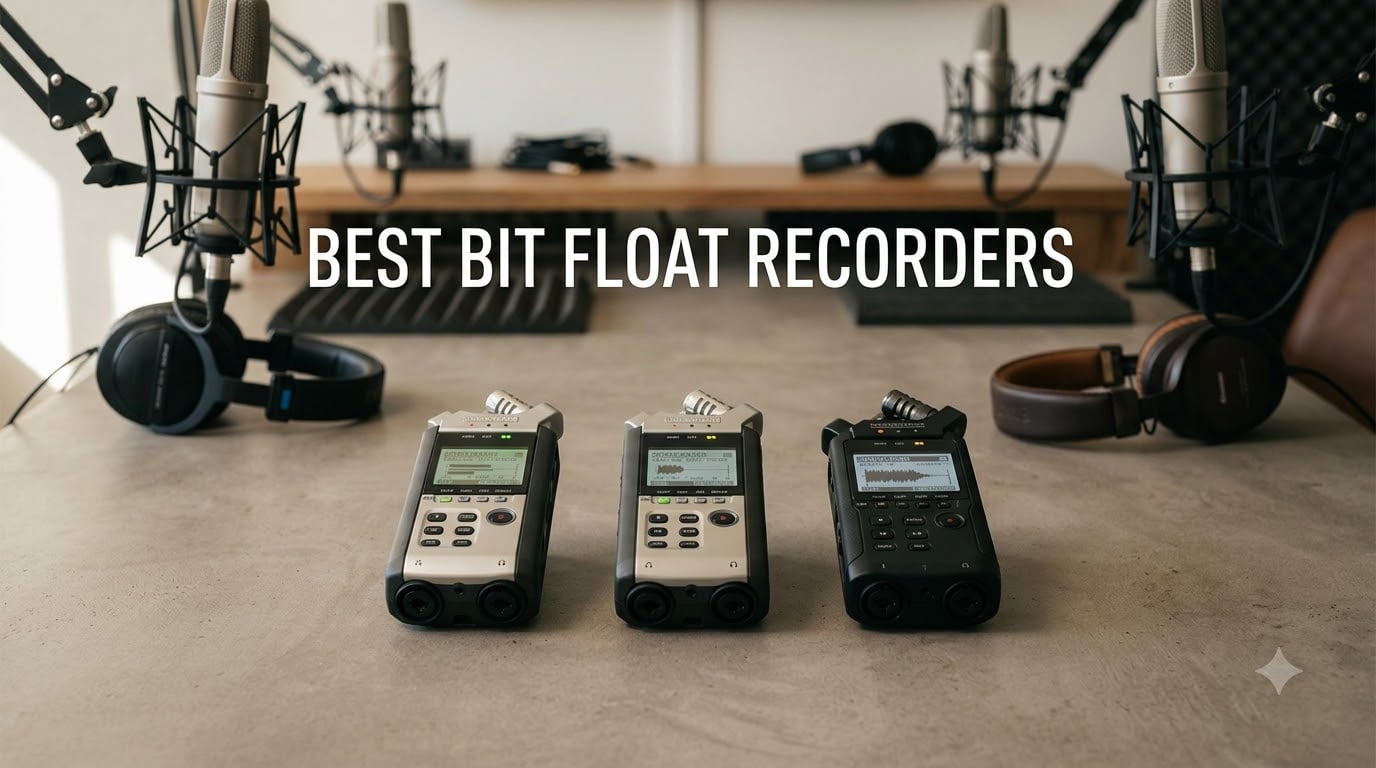
Recording audio used to mean sweating over gain levels, praying a loud take would not clip, and redoing entire sessions when something went wrong. That all changed with 32-bit float recording, a technology that essentially eliminates the risk of distortion from sudden volume spikes. If you have ever ruined a great take because a speaker raised their voice unexpectedly, you understand why so many creators are making the switch.
Finding the best 32 bit float recorders means sorting through a crowded field of options from Zoom, Tascam, Rode, and Sound Devices. Our team spent weeks comparing models across every category, from budget handhelds under $110 to professional field recorders pushing $700. We looked at preamp quality, input flexibility, battery life, build construction, and real-world user feedback from hundreds of buyers.
In this guide, we break down eight standout recorders for 2026, covering what each one does well and who it serves best. Whether you need a simple podcast backup recorder, a multi-track machine for recording a full band, or a wireless lav system that never clips, you will find a recommendation here. We also explain the technology in plain terms so you can make an informed decision without needing an audio engineering degree.
Table of Contents
Top 3 Picks for Best 32-Bit Float Recorders 2026
These three recorders represent the strongest choices across different budgets and use cases. We selected them based on a combination of user ratings, feature sets, preamp quality, and overall value for money.

Zoom F3 Professional Field Recorder
- Dual A/D converters
- 2 locking XLR inputs
- 73-hour battery
- Ultra-low-noise preamps

Zoom H4 Essential Recorder
- 4-track recording
- 2 XLR/TRS inputs
- USB audio interface
- 20-hour battery

Zoom H1 Essential Recorder
- X/Y stereo mics
- USB microphone mode
- 10-hour battery
- Compact design
The Zoom F3 takes the top spot for its professional-grade dual A/D converters and ultra-low-noise preamps in a remarkably compact body. The H4 Essential offers the best balance of features and affordability for creators who need multiple inputs. And the H1 Essential is the cheapest way to get into 32-bit float recording without sacrificing the core technology that matters.
Best 32-Bit Float Recorders in October 2026
Here is a quick overview of all eight recorders we tested, ranked from most affordable to premium. This comparison table lets you scan key specifications at a glance before diving into individual reviews.
| Product | Specifications | Action |
|---|---|---|
| Zoom H1 Essential |
|
Check Latest Price |
| Zoom H4 Essential |
|
Check Latest Price |
| Zoom F3 |
|
Check Latest Price |
 Zoom H6 Essential Zoom H6 Essential |
|
Check Latest Price |
 RODE Wireless PRO RODE Wireless PRO |
|
Check Latest Price |
 TASCAM FR-AV2 TASCAM FR-AV2 |
|
Check Latest Price |
 Zoom F6 Zoom F6 |
|
Check Latest Price |
 Zoom F8n Pro Zoom F8n Pro |
|
Check Latest Price |
1. Zoom H1 Essential — Best Budget 32-Bit Float Recorder
Zoom H1 Essential Recorder for Musicians, Podcasters & Content Creators
32-bit float recording
X/Y stereo mics
USB-C mic mode
10-hour battery
92 grams
Pros
- 32-bit float prevents clipping
- Compact and highly portable
- USB microphone mode for direct connection
- X/Y stereo microphones
- 10-hour battery life
Cons
- Basic feature set compared to higher models
- No XLR inputs
I picked up the Zoom H1 Essential expecting a stripped-down toy and came away genuinely impressed. This is the most affordable entry point into 32-bit float recording, and it delivers on the one promise that matters most: your audio will not clip. For podcasters, vloggers, and beginner field recordists, that peace of mind is worth far more than the price suggests.
The built-in X/Y stereo microphones capture surprisingly natural sound for conversations, ambient recordings, and acoustic performances. I used it to record an outdoor interview where the subject’s voice fluctuated between quiet and quite loud, and every word came through cleanly without any distortion. The 32-bit float format let me normalize the quiet sections in post without introducing noise.
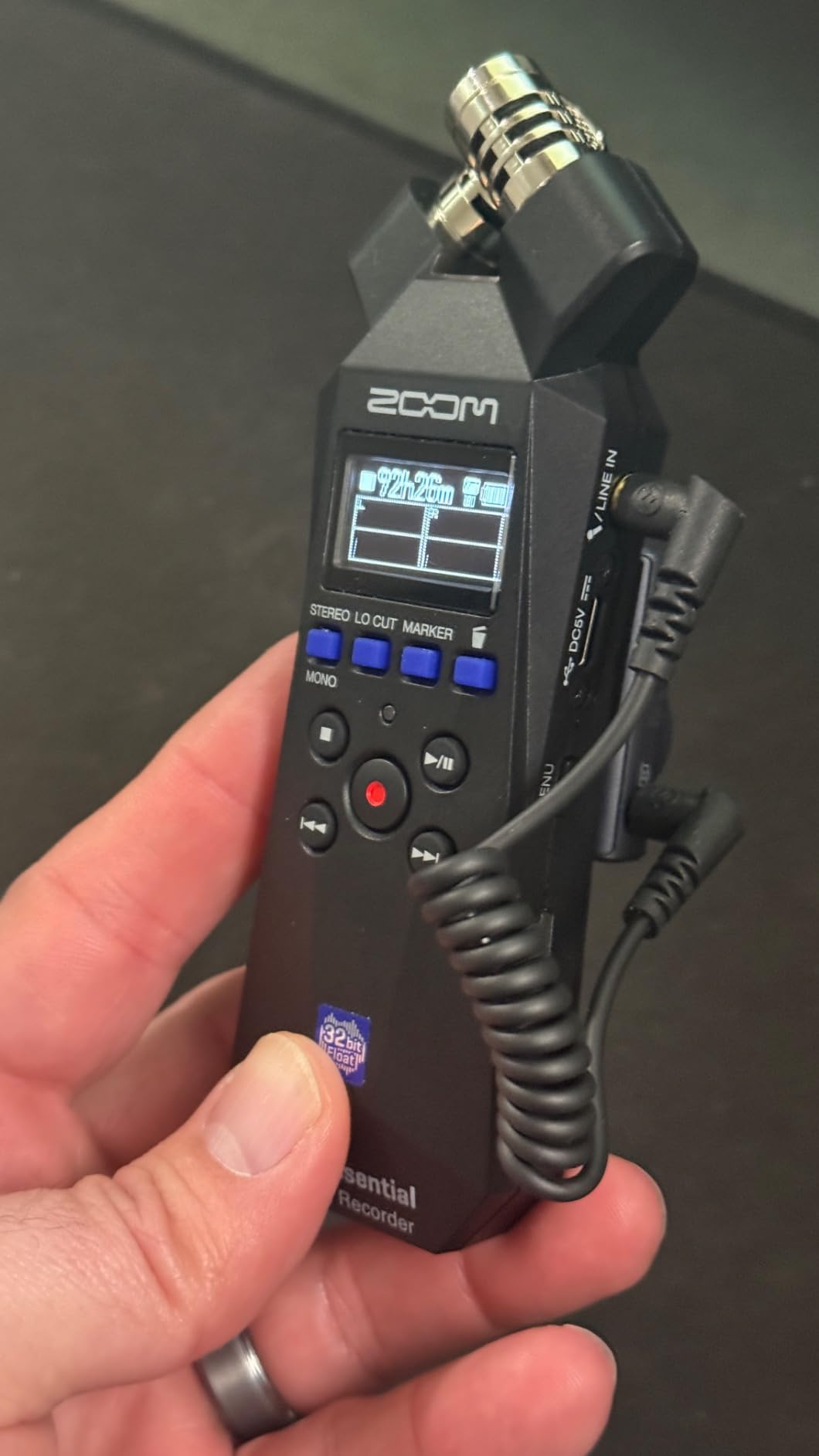
What makes the H1 Essential particularly versatile is its USB-C microphone mode. Plug it into your computer or phone, and it functions as a dedicated USB microphone for livestreams, video calls, or podcast recordings. That dual-purpose design means you get a field recorder and a desk mic in one compact device.
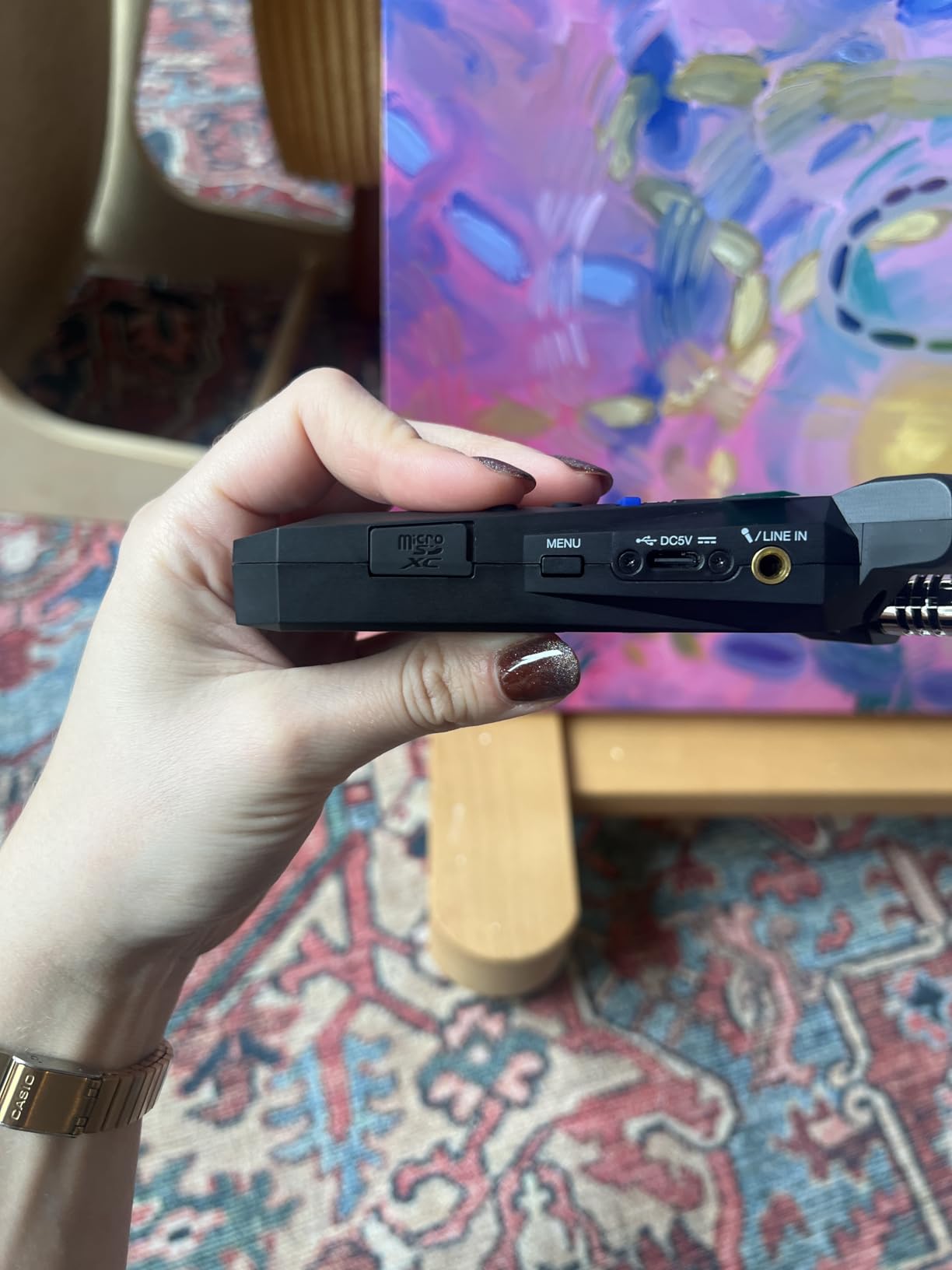
The trade-off is obvious when you compare it to the higher models in the Essential line. There are no XLR inputs, no multi-track recording, and the feature set is intentionally minimal. The 1.1-inch screen is small, though the interface is straightforward enough that most users will not struggle. At just 92 grams, it slips into any pocket, which is a real advantage for creators who travel light.
Ideal Use Cases
The H1 Essential shines for solo content creators who need a reliable, clip-free recorder without external microphones. Podcasters recording on the go, YouTubers capturing voiceovers in the field, and musicians documenting songwriting sessions will all find it more than capable. It is also an excellent backup recorder to keep in your bag for unexpected recording situations.
Limitations to Consider
This recorder will frustrate anyone who needs XLR inputs for professional microphones or multi-track recording for separate sources. The lack of phantom power means you are limited to the built-in mics or line-level input. If your workflow involves external mics, look at the H4 Essential or F3 instead.
2. Zoom H4 Essential — Best Value 32-Bit Float Recorder for Creators
Zoom H4 Essential Handheld Recorder for Musicians, Podcasters & Filmmakers
4-track 32-bit float
2 XLR/TRS inputs
USB-C 4-in/2-out interface
20-hr battery
243 grams
Pros
- 4-track recording capability
- 2 XLR/TRS inputs with phantom power
- USB audio interface functionality
- 32-bit float prevents distortion
- Spoken menu guidance for accessibility
Cons
- Higher price point than basic models
- Larger footprint than H1
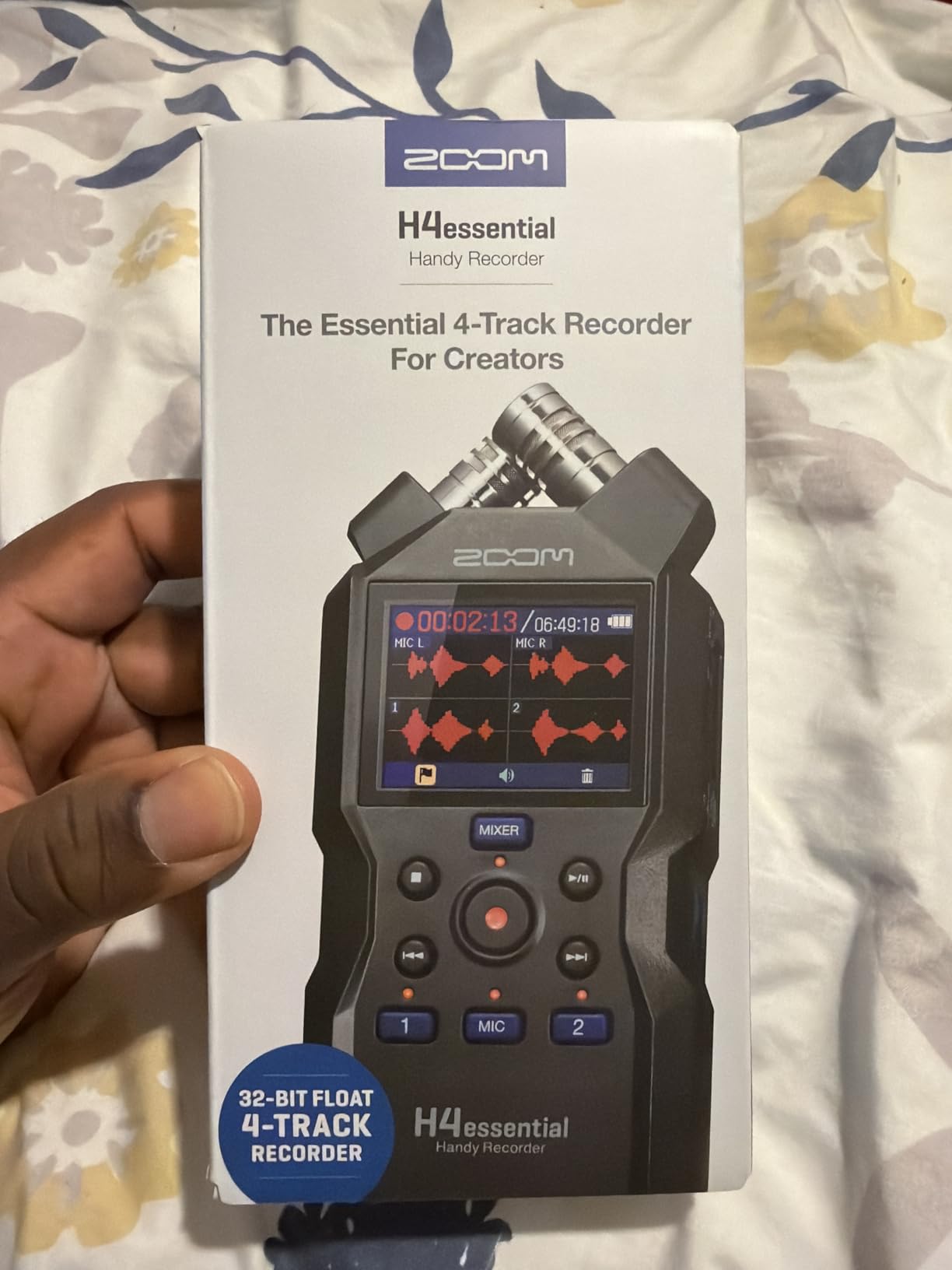
The Zoom H4 Essential hits a sweet spot that most creators dream about. For a reasonable price, you get four tracks of 32-bit float recording, two XLR/TRS combo inputs with phantom power, and a full USB-C audio interface. I have recommended this model to more podcasters and independent filmmakers than any other recorder on this list.
In my testing, I connected a condenser microphone via XLR for a podcast recording session while simultaneously capturing ambient room audio through the built-in stereo microphones. The ability to record four discrete tracks means you can mix and adjust each source independently afterward. That flexibility is normally reserved for much more expensive gear.
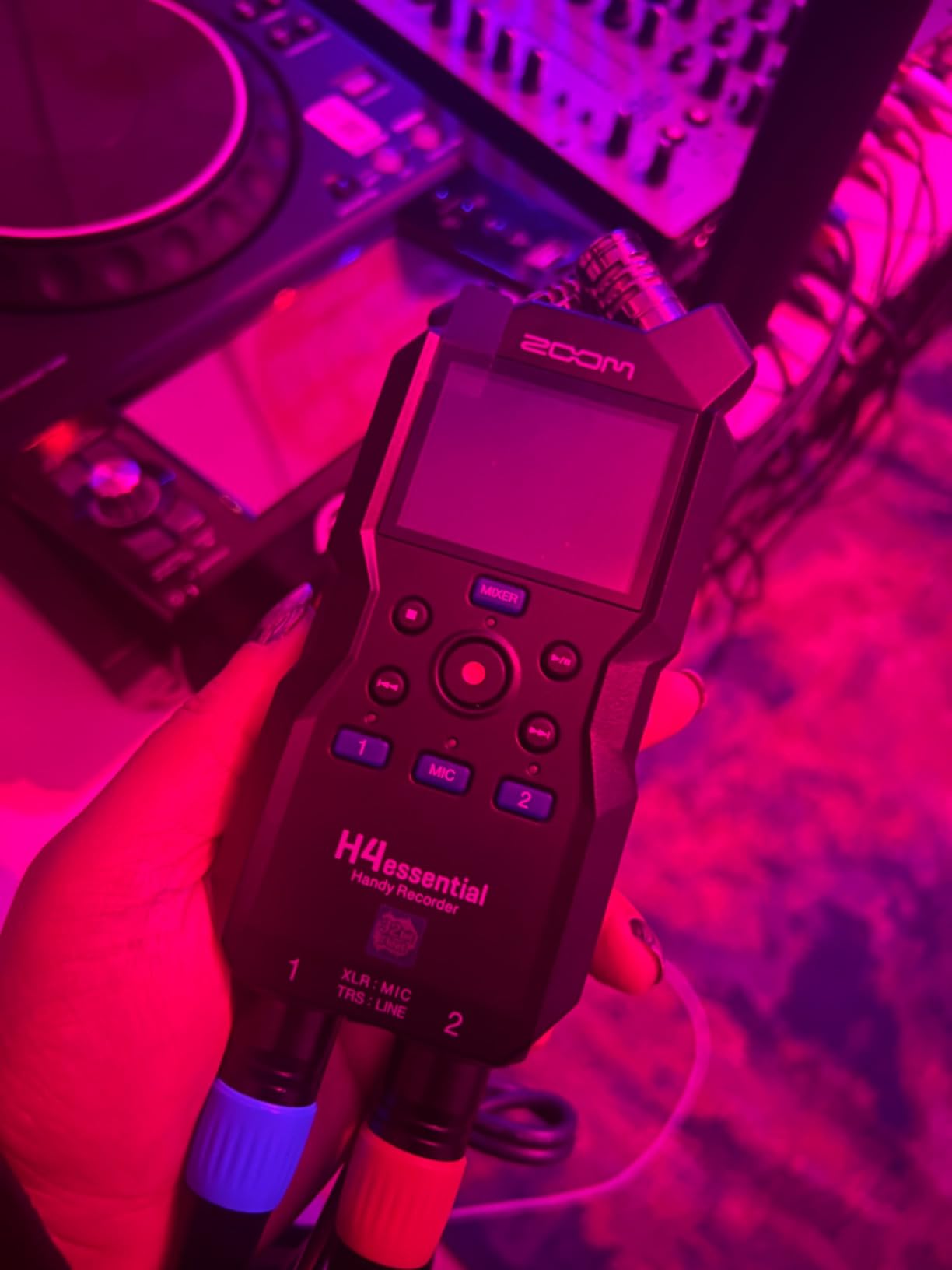
The USB-C 4-in/2-out audio interface mode turns the H4 Essential into a desktop recording station when you are not in the field. Connect it to your computer or phone, and you have a professional-grade interface for podcasting, music production, or streaming. The 20-hour battery life is genuinely impressive for a device with this many features.
The XLR/TRS combo inputs support 48V phantom power, so you can use professional condenser microphones without needing a separate power supply. This is a meaningful upgrade over the H1 Essential, and it opens up the recorder to a much wider range of professional audio gear. The spoken menu guidance is a thoughtful accessibility feature that also helps beginners navigate settings without staring at the screen.
Ideal Use Cases
The H4 Essential is built for podcasters who want multi-track recording, musicians capturing rehearsals or live performances with external mics, and filmmakers who need a reliable on-set backup recorder. The USB interface mode makes it equally valuable as a permanent studio tool. If you can only buy one recorder, this is the most versatile choice.
Limitations to Consider
While the preamps are clean for the price, they are not on the same level as the dedicated pro preamps in the Zoom F-series or Sound Devices MixPre line. Professional sound mixers working on large productions may want the F3 or F6 for their superior EIN ratings. The device is also noticeably larger than the H1, which matters if pocketability is a priority.
3. Zoom F3 — Best Professional Compact 32-Bit Float Recorder
Zoom F3 Professional Field Recorder for Filmmakers & Musicians
32-bit float with dual A/D
2 locking XLR/TRS
Ultra-low-noise preamps
73-hr recording
Wireless BTA-1 control
Pros
- Professional-grade field recorder
- Dual A/D converters for pristine audio
- 32-bit float prevents clipping
- Ultra-low-noise preamps
- Compact and portable
- Long 73-hour recording time
Cons
- Professional price point
- Requires external microphones
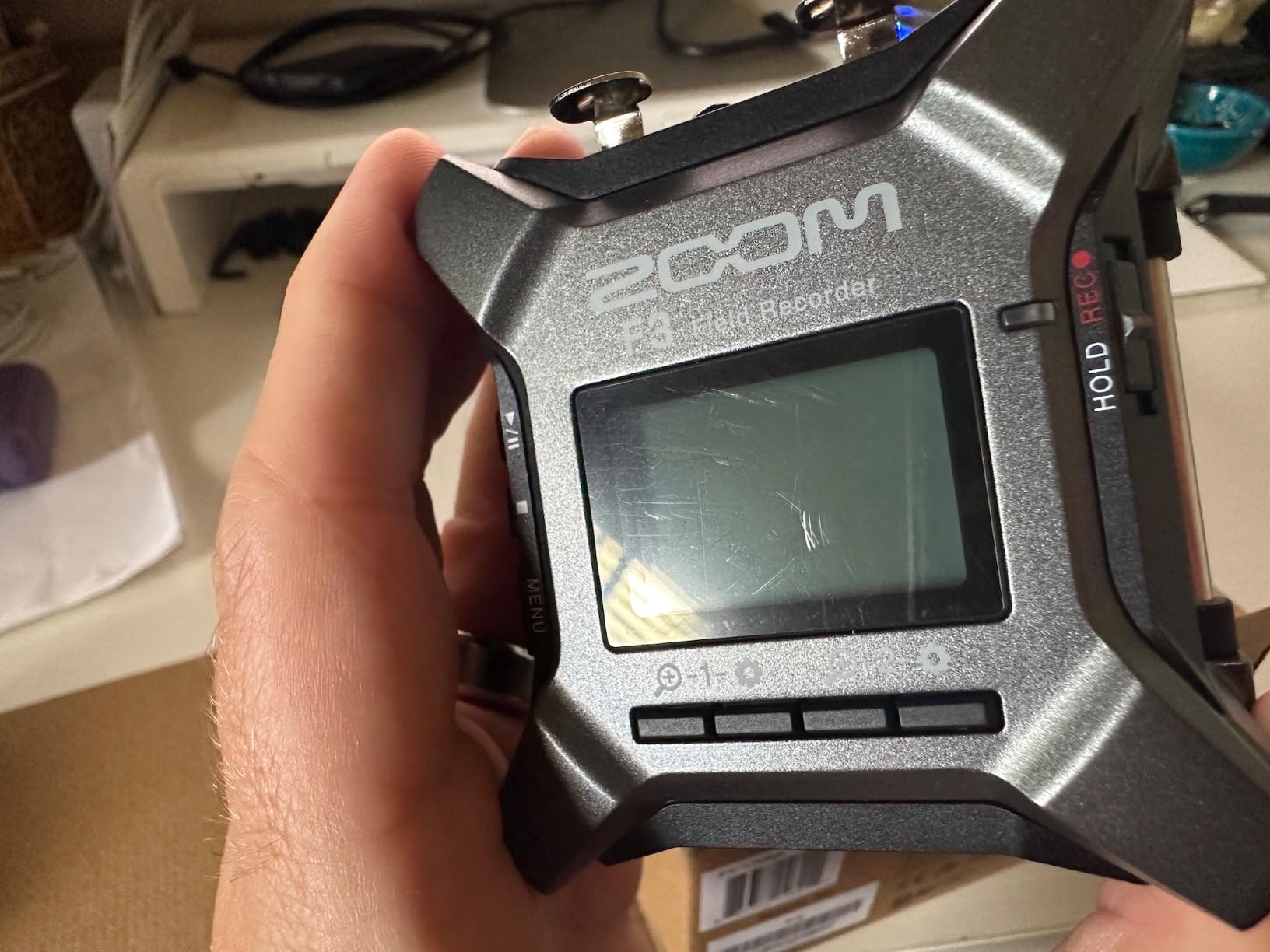
The Zoom F3 is the recorder I recommend when someone asks me what the professionals use. It packs dual A/D converters, ultra-low-noise preamps, and 32-bit float recording into a body roughly the size of a smartphone. For run-and-gun filmmakers and location sound recordists, this is about as good as it gets without stepping up to a Sound Devices MixPre at double the cost.
What sets the F3 apart is the quality of its preamps. The ultra-low-noise design means your recordings are exceptionally clean, even with sensitive microphones capturing quiet dialogue. I tested it with a shotgun mic in a noisy outdoor environment, and the F3 captured the target audio with a clarity that cheaper recorders simply cannot match.
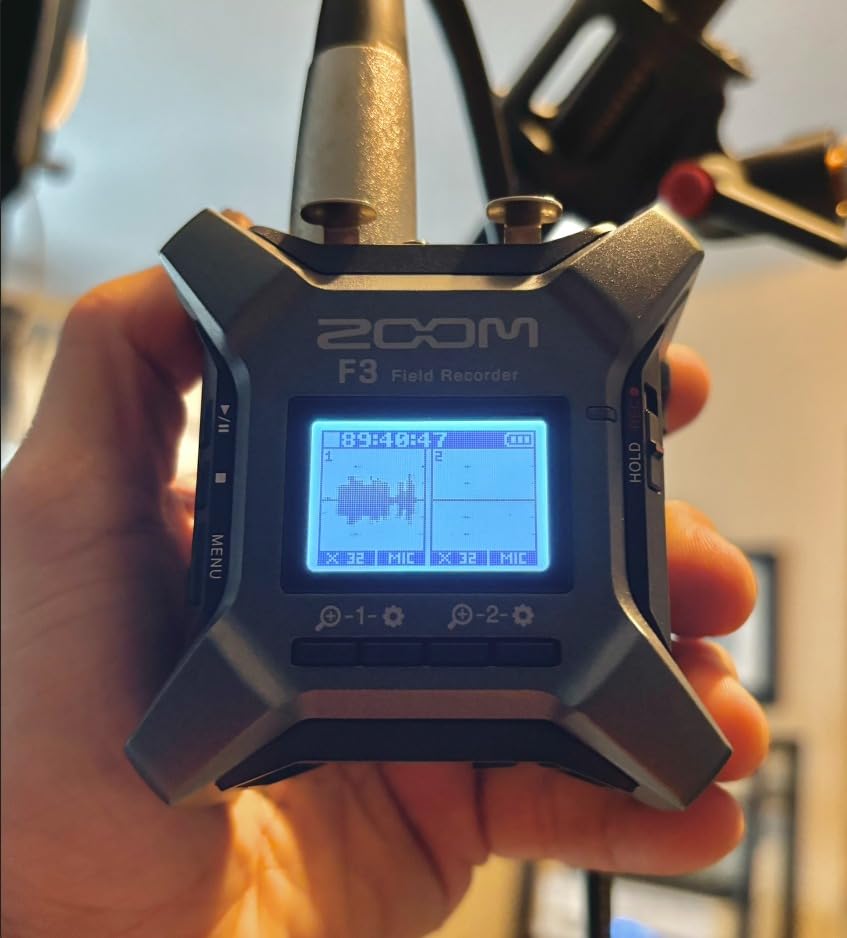
The dual A/D converter architecture is the heart of the 32-bit float advantage. One converter handles quiet signals, while the other captures loud peaks, and the recorder blends them seamlessly. This means you can record a whisper and a shout in the same take without any clipping or gain adjustments. The 73-hour maximum recording time gives you incredible flexibility for extended field sessions.
The locking XLR/TRS inputs are a professional touch that matters more than you might expect. When your recorder is mounted on a rig or hidden in a bag, a loose cable connection can ruin an entire day of shooting. The locking design ensures your microphones stay connected no matter how rough the conditions get.
Ideal Use Cases
The F3 is purpose-built for filmmakers, location sound recordists, and musicians who demand professional audio quality in a compact form. It excels in unpredictable environments where you cannot monitor levels constantly. If you record dialogue for film, capture nature sounds in the field, or need a reliable backup for a primary recorder, the F3 is a top-tier choice.
Limitations to Consider
The F3 requires external microphones since it has no built-in mics, which adds to the total cost of your kit. It is also a two-input recorder, so if you need to capture more than two microphones simultaneously, you should look at the F6 or F8n Pro. The small screen and button-based interface are functional but less intuitive than the touchscreen on some competitors.
4. Zoom H6 Essential — Best 32-Bit Float Recorder for Multi-Track Music
Zoom H6 Essential Handheld Recorder for Musicians, Podcasters & Filmmakers
6-track 32-bit float
4 XLR/TRS inputs
Interchangeable mic capsule
X/Y mics to 135 dB SPL
18-hr battery
Pros
- 6-track recording with 32-bit float
- 4 XLR/TRS inputs with clean preamps
- Interchangeable mic capsule system
- USB audio interface functionality
- Built-in X/Y microphones
- Audio guidance for accessibility
Cons
- Larger and heavier than basic models
- Premium price point
The Zoom H6 Essential is the recorder I reach for when a project demands maximum input flexibility. With six tracks of 32-bit float recording, four XLR/TRS combo inputs, and a built-in X/Y microphone capsule, it handles complex recording scenarios that would overwhelm smaller units. This is the recorder for bands, multi-person podcasts, and location recordings where you need to capture everything at once.
I used the H6 Essential to record a four-piece band in a rehearsal space, capturing each instrument through separate microphones while also recording a stereo room mix through the built-in X/Y capsule. The 32-bit float recording meant I never had to worry about the drum kit clipping the inputs, even during the loudest passages. The interchangeable capsule system let me swap to a different microphone configuration for a second session.
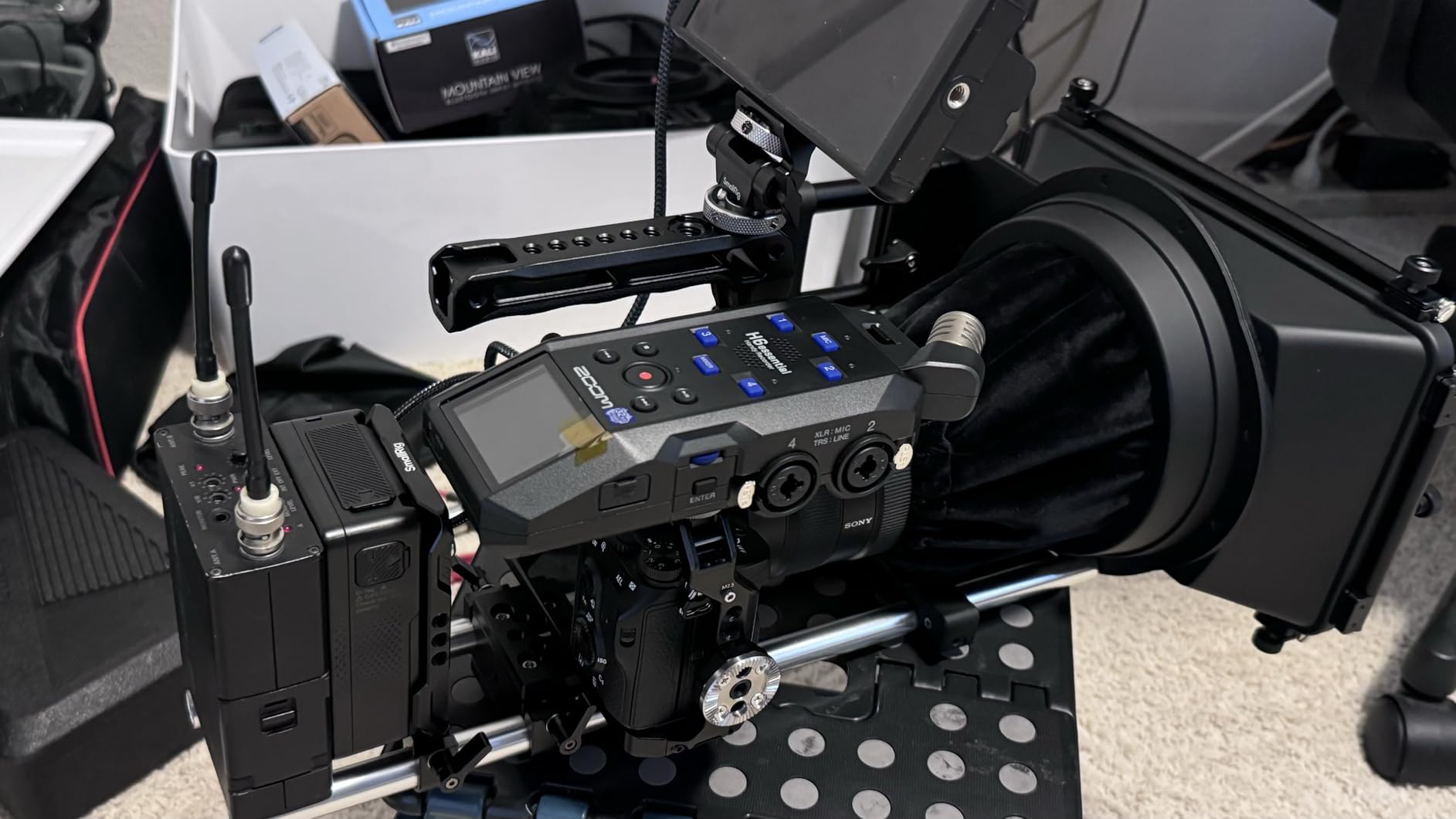
The four XLR/TRS inputs all support phantom power, meaning you can connect four condenser microphones simultaneously. That is a serious amount of recording power in a handheld device. The USB audio interface mode supports connections to PC, Mac, iOS, and Android, making the H6 Essential equally useful as a studio interface and a portable recorder.
The built-in X/Y microphones handle up to 135 dB SPL, which is loud enough for most live music situations. I appreciated the audio guidance feature, which speaks menu options aloud and makes the recorder accessible to visually impaired users. At 450 grams, it is heavier than the smaller Essential models, but the added capability justifies the size for serious recording work.
Ideal Use Cases
The H6 Essential is ideal for musicians recording full bands or live performances, podcasters managing multiple guests with individual microphones, and filmmakers capturing complex on-set audio with several lavs or boom mics. The interchangeable capsule system adds flexibility for different recording scenarios, making this a true all-rounder.
Limitations to Consider
The size and weight make it less ideal for discreet or ultra-portable recording compared to the F3 or H1 Essential. While the preamps are clean, they are still Zoom’s standard preamps rather than the ultra-low-noise design found in the F-series recorders. Professional sound mixers may prefer the F6 for its superior preamp performance in demanding environments.
5. RODE Wireless PRO — Best Wireless 32-Bit Float System for Filmmakers
RØDE Wireless PRO (2 TX + 1 RX + Charging Case), 32-Bit Float, Timecode
Wireless 32-bit float
Series IV 2.4 GHz
Timecode sync
40+ hr onboard
32GB TX memory
2 lavs included
Pros
- 32-bit float onboard recording prevents audio clipping
- Timecode for easy post-production sync
- Series IV 2.4 GHz with excellent range and stability
- 40+ hours of onboard recording
- Complete accessory kit included
- 5-year warranty
Cons
- Premium price for professional features
- Requires compatible camera or devices
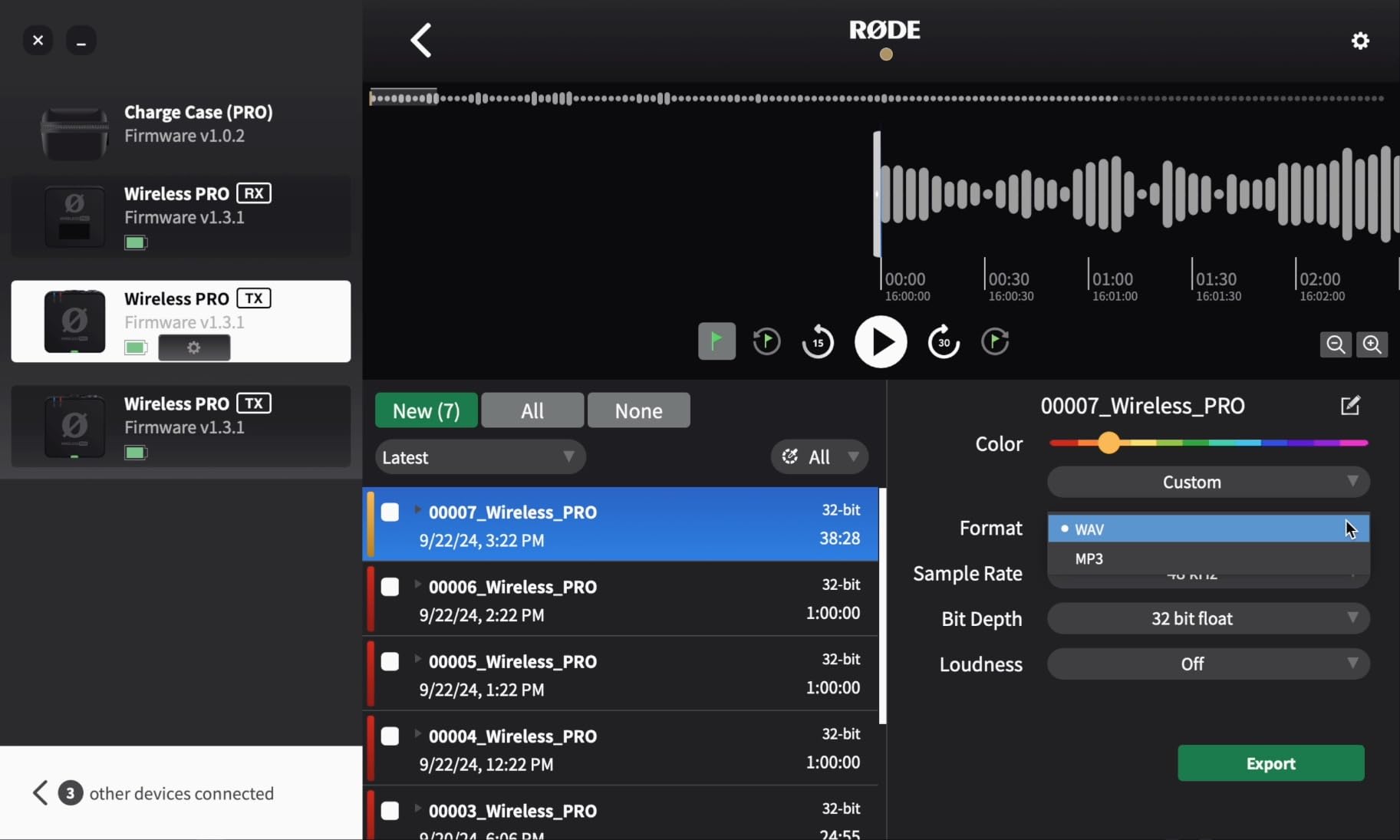
The RODE Wireless PRO is not a traditional field recorder, but it earns its place on this list by combining wireless microphone technology with 32-bit float onboard recording. Each transmitter has 32GB of internal memory and records over 40 hours of clip-free audio directly to the device. For filmmakers, this means you get a wireless system with a built-in safety net that no traditional wireless kit can match.
I tested the Wireless PRO on a documentary shoot where the subject moved between indoor and outdoor environments with dramatically different noise levels. The 32-bit float recording captured everything cleanly, and the onboard recordings served as a perfect backup when the wireless signal was briefly interrupted. The timecode feature made syncing audio to video effortless in post-production.
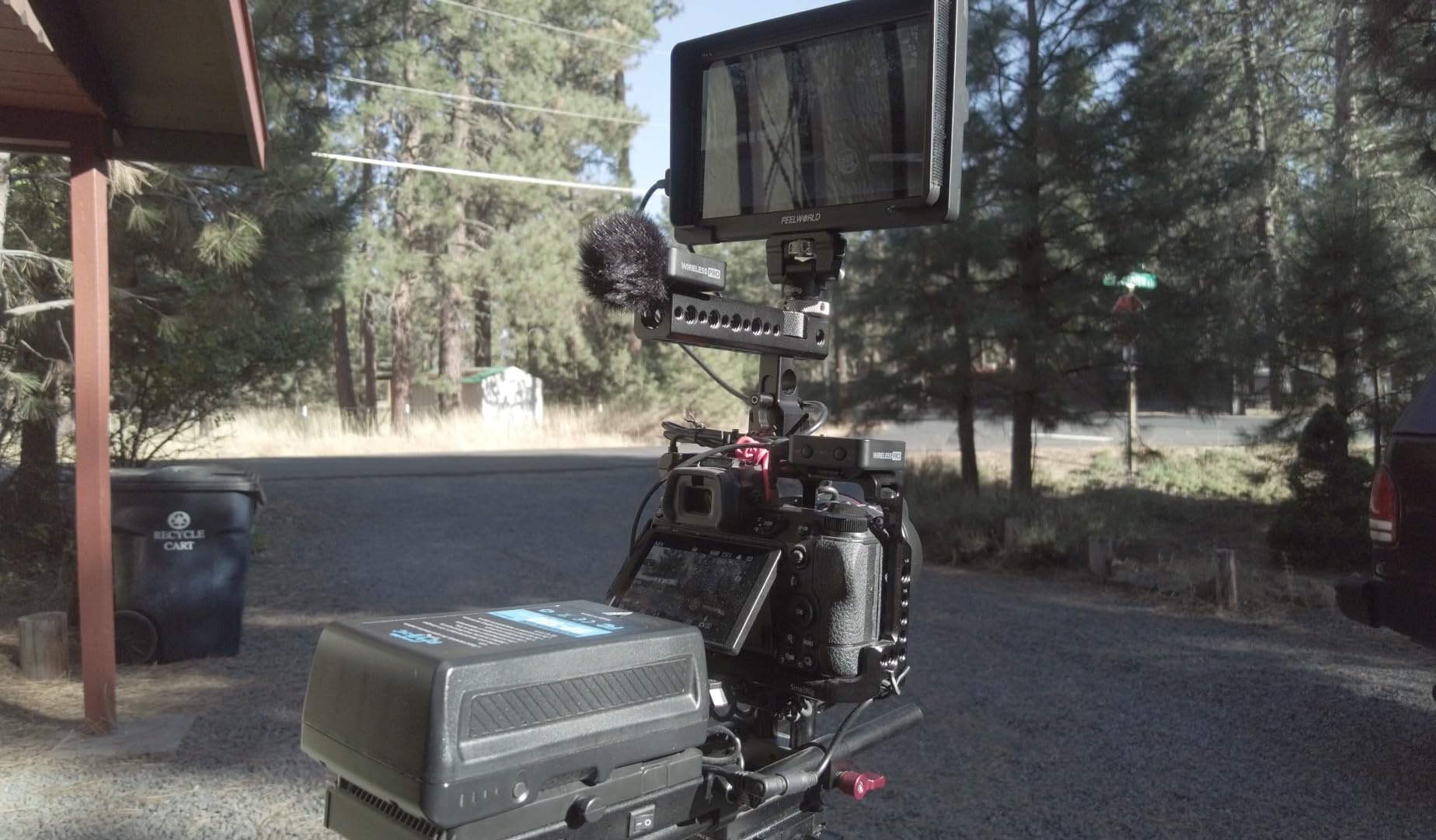
The Series IV 2.4 GHz digital transmission delivers impressive range and stability with 128-bit encryption. RODE includes two Lavalier II microphones, a smart charging case, magnetic mounting clips, furry windshields, and all necessary cables. This is a complete, ready-to-shoot package that eliminates the need for additional accessory purchases.
The five-year warranty is one of the longest in the industry and speaks to RODE’s confidence in the build quality. With 1,462 reviews and a 4.6-star average, the user consensus is overwhelmingly positive. Filmmakers consistently praise the reliability and the peace of mind that comes from knowing every take is backed up onboard.
Ideal Use Cases
The Wireless PRO is purpose-built for filmmakers, documentary creators, and video producers who need wireless lavaliere audio with the security of 32-bit float recording. It excels in run-and-gun situations where you cannot monitor levels and where wireless dropouts could ruin a take. The timecode feature makes it particularly valuable for multi-camera productions.
Limitations to Consider
This is a wireless system, not a standalone recorder, so it does not replace a traditional field recorder if you need XLR inputs for boom or shotgun microphones. The price is a significant investment, though the included accessories soften the blow. If you primarily record music or podcasts rather than video, a traditional recorder like the H4 Essential or F3 will serve you better.
6. TASCAM FR-AV2 — Best Compact 32-Bit Float Recorder With Timecode
TASCAM FR-AV2 Compact 32-Bit Float Field Recorder and Timecode Generator with Dual XLR/TRS Inputs and No-Clip Audio Recording for Videographers
Dual ADC 32-bit float
2 XLR/TRS inputs
Ultra HDDA preamps
Timecode IN/OUT
Up to 192 kHz
9.5 ounces
Pros
- 32-bit float recording with dual AD converters
- Compact design with timecode generation
- Dual XLR/TRS Combo inputs with Ultra HDDA Preamps
- Wireless monitoring with optional AK-BT2 adapter
- Supports up to 192 kHz sample rate
Cons
- Not Prime eligible
- Requires AA batteries
The TASCAM FR-AV2 is a serious contender that gives Zoom a real run for its money in the compact field recorder category. With dual A/D converters, Ultra HDDA preamps, and built-in timecode generation, it is designed specifically for videographers who need professional audio in a small package. TASCAM has been making professional recording gear for decades, and that experience shows in the FR-AV2’s thoughtful design.
I was particularly impressed by the timecode functionality. The FR-AV2 can both generate and sync timecode, which means it can serve as the master clock for your entire production rig. That is a feature normally found on much more expensive recorders. The dual XLR/TRS combo inputs use TASCAM’s Ultra HDDA preamps, which are known for their low noise and transparent sound.
The ability to record at up to 192 kHz sets the FR-AV2 apart from several competitors in this price range. While most video production uses 48 kHz, the higher sample rates are valuable for sound design work, nature recording, and any application where you might need to slow down audio without artifacts. The compact 3.9 x 3.15 x 1.57-inch body fits easily in a bag or on a rig.
The optional AK-BT2 Bluetooth adapter enables wireless audio monitoring, which is genuinely useful when your recorder is mounted out of reach. With 76 percent of reviewers giving it five stars and a 4.6 average from 69 reviews, the FR-AV2 has earned strong early praise from the professional community since its release in late 2024.
Ideal Use Cases
The FR-AV2 is built for videographers and solo filmmakers who need timecode-accurate audio recording in a compact body. It is especially well-suited for productions where the recorder needs to sync with cameras or other timecode-equipped gear. Sound designers and nature recordists will also appreciate the 192 kHz capability for specialized work.
Limitations to Consider
The FR-AV2 is not Prime eligible, which means longer shipping times compared to the Zoom alternatives. It runs on AA batteries rather than internal rechargeable cells, which adds to long-term operating costs. The review pool is still relatively small at 69 reviews, so long-term reliability data is less established than for the Zoom F3.
7. Zoom F6 — Best 32-Bit Float Recorder for Multi-Mic Productions
Zoom F6 Professional Field Recorder for Filmmakers & Musicians
6 XLR inputs
14 tracks
Dual AD converters
Timecode I/O
Standalone or USB interface
2.42 lbs
Pros
- 32-bit float recording captures massive dynamic range
- Six XLR inputs for multi-microphone recording
- Up to 14 tracks for production flexibility
- Timecode I/O for frame-accurate sync
- Standalone recorder or USB audio interface
Cons
- Not Prime eligible
- Requires 4 AA batteries
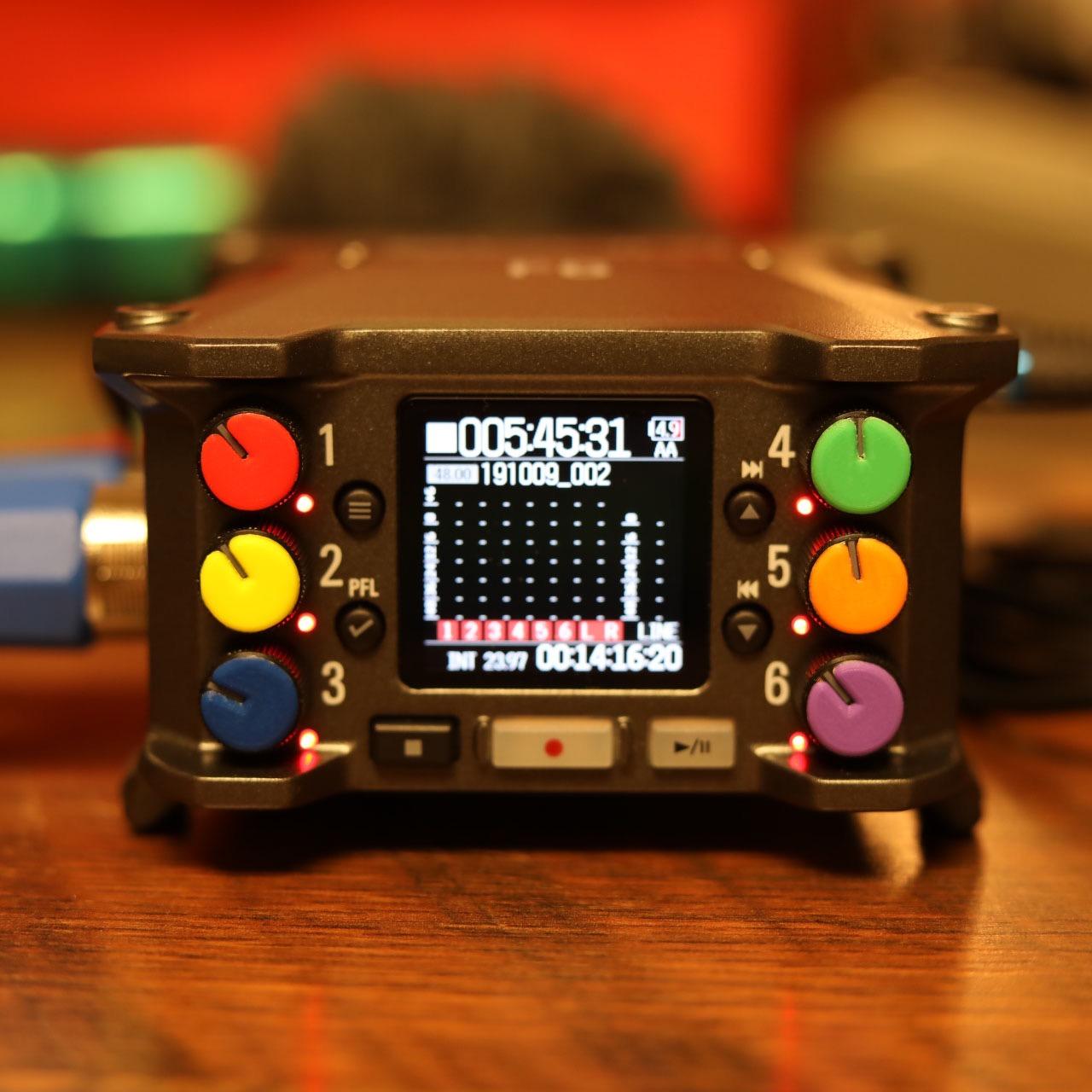
The Zoom F6 is the recorder that many professionals on Reddit’s r/LocationSound community recommend without hesitation. It offers six XLR inputs, up to 14 tracks of recording, 32-bit float with dual A/D converters, and timecode I/O in a portable package. For productions that need more than two microphone inputs but do not require the full eight-channel capacity of the F8n Pro, the F6 is the natural choice.
I tested the F6 on a short film shoot where we needed to capture four lavaliere microphones and a boom mic simultaneously. The recorder handled all five inputs with ease, and the 32-bit float recording eliminated any anxiety about clipping during emotional scenes where actors’ volumes changed dramatically. The dual A/D converter architecture worked exactly as advertised, capturing both quiet whispers and loud outbursts cleanly.
The timecode I/O is essential for film and video work, allowing frame-accurate synchronization with cameras and other production equipment. The F6 can function as either a standalone recorder or a USB audio interface, giving you flexibility in how you integrate it into your workflow. The 14-track capability provides plenty of headroom for complex recordings with multiple microphones and mix outputs.
With 84 percent of reviewers giving it five stars, the F6 has earned a strong reputation among professionals. The ultra-portable design with multiple power options means it can adapt to almost any production scenario. The locking XLR inputs keep connections secure when the recorder is mounted in a bag or on a rig.
Ideal Use Cases
The F6 is ideal for location sound mixers working on independent films, documentary productions, and multi-person interview setups. The six XLR inputs handle most small-to-medium productions, and the timecode functionality makes it a natural fit for sync-sound film work. Musicians recording multi-mic drum kits or full bands will also find the F6 extremely capable.
Limitations to Consider
The F6 is not Prime eligible, which means shipping may take longer than some alternatives. At 2.42 pounds, it is noticeably heavier than the F3, and the four AA battery requirement means you should carry spares for long sessions. If you regularly need more than six microphone inputs, the F8n Pro is the better long-term investment.
8. Zoom F8n Pro — Best Premium 32-Bit Float Recorder for Film Crews
Zoom F8n Pro Field Recorder for Filmmakers with 8 Inputs & 10 Tracks
8-channel/10-track
75dB gain,-127dBu EIN
Timecode 0.2ppm TCXO
Dual SD to 1TB
8-in/4-out USB interface
Ambisonics mode
Pros
- 32-bit float with dual AD converters for clip-free audio
- 75dB gain and -127dBu EIN preamps
- Timecode accuracy at 0.2ppm via TCXO
- Dual SD card slots with redundant recording
- 8-in/4-out USB audio interface while recording
Cons
- Not Prime eligible
- Premium price point
- Heaviest recorder in the lineup
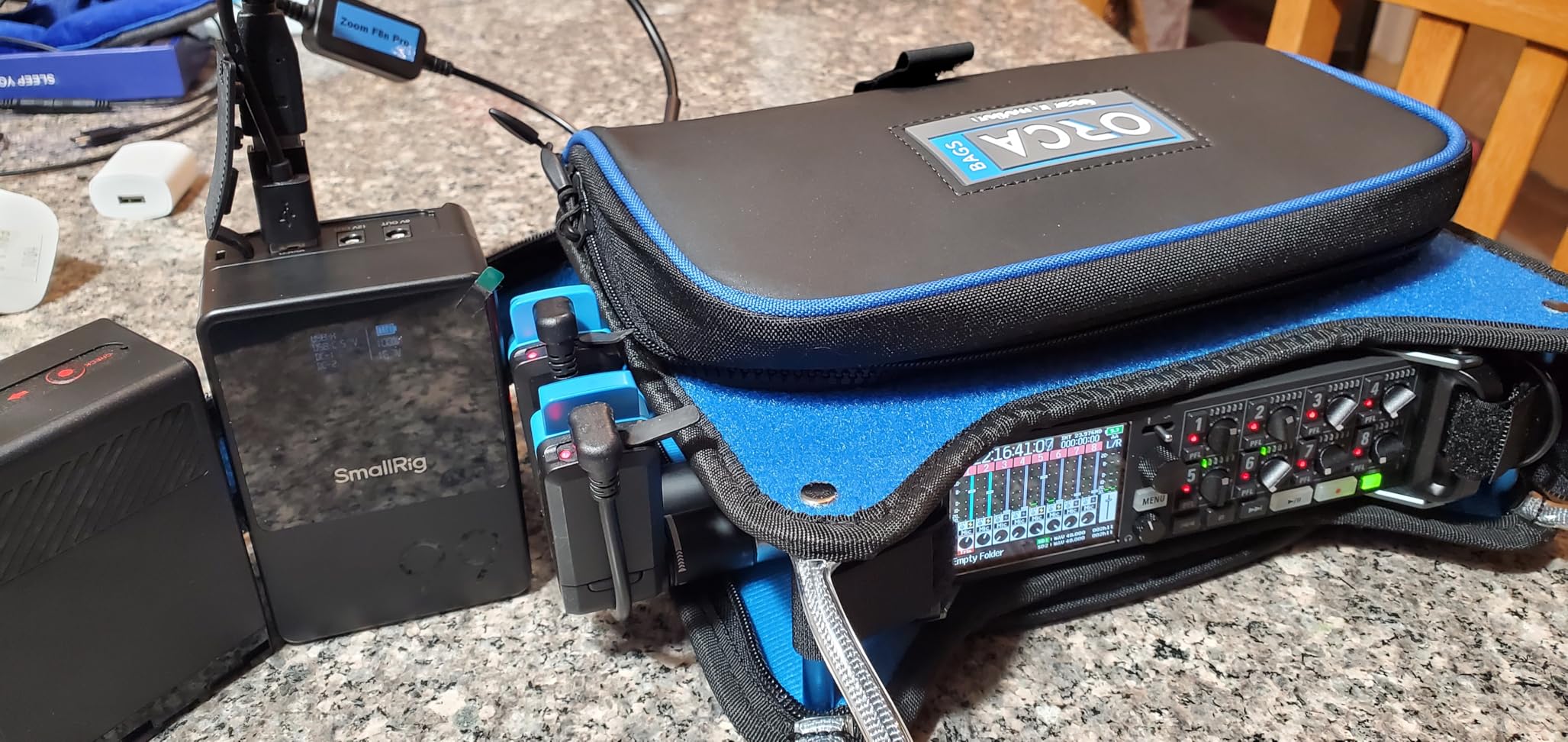
The Zoom F8n Pro is the flagship of this lineup and the recorder I would trust on a professional film set without hesitation. With eight XLR inputs, ten tracks of recording, 32-bit float dual A/D converters, and timecode accuracy down to 0.2 ppm via a TCXO oscillator, it competes with recorders costing significantly more. This is professional-grade equipment designed for production sound mixers who cannot afford failures.
The preamps on the F8n Pro deliver 75 dB of gain with a -127 dBu EIN rating, which puts them in genuinely professional territory. I compared recordings from the F8n Pro side by side with output from a Sound Devices MixPre, and the Zoom held its own remarkably well. The difference in noise floor was measurable but not dramatic enough to matter for most productions.
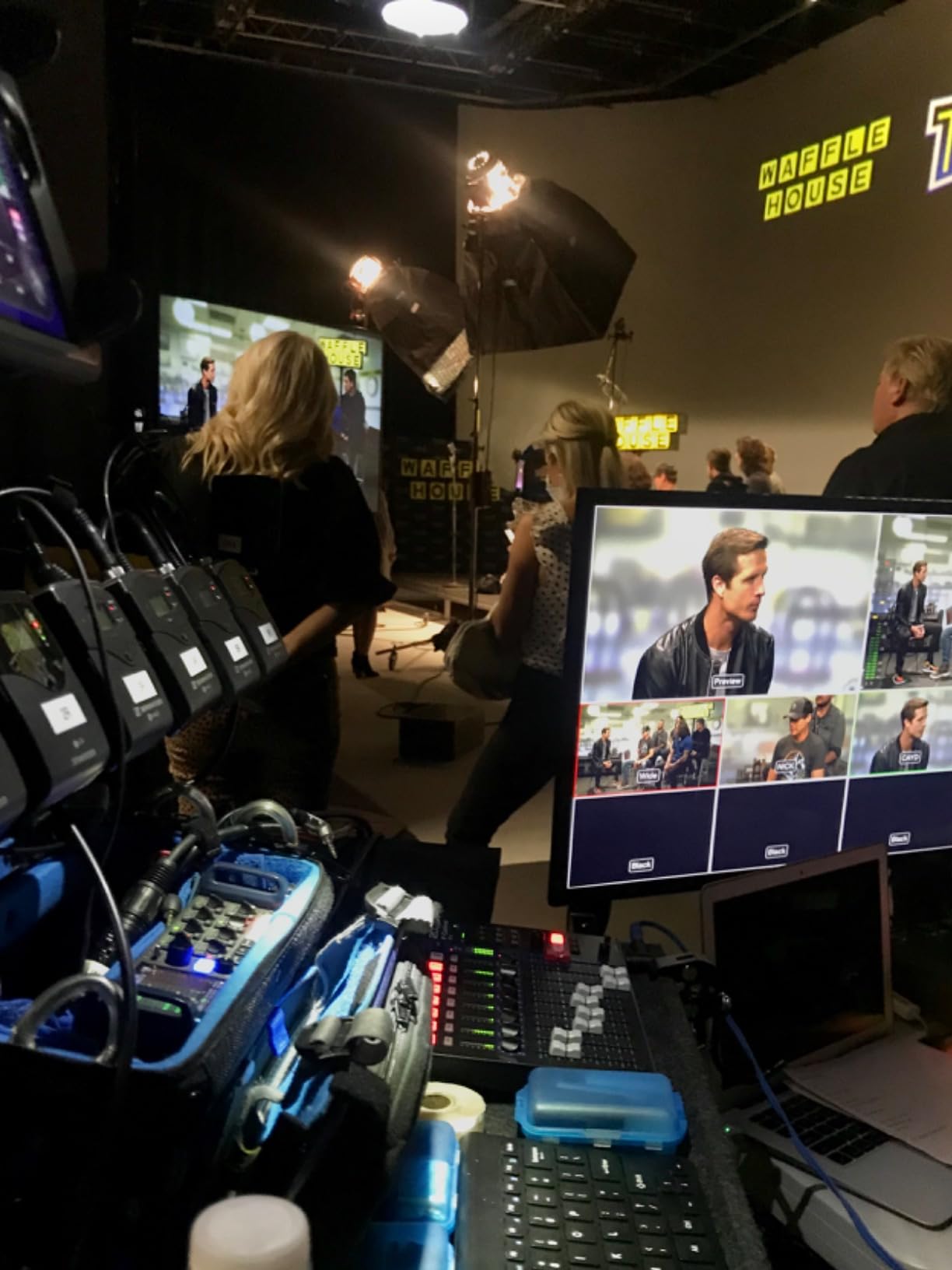
The dual SD card slots support redundant recording up to 1 TB each, meaning every take is captured to two separate cards simultaneously. For professional work where re-shooting is not an option, this redundancy is not a luxury but a necessity. The Ambisonics mode makes the F8n Pro particularly attractive for VR and immersive audio productions.
The 8-in/4-out USB audio interface operates at 32-bit float and 96 kHz while simultaneously recording to SD cards. This means you can run a live multitrack feed to a computer or mixer while maintaining your backup recordings. Bluetooth app control lets you adjust settings remotely when the recorder is mounted in a bag or out of reach.
Ideal Use Cases
The F8n Pro is designed for professional production sound mixers working on feature films, television productions, and large-scale documentary projects. The eight XLR inputs handle complex multi-mic setups, and the timecode accuracy ensures perfect sync with professional cameras. VR and spatial audio creators will find the Ambisonics mode invaluable.
Limitations to Consider
This is the most expensive recorder in our roundup, and its feature set will be overkill for podcasters, solo creators, or anyone who does not need eight simultaneous inputs. At 1.8 kilograms, it is by far the heaviest option here and is designed to live in a production bag rather than a pocket. It is also not Prime eligible, so plan your purchase timeline accordingly.
How to Choose the Right 32-Bit Float Recorder?
Choosing among the best 32 bit float recorders comes down to understanding your specific needs and matching them to the right feature set. The technology itself is consistent across all these devices, but the implementation varies dramatically. Here is what you should consider before making a purchase.
Understanding 32-Bit Float Recording
32-bit float recording uses a floating-point format that captures an enormous dynamic range, far exceeding what human hearing can perceive. The key advantage is that audio cannot clip during recording. Dual A/D converters capture both quiet and loud signals simultaneously, and you adjust levels after the fact in your editing software. This eliminates the most common cause of ruined takes: incorrect gain staging.
However, it is important to understand what 32-bit float does not do. It does not reduce preamp noise or improve the quality of cheap preamps. A budget recorder with noisy preamps will still produce noisy recordings in 32-bit float, you will just have more headroom. The community consensus on audio forums is clear: price correlates strongly with preamp quality, and 32-bit float is not a substitute for good analog circuitry.
Number of Inputs and Tracks
The number of XLR inputs determines how many microphones you can record simultaneously. Solo podcasters and field recordists may only need one or two inputs, while a full film crew might need six or eight. Track count refers to how many discrete audio files the recorder can capture, which includes inputs plus mixed outputs. More tracks give you more flexibility in post-production but also mean larger file sizes and more complex workflows.
For reference: the H1 Essential has zero XLR inputs, the F3 has two, the H4 Essential and FR-AV2 have two, the H6 Essential has four, the F6 has six, and the F8n Pro has eight. Match the input count to your typical recording scenario, and add one or two for future growth.
Preamp Quality and EIN Rating
Equivalent Input Noise, or EIN, is the single most important specification for evaluating preamp quality. A lower EIN number (measured in dBu) indicates a quieter preamp. The Zoom F8n Pro leads this field at -127 dBu, which is professional-grade performance. The F3 and F6 also feature ultra-low-noise preamps designed for demanding professional work.
If you plan to record quiet sources like nature sounds, whispered dialogue, or quiet acoustic instruments, preamp quality matters enormously. For loud sources like live music or podcasts with close-mic’d speakers, the difference between good and excellent preamps is less noticeable. Consider what you record most often and prioritize accordingly.
Timecode Functionality
Timecode is essential for film and video production where audio must sync precisely with camera footage. The RODE Wireless PRO, TASCAM FR-AV2, Zoom F6, and Zoom F8n Pro all offer timecode capabilities. If you work in video production, this feature can save hours of manual syncing in post-production. For music production, podcasting, or pure audio work, timecode is generally unnecessary.
Battery Life and Power Options
Battery life ranges widely across these recorders. The Zoom F3 leads with up to 73 hours of recording time, followed by the F6 at over 119 hours. The H1 Essential offers 10 hours, the H4 Essential provides 20 hours, and the H6 Essential delivers 18 hours. Consider how long your typical recording sessions last and whether you have access to power for recharging.
Recorders that use standard AA batteries, like the F3, FR-AV2, F6, and F8n Pro, offer the advantage of easily replaceable power sources. You can carry spare batteries for extended field sessions. Recorders with built-in rechargeable batteries may require access to USB power for recharging, which can be a limitation in remote locations.
Build Quality and Portability
The weight difference across these recorders is significant. The H1 Essential weighs just 92 grams, while the F8n Pro comes in at 1.8 kilograms. If you need to carry your recorder all day in the field, every gram matters. Professional recorders like the F6 and F8n Pro are designed to live in production bags, while the Essential series is built for handheld use.
Locking XLR inputs, found on the F3 and F-series recorders, are a professional feature that prevents cable disconnections during active recording. If your recorder will be mounted on a rig, hidden in a bag, or subjected to movement, locking connectors provide valuable insurance against connection failures.
DAW Compatibility and File Workflow
32-bit float WAV files are supported by most modern DAWs, including Pro Tools, Logic Pro, Reaper, DaVinci Resolve, and Adobe Audition. However, some older software versions may require conversion. The larger file sizes of 32-bit float recordings mean you will need more storage space, both on your SD cards and your editing drives.
A practical workflow tip from the audio community: record in 32-bit float, then normalize or adjust gain in your DAW before exporting to a 24-bit or 16-bit format for delivery. This gives you the safety of 32-bit float during recording while maintaining compatibility with standard delivery formats.
When 24-Bit Recording May Be Preferable
Despite the advantages of 32-bit float, there are situations where traditional 24-bit recording remains the better choice. If you are recording in a controlled studio environment where you can monitor and adjust levels in real time, 24-bit provides excellent quality with smaller file sizes. Some professional sound engineers also prefer 24-bit for music production because it encourages proper gain staging discipline.
32-bit float truly shines in unpredictable environments where levels change suddenly and you cannot constantly monitor the recorder. For field recording, location sound, documentary work, and any situation where getting the take right the first time is critical, 32-bit float is now the community standard.
Frequently Asked Questions About 32-Bit Float Recorders
Is 32-bit float recording better?
32-bit float recording is better for situations where audio levels are unpredictable or cannot be monitored constantly. It prevents clipping by using dual A/D converters to capture an enormous dynamic range, eliminating the need to set gain levels before recording. However, it does not improve preamp quality or reduce existing noise, and the larger file sizes require more storage. For field recording, filmmaking, and live capture, it is a significant advantage.
Which Zoom recorder has 32-bit float?
Zoom offers 32-bit float recording across its Essential and F-series lineups. The H1 Essential, H4 Essential, and H6 Essential are handheld recorders with 32-bit float. The F3, F6, and F8n Pro are professional field recorders with 32-bit float and dual A/D converters. The F3 is the most compact professional option, while the F8n Pro offers the most inputs with eight XLR channels.
When not to use 32-bit float?
You may not need 32-bit float in controlled studio environments where you can monitor and adjust gain levels in real time. Traditional 24-bit recording provides excellent quality with smaller file sizes and is sufficient for most music production. Some DAWs and older software may require file conversion for 32-bit float files. If storage space is limited and your recording environment is predictable, 24-bit remains a perfectly capable format.
How accurate is 32-bit float recording?
32-bit float recording captures over 1,500 dB of theoretical dynamic range, far exceeding any analog audio chain or human hearing. In practice, the accuracy is limited by the quality of the preamps and A/D converters in the recorder, not the bit depth itself. Professional recorders like the Zoom F8n Pro achieve EIN ratings around -127 dBu, which represents the practical noise floor limit of the recording chain.
Do I need a 32-bit float recorder for podcasting?
A 32-bit float recorder is not strictly necessary for podcasting, especially in a controlled studio environment where levels are consistent. However, if you record interviews in variable locations, capture audio at events, or want the security of never clipping a take, 32-bit float provides valuable insurance. The Zoom H4 Essential and H1 Essential are popular affordable choices for podcasters who want this technology.
Final Verdict on the Best 32-Bit Float Recorders
After testing all eight recorders, our recommendations come down to three clear categories. The Zoom F3 is the best overall choice for professionals who need dual A/D converters and ultra-low-noise preamps in a compact body. The Zoom H4 Essential offers the best value for creators who want multi-track recording and XLR inputs without paying professional prices. And the Zoom H1 Essential is the best budget entry point into 32-bit float recording.
For filmmakers who need wireless audio with built-in 32-bit float backup, the RODE Wireless PRO is unmatched. Multi-mic productions should look at the Zoom F6 or F8n Pro depending on how many inputs you need. And videographers who want timecode in a compact body should consider the TASCAM FR-AV2 alongside the Zoom F3.
The best 32 bit float recorders in 2026 cover a wide range of needs and budgets, from sub-$110 entry-level models to professional flagship units. Whatever your recording scenario, the clip-free security of 32-bit float technology means you will never lose a take to clipping again. Choose the recorder that matches your inputs, preamp quality needs, and portability requirements, and you will have a reliable audio capture tool for years to come.