
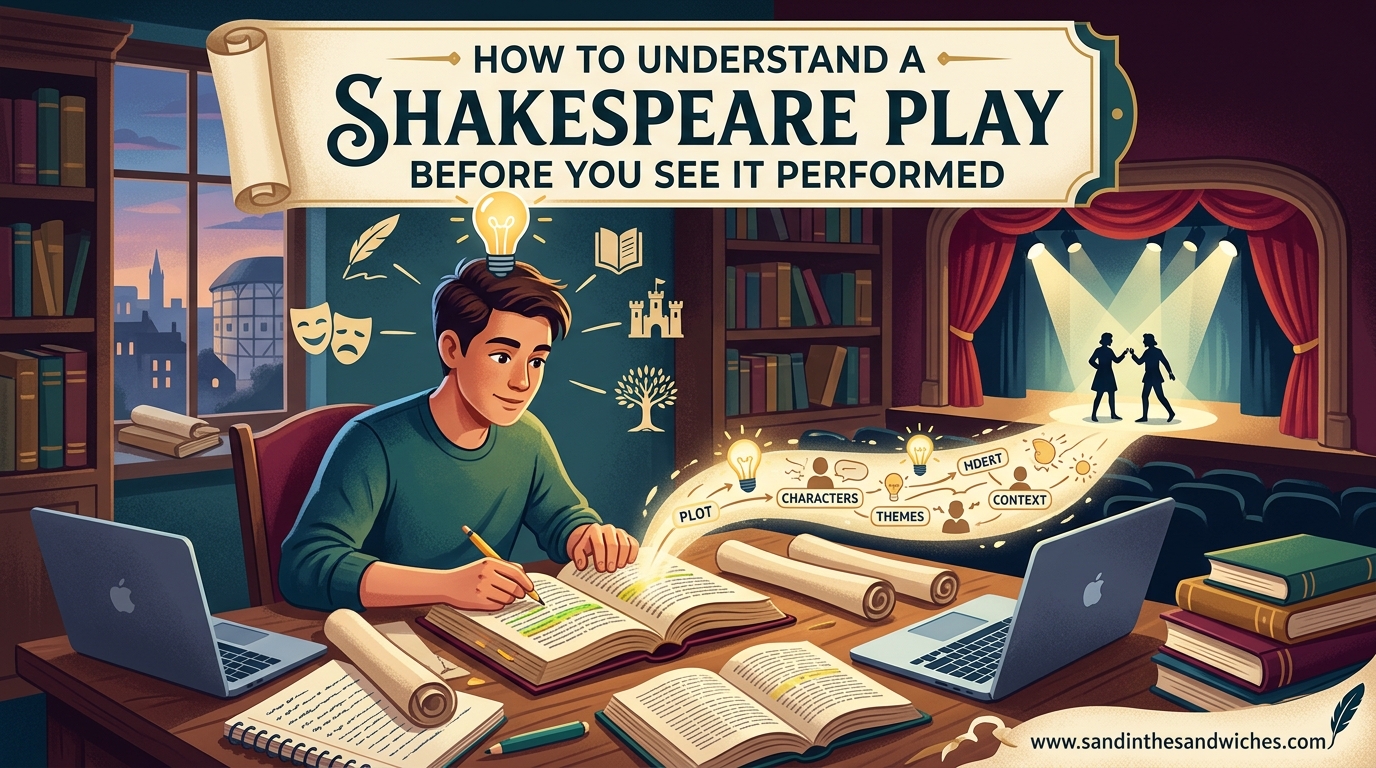
There is a particular kind of dread that arrives when the lights dim in a theater and the first actor steps forward speaking verse you cannot quite parse. I have sat in that seat, and I have watched friends whisper, “What did he just say?” That moment of confusion is exactly what learning how to understand a Shakespeare play before you see it performed is designed to prevent.
To understand a Shakespeare play before you see it performed, read a short plot summary first, learn key archaic words like “thee,” “thou,” and “wherefore,” read the play aloud once using an annotated edition, watch one film adaptation to hear the language spoken, and review the character list the night before. This preparation lets you focus on the performance instead of struggling to follow the story.
Our team has spent years attending productions at regional theaters, the Globe, and student-run festivals, and the single biggest difference between a magical night out and a confusing one is always preparation. In this guide I will walk through the exact steps that work for first-time viewers, returning theatergoers, students, and anyone who has ever felt that Shakespeare just was not written for them. By the end you will have a clear plan, a vocabulary cheat sheet, and a day-by-day timeline so you can walk into the theater confident.
Table of Contents
Quick-Start Checklist: Prepare for Any Shakespeare Performance
If you only have a few minutes, here is the short version of what to do before the curtain rises. These six steps come up again and again in community discussions on the Shakespeare subreddit and in acting workshops, and they form the backbone of the longer guide below.
- Read a one-page plot summary so you know the major beats before you encounter the language.
- Learn ten archaic words like thee, thou, thy, hath, dost, and wherefore so you are not translating on the fly.
- Skim a character list and family tree, especially for histories and tragedies with overlapping names.
- Read the play aloud once using an annotated edition or a side-by-side modern translation.
- Watch one film or recorded stage adaptation to hear how professional actors deliver the verse.
- Reread your favorite speeches the night before so they feel familiar when you hear them live.
This list looks short, but it does more work than reading the play silently three times. The combination of plot knowledge, vocabulary, sound, and visual staging is what unlocks the live experience.
Why Shakespeare Feels Difficult for Modern Readers
Before diving into strategies, it helps to know what you are actually up against. Shakespeare wrote in Early Modern English, not Old English and not quite the English you are reading right now. The gap is real, but it is also smaller and more manageable than most people assume.
Shakespeare’s vocabulary sits somewhere around a 9th to 11th grade reading level for individual words, but the difficulty comes from how those words are arranged. Sentences are often inverted, clauses nest inside each other, and characters speak in metaphors that were obvious to an Elizabethan audience but invisible to us. A line that is technically readable can still feel like a puzzle because the references have aged out of common knowledge.
Forum users on r/shakespeare regularly mention three specific hurdles: unfamiliar pronouns like “thee” and “thou,” reversed sentence structure where the verb sometimes comes before the subject, and cultural references that nobody outside a humanities seminar would recognize today. Naming those three problems is half the battle, because each one has a specific fix that you will see in the strategies below.
There is also a psychological barrier. Many people are told, implicitly or explicitly, that Shakespeare is too lofty for them, and that fear of looking stupid makes them tense up. The actors and directors I have spoken with all say the same thing: Shakespeare wrote for everyone from groundlings to royalty, and his plays were designed to be felt before they were analyzed. Approaching the text that way removes a lot of the pressure.
Shakespeare Archaic Words You Need to Know
If you learn nothing else before a performance, learn a handful of archaic words. They appear constantly, and once you have them locked in, large stretches of dialogue suddenly become clear. Here is a practical glossary I keep taped inside my playbills.
Thou, thee, thy, thine are the familiar, intimate forms of “you.” Think of them as the equivalent of speaking to a close friend, a child, or someone you are addressing with warmth or contempt. “You” was the formal, polite form. So when Juliet says “Romeo, doff thy name,” she is speaking intimately to him, not formally.
Hath, dost, art, hast, wert are older verb endings. “Hath” means “has,” “dost” means “do,” “art” means “are,” “hast” means “have,” and “wert” means “were.” Once you spot the pattern, your brain stops tripping on them.
Wherefore is the famous one. When Juliet asks “Wherefore art thou Romeo?” she is not asking where he is. She is asking why he has to be Romeo, a Montague, her family’s enemy. “Wherefore” means “why.” This single word trips up almost every first-time viewer.
Prithee means “I pray thee” or “please.” Methinks means “it seems to me.” Ay means “yes.” Nay means “no.” Anon means “soon” or “shortly.” Hark means “listen.” Forsooth means “in truth” or, more cynically, “really.”
You do not need to memorize all of Early Modern English. A short list like this handles maybe 80 percent of the words that slow modern readers down. Keep it on your phone and glance at it once on the train to the theater.
Iambic Pentameter, Verse, and Prose Explained Simply
You do not need a degree in poetics to enjoy Shakespeare, but a few basic terms make a huge difference. The most important is iambic pentameter, the rhythm Shakespeare used for most of his elevated dialogue. An “iamb” is a pair of syllables with the stress on the second one, like “a-LOUD” or “to-DAY.” Pentameter means five of those pairs per line, giving you ten syllables that go da-DUM da-DUM da-DUM da-DUM da-DUM.
Here is the magic of iambic pentameter: it mirrors the human heartbeat. When you read it aloud, or when an actor speaks it well, the rhythm carries the meaning forward naturally. A line that looks confusing on the page often makes perfect sense the moment you hear it spoken in rhythm. This is why reading aloud and watching performances are such powerful preparation tools.
Shakespeare switches between verse (lines of poetry, usually in iambic pentameter) and prose (regular sentences without line breaks). Nobles, lovers, and characters in emotional peaks tend to speak in verse. Clowns, servants, and characters in casual or comic moments tend to speak in prose. Knowing this small convention tells you a lot about who a character is and how seriously the scene wants you to take them.
A soliloquy is a speech a character delivers alone on stage, revealing their thoughts to the audience. A monologue is a long speech delivered to other characters. The distinction matters because soliloquies are where you learn what a character truly believes, and they are usually the most famous lines in any play.
Practical Reading Strategies for Pre-Performance Prep
This is the core of how to understand a Shakespeare play before you see it performed. Below are seven reading strategies, roughly in the order I recommend using them. You do not have to do all seven for every play, but each one solves a specific problem.
Step 1: Read a Short Plot Summary First
This is the single most effective thing you can do, and it is the one strategy that almost every forum user, teacher, and Oxford literature guide agrees on. Read a one- or two-paragraph summary of the plot before you touch the text itself. Knowing the major beats ahead of time means you can pay attention to the language, the characters, and the staging instead of desperately trying to figure out what is happening.
A plot summary is not a spoiler for Shakespeare. These stories are over four hundred years old, and the pleasure is not in the surprise of the plot but in how the language makes you feel along the way. Freeing yourself from plot anxiety is a gift.
Step 2: Use an Annotated Edition or Side-by-Side Translation
Annotated editions like the Folger Shakespeare Library, Arden Shakespeare, or Pelican put helpful notes on the facing page so you can quickly check a reference or a tricky word without breaking your reading flow. Side-by-side modern translations, including the popular No Fear Shakespeare series, print the original text next to a modern English version so you can compare line by line.
Some purists argue against modern translations, but in my experience they are a bridge, not a crutch. Once you have read a few plays this way, you find yourself glancing at the modern column less and less, and eventually you stop needing it. Use whatever tool gets you through the door.
Step 3: Read the Play Out Loud
This is the strategy most people skip and almost everyone benefits from. Shakespeare wrote for actors to speak, not for readers to silently parse. Reading the lines aloud forces you to engage with the rhythm, the punctuation, and the meaning all at once. Even reading aloud badly helps, because the act of speaking the verse surfaces the natural pauses and emphases.
If you feel self-conscious, read to an empty room, a pet, or a voice memo. The point is not performance. The point is to let your mouth and ears do some of the work your eyes cannot do alone. Actors and directors I have spoken with universally recommend this technique.
Step 4: Listen to an Audio Production While Following the Text
If reading aloud feels awkward, the next best thing is to listen to a professional audio production while following along in your printed copy. The BBC Shakespeare and Arkangel recordings, along with many free LibriVox versions, give you skilled actors performing the play in full. Your eyes follow the text while your ears do the heavy lifting of interpretation.
Reddit users on r/shakespeare recommend this constantly, especially for non-native English speakers and for anyone tackling the histories, which can be dense on the page but vivid when spoken. Plan on roughly three hours for a full audio play, which you can split across a couple of commutes.
Step 5: Watch One Film or Recorded Stage Adaptation
Pick one well-regarded film adaptation and watch it once, ideally before your live performance. Film versions translate the language into visual storytelling, and seeing a great actor deliver a famous speech often unlocks it forever. Good starting points include Kenneth Branagh’s “Henry V” and “Much Ado About Nothing,” Ian McKellen’s “Richard III,” or the National Theatre’s streamed productions.
You do not need to love the adaptation. The point is to give your brain a model of how the play looks and sounds in performance, so the live version feels like a refinement rather than a first encounter.
Step 6: Do Not Get Stuck on Every Single Word
This is the advice Oxford’s Faculty of English gives, and it is the advice almost every experienced Shakespeare reader repeats. You will not understand every word. You are not supposed to. Even scholars disagree on what certain passages mean. Your job as an audience member is to follow the story and feel the emotional shape of the scenes, not to produce a line-by-line translation.
When you hit a passage you do not understand, keep going. Context usually fills in the gap. If it does not, the actor’s delivery often will. Letting go of the need to comprehend every syllable is one of the most freeing things you can do for yourself as a Shakespeare viewer.
Step 7: Track Characters With a List
Shakespeare’s plays can have dozens of characters, sometimes with confusingly similar names. Histories are the worst offenders, with multiple Henrys, Richards, and Edwards. Before you start reading, print or screenshot a character list, and refer back to it whenever someone new enters. A simple family or faction tree is often enough to keep everyone straight.
This small bit of bookkeeping pays off enormously in performance. When an actor walks on stage, you want to know instantly who they are and which side they are on, so you can focus on what they are doing rather than flipping through your program in the dark.
A Pre-Performance Timeline: When to Start and What to Do
One of the biggest content gaps in existing Shakespeare guides is that nobody tells you when to do all this preparation. So here is a practical timeline I have refined over dozens of productions. Adjust it to fit your schedule, but the rhythm works.
Two Weeks Before the Performance
Read a short plot summary and skim a character list. This is a thirty-minute investment that lays the foundation for everything else. At this stage you are not trying to absorb the language, just the shape of the story and the names of the major players.
Ten Days Before
Start reading the play itself, ideally in an annotated edition. Aim for one act per day, which means you will finish in about five short sessions. Reading slowly over several days gives your brain time to absorb the language and notice patterns. Cramming the whole play the night before rarely works.
One Week Before
Watch one film or recorded stage adaptation of the play. This is the moment where a lot of the language clicks, because you finally hear professional actors speak the lines you have been reading. Take notes on any moments that move you or confuse you.
Two Days Before
Reread your favorite speeches and soliloquies out loud. You do not need to revisit the whole play. Pick three or four famous passages, the ones you are most likely to hear in performance, and spend twenty minutes speaking them. This builds familiarity with the rhythm and primes you to recognize them on stage.
The Night Before
Review the character list one more time, glance at your archaic words glossary, and skim a plot summary to refresh the major beats. Keep it light. The goal is to walk into the theater rested and confident, not stressed about last-minute studying.
Day of the Performance
Arrive early, read the program notes for any production-specific context the director has provided, and give yourself a few quiet minutes before the lights go down. During intermission, glance at your character list again if the second half introduces new figures. Trust the preparation you have done.
Best Shakespeare Plays for Beginners to Start With
If you have flexibility in which play you are preparing for, some are genuinely easier entry points than others. The list below comes from a mix of educator recommendations, forum consensus, and my own experience bringing first-time viewers to productions.
A Midsummer Night’s Dream is widely considered the easiest comedy to start with. The plot is layered but easy to follow, the language is playful, and the supernatural elements keep the energy high. Most first-time viewers love it.
Romeo and Juliet is the tragedy most people already know. The plot is familiar, the language is accessible, and the famous speeches are short and powerful. It is an excellent first tragedy.
Macbeth is short, fast-moving, and has a clear central character. The supernatural elements and the psychological arc are gripping on stage. It is often the gateway tragedy for students.
Much Ado About Nothing is a witty comedy built around two sparkling central characters, Beatrice and Benedick. The banter is approachable and the plot is satisfying.
Twelfth Night is a slightly more sophisticated comedy with mistaken identity, music, and a bittersweet edge. If you enjoy Midsummer, this is a great second play.
Plays to avoid as a first experience include the histories like the Henry VI cycle, the late romances like Cymbeline and The Winter’s Tale, and the dense tragedies like King Lear and Antony and Cleopatra. These reward experience but can overwhelm newcomers.
Reading at Home vs Attending a Live Performance
One question that comes up constantly on forums is whether reading is enough, or whether you really need to see Shakespeare performed. The honest answer is that reading and performance are two different experiences, and preparing for one enriches the other.
Reading gives you control. You can pause, reread, look things up, and sit with a passage for as long as you want. Performance takes that control away but gives you something reading cannot: the physical presence of actors, the chemistry between them, the timing of a laugh, the silence before a confession. Shakespeare wrote for the stage, and large portions of his work only fully make sense when you see them embodied.
This is why the ideal combination is to read the play at home first, then see it live. The reading builds your understanding of the language. The performance reveals what the language does in motion. Theatergoers who skip the reading often enjoy the show but miss half of what is happening, while readers who never see a production miss the physical and emotional punch the verse was designed to deliver.
Live performance also clarifies ambiguous moments. A line that could be read five ways on the page becomes one specific thing when an actor commits to it. Watching a skilled actor navigate a tricky soliloquy often teaches you more in two minutes than an hour of study would.
FAQs
Should I read a Shakespeare play before watching it performed?
Yes, reading the play before watching it performed helps you follow the story, recognize the major speeches, and focus on the performance instead of struggling to parse the language. Even a single read-through with a plot summary makes a live production significantly more enjoyable.
What is the easiest Shakespeare play to study?
A Midsummer Night’s Dream is widely considered the easiest Shakespeare play for beginners because of its accessible language, layered but clear plot, and playful supernatural elements. Macbeth and Romeo and Juliet are also common starter choices.
What grade level reading is Shakespeare?
Shakespeare’s individual vocabulary is roughly at a 9th to 11th grade reading level, but the difficulty comes from inverted sentence structure, archaic words, and unfamiliar cultural references rather than the vocabulary itself.
How do I analyse a Shakespearean play?
Start with a plot summary, identify the main characters and their relationships, note the verse versus prose shifts, track recurring themes and motifs, pay attention to soliloquies for a character’s true thoughts, and read critical commentary after forming your own impressions.
How long does it take to read a Shakespeare play for the first time?
A first read-through of a typical Shakespeare play takes about three to four hours at a relaxed pace, which works out to roughly one act per day over five sessions if you spread it across a week.
Can I enjoy Shakespeare without understanding every word?
Yes. Scholars themselves disagree on many passages, and Shakespeare wrote his plays to be felt before they are analyzed. Focus on the overall story, the emotional beats, and the rhythm of the verse rather than translating every single word.
Conclusion
Learning how to understand a Shakespeare play before you see it performed comes down to a handful of repeatable steps: read a plot summary, learn a small set of archaic words, work through an annotated edition, read aloud or listen to audio, watch one film adaptation, and give yourself a sensible timeline of a week or two. None of these steps require special training. They just require doing them ahead of time.
The goal is not to become a scholar before the curtain rises. The goal is to walk into the theater relaxed enough to be moved. Once the pressure of decoding every word is gone, the verse starts to land the way Shakespeare intended, and a four-hundred-year-old play starts to feel surprisingly current.
So pick the play on your calendar, work through the checklist, and trust the process. The first time a famous soliloquy lands on you live, after weeks of preparation, you will understand exactly why people keep returning to Shakespeare. The preparation is the bridge, and the performance is the reward.