
If you have ever Googled “what is synecdoche” more than once, you are not alone. I have lost count of how many times I had to look up the difference between these two figures of speech while studying poetry in college.
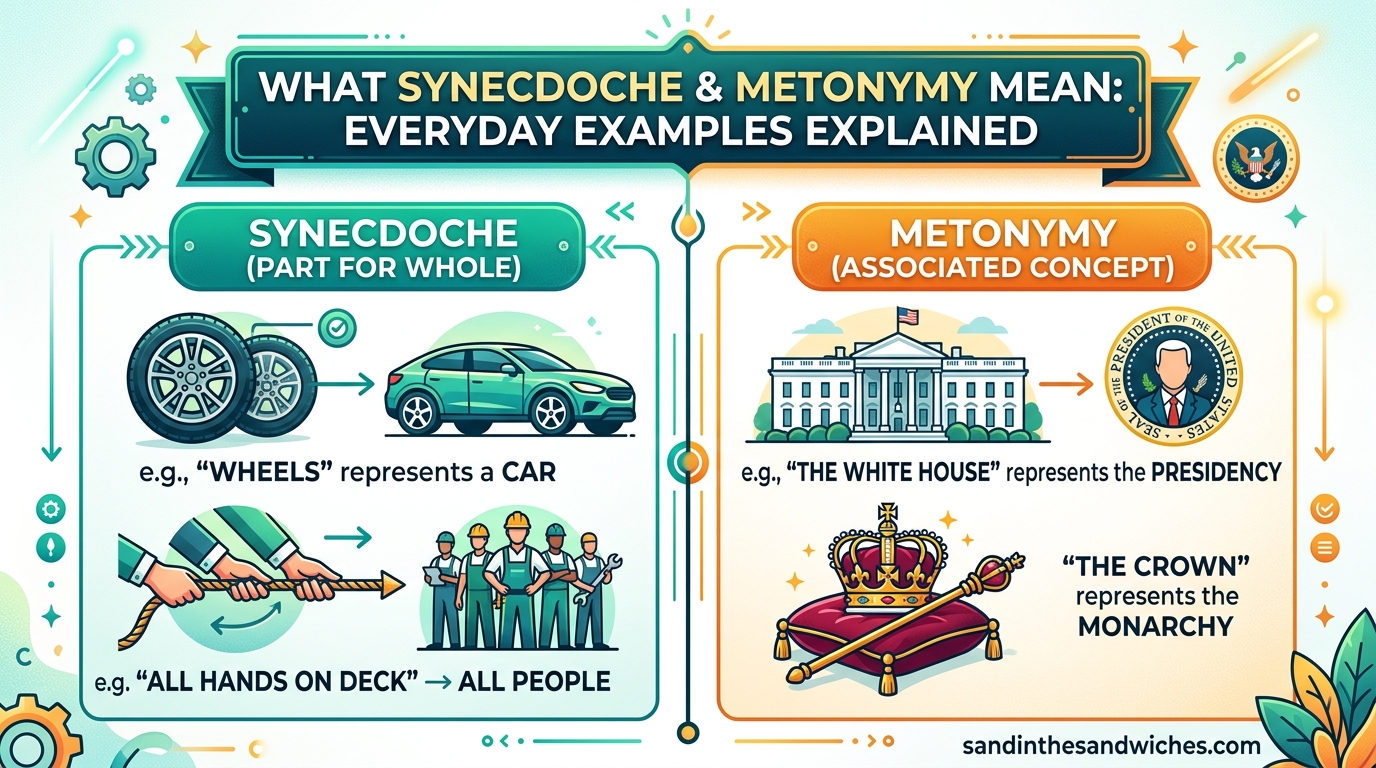
Here is the short version: synecdoche uses a part of something to stand for the whole thing, while metonymy uses something closely associated with a thing to stand in for it. They look similar from the outside, but the difference comes down to one word: association.
In this guide, I will walk you through both devices with everyday examples, a side-by-side comparison, a memory trick I wish someone had taught me earlier, and answers to the questions students ask most. By the end, you will be able to spot synecdoche and metonymy in songs, news headlines, and your own conversations.
Table of Contents
What Is Synecdoche? Definition and Pronunciation
Synecdoche (pronounced sih-NEK-duh-kee) is a figure of speech in which a part of something represents the whole, or the whole represents a part. The word comes from the Greek synekdochē, meaning “to receive together” or “to take on a share.”
Think of it as a literary shortcut. Instead of saying “the entire sailing crew,” you say “all hands on deck.” Hands are only part of a sailor, but the word does the job of the whole person.
Pronunciation Guide for Synecdoche
Syllable breakdown: sih – NEK – duh – kee. The stress lands firmly on the second syllable. If you say “sy-NECK-dokey,” you have nailed it.
Everyday Examples of Synecdoche
Here are synecdoche examples you have probably heard this week without realizing it.
- “Nice wheels.” Wheels are a part of a car, not the car itself.
- “Boots on the ground.” Boots stand in for soldiers or troops.
- “All hands on deck.” Hands represent the entire crew.
- “Suits arrived at the meeting.” Suits refer to business executives.
- “Plastic is ruining the oceans.” Plastic stands in for single-use plastic products.
- “Gray hair wisdom.” Gray hair represents older people.
- “Nice threads.” Threads (cloth) stand for clothing.
- “The crown has spoken.” The crown stands for the monarch or royal authority.
Notice the pattern: in every example, one word names a literal piece of the thing being talked about, and that piece stands in for the bigger concept.
The Two Directions of Synecdoche
Synecdoche works in two directions. The most common form is part for whole, like calling your car your “wheels.”
The less common form is whole for part, like saying “America won gold” when you really mean the American team won gold. The country (whole) stands in for a specific team (part).
A third subtype is material for object. When a jeweler asks if you want “gold” or “silver,” they mean jewelry made from that metal. The material stands in for the finished product.
What Is Metonymy? Definition and Pronunciation
Metonymy (pronounced meh-TON-uh-mee) is a figure of speech in which something closely associated with a thing is used to refer to that thing itself. The word traces back to Greek metōnymia, meaning “a change of name.”
Here is the key difference from synecdoche: with metonymy, the substitute word is not a literal part of the thing. It is only connected to it by habit, location, or cultural association.
Pronunciation Guide for Metonymy
Syllable breakdown: meh – TON – uh – mee. Stress falls on the second syllable, just like synecdoche. Say “meh-TON-uh-mee” and you are set.
Everyday Examples of Metonymy
Metonymy hides in headlines, sports commentary, and casual conversation.
- “The White House announced new policy.” The building stands for the presidential administration inside it.
- “The Crown demanded a meeting.” The crown represents royal power or the monarch.
- “Wall Street crashed.” A street stands for the financial industry.
- “The pen is mightier than the sword.” The pen represents writing, the sword represents military force.
- “Hollywood released a new film.” Hollywood stands for the American film industry.
- “Silicon Valley is hiring.” A geographic region stands for the tech industry located there.
- “Cups cheered the home run.” Cups of coffee or drinks stand for the people drinking them.
- “The press arrived at the scene.” The press stands for journalists.
- “Read Shakespeare from cover to cover.” Shakespeare stands for his written works.
- “Beijing responded to the allegations.” A city stands for its government.
None of these substitutes are physically part of the thing being discussed. The White House is not the president. Wall Street is not the stock market. They are simply tightly linked by custom and context.
Synecdoche vs Metonymy: The Core Difference
The difference boils down to a single question: Is the substitute word a literal part of the thing?
If yes, you are looking at synecdoche. If no, but the words are linked by association, you are looking at metonymy.
Side-by-Side Comparison
| Feature | Synecdoche | Metonymy |
|---|---|---|
| Substitute type | A literal part (or whole) of the thing | Something closely associated with the thing |
| Connection | Physical or material inclusion | Custom, location, or cultural link |
| Greek root meaning | “To receive together” | “Change of name” |
| Pronunciation | sih-NEK-duh-kee | meh-TON-uh-mee |
| Classic example | “Nice wheels” (wheels = car) | “The White House announced…” (building = administration) |
| Direction | Part-for-whole OR whole-for-part | Associated term for the thing |
Memory Trick to Keep Them Straight
Here is the trick I use every time. Look at the prefix of each word.
- Synecdoche starts like synergy, symmetry, and system. It is about parts that fit together in one literal thing. Part equals whole because they belong together.
- Metonymy starts like metaphor and metamorphosis. It is about things that change or shift. The name shifts to something associated.
So if the words are physically attached, you have synecdoche. If the words have just shifted meaning by association, you have metonymy.
Why the Confusion Is So Common
The confusion happens because some examples fit both categories depending on how you interpret them. Take the word “crown.”
If you read “the crown” as a physical piece of the king’s outfit standing for the whole monarchy, that is synecdoche. If you read it as a symbol of royal authority standing in for the monarchy itself, that is metonymy.
Many scholars treat synecdoche as a special type of metonymy because both rely on substitution. That is why a quick Google search can feel frustrating. The two devices genuinely overlap at the edges.
Everyday Examples in Conversation, Media, and Literature
The fastest way to lock these terms in is to see them in the wild. Here are real examples from everyday speech, news headlines, and famous literature.
Synecdoche in Everyday Speech
- “Mouths to feed.” Mouths stand for hungry people.
- “Five sails on the horizon.” Sails represent whole ships.
- “Give us this day our daily bread.” Bread stands for food in general.
- “The driveway is full.” The driveway stands for the cars parked there.
- “Friends, Romans, countrymen, lend me your ears.” Ears represent attention.
Metonymy in Everyday Speech
- “The Kremlin issued a statement.” The building stands for the Russian government.
- “The bench ruled against the defendant.” The bench stands for the judges collectively.
- “Tinseltown is buzzing.” A nickname stands for the entertainment industry.
- “Brass approved the operation.” Military brass (officers) stand for the leadership.
- “The suits in accounting.” Suits stand for executives or bureaucrats.
Literary Examples Worth Knowing
Writers have always loved both devices because they pack big ideas into small words.
In Shakespeare’s Julius Caesar, Mark Antony pleads, “Friends, Romans, countrymen, lend me your ears.” Ears stand in for the audience’s attention. This is synecdoche because ears are a literal part of listening.
In Bob Dylan’s “Blowin’ in the Wind,” the line “The answer is blowin’ in the wind” treats the wind as a stand-in for something larger and harder to name. This is metonymy because wind is associated with truth or change, not literally part of it.
Walt Whitman’s “I hear America singing” uses synecdoche, since “America” stands for its people. Meanwhile, headlines like “Beijing condemns the attack” use metonymy, since the city stands for the Chinese government.
Synecdoche and Metonymy in Pop Music
Listen for these devices in your favorite songs. Taylor Swift’s “Bad Blood” uses metonymy when she sings about an industry or a feud, depending on context. “All eyes on me” is synecdoche because eyes are literal parts of people looking.
Why These Distinctions Matter for Readers and Writers
Knowing the difference between synecdoche and metonymy is more than a vocabulary flex. It sharpens how you read poetry, understand news headlines, and write with precision.
For students, recognizing these devices unlocks deeper literary analysis. Teachers love asking about them because they reveal how language compresses meaning. For writers, choosing synecdoche or metonymy on purpose changes the texture of a sentence. “All hands on deck” hits harder than “all crew members on deck” because synecdoche paints a picture.
For everyday readers, spotting these figures helps you catch nuance in headlines. When you read “Wall Street reacted,” you know the street is standing in for traders, not pedestrians.
How These Devices Compare to Metaphor and Simile
People often mix up synecdoche and metonymy with metaphor and simile. Here is how they differ.
A simile compares two things using “like” or “as.” “Her smile was like sunshine.” A metaphor does the same without those words. “Her smile was sunshine.”
Synecdoche and metonymy are not really comparisons at all. They are substitutions. One word replaces another by physical or associative link. Metaphor and simile work by resemblance. The key distinction: substitution versus comparison.
Quick Quiz: Try These Yourself
Test your understanding. Decide whether each phrase is synecdoche or metonymy.
- “Nice set of wheels.”
- “The Oval Office made a decision.”
- “All hands on deck.”
- “Detroit is producing more trucks this year.”
- “I need some new threads.”
Answers: 1 is synecdoche (wheels are part of a car), 2 is metonymy (a room stands for the president), 3 is synecdoche (hands are part of a sailor), 4 is metonymy (a city stands for the auto industry), 5 is synecdoche (threads stand for clothing).
Frequently Asked Questions About Synecdoche and Metonymy
What is an example of metonymy and synecdoche?
Synecdoche example: u0022Nice wheelsu0022 uses a part of a car to represent the whole car. Metonymy example: u0022The White House announced a new policyu0022 uses a building associated with the presidency to represent the administration itself.
What are 5 examples of synecdoche?
Five common synecdoche examples: (1) u0022all hands on decku0022 (hands stand for sailors), (2) u0022nice wheelsu0022 (wheels stand for a car), (3) u0022boots on the groundu0022 (boots stand for soldiers), (4) u0022the crown will decideu0022 (crown stands for the monarch), and (5) u0022America won goldu0022 (America stands for the American team).
What are 10 examples of metonymy?
Ten common metonymy examples: (1) u0022The White House announcedu0022 (administration), (2) u0022Wall Street crashedu0022 (financial industry), (3) u0022The pen is mightier than the swordu0022 (writing vs. military force), (4) u0022Hollywood released a new filmu0022 (film industry), (5) u0022Silicon Valley is hiringu0022 (tech industry), (6) u0022The press arrivedu0022 (journalists), (7) u0022Beijing respondedu0022 (Chinese government), (8) u0022The bench ruledu0022 (judges), (9) u0022The Kremlin issuedu0022 (Russian government), and (10) u0022Read Shakespeareu0022 (his written works).
How is synecdoche used in everyday language?
Synecdoche shows up constantly in everyday speech. People say u0022nice wheelsu0022 instead of u0022nice car,u0022 u0022all hands on decku0022 instead of u0022everyone,u0022 and u0022boots on the groundu0022 instead of u0022soldiers.u0022 These shortcuts make conversation faster and more colorful by letting one part stand in for the whole.
Final Thoughts on Synecdoche and Metonymy
The cleanest way to remember synecdoche and metonymy is to test one question: Is the substitute a literal part of the thing? If yes, it is synecdoche. If no, it is metonymy.
Both devices give language its snap and rhythm. Once you start noticing them, you will spot synecdoche in songs, metonymy in headlines, and both in poetry. You will also catch yourself using them without thinking. That is the sign the difference has finally stuck.
Next time you hear someone say “the suits decided” or “all hands on deck,” pause for a second. You are watching figurative language do its quiet work, and you now have the words to name it.