
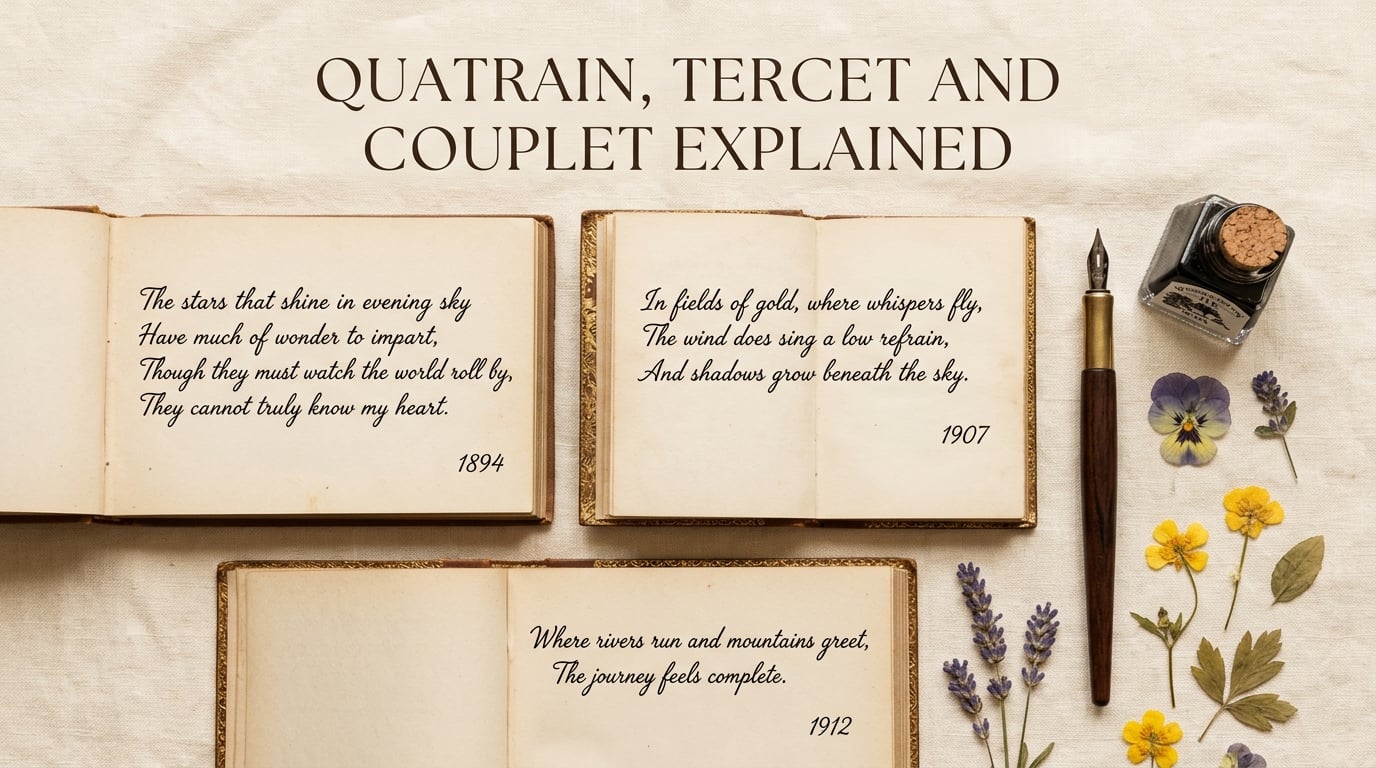
When I first started writing poetry, I kept mixing up these three terms. Here’s the simple answer: a couplet is a two-line stanza, a tercet is a three-line stanza, and a quatrain is a four-line stanza. Each is one of the most common building blocks poets use to shape a poem.
Once I understood that line count is what separates them, the rest of poetry structure started to click. Let me walk you through each form with examples so it sticks for you too.
Table of Contents
What Is a Stanza in Poetry?
Before we get into couplets, tercets, and quatrains, you need to know what a stanza is. A stanza is a grouped block of lines in a poem, separated from other blocks by a line break or extra space. Think of a stanza like a paragraph, but for poetry instead of prose.
Stanzas give poems their structure and rhythm. The number of lines in a stanza determines what kind it is, and poets choose specific stanza types to control pacing, rhyme, and emphasis.
The most common stanza types are named by their Latin roots. Couplet comes from the Latin “copula” meaning “bond.” Tercet comes from the Italian “terzetto” meaning “group of three.” Quatrain comes from the Latin “quattuor” meaning “four.”
What Is a Couplet?
A couplet is a two-line stanza in poetry. The two lines usually work together as a unit, often with matching rhythm and a shared thought or closing punch.
A rhyming couplet is the most recognized type, where both lines end with the same sound. Alexander Pope made heroic couplets famous in English poetry, using pairs of iambic pentameter lines that rhyme.
Example of a rhyming couplet:
Whether or not we find what we are seeking,
The hour is sweet, and worth a moment’s keeping.
Couplets show up everywhere: in Shakespearean sonnets (which close with a rhyming couplet), in jokes (“Why did the chicken cross the road? / To get to the other side.”), and in modern rap lyrics. They’re easy to spot because they form a tidy two-line package.
Writers love couplets because they create a sense of finality. When you read a couplet, the two lines feel complete on their own. That’s why epigrams and proverbs so often use them.
What Is a Tercet?
A tercet is a three-line stanza in poetry. Because three is an odd number, tercets create a different feel than couplets or quatrains. They build momentum without the neat closure of a paired rhyme.
Tercets have five main types, and recognizing them helps you read poetry more deeply.
Types of Tercets
Triplet (AAA): All three lines rhyme with each other. This is the simplest tercet form.
Will there really be a morning?
Is there such a thing as day?
Could I see it from the mountains
Enclosed Tercet (ABA): The first and third lines rhyme, with a different rhyme in the middle.
Sicilian Tercet (ABA): Similar to the enclosed tercet, but with a specific pattern of stressed syllables in each line, usually linked by an interlocking pattern across stanzas.
Terza Rima (ABA BCB CDC): This is the famous Dante form. Each tercet weaves into the next by sharing a rhyme. The end of one stanza’s rhyme picks up the start of the next.
Haiku (5-7-5): A Japanese tercet of three lines with 5, then 7, then 5 syllables, traditionally about nature.
Haiku are probably the most familiar tercet to most readers. But Dante’s Divine Comedy is the gold standard for terza rima, and Shakespeare loved mixing enclosed tercets in his sonnets.
What Is a Quatrain?
A quatrain is a four-line stanza in poetry. Of the three forms, the quatrain is the most widely used. Most ballads, many hymns, and a huge number of sonnets depend on quatrains for their structure.
Quatrains are popular because four lines offer enough room to develop a complete thought while staying tight and focused. They’re flexible too, working with many different rhyme schemes.
Common Quatrain Rhyme Schemes
AABB: The first two lines rhyme, and the last two lines rhyme. This is the classic nursery rhyme pattern.
Roses are red,
Violets are blue,
Sugar is sweet,
And so are you.
ABAB: The first and third lines rhyme, and the second and fourth lines rhyme. This is the alternating pattern used in many ballads.
ABBA: The outer lines rhyme, and the inner lines rhyme. This “enclosed” quatrain creates a feeling of a completed frame.
AABA: Sometimes called the “hymn” form, used by Irving Berlin in “White Christmas” and other American standards.
Most sonnets are built from quatrains. A Shakespearean sonnet has three quatrains followed by a closing couplet. A Petrarchan sonnet has eight lines (an octave, often two quatrains) and six lines (a sestet).
Quatrain, Tercet, and Couplet: Side-by-Side Comparison
| Stanza Type | Line Count | Common Rhyme Schemes | Famous Use |
|---|---|---|---|
| Couplet | 2 lines | AA | Shakespearean sonnet endings, heroic couplets, epigrams |
| Tercet | 3 lines | AAA, ABA, ABA-BCB | Haiku, Dante’s Divine Comedy, villanelles |
| Quatrain | 4 lines | AABB, ABAB, ABBA, AABA | Sonnets, ballads, hymns, nursery rhymes |
The key differences come down to three things: line count, rhyme possibilities, and the feel each creates. Couplets feel finished. Tercets feel moving. Quatrains feel balanced and complete.
Why These Stanza Forms Matter
Knowing the difference between a quatrain, a tercet, and a couplet is like knowing the difference between a short story, a poem, and a novel. They’re all writing, but each works differently.
For readers, recognizing these forms helps you catch a poet’s choices. When a writer ends a poem on a couplet, that’s a deliberate signal of closure. When a poet uses terza rima, they’re tying ideas together stanza by stanza in a chain.
For writers, picking the right stanza form shapes how your poem feels. Want a punchy ending? Use a couplet. Want a driving rhythm? Try a tercet. Want room to develop an idea? A quatrain gives you space.
Self-referential examples help me remember. A couplet is a two-line poem about couplets. A tercet is three lines. A quatrain is four. Once you see the form working on itself, the concept locks in.
Quick Reference: How to Tell Them Apart
Count the lines. If you see two, it’s a couplet. Three, a tercet. Four, a quatrain. That’s the only hard rule.
Beyond line count, the structure tells you which form is being used. Look for rhyme scheme clues and how the ideas group. A complete thought in two lines is almost always a couplet. Three lines with a moving rhythm is a tercet. Four lines with developed imagery is usually a quatrain.
FAQs
What is the difference between a quatrain and a couplet?
A quatrain has four lines while a couplet has only two. Quatrains offer more room to develop an idea and often use rhyme schemes like AABB, ABAB, or ABBA. Couplets use the AA scheme and create a sense of finality or punch.
What are couplets, tercets, and quatrains?
Couplets, tercets, and quatrains are all types of stanzas in poetry. A couplet is a 2-line stanza, a tercet is a 3-line stanza, and a quatrain is a 4-line stanza. The names come from counting lines: two, three, and four.
What is an example of a tercet?
A simple example of a tercet is the haiku: An old silent pond / A frog jumps into the pond / The sound of water. This Japanese tercet has three lines following a 5-7-5 syllable pattern.
What is a 7 line stanza called?
A 7-line stanza is called a septet or sometimes a rhyme royal when it follows a specific ABABBCC pattern. The rhyme royal is famous in English poetry and was used by Chaucer.
What is a 9 line stanza called?
A 9-line stanza is called a nonet. Poets use nonets for their own structured forms, often following a decreasing syllable or line pattern across the nine lines.
Wrapping Up the Difference Between a Quatrain, a Tercet, and a Couplet
The difference between a quatrain, a tercet, and a couplet comes down to line count. A couplet has 2 lines, a tercet has 3, and a quatrain has 4. Once you memorize those numbers, you can identify any stanza you see.
Try writing one of each this week. Start with a rhyming couplet, then a haiku, then a quatrain. The exercise will lock in the difference faster than any definition.