
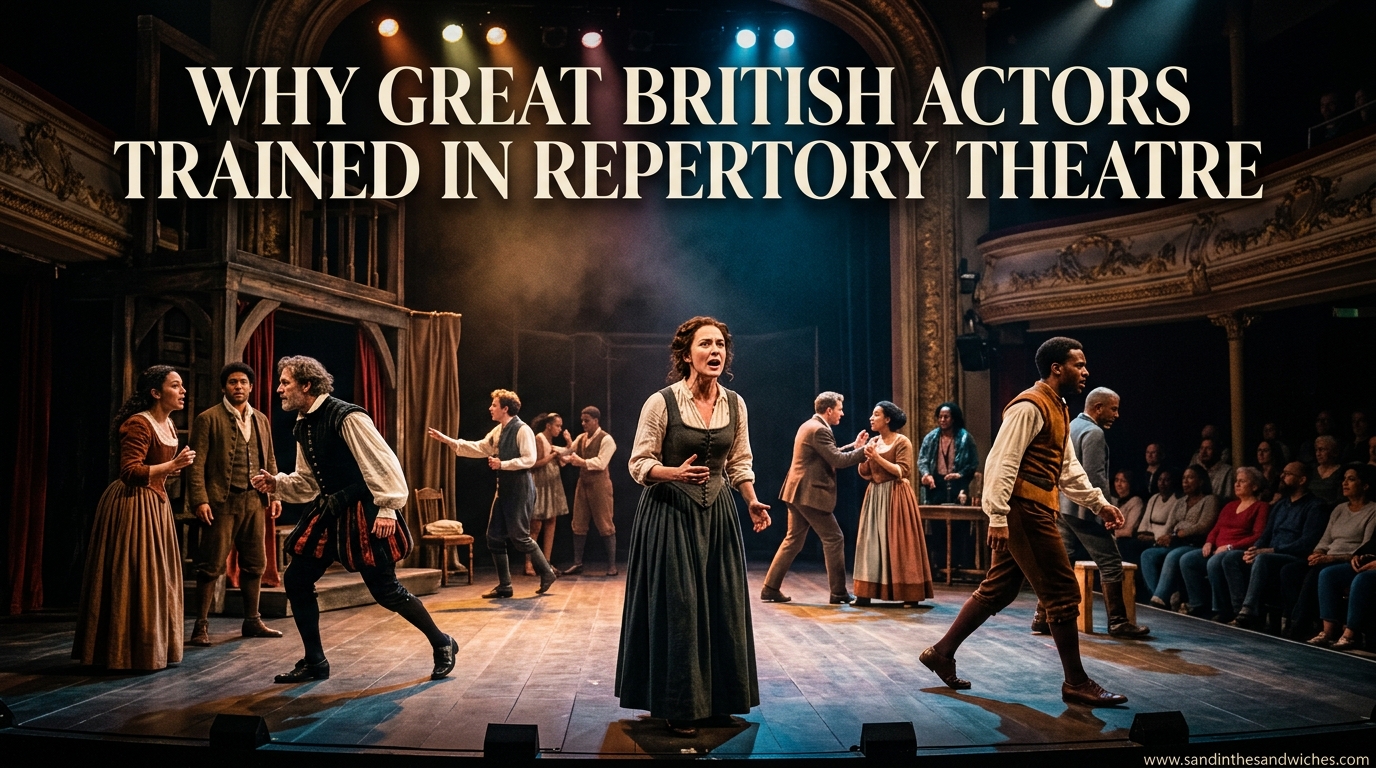
For over a century, an unusual training system quietly produced some of the finest performers the world has ever seen. Walk through almost any list of British acting royalty and you will find the same origin story. Laurence Olivier started there. Judi Dench cut her teeth there. Michael Caine, Patrick Stewart, Ian McKellen, Derek Jacobi, Michael Gambon, Imelda Staunton, and Harold Pinter all did their early work in the same kind of place. That place was the repertory theatre, and understanding why so many great British actors trained in repertory theatre explains a lot about how British stage craft became a global gold standard.
Rep theatre was not glamorous. It was a working system that gave young performers something rare. A stage, a steady contract, a rotating bill of plays, and a company of colleagues who would not let you get away with anything less than your best. In this guide, I will walk you through what rep actually was, where it came from, who it shaped, and why the answer to “why are British actors so good at acting” almost always loops back to a regional rep company somewhere outside London.
Table of Contents
What is repertory theatre and how did it work in Britain?
Repertory theatre is a system in which a resident acting company is hired on annual contracts to perform a rotating programme of plays at a single venue. Instead of casting each production from scratch, a rep company keeps a core group of actors together week after week, switching between shows. One night you might play the lead in a Shakespeare comedy, and the next week you could be the villain in a thriller, a maid in a drawing room farce, or the gravedigger in Hamlet.
This is the heart of how British acting developed its signature versatility. The actors were not specialists hired for one job. They were craftspeople expected to handle tragedy, comedy, classical text, and contemporary drama in quick rotation. A typical weekly rep schedule might involve rehearsing one play by day, performing another in the evening, and learning lines for a third at night. It was exhausting, and it was excellent training.
There is an important distinction between true repertory and the later “weekly rep” that took over in the 1950s and 60s. True repertory gave actors long contracts and a deep bench of plays they would return to over months or years. Weekly rep kept the same rapid rotation idea but with shorter runs and more turnover. Both formats produced great actors, but the original model is where the training tradition really took root.
How repertory theatre became Britain’s acting training ground
The story starts in the late 1800s, when a handful of actor-managers and impresarios wanted to take good theatre beyond London. Before repertory arrived, regional British cities had mostly hosted touring companies that would come, perform, and leave. That model left local audiences with no permanent ensemble and gave local performers almost no career path outside the capital.
Two figures changed that. Annie Horniman, often called the founder of modern repertory, opened the Gaiety Theatre in Manchester in 1908 with a permanent company and a serious artistic policy. Around the same time, Harley Granville-Barker, Barry Jackson, and others championed a vision of theatre as a craft rather than a commercial product. They wanted plays performed well, in cities that had never seen serious drama performed well before.
By the 1930s and 1940s, repertory companies had spread to Birmingham, Liverpool, Bristol, Glasgow, Oxford, Sheffield, and dozens of smaller towns. The Old Vic in London became a national training company in its own right, eventually feeding the Royal Shakespeare Company and the National Theatre. State support through the Arts Council, founded in 1946, made much of this possible. Subsidised companies could afford to pay young actors a real wage, take risks on new writing, and rehearse properly.
This was the economic engine that made British acting talent possible. A working-class kid from the Midlands could join a rep company straight out of school, earn a living, and learn the craft on the job. There was no need to spend three years and a small fortune at drama school before you ever stood on a stage. Rep gave you a stage first, and the training happened in the doing.
Which great British actors cut their teeth in repertory?
The list of actors who came up through rep reads like a roll call of 20th century British theatre. Here are some of the most famous names, and the kinds of roles they played early on.
- Laurence Olivier – Began his professional career with small touring companies before joining Birmingham Rep, where he played a wide range of parts and learned to handle Shakespeare on his feet.
- Judi Dench – Joined the Old Vic company in 1957, playing roles as varied as Ophelia in Hamlet and Katherine in Henry V in the same season.
- Michael Caine – Spent his early years in rep around the south of England, picking up whatever roles came his way and learning the trade from older actors in the company.
- Patrick Stewart – Cut his teeth at the Manchester Royal Exchange and other regional companies, building the vocal and physical control that would later make him a star.
- Ian McKellen – Came up through provincial rep and became known for his Shakespearean work long before Hollywood came calling.
- Derek Jacobi – Trained at Cambridge and then joined the Birmingham Rep, an almost direct pipeline from university to professional stage.
- Michael Gambon – Spent years in regional theatre before becoming a national figure, treating every role in a small-town rep as if it were the lead at the National.
- Imelda Staunton – Built her craft in rep before joining the RSC and becoming one of the most respected stage actresses in Britain.
- Harold Pinter – Was an actor long before he became a playwright, and he learned how to land a silence on stage by performing in rep.
What you notice when you read the list is the range. These are not actors who came up playing one type of role. They played leads, supporting parts, villains, lovers, and clowns. They did it year after year, in bad weather, in small theatres, for audiences who paid a few shillings to see them work.
Why repertory training produced such versatile, classically trained actors
Rep trained actors in three ways that no other system quite matched. First, it gave them volume. A single season might include ten, twelve, or more productions. That kind of repetition builds a muscle memory for performance that is very hard to fake.
Second, it forced them to switch styles. You could be playing a Restoration comedy one week and a kitchen-sink drama the next. The voice, body, and emotional range required were completely different. British actors came out of rep knowing how to command a theatre with their voice alone, which is one reason so many of them transitioned easily to film and television without losing their presence.
Third, rep put young actors in the same room as experienced ones. A 22-year-old joining a company might share a dressing room with a 60-year-old stage veteran who had been doing the job for forty years. That kind of apprenticeship does not exist in most modern training pipelines. You learned by watching, by being corrected, and by being thrown into parts you were not quite ready for and figuring them out.
The result is a particular kind of British actor. Technically sound, vocally clear, willing to disappear into a role, and able to play anything from Shakespeare to a modern thriller. When American casting directors and audiences talk about why British actors “seem better trained,” they are usually describing the residue of a rep training that the United States never built an equivalent of at scale.
The decline of repertory and what it means today
True repertory is now a fraction of what it once was. Subsidy cuts, the rise of film and television work, and changes in how plays are produced have all reduced the number of full-time resident companies. There are still excellent rep theatres, particularly at places like the Royal Exchange in Manchester, the Birmingham Rep, the Bristol Old Vic, and the Theatre Royal Windsor, but the pipeline that once trained hundreds of young actors a year is much thinner.
This has consequences. Working-class performers in 2026 find it harder than ever to break in. Drama school fees can run into the tens of thousands of pounds, and a young actor who cannot afford the three-year RADA or LAMDA route often has nowhere else to turn. Forum discussions among working actors frequently return to the same point. Without rep, there is no longer an obvious on-the-job training ground for the next generation.
That is part of why conversations about British acting training keep coming back to repertory. It was not the only factor in producing great actors, but it was the foundation. Without it, the next Laurence Olivier or Judi Dench will have to find another way in, and many never do.
Frequently asked questions about British actors and repertory theatre
Are most British actors classically trained?
Most leading British actors have some form of classical training, whether through drama school, the Royal Shakespeare Company, or years of repertory work. Repertory was the original mass training ground, where young actors learned classical technique on the job by performing Shakespeare and other demanding material as part of a rotating company.
What is the 3 actor rule?
The 3 actor rule is the informal industry observation that British actors tend to outperform in Hollywood because of rigorous training in repertory, drama school, and stage work. Casting directors in the US often note that a British actor can typically play across a wider range of roles with greater technical confidence than a peer with comparable film credits.
Why are British actors so good at acting?
British actors tend to be technically strong because the training system demanded it. Repertory companies forced performers to switch between classical and modern plays, learn from senior colleagues, and build vocal and physical skills that translate easily to screen. The tradition produced generations of versatile, classically trained actors.
Is repertory theatre still viable for young actors today?
Repertory still offers one of the best entry routes into professional acting, particularly through regional companies in Manchester, Birmingham, Bristol, and Windsor. The number of full-time rep companies is much smaller than it was in the mid-20th century, but young actors who land a place still get the kind of intense, varied training that built the careers of British acting legends.
What is the difference between weekly rep and true repertory?
True repertory gives actors long-term contracts and a deep bench of productions they return to over months or years, while weekly rep rotates productions more quickly with shorter runs. Both formats demand versatility, but true repertory is the original model that produced the bulk of Britain’s classical acting tradition.
The final word on repertory and British acting
So why did so many great British actors train in repertory theatre? The honest answer is that for a long stretch of the 20th century, rep was the most reliable, most affordable, and most thorough acting school in the country. It took young performers, threw them into a working company, and demanded that they rise to the work. It produced actors who could handle Shakespeare on a Tuesday and a contemporary thriller on a Friday, often in the same week.
The system has thinned, and the path into acting is harder for working-class talent than it used to be. But the legacy of British repertory theatre still shapes how the country’s actors are trained, how they approach a role, and why the world keeps coming back to British performers when it wants craft as well as charisma. If you want to understand the British acting tradition, you have to start in a small regional rep house on a wet Wednesday night, where a 24-year-old is learning how to land a Shakespearean soliloquy in front of a half-full house. That is where the tradition was built, and that is why it lasted.