
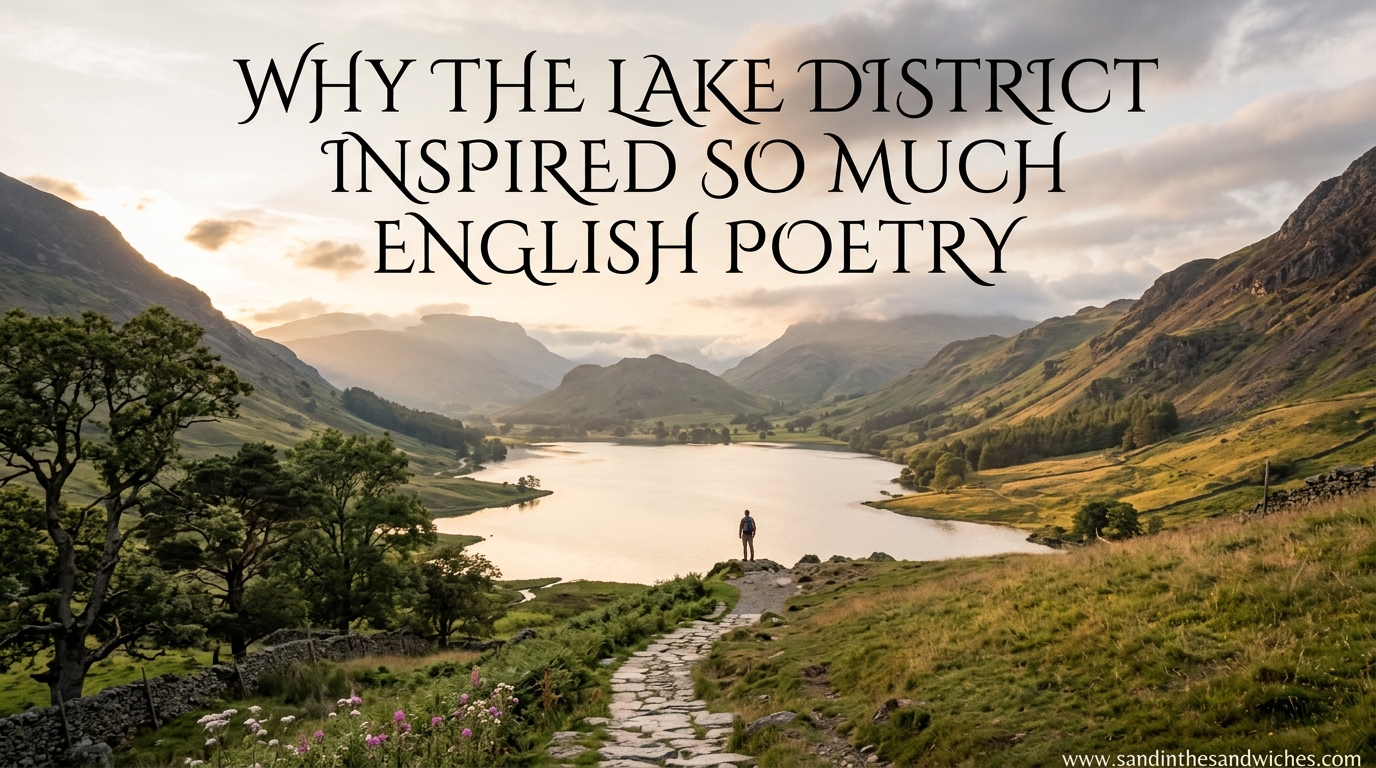
The Lake District inspired English poetry more powerfully than almost anywhere else in Britain because it offered Romantic writers something they could not find in 18th-century cities: raw, dramatic, unengineered landscape. Craggy fells, deep glacial lakes, hidden valleys, and sudden weather created the kind of scenery that the Romantic imagination craved. When William Wordsworth, Samuel Taylor Coleridge, and Robert Southey settled there in the late 1700s and early 1800s, they turned a remote corner of Cumbria into the spiritual home of English Romanticism.
In this guide I want to answer the question properly rather than just list poets and dates. Most articles tell you that Wordsworth lived in Grasmere. Far fewer explain why the landscape itself unlocked the poetry, what poets were running away from, and why the inspiration still matters in 2026. I will walk you through the geography, the historical timing, the three poets at the centre of it, the famous poems the region produced, and the legacy you can still visit today.
Table of Contents
What Made the Lake District So Different From the Rest of England
The Lake District sits in the northwest corner of England, in what is now Cumbria, and geologically it is a different country from the rolling farmland most people picture when they think of England. Volcanic rock, sculpted by glaciers during the last Ice Age, left behind a landscape of sharp ridges, deep U-shaped valleys, and ribbon lakes that pool in the lower ground. Scafell Pike, England’s highest mountain at 978 metres, rises here. Wastwater, its deepest lake, plunges to 79 metres.
That geography matters for poetry because it produces emotional intensity. The fells are steep enough to leave a walker breathless, the weather shifts in minutes, and the clouds sit so low they often swallow the peaks whole. There is nothing polite or manicured about it. For writers raised on the ordered landscapes of southern England, this felt closer to the Scottish Highlands or the Alps than to anything in Surrey.
It was also genuinely remote. Before the railways, getting to the Lakes from London took days of travel on rough roads. That isolation protected the region from the enclosure, industrial sprawl, and urbanisation that reshaped much of England in the 18th and 19th centuries. When poets arrived, they found villages, Herdwick sheep, stone walls, and a way of life that still felt ancient. To Romantic eyes, the Lakes looked like a surviving fragment of an older, more authentic England.
The Romantic Movement and the Escape From Industrialisation
You cannot understand why the Lake District inspired English poetry without understanding what the poets were fleeing. By the 1780s, the Industrial Revolution was transforming northern England. Manchester, Birmingham, Leeds, and Sheffield were filling with factories, smoke, and overcrowded slums. The enclosure movement had fenced off common land, and rural life was being gutted by economic change.
The Romantic movement pushed back against all of this. Romantics rejected the Enlightenment’s faith in reason, machinery, and urban progress. Instead they championed emotion, individual experience, the imagination, and a near-religious connection to nature. They believed a person could be morally and spiritually healed by standing on a mountain or beside a lake.
The Lake District was the perfect physical expression of those beliefs. It was wild where cities were ordered, slow where factories were fast, quiet where mills were deafening. When Wordsworth wrote in his preface to Lyrical Ballads that poetry should be “the spontaneous overflow of powerful feelings,” he was describing the mental state the Lakes produced in him. The landscape did not just give poets scenery to describe. It gave them a philosophy.
Why the Lake District Inspired English Poetry: The Landscape as Muse
Here is the part most guides skip. A pretty view does not, on its own, generate great poetry. So why did this particular landscape unlock so much writing? I think there are four reasons worth naming directly.
First, the sublime. The Romantics were obsessed with the idea of the sublime, an aesthetic category defined by awe mixed with fear. A calm pastoral scene is beautiful. A storm rolling over a 3,000-foot fell with you standing on top of it is sublime. The Lake District produces sublime moments constantly because of its vertical relief and unpredictable weather.
Second, scale. The Lakes force you to feel small. When you stand beside Wastwater and look up at the Screes, or cross the saddle of Striding Edge in wind, your individual problems shrink. That shift in perspective is fertile ground for poetry about mortality, eternity, and the human place in nature.
Third, memory. Wordsworth’s most famous poems are not written on the spot. They are written later, recollecting the landscape in tranquillity. The Lakes left such vivid impressions on him that they kept producing poems years after he had walked the paths. The landscape was not just a backdrop. It was a storehouse of mental images he could return to again and again.
Fourth, walking. The Lake District is a walking culture. Wordsworth, Coleridge, and Southey all thought on their feet, sometimes covering 20 miles in a day. Walking produces a particular rhythm of attention that lends itself to verse. You move slowly enough to notice individual flowers, streams, and clouds, and that granular noticing is exactly what Romantic poetry is built from.
William Wordsworth: The Poet Who Made the Lakes Famous
William Wordsworth is the central figure in this story. Born in 1770 in Cockermouth, on the edge of the Lake District, he spent his childhood roaming the fells and sailing on the lakes after his mother’s death sent him into the countryside for comfort. Those early encounters with the landscape became the raw material for almost everything he later wrote.
In 1799, after years of travel in France, Germany, and the south of England, Wordsworth returned to the Lakes with his sister Dorothy and settled at Dove Cottage in Grasmere. The years between 1799 and 1808, when he lived there, are widely considered his most productive. Dorothy’s Grasmere Journals record the daily walks, weather, and encounters that fed both siblings’ work, and several of William’s best poems can be traced directly to entries in her journal.
The most famous example is “I wandered lonely as a Cloud,” better known as “Daffodils.” On 15 April 1802, Dorothy recorded a walk along Glencoyne Bay near Ullswater where she and William saw a long belt of daffodils “tossing their heads in sprightly dance.” William turned that observation into a poem two years later, and the closing lines, where the daffodils “flash upon that inward eye which is the bliss of solitude,” are the clearest statement of his whole poetic method. The landscape gave the experience. Memory, later, turned it into poetry.
Wordsworth went on to live at Rydal Mount, served as Poet Laureate from 1843 until his death in 1850, and published The Prelude, his autobiographical epic, posthumously. That poem is essentially the story of how the Lake District shaped his mind from childhood onward. There is no major English poet more inseparable from a single landscape.
Samuel Taylor Coleridge and the Collaborative Spark
Samuel Taylor Coleridge arrived in the Lake District in 1797, settling first at Nether Stowey in Somerset near Wordsworth, and then moving north to Greta Hall in Keswick in 1800. His friendship with Wordsworth produced Lyrical Ballads in 1798, the volume most historians point to as the opening shot of English Romanticism.
Coleridge’s contribution to that book included “The Rime of the Ancient Mariner” and the fragment we know as “Kubla Khan.” These are not Lake District poems in the literal sense, but they were shaped by the same conversations, walks, and shared philosophy that the Lakes made possible. Coleridge and Wordsworth walked together for miles, arguing about imagination, dreams, and the natural world, and the region was the studio where those ideas were tested.
Coleridge also wrote directly about the landscape, most notably in reflections on Scafell and on his walking tours, which were genuinely extreme by modern standards. He suffered from poor health, opium addiction, and what we would now recognise as depression, and the wildness of the fells offered him a kind of relief he could not find elsewhere. The Lakes did not cure him, but they gave him a setting where his chaotic interior life felt less out of place.
Robert Southey and the Original “Lake Poets” Label
Robert Southey, the third of the so-called Lake Poets, lived at Greta Hall in Keswick from 1803 until his death in 1843. He was Poet Laureate before Wordsworth, a prolific writer of poems, biographies, and histories, and an early champion of the region as a permanent home rather than a temporary retreat.
The phrase “Lake Poets” was originally thrown at the three men as an insult by the Edinburgh Review. Critics used it to suggest they were a provincial clique writing about the same small patch of countryside. The poets themselves never really used the term as a self-description, and they did not consider themselves a school in any formal sense. They were friends and rivals who happened to live near each other and to share a view of nature.
Southey is now the least read of the three, partly because his writing aged less gracefully than Wordsworth’s and Coleridge’s. But his presence in Keswick helped anchor the Lakes as a literary colony. He hosted visitors, corresponded widely, and turned Greta Hall into a hub for writers travelling through the region. Without Southey, the Lake District might have remained Wordsworth’s private landscape instead of becoming a recognised literary destination.
Beyond the Big Three: Other Writers the Lakes Shaped
The Lake District did not stop inspiring writers after the original Lake Poets died. John Ruskin, the Victorian art and social critic, grew up in Denmark Hill in London but spent formative childhood holidays in the Lakes and eventually settled at Brantwood on the shore of Coniston Water in 1871. His writing on art, architecture, and the moral value of landscape is saturated with Cumbrian imagery, and his later environmental warnings read almost as prophecy today.
Beatrix Potter is the other name every visitor hears. She first came to the Lakes on family holidays in the 1880s and 1890s, fell in love with Hill Top Farm in Near Sawrey, and used her book royalties to buy up working farms across the region. Her children’s books, from The Tale of Peter Rabbit onward, are filled with Lake District landscapes, buildings, and wildlife. By the time she died in 1943, she had bequeathed over 4,000 acres to the National Trust, much of which formed the backbone of today’s protected Lake District.
Arthur Ransome set Swallows and Amazons on a fictional lake drawn from Coniston Water and Windermere. Thomas de Quincey, the essayist best known for Confessions of an English Opium-Eater, lived at Dove Cottage after Wordsworth moved out. Alfred Wainwright, the 20th-century walking guide writer, produced the famous pictorial guides that still shape how millions of people experience the fells. The Lakes have always been a literary landscape, not just a Romantic one.
Famous Poems Born in the Lake District
If you want to feel the inspiration directly, these are the poems and places to start with. “I wandered lonely as a Cloud” grew from a real walk along Ullswater in April 1802 and is the most anthologised Lake District poem in English. “The Prelude” is Wordsworth’s full autobiography in blank verse, and Book 1 in particular is a sustained portrait of the Lakes as a moral and imaginative education.
Wordsworth’s “Composed upon Westminster Bridge, September 3, 1802” was actually written about London, but its vision of a sleeping city at dawn reflects a poet whose sense of beauty had been trained by years of Cumbrian landscape. “Michael,” his 1800 pastoral poem about a Grasmere shepherd, is set explicitly in the valley he could see from Dove Cottage and is one of the first serious English poems about ordinary rural working life.
Coleridge’s “Frost at Midnight,” written during a cold night in Somerset but conceived in the context of his Lake District friendship with Wordsworth, captures the same belief that nature is the best teacher of a child. Read together, these poems show how a single region could produce work that reshaped what English poetry was allowed to be about.
The Lasting Legacy: Conservation, Tourism, and Modern Inspiration
The inspiration did not end in the 19th century. In 1951 the Lake District was designated a National Park, and in 2017 it became a UNESCO World Heritage Site, partly on the strength of its cultural landscape and its connection to the Romantic movement. That is rare. Most World Heritage Sites are listed for natural or architectural reasons. The Lakes were recognised because of what poets did there.
The conservation movement in Britain owes a direct debt to the writers who loved the region. Wordsworth himself argued in the 1840s that the Lakes should be protected as a “sort of national property.” Beatrix Potter’s land bequests built the National Trust’s holdings in the area. The modern campaign to keep the fells open, the farms working, and the lakes clean still draws on the moral language the Romantics invented.
The inspiration is alive in popular culture too. Taylor Swift’s song “The Lakes,” from the 2020 album Evermore, name-checks Windermere and Wordsworth and is explicitly about wanting to escape to the Lake District with a lover. The lyrics mention “iambic pentameter” and “talentless poets,” a direct nod to the Romantic poets Swift has said she admires. A new generation is now making literary pilgrimages to Grasmere and Ullswater because of a pop song, which is exactly the kind of chain reaction Wordsworth set in motion more than two centuries ago.
FAQs
Why did poets go to the Lake District?
Poets went to the Lake District because it offered wild, dramatic, and unindustrialised landscape at a time when northern England was being transformed by factories and urban growth. The Romantic poets believed nature could heal and inspire the human spirit, and the Lakes gave them the most powerful version of that nature anywhere in England.
How has the Lake District inspired people?
The Lake District has inspired people by giving them a landscape that produces awe, solitude, and reflection. For Romantic poets it generated some of the most famous verse in English. For later writers like Beatrix Potter and John Ruskin it shaped their art and their conservation work. For modern visitors and artists like Taylor Swift it still functions as a symbol of retreat and creative renewal.
Who was the poet who found inspiration in England’s Lake District?
William Wordsworth is the poet most strongly associated with the Lake District. Born in Cockermouth in 1770, he lived at Dove Cottage in Grasmere from 1799 and wrote many of his most famous poems, including I wandered lonely as a Cloud, about the region. He is widely regarded as the central figure of English Romanticism.
What did Wordsworth say about the Lake District?
Wordsworth called the Lake District a sort of national property and argued it should be protected for the nation. In his poetry he described it as the landscape that formed his imagination from childhood onward, especially in his long autobiographical poem The Prelude. He believed the region had a unique moral and spiritual power that cities could not provide.
Who are the three lake poets from the Lake District?
The three Lake Poets are William Wordsworth, Samuel Taylor Coleridge, and Robert Southey. They lived in or near the Lake District in the late 18th and early 19th centuries, knew each other well, and were grouped together by critics of the time. The term Lake Poets was originally used dismissively in the Edinburgh Review.
Why are they called the Lake Poets?
They are called the Lake Poets because they all lived near the lakes of Cumbria and wrote about that landscape. The term was coined by critics in the Edinburgh Review in the early 19th century and was originally meant as an insult, implying the three writers were a provincial clique. The poets themselves never formally adopted the label.
Conclusion
The reason the Lake District inspired English poetry is not simply that the scenery is beautiful. Beautiful scenery exists all over Britain. The Lakes mattered because they arrived at exactly the right historical moment, in the hands of exactly the right poets, with exactly the right philosophy to make sense of them. When Wordsworth, Coleridge, and Southey settled in Cumbria at the height of the Industrial Revolution, they found a landscape that gave physical form to their belief that nature, emotion, and imagination were more important than machinery and money.
The fells produced the sublime experiences. The walking produced the rhythm. The isolation produced the solitude. And memory, working over years, turned all of it into verse that is still read today. That same chain of inspiration ran forward through Ruskin and Potter to modern artists like Taylor Swift, which is why the Lake District inspired English poetry then and is still doing it now, in 2026.
If you want to feel it for yourself, start at Dove Cottage in Grasmere, walk the shore of Ullswater in early spring when the daffodils are out, and climb a fell high enough to lose the sound of the road. The poets did not write about the Lakes because they had to. They wrote about them because, after a day on the fells, they could not help it.