
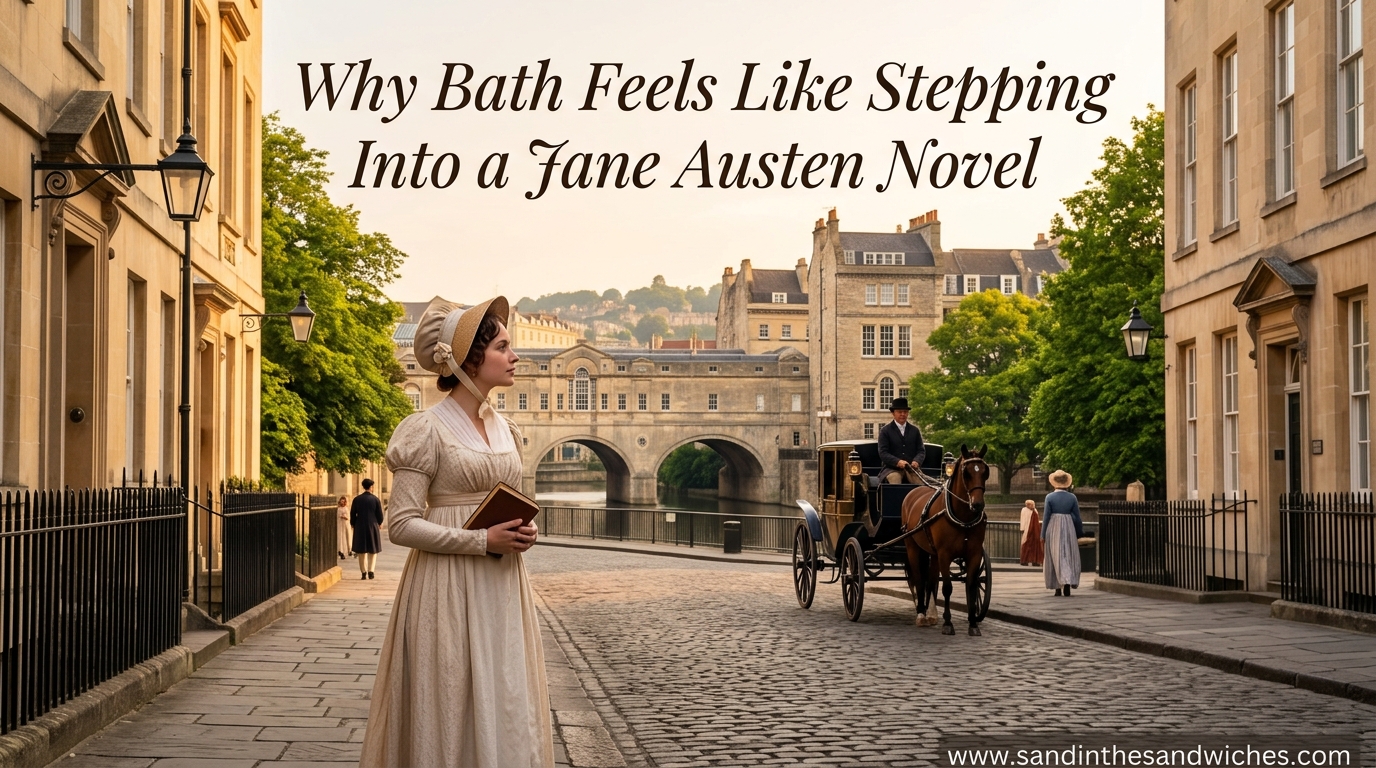
I rounded the corner from Milsom Street on a grey October morning, and there it was: a woman in a bonnet, a long wool shawl, and half-boots walking a spaniel along the gravel path behind the Royal Crescent. For a single, slightly disorienting second, my brain insisted she had wandered off the set of a BBC adaptation. That is the strange trick Bath plays on visitors. It is not that the city is old. Half of Europe is old. It is that the specific era Jane Austen wrote about, the Georgian and Regency world of 1800 to 1817, has refused to leave. The honey-coloured Bath stone still glows the same gold it did in her lifetime. The crescents still curve in their elegant arcs. And the social rituals she mocked in her novels, the public breakfasts, the circulating libraries, the daily taking of the waters, still echo in the Pump Room. If you have ever wondered why Bath feels like stepping into a Jane Austen novel, the honest answer is that the city is the novel. We just get to walk through it.
Table of Contents
Jane Austen’s real Bath: what the novelist actually knew
Jane Austen lived in Bath from 1801 to 1806, and the city seeped into her writing the way a cup of tea soaks into a saucer. She arrived as a 25-year-old writer whose first three novels, Sense and Sensibility, Pride and Prejudice, and Northanger Abbey, were already drafted but unpublished. Her father, George Austen, had retired there for the supposed health benefits of the mineral springs, and Jane moved with her parents and her sister Cassandra into lodgings at 4 Sydney Place, a graceful terraced house a short walk from Sydney Gardens.
Those five Bath years were quieter, lonelier years for Austen. She wrote very little that we know of. The teenage fizz of her early drafts gave way to a long creative pause, broken mostly by letters to Cassandra, who was often away. She did, however, take the waters at the Pump Room, attended concerts at the Assembly Rooms, promenaded in Sydney Gardens, and walked the Gravel Walk behind what is now the Holburne Museum. All of those locations show up, transformed, in the books that followed her move.
By 1809 she was back in Hampshire, in the Chawton cottage where she would publish her four later novels. But Bath kept working on her. Her final completed novel, Persuasion, is set almost entirely in the city, and Northanger Abbey takes a sharp detour from the gothic to send Catherine Morland into the Bath social season. The Bath of her pages is a place of witty drawing-room banter, disappointing dances, and a slightly exhausted pleasure trade. It is also recognisably the same place visitors walk through today.
Austen herself was famously ambivalent about the city. In a letter to Cassandra from November 1800, written just before the family moved, she made her feelings plain: “It will be two years tomorrow since we left Bath for Clifton, with what happy feelings of escape.” She came anyway, and lived there five years. The city got under her skin in spite of herself, the way the most interesting places always do.
Georgian architecture: the set design that refuses to be remodelled
Bath’s visual identity as “Austen-land” comes down to one unusually disciplined decision by the city over three centuries: a refusal to knock it down and start again. The honey-coloured Bath stone, quarried locally, gives every facade in the centre a warm gold tone that changes through the day. In late afternoon, the crescents glow almost amber. On a wet morning, they look like burnt sugar.
The architecture itself is the work of two names any Austen fan should know. John Wood the Elder designed The Circus, a ring of grand terraced houses completed in 1764, and Ralph Allen’s influential Quarry Hotel helped inspire the Palladian revival that swept through the city. John Wood the Younger, his son, then designed the Royal Crescent, completed in 1774. The Royal Crescent is a sweeping arc of 30 terraced houses that looks, from the lawn in front, exactly like a film set, because it has been a film set many times. The facade is uniform, the proportions are faultless, and the effect on a first-time visitor is the slightly giddy feeling of having walked into a wedding cake.
Walking from the Royal Crescent down Brock Street, then along the length of Milsom Street, you pass the same kind of high-end retail that the Austen family would have recognised. Milsom Street in Northanger Abbey is the home of the circulating library where Catherine Morland borrows her gothic horrors, and it was also the location of actual circulating libraries in Austen’s day, the bookshop-lending hybrids that functioned as dating apps for the Regency middle classes. Today you can still browse bookshops, though the modern purveyors tend to sell hardback fiction and Persephone Books reprints rather than The Mysteries of Udolpho.
The Pump Room and the Roman Baths: where the social world happened
If any single place answers the question of why Bath feels like stepping into a Jane Austen novel, it is the colonnaded room above the Roman Baths. The Pump Room has been the social heart of Bath since 1706, and Austen sets scenes there in both Northanger Abbey and Persuasion. Catherine Morland, Isabella Thorpe, and the Tilney siblings drink their first tepid glass of mineral water in the Pump Room. Anne Elliot, in Persuasion, walks past it on her way to the Octagon Room of the Assembly Rooms.
The ritual Austen was writing about is still performed. The hot spring water, which arrives at the surface at about 46 degrees Celsius, is served to visitors in the Pump Room from a small fountain, along with a hand-pump font for those who prefer to take a smaller dose. It tastes, to put it gently, of warm egg. The social point was never the taste. It was being seen drinking it. The Pump Room today is a tearoom and restaurant that serves afternoon tea, and the experience of being handed a small glass of warm mineral water by a server in Regency-style livery is, somehow, exactly as faintly ridiculous and oddly moving as Austen described.
Beneath the Pump Room, the Roman Baths themselves are older than any Austen could have imagined. The Romans built a bathing complex here around 70 AD, and the steaming green pool you see today is the same spring the Romans tapped. Austen would have known the Baths as a tourist attraction, not a working bathhouse. The very modern Thermae Bath Spa, opened in 2006, restored the tradition of actually bathing in the waters. You can take a steam in the Georgian-style hot rooms or float in the open rooftop pool while the city spreads below. It is, in a literal sense, the closest living experience to what Austen and her characters did and did not quite manage to do.
The Jane Austen Centre: a small museum that punches above its weight
Set in a townhouse at 40 Gay Street, the Jane Austen Centre is not the house where she actually lived (that was at 4 Sydney Place and is now a private residence, though the lower floor is occasionally available as a holiday let). The Centre is a museum run by a charity dedicated to the author’s life in Bath, and it has a small permanent exhibition on the third and fourth floors, plus a wax figure of the writer herself on the first floor that has been known to startle a few visitors.
TripAdvisor reviews, as is the way, run from rapturous to underwhelmed. I went in expecting a heritage-tour dustiness and came out charmed by the level of detail, including the small exhibits on servants’ working conditions, the Regency costume display, and a tearoom that serves fan-flavoured fancies. The Centre also runs the annual Jane Austen Festival in September, with costumed parades, walking tours, and a Grand Regency Costumed Promenade through the city centre that is one of the most surprising sights in the British events calendar.
For a more pointed look at the social world Austen satirised, head to No. 1 Royal Crescent. This is the first house in the Crescent, restored to a Georgian townhouse interior, and from spring 2025 it hosted a new exhibition called Bath: The Most Tiresome Place in the World, taking its title from a Catherine Morland outburst in Northanger Abbey. The exhibition is a thoughtful look at why Austen, while using Bath as a setting, was so often gently savage about its pleasures.
Sydney Gardens: the place Austen actually liked
Of all the locations in Bath connected to Jane Austen, Sydney Gardens is the one that surprises visitors most. Where the Royal Crescent and the Pump Room deliver on the obvious cinematic promise of an Austen city, Sydney Gardens is quieter, leafier, and a great deal more human.
Sydney Gardens was a commercial pleasure garden opened in 1795, a sort of Georgian theme park that charged a shilling for entrance, served tea in a pavilion, offered boating on a kidney-shaped lake, and hosted fireworks. The Austen family moved into 4 Sydney Place in 1801, and the gardens were effectively on their doorstep. Diana White, the historian who has worked extensively on the Sydney Gardens story, has pointed out that Austen and Cassandra walked there almost daily. The shilling entrance fee was modest enough for the Austen budget.
Persuasion readers will recognise the gardens as a quiet setting for Anne Elliot’s reflective walks and as a meeting point for several of the novel’s social gatherings. The gardens survive, astonishingly intact. You can still walk the same paths the Austen sisters walked, sit under the same plane trees, and rent a boat on the same lake (now the Sydney Gardens Boating Lake, run by a local community trust). A small but well-curated Sydney Gardens interpretation display explains the layout in Regency terms. It is, of all the Bath locations, the one that feels least like a set and most like a place a person could simply inhabit.
The Gravel Walk: Persuasion’s quiet heart
Persuasion, Austen’s last completed novel, is the most Bath-set of all her books, and the Gravel Walk scene is its emotional centrepiece. Captain Wentworth’s famous letter to Anne Elliot, in which he confesses he has loved her all along, is read aloud in the book by Captain Benwick, but the novel’s most tender moment takes place earlier, when Wentworth helps a small boy retrieve a hat he has tossed into the high hedge along the Gravel Walk. Anne sees Wentworth from a window, walks out to him, and the two share the scene that turns the whole novel’s resolution.
The real Gravel Walk runs along the back of the Holburne Museum, formerly the Sydney Hotel, where the Austen family attended balls. The path is exactly as Persuasion describes: a narrow, raised walkway between high hedges, with a second gravel path at a lower level, and a low wall overlooking the road. Walking it, you have to do a small double-take. The path is essentially unchanged. The hedge is taller. The light is the same.
The Holburne Museum itself sits at the end of the walk, and it is a worthwhile stop on any Jane Austen itinerary in its own right. The Holburne hosts a small collection of period paintings, silver, and porcelain, and was used as Lady Danbury’s house in the first two series of Netflix’s Bridgerton, which has made it a fixture on a new generation of period-drama-themed Bath visits.
Beechen Cliff and the Northanger Abbey skyline
Vogue’s 2025 walk-through of Austen’s Bath singled out Beechen Cliff as one of its most evocative stops, and the choice is more than scenic. Beechen Cliff is a steep, tree-covered limestone escarpment that rises directly above the city centre, and Catherine Morland climbs it in Northanger Abbey on a walking outing with Henry and Eleanor Tilney. From the top, the view back across Bath is the exact composition an early-19th-century engraver would have recognised: the Abbey in the foreground, the crescents behind, the river curving south through the valley.
There are two main routes up. The first is the wooded zig-zag path starting near the Jane Austen Centre on Gay Street, a quiet climb that emerges at a viewpoint used by generations of Romantic poets and painters. The second is the more formal Alexandra Park approach, which gives you a longer, gentler walk. Either way, plan for at least 45 minutes up and back, and bring a water bottle, because the path is steep enough to leave Catherine Morland feeling fatigued and she is fictional.
For Northanger Abbey pilgrims, the literary payoff of standing on Beechen Cliff and looking back at Bath is the realisation that the landscape Austen was writing about is the same one the visitors are still looking at. The Abbey has been restored, the crescents have been kept in use, and the river still curves the same way. Catherine’s day out is reproducible.
Literary Bath: the novels, the city, and Austen’s ambivalent love
Austen’s six published novels all touch Bath in some way, though only two of them are truly Bath novels. Northanger Abbey, written in the late 1790s and revised for publication in 1817, follows Catherine Morland into the city and makes a pointed joke of Catherine’s disappointment that Bath is not the gothic setting of her imagination. Persuasion, completed in 1816 and published posthumously in 1818, is a different kind of book, quieter and a little sadder, in which Bath is the backdrop for a second-chance love story between Anne Elliot and Captain Wentworth.
The other four novels mention Bath as a place characters go for the season, and as a useful shorthand for social striving. John Willoughby in Sense and Sensibility has a Bath past. George Wickham, the charming liar of Pride and Prejudice, decamps to Bath when his debts catch up with him in Meryton. Mrs Rushworth in Mansfield Park, in one of Austen’s most pointed social cuts, gives up her country home for the superior society of the Bath season. Emma, more loosely, makes a glancing reference to the town. Bath in Austen’s hands is, more than any other English city, a moral instrument. A character can be measured by how they behave there.
Austen’s own feelings about Bath were complicated. She was sardonic about its social rituals, sharp about its marriage market, and clear-eyed about its commercialism. But she also returned, in Persuasion, to write about it as the setting for one of the most tender love stories in the English language. The city got under her skin. It still does, and that is the trick. The novel we are walking through when we visit Bath is, in the end, the novel Austen could not quite stop writing about.
Walking in Jane Austen’s footsteps: a one-day itinerary
Most visitors can cover Austen’s Bath in a long day, with comfortable shoes and an early start.
Begin at the Jane Austen Centre on Gay Street, when it opens at 10am, and walk down to the Circus and the Royal Crescent for the most concentrated dose of Georgian architecture in the country. From the Crescent, walk through Brock Street into Milsom Street and on to the Pump Room above the Roman Baths. Take the waters, then lunch in the Pump Room, or walk the short distance to Sally Lunn’s, the oldest house in Bath, for a Bath bun and a pot of tea.
In the afternoon, cross the river at Pulteney Bridge and walk along the Kennet and Avon towpath to the Holburne Museum and the Gravel Walk. End the day with tea in the Holburne garden, or, if you have a free evening, climb Beechen Cliff for the sunset. A second day, if you have one, is best spent in the Assembly Rooms, Sydney Gardens, and a slow browse of the bookshops on Milsom Street. Persephone Books and Toppings & Co are the two best for the literary-minded visitor.
Bath is a 90-minute train ride from London Paddington and around an hour and a half by direct service from Cardiff. Driving takes about two and a half hours from London via the M4, and parking in the city centre is limited and expensive, so the train is the better option for most visitors. The September Jane Austen Festival is the obvious time to visit for a deep dive, but Bath in winter, with the Christmas Market running in the Abbey churchyard, has its own quieter charm.
FAQs
What is the connection between Bath and Jane Austen?
Jane Austen lived in Bath from 1801 to 1806, after her father retired there for the supposed health benefits of the mineral springs. The city appears in all six of her published novels, and two of them, Northanger Abbey and Persuasion, are set there. Bath’s Georgian architecture, social scene, and spa culture fed directly into her writing and shaped how readers picture the Regency world.
Did Jane Austen like living in Bath?
Austen’s feelings about Bath were famously ambivalent. In a November 1800 letter to her sister Cassandra, written just before the family moved, she described leaving the city with feelings of escape. She lived there five years anyway, walked almost daily in Sydney Gardens, attended the Assembly Rooms, and returned to Bath in her final completed novel, Persuasion, with clear affection for the city even while gently mocking its social rituals.
What Jane Austen novels are set in Bath?
Two of Austen’s six published novels are set substantially in Bath. Northanger Abbey follows Catherine Morland into the Bath social season and satirises both gothic fiction and Regency society. Persuasion, Austen’s last completed novel, is set almost entirely in the city and follows Anne Elliot and Captain Wentworth. The other four novels mention Bath as a place characters visit for the season.
What are the best Jane Austen sites to visit in Bath?
The five essential Jane Austen sites in Bath are the Jane Austen Centre on Gay Street, the Pump Room and Roman Baths, the Royal Crescent and No. 1 Royal Crescent, the Gravel Walk behind the Holburne Museum, and Sydney Gardens near the old family home at 4 Sydney Place. Add the Assembly Rooms for the social context and Beechen Cliff for the Northanger Abbey view.
How long do you need at the Jane Austen Centre?
Plan for about 90 minutes at the Jane Austen Centre, including the wax figure display, the permanent exhibition on Austen’s life in Bath, and the small Regency tearoom. Visitors with a strong interest in costume, letters, or Regency social history can easily spend two hours, and the Centre runs occasional costumed workshops that extend the visit further.
Stepping back out of the novel
Bath is one of the very few cities in the world that lets you walk in and out of a literary period without thinking about it. The crescents are still crescents, the Pump Room still serves the waters, the Gravel Walk still has its hedge. The reason why Bath feels like stepping into a Jane Austen novel in 2026 is that the city never quite stepped out of one. The 250th anniversary of Austen’s birth, marked across 2026, has brought fresh attention to the smaller details, from the circulating-library shelf at the Jane Austen Centre to the small brass markers noting where she shopped. Walk the city slowly, read Persuasion on the train down from London, and you will see what I mean. The book is the city. The city is the book. And, in Bath, both are still open.