
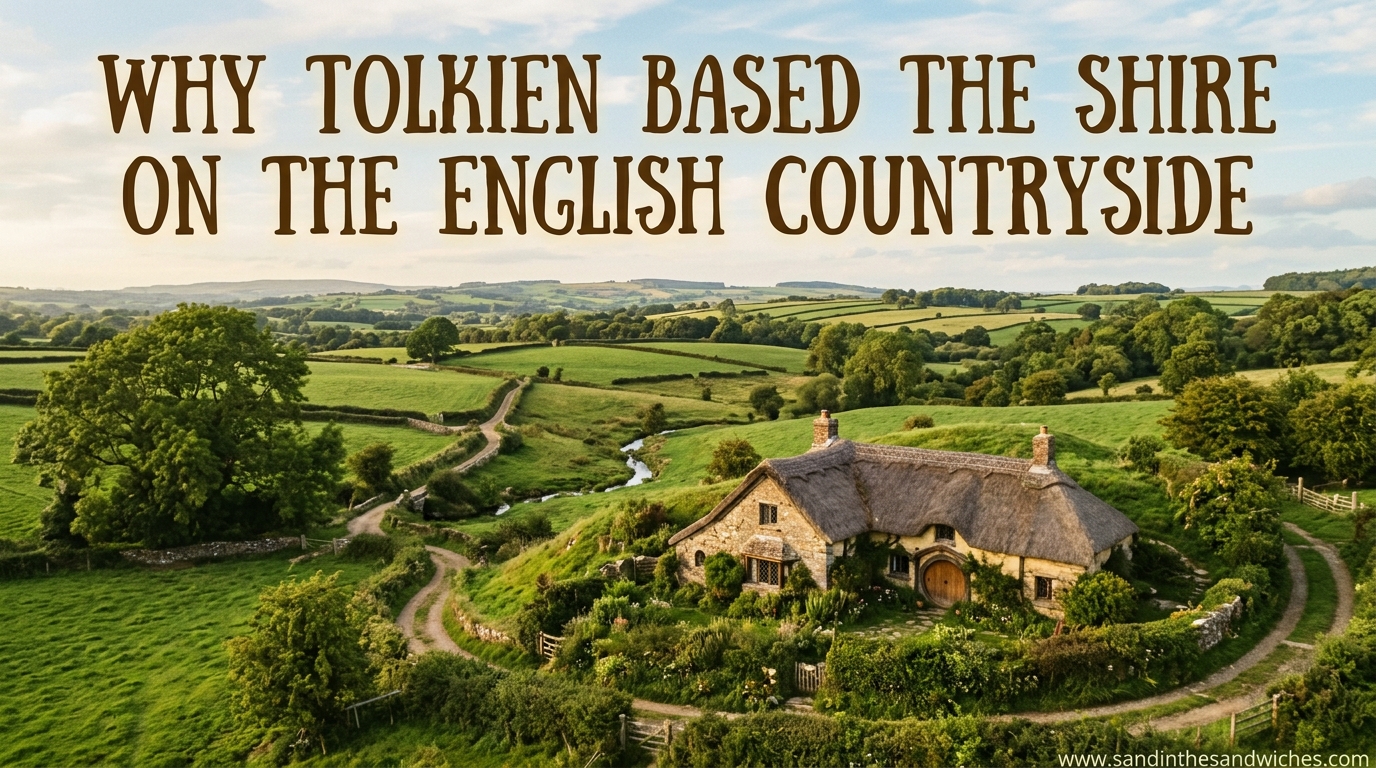
J.R.R. Tolkien based the Shire on the English countryside of his childhood, specifically a few cherished square miles of actual countryside around Sarehole Mill in Warwickshire and Worcestershire, where he lived between 1896 and 1900. In a 1966 newspaper interview, Tolkien himself confirmed this, calling the Shire “inspired by a few cherished square miles of actual countryside at Sarehole.” That simple, direct answer unlocks a deeper story about memory, loss, and a writer’s attempt to preserve a vanishing world in fiction.
If you have ever wondered why the Shire feels so vivid, so grounded, so unmistakably English, the answer is not pure imagination. It is autobiography. Tolkien took the hedgerows, the corn-grinding mills, the rolling farmland, and the village life of late-Victorian rural England and translated them into a fictional homeland for his hobbits. He did this with such care that scholars now study the Shire as a near-documentary record of a vanished countryside.
This article explores the real places, the personal grief, and the cultural forces that explain why Tolkien based the Shire on the English countryside. We will walk through Sarehole Mill, the Warwickshire fields, the rising smoke of industrial Birmingham, and the walking trails that still let you trace his footsteps today.
Table of Contents
The Childhood Paradise: Sarehole Mill and Tolkien’s Early Years
The story of the Shire begins in 1896, when four-year-old Ronald Tolkien moved with his widowed mother Mabel and younger brother Hilary to a cottage beside Sarehole Mill, then a working watermill on the River Cole in the Worcestershire countryside just outside Birmingham. After the death of their father in South Africa, Mabel Tolkien had returned to England and chosen this quiet rural spot to raise her sons.
For the next four years, Sarehole was Ronald’s world. The boys explored the millpond, watched the miller grind corn, climbed trees, and wandered through meadows and orchards. Tolkien later said that he based the Shire on this small patch of countryside and the years he spent there were his happiest childhood memories. The mill itself, with its creaking wheel and the miller who the boys found terrifying, was later transmuted directly into the mill at Hobbiton operated by Ted Sandyman.
In a now-famous newspaper interview, Tolkien described the area around Sarehole as the inspiration for the Shire, calling it “a few cherished square miles of actual countryside.” He remembered the place in extraordinary detail, decades later, the millpond, the willow trees, the mushrooms they used to steal from a farmer’s field (an episode that surfaces directly in the early chapters of The Hobbit, when young hobbits are caught mushroom-poaching by Farmer Maggot).
What Tolkien lost when he left Sarehole in 1900 was not just a house but a way of seeing the world. He carried those four years with him for the rest of his life. Everything he later wrote about the Shire, its lanes, its gardens, its slow village rhythms, was an act of preservation. He was writing back toward a place he could never quite return to.
Warwickshire and Worcestershire: The Geographic Foundation
Sarehole Mill sat right on the boundary between Worcestershire and Warwickshire, two counties whose landscapes Tolkien drew on directly. In letters and academic writings, Tolkien confirmed that the Shire’s landscapes, climate, flora, fauna, and place-names were all based on Worcestershire and Warwickshire. This was not loose inspiration. It was, by Tolkien’s own description, a fairly literal translation.
The Shire’s geography mirrors this region with deliberate care. The rolling farmland, the slow rivers, the patchwork of small villages connected by lanes rather than highways, the patches of woodland and common grazing land, all of these are recognizable features of the Warwickshire and Worcestershire countryside as it existed around the turn of the twentieth century. Even the weather of the Shire, mild and wet, with long autumns and gentle summers, is the weather of the English Midlands.
Tolkien’s training as a philologist, a scholar of historical languages, made the place-name connection even stronger. He grew up surrounded by Anglo-Saxon place-names, many of them in the old Mercian dialect that he spent his academic career studying. The kingdom of Mercia had covered exactly this part of England. When Tolkien named hobbit settlements like Michel Delving, Tuckborough, or Bywater, he was constructing English-style place-names using the same linguistic roots he studied professionally. The Shire is not just set in England geographically. It is named in English, linguistically, at the deepest level.
This is why Tolkien scholars often call the Shire a pastoral England rendered in miniature. It is the real Warwickshire countryside, distilled through one man’s memory and scholarship into something at once familiar and mythic.
Why Tolkien Based the Shire on the English Countryside: The Nostalgia Factor
To understand why Tolkien based the Shire on the English countryside, you have to look past the geography and into the grief. Tolkien lost his father when he was three. He lost his mother when he was twelve. By the time he was a teenager, the safe rural childhood of Sarehole was gone forever, and so were the people who had shared it with him.
That loss shaped everything he wrote. The Shire is not just a setting. It is a memorial. Tolkien was reconstructing, in fiction, the world that had been taken from him. When hobbits talk about home, when they long for their smial and their garden and their second breakfast, they are speaking with the voice of a man who lost his own home young and never fully recovered from it.
Tolkien described the Shire in his letters as a kind of lost paradise, an idealized version of rural England as he remembered it from childhood. Friends and biographers have noted that his descriptions of hobbit life are saturated with sensory detail, the smell of cut grass, the sound of a millwheel, the taste of fresh bread, that can only come from vivid personal memory. The Shire is the most autobiographical place in all of Middle-earth precisely because it is built out of things Tolkien actually heard, smelled, touched, and tasted as a small boy.
Several forum discussions on Reddit’s r/tolkienfans highlight this emotional layer, with readers noting that the Shire feels different from the rest of Middle-earth. It feels real in a way that Mordor or Rivendell do not, because it is not invented from mythology. It is remembered from life. That is the nostalgia factor. Tolkien did not base the Shire on the English countryside because he needed a setting. He based it there because he was trying to get back to a place he had loved and lost.
Industrialization and the Disappearing Countryside
The other half of why Tolkien based the Shire on the English countryside is what was happening to that countryside while he watched. When Tolkien returned to the Birmingham area as an adult, the rural Sarehole of his childhood had been swallowed by spreading suburbs. The mill had stopped grinding corn. The lanes he had wandered were being paved over. The hedgerows were being torn out.
Tolkien hated this. He was openly and vocally hostile to industrialization, mechanization, and the spread of what he called “the machine.” In his letters, he railed against the destruction of the English countryside by developers, factories, and motorways. This was not a casual opinion. It was one of the deepest convictions of his life, and it shaped the moral universe of The Lord of the Rings.
The clearest expression of this is the chapter “The Scouring of the Shire,” near the end of The Return of the King. When the hobbits return home after the war, they find the Shire has been industrialized by Saruman’s men. Trees have been felled, ugly new buildings thrown up, the old mill replaced by a larger, polluting one, and hobbits driven off their land. This chapter is not just fantasy drama. It is a direct, barely-fictionalized protest against what Tolkien saw happening to the real English countryside in his own lifetime. Saruman’s “Sharky” is a stand-in for every developer and industrialist who paved over the fields Tolkien loved.
Isengard itself, with its furnaces, pits, and wheels, is Tolkien’s image of industrial England turned to evil. The contrast between the green Shire and the blackened, mechanized Isengard is the central moral contrast of the book, and it comes directly from Tolkien’s own experience of watching the Birmingham sprawl consume the countryside he had grown up in. The Shire is based on the English countryside partly because Tolkien wanted to defend that countryside, in fiction, against the forces that were destroying it in reality.
Hobbiton and Real-World Parallels
Hobbiton, the village at the heart of the Shire, has specific real-world parallels that Tolkien drew on directly. The hobbit holes, with their round doors and their burrow-like construction, are not pure invention. The English countryside was full of agricultural workers’ cottages dug into banks and hillsides, and Tolkien would have seen these as a child. The round door may be the most famous hobbit design feature, but the idea of a cozy, half-underground home built into the earth is rooted in English vernacular architecture.
The Green Dragon Inn, where Frodo and his friends gather before setting out, is a classic English village pub. Hobbit parties, with their tents, their bonfires, their fireworks, and their enormous shared meals, are village fêtes and harvest festivals translated into fiction. Even the social structure of the Shire, with its respectability, its family genealogies, its dislike of adventure and its love of routine, is recognizably based on the close-knit village life of rural England in the late Victorian and Edwardian periods.
Tolkien himself said that hobbits were inspired by ordinary Englishmen living in villages among peaceful landscapes. He was one of those Englishmen, or had been, briefly, before his childhood ended. Every detail of Hobbiton, from Bag End’s well-stocked larder to the gossiping of Lobelia Sackville-Baggins, is drawn from a real social world Tolkien had observed firsthand.
The Shire as a “Calque Upon England”: Academic Perspective
Scholars who study Tolkien often use a specific term for what he did with the Shire: they call it a “calque upon England.” A calque is a word-for-word translation from one language into another. To say the Shire is a calque upon England is to say that Tolkien translated England into a fictional register, keeping its essential character while changing its surface details.
Tolkien himself used this phrase, or close variants of it, in his letters. He was clear that the Shire was not England in disguise. It was, rather, a constructed version of what he wished England, or at least the best parts of rural England, could be. The geography and political history of the Shire are invented. But its culture, its feel, its climate, its agriculture, and its people are English, deliberately and unmistakably.
Some Tolkien scholars, including the writers at Middle-earth Xenite, have argued that the geography and history of the Shire bear “no resemblance to real England” in a literal sense, since the Shire’s borders and its place in Middle-earth do not map onto the actual map of Britain. That distinction is important. The Shire is not a portrait of England as a political entity. It is a portrait of English rural culture, transported into a fictional landscape. Tolkien drew the people and the way of life from memory, but he gave them a new continent to live on.
This is why Tolkien resisted attempts to map the Shire onto specific real-world locations too literally. He wanted readers to feel the Englishness of the Shire without mistaking it for a guidebook. The Shire is England distilled, not England photographed.
Visiting Tolkien’s England Today
If you want to see the countryside that inspired the Shire, you can still visit it, though it has changed. Sarehole Mill still stands. It is now a museum run by the Birmingham Museums Trust, restored to look much as it would have in Tolkien’s day, complete with the working waterwheel that fascinated him as a boy. The surrounding area, however, is no longer rural. Birmingham’s suburbs have long since surrounded the mill, and visitors on Reddit often express disappointment that the unspoiled countryside Tolkien described is now buried under housing estates and ring roads.
That said, the Tolkien Trail, a walking route through the parts of Warwickshire and Worcestershire associated with Tolkien, still offers stretches of genuine countryside. Walking the lanes around Warwick, Kenilworth, and the villages of the Forest of Arden, you can still find hedgerows, old mills, and slow rivers that feel unmistakably Shire-like. Reddit users on r/AskUK and r/tolkienfans regularly recommend the Warwickshire countryside as the most “Tolkienish” part of England still surviving.
For those who want to go further afield, the Cotswolds, the Malvern Hills (where Tolkien walked with C.S. Lewis), and the rolling farmland of northern Worcestershire all preserve something of the landscape Tolkien carried in his memory. None of them is the Shire, exactly. But all of them are close enough that you can understand, standing in them, why Tolkien based the Shire on the English countryside rather than anywhere else.
The irony is that the very thing Tolkien feared, the destruction of rural England by industry and sprawl, has continued in the century since he wrote. The Shire survives, in the end, only in fiction. That may be the deepest reason of all for why he created it.
FAQs
Is the Shire based on the English countryside?
Yes. Tolkien confirmed in interviews and letters that the Shire was inspired by a few cherished square miles of actual countryside around Sarehole Mill in Warwickshire and Worcestershire, where he spent his childhood from 1896 to 1900.
Where did Tolkien get the inspiration for the Shire?
Tolkien drew his inspiration from the rural English countryside of his childhood, especially Sarehole Mill, the surrounding villages of Warwickshire and Worcestershire, and the Anglo-Saxon place-names and Mercian dialect he studied as an academic philologist.
What part of England inspired the Shire?
The Shire was primarily inspired by the countryside around Sarehole Mill on the border of Warwickshire and Worcestershire, then a rural area just outside Birmingham. Tolkien also drew on the wider Warwickshire countryside and the Forest of Arden region.
Why do most English counties end in shire?
The suffix -shire comes from the Old English word scir, meaning an administrative district or share of land. Many English counties established during the Anglo-Saxon period were named this way, which is also why Tolkien used the word for his fictional hobbit homeland.
Can you still visit the places that inspired the Shire?
Yes. Sarehole Mill is now a museum in Birmingham and still features the working waterwheel Tolkien knew as a boy. The Tolkien Trail and the surrounding Warwickshire countryside also offer walks through landscapes that preserve much of the rural character Tolkien remembered.
Conclusion
Why Tolkien based the Shire on the English countryside is a question with a single, simple answer at its surface and a deeply human answer underneath. The simple answer is geography: Tolkien grew up at Sarehole Mill in Warwickshire and Worcestershire, and he built the Shire directly from that landscape, its hedgerows, its mill, its lanes, and its village life. He said so himself, in plain language, more than once.
The deeper answer is that Tolkien was writing out of loss. He lost his parents, he lost his rural childhood, and he watched the countryside he loved disappear under Birmingham’s expanding sprawl. The Shire is his attempt to preserve, in fiction, a world he could not hold onto in life. Every round hobbit door, every stolen mushroom, every pint at the Green Dragon is a small act of memory and resistance.
If you want to understand Tolkien, walk through a quiet English village on a wet autumn afternoon and imagine it. That feeling, half-peaceful and half-sad, is what he was trying to capture. He based the Shire on the English countryside because it was the only home he ever truly loved, and because by writing it down, he could keep it alive a little longer.