
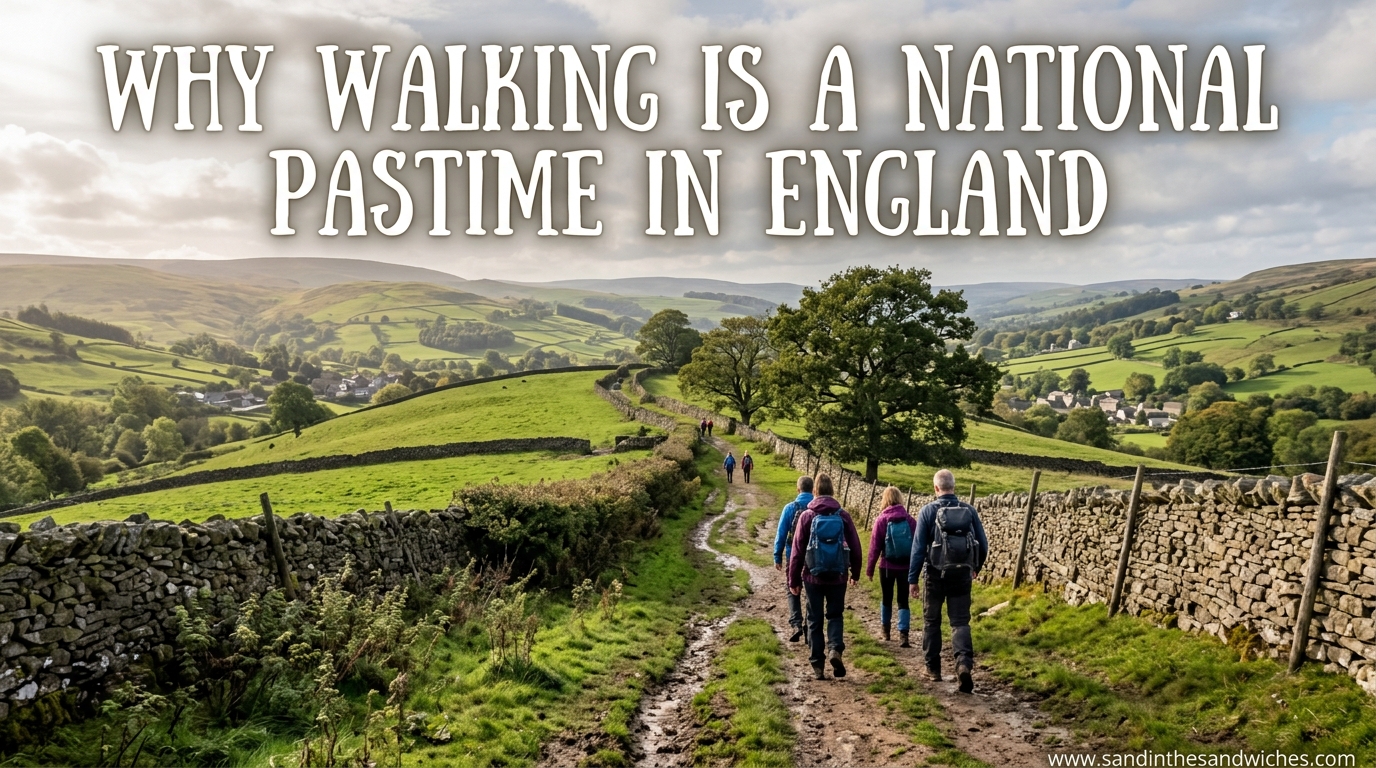
I lost count of how many times I said hello that Sunday. I was somewhere on the Cotswold Way, somewhere between a stone wall older than my country and a pub that had been pouring ale since the 1600s, when a man in a flat cap and walking poles nodded, smiled, and asked where I was headed. “Just out for the day,” I told him. “Good lad,” he said, like we’d known each other for years. Then he walked on, steady as a metronome, into a fine mist that anyone else would have called bad weather.
That brief exchange captured something I have come to think of as a very English magic. Walking, in England, is not just exercise or transport. It is a quiet social contract. It is how millions of people choose to spend their weekends, their holidays, and the smallest slivers of free time between work and sleep. According to the latest GOV.UK walking statistics, seven out of ten adults in England walk for leisure at least once a week, and the country logs well over 500 million walking trips every year.
So why is walking practically a national pastime in England? The honest answer is layered, stretching back more than three centuries, crossing class lines, royal estates, mining villages, and the Lake District. It is the story of how a country that once viewed walkers as vagrants came to view them as custodians of the countryside. It is a tale of poets, trespassers, Victorian health reformers, ramblers, and millions of us in waterproof jackets. And it is, I would argue, one of the most underappreciated parts of English culture.
This guide traces that story from the 18th century to today. We will look at the historical shift from walking as necessity to walking as pleasure, the role of the Romantic poets, the fight for the right to roam, the trails that defined a nation, and the social rituals – the pub stops, the weather jokes, the group walks – that keep the tradition alive. I have pulled in statistics from GOV.UK, historical records, and the experiences of modern walkers. By the end, you will understand not only why the English walk, but why they cannot seem to stop.
Table of Contents
Walking Is Practically a National Pastime in England: The Short Answer
Walking is practically a national pastime in England because three centuries of cultural, legal, and social change turned an act once associated with poverty into one of the country’s most cherished traditions. The 18th century Romantic Movement gave walking moral and aesthetic value, the 19th and 20th century access movements gave walkers legal rights, and the 21st century has turned the walk into a pillar of British health, community, and identity.
If you have ever wondered why a country with such a small landmass has more than 140,000 miles of public footpaths, why the Ramblers’ Association counts more than 100,000 members, or why the South West Coast Path alone attracts eight million walking days a year, the short answer is this: walking in England is older than cricket, older than football, and far more universally loved. It is woven into the landscape, the law, and the way people say hello to strangers in the rain.
Walking in England at a glance
- 7 in 10 adults walk for leisure at least once a week (GOV.UK Walking Factsheet)
- Over 500 million walking trips a year are taken in England
- More than 140,000 miles of public footpaths crisscross the country
- England has 10 National Parks and 34 Areas of Outstanding Natural Beauty
- The Ramblers charity has more than 100,000 members and 500 local groups
- The Pennine Way, opened in 1965, was England’s first long-distance footpath
How Walking Shifted from Necessity to National Obsession
For most of English history, walking was not a pastime. It was a punishment. Before the 18th century, people on foot were often assumed to be poor, criminal, or both. The Vagrancy Acts of the Tudor and Stuart eras treated anyone walking without visible purpose as suspect. A man without a horse, a livery, or a destination was, in the eyes of the law, a problem to be moved on. Walking was what servants, soldiers, and peddlers did. It was not what respectable people did for fun.
The respectable alternative was a carriage, a sedan chair, or simply staying indoors. Even the gentry, when they needed to move through the countryside, travelled by horse. To be seen walking was, in many social settings, a quiet admission of failure. As the outdoor historian Sarah Lyon put it, the body in motion was, for centuries, the body that could not afford to be still.
Three forces began to change that, all of them gathering strength during the 18th and early 19th centuries. The first was intellectual. The Enlightenment, and the Romantic Movement that followed it, asked English people to look at wild landscapes and see something more than waste. Mountains, lakes, moors, and forests became places of moral and spiritual value, not just resources to be exploited or avoided. The second was industrial. The factories, soot, and overcrowding of cities like Manchester, Birmingham, and Sheffield made clean air and green space a kind of medicine. Workers and the new middle class alike needed somewhere to breathe. The third was medical. A growing body of writing argued that walking was good for the body, the mind, and the soul – a kind of free, portable, democratic therapy.
By the time Queen Victoria took the throne in 1837, walking had been thoroughly rebranded. The footpath was no longer a sign of poverty. It was a sign of taste, health, and patriotic appreciation of the homeland. That shift, more than any single act of Parliament, is the foundation of the modern English walking habit.
It is a shift worth dwelling on, because the rest of this story depends on it. Once walking became respectable, the question was no longer whether to walk, but where, how, and with whom. The rest of the 19th century is, in a sense, the long answer to that question.
The view of walking as a sign of poverty, before the 18th century
To understand how strange modern English walking culture is, you have to understand how suspicious earlier centuries were of it. Tudor poor laws punished able-bodied people who wandered the roads. Local magistrates could imprison or whip a man simply for being on the move. The character of the “sturdy beggar” became a stock villain in 16th and 17th century writing. Travellers, tinkers, and peddlers were tolerated at best, arrested at worst.
Even in the early 1700s, Daniel Defoe could describe the English countryside as a place where the man on foot was assumed to be a rogue, and the man on horseback was assumed to be his betters. Walking was a confession of being unable to afford anything better. That is the cultural soil in which the Romantic Movement planted its seed. To take that soil and turn walking into a national pleasure took more than a generation. It took a small army of poets, clergymen, doctors, and guide-book writers.
There is a useful comparison here with continental Europe. In Italy, France, and Spain, the long walk had long been a normal part of religious and civic life. Pilgrims walked to Compostela, Rome, and local shrines. Soldiers marched across Europe. The English, by contrast, had inherited a deeply suspicious attitude to the unhorsed traveller. To change that took an unusual combination of cultural prestige and political pressure. The Romantics provided the first; the ramblers of the 20th century would provide the second.
The Romantic Movement Turned Walking into a National Pleasure
The Romantic poets did not invent walking. But they made it respectable. Between roughly 1750 and 1850, a rolling cast of writers, painters, and thinkers redefined what the English countryside was for. The Lake District, the Peak District, Snowdonia, and the Scottish Highlands stopped being forbidding wastes and started being places of awe. And the only way to experience them properly, the Romantics insisted, was on foot.
William Wordsworth, walking the Lake District fells with his sister Dorothy and his friend Samuel Taylor Coleridge, made pedestrian travel into a kind of religious practice. His long autobiographical poem The Prelude is essentially a meditation on what you see and feel when you walk slowly through landscape. John Keats wandered the Lake District and Scotland in the summer of 1818, and the long, untroubled walking tour became, in his letters, a model of the imaginative life. Percy Bysshe Shelley, Jane Austen, and later writers like Thomas Hardy built whole novels around the social meanings of a long country walk.
The Lake District in particular became the cradle of English walking culture. By the 1780s, wealthy visitors were arriving in the region, hiring guides, and seeking out the very best viewpoints. The challenge was that the best viewpoints were often unmarked, dangerous, and inaccessible. That is where one quiet guidebook writer changed everything.
It is worth pausing on the scale of this cultural shift. By 1800, the English landscape had gone, in the space of a single lifetime, from a place to be exploited to a place to be revered. The new feeling required new behaviour. Walking was the obvious response. Once a gentleman had decided that a mountain view was worth seeing, he had no choice but to walk up the mountain.
Thomas West and the guidebook that started a tourism boom
In 1778, a Scottish priest named Thomas West published A Guide to the Lakes, and it did for English walking what Michelin would later do for French driving. West’s idea was simple but new. He identified specific viewpoints around Windermere and Ullswater, built small stone shelters at each, and told walkers exactly how to reach them, what they would see, and why the view mattered. The shelters became known as “stations,” and the most famous of them, Claife Station on the western shore of Windermere, still stands today.
West’s guidebook was the first to treat the landscape as a series of curated experiences designed for the pedestrian visitor. It is fair to say he invented the scenic walk as we now know it. Within a decade, dozens of similar guides had appeared. By the 1820s, Windermere had its first steamship service. By the 1850s, the Lake District was a firmly established tourist destination. None of that tourism would have made sense without a culture that valued walking.
West’s legacy is the idea that the countryside can be read like a book, and that walking is the act of reading it. Once you have accepted that idea, the entire infrastructure of the modern National Park – the viewpoints, the visitor centres, the waymarked trails – follows almost inevitably. West is, in a real sense, the grandfather of every blue plaque and brown sign on a footpath in England.
The Romantics, in short, gave England two gifts. They gave it a national landscape worth walking in, and they gave it permission to walk there.
The Fight for the Right to Roam
Even as the gentry started taking genteel walks, much of the English countryside was still privately owned and strictly off-limits. Industrial cities were surrounded by private hunting estates, grouse moors, and landed farms where any walker caught straying from a public road risked being prosecuted, or worse, shot at. The freedom to wander that the Romantics praised in poetry was, in practice, denied to most of the population.
By the late 19th century, this contradiction had begun to spark a movement. Working-class groups in the industrial north of England started organising Sunday Tramps – mass walks into the countryside as a kind of quiet protest. The Manchester-based Sunday Tramps and the Federation of Rambling Clubs brought together factory workers, trade unionists, and socialists who believed that fresh air and open land were a right, not a privilege. The clubs sometimes numbered in the hundreds on a single walk.
The movement was loud, organised, and deeply threatening to landowners. In 1932, the pressure finally boiled over at Kinder Scout, a high moorland plateau in the Peak District. On Sunday 24 April, around 400 ramblers set off to walk the plateau in defiance of the Duke of Devonshire, who owned it. They were met by gamekeepers and police. A fight broke out. Five ramblers were jailed for “riotous assembly.”
The Kinder Scout mass trespass did not open the moor on the day it happened. But it did something far more durable. It put rural access on the national political agenda. Within 17 years, Parliament passed the National Parks and Access to the Countryside Act 1949, which created the legal framework for England’s ten National Parks and began mapping the public footpath network. Half a century later, the Countryside and Rights of Way Act 2000 finally extended a limited right to roam over registered common land and mapped open country.
For a country with such a long history of enclosure, the right to walk through private land is not a small thing. It is the reason the English countryside is, in practice, as accessible as it is. And it is the reason the walking habit is so class-transcending. Whether you are a doctor in Surrey, a retired miner in South Yorkshire, or a student in Cornwall, the footpath is the great social leveler of rural England.
The Ramblers charity: 100,000 walkers and counting
No organisation tells the story of modern English walking more clearly than The Ramblers. Founded in 1935 as a direct outgrowth of the access movement, The Ramblers now counts more than 100,000 members and supports more than 500 local walking groups across England, Scotland, and Wales. It maintains the definitive maps of public rights of way, trains volunteer walk leaders, and runs campaigns on everything from coastal access to dog-friendly paths.
The Ramblers is also the engine behind Britain’s long-distance trails. The charity helped establish the Pennine Way in 1965, England’s first official long-distance footpath, and continues to advocate for new National Trails. Without The Ramblers, the modern English walking map would look very different – and very much smaller.
The Ramblers also represents a quietly radical idea in British life. It says that you do not have to own the land to belong to it. You do not have to be a landowner, a duke, or a captain of industry to stand on a hilltop. You only have to be a person, in sturdy shoes, willing to put one foot in front of the other. In a country still defined by the legacy of enclosure, that is a powerful statement.
Modern Walking Culture: From Pub Walks to National Walking Month
Walk into any English village on a Sunday morning and you will see the tradition in action. Groups of two, four, ten, or twenty people, dressed in everything from £30 supermarket waterproofs to £400 Gore-Tex shells, setting off from the church car park, the village hall, or the back gate of the local pub. By lunchtime, half of them are in the pub, ordering roast beef and pints of bitter, muddy boots tucked under the bench. The other half have pushed on to do a longer loop. Either way, they will be back next week.
This is the everyday engine of English walking culture. It is not a single dramatic event. It is a habit, repeated millions of times, by millions of people. The British government estimates that walking generates more than £2 billion a year for the rural economy. A single 10-kilometre loop in the Lake District, the Cotswolds, or the South Downs can pass through two or three villages, each with its own tea room, pub, and bed-and-breakfast. Walking is the quiet backbone of the rural English economy.
A few numbers help to show the scale. The South West Coast Path, at 630 miles the longest National Trail in England, attracts roughly eight million walking days a year. The Pennine Way, opened in 1965, draws around 250,000 walkers a year for at least part of its length. The Thames Path, which follows England’s most famous river for 184 miles, is the most accessible of the lot, with multiple transport links and urban sections. Together, the 16 National Trails of England, Scotland, and Wales cover more than 2,500 miles.
On top of that, May is National Walking Month, run by the UK charity Living Streets. The campaign encourages a million “walk to school” trips, dozens of workplace step challenges, and free community walks in towns and cities. If you have ever seen a class of six-year-olds in hi-vis vests marching to school in May, you have seen National Walking Month in action.
The post-pandemic walking boom
If you wanted to put a date on the modern walking boom, you would pick 2026. The pandemic pushed millions of Britons outdoors for the first time, or for the first time in years. Searches for “walks near me” tripled. Sales of walking boots, hiking poles, and Ordnance Survey maps hit record highs. The Ramblers reported a 60 percent jump in membership interest during 2026 and the year after. Local councils scrambled to create new permissive paths to relieve pressure on popular routes.
Some of that boom has cooled, but the underlying shift has stuck. Walking is now the most common form of physical activity in England, ahead of gym sessions, swimming, and cycling. Roughly 30 million adults in England walk for leisure at least once a month. Walking has, in the space of a single generation, become the default British form of exercise.
The pandemic also changed who walks. Before 2026, walking groups skewed towards older, retired people. The boom brought in a much younger, more diverse crowd. New parents with buggies, students on tight budgets, office workers between Zoom calls, families looking for screen-free weekends – all of them rediscovered the footpath. That new, broader demographic is the main reason the post-pandemic walking habit has lasted.
Why Walking Stuck: The Health and Community Payoff
Health is the most obvious reason the walking habit has held. The NHS recommends that adults take at least 150 minutes of moderate exercise a week, and walking is the most accessible way to hit that target. It costs nothing. It does not require a subscription. It is low-impact enough for most people in their 80s and 90s, and challenging enough, in the Lake District or Snowdonia, to exhaust serious athletes.
But the health story is only half the reason walking stuck. The other half is community. Britain has a long tradition of organised group walks, run by volunteers and charities, that explicitly combine exercise with social connection. The Walking for Health Initiative, now part of the Ramblers, runs free short walks led by trained volunteers in towns and cities across England. Participants are often older adults, people with long-term health conditions, or people recovering from illness. The format is simple – a 30 to 90 minute walk, ending with tea and a chat – but the impact is significant. Public Health England has cited the programme as a model of low-cost, community-led preventative care.
The same pattern shows up in working-age walking groups, in mental health peer-support walks, in stroller-friendly buggy walks, and in rambling clubs for new arrivals and refugees. The English walking habit, in other words, is not just a private pleasure. It is a public health infrastructure, run on a shoestring, with surprisingly few staff and a great many volunteers.
There is a quiet, often unspoken class element to this, too. The British class system still has a long reach. Walking clubs are one of the few places where it softens. A retired professor, a junior doctor, a factory worker, a refugee, and a sixth-form student can walk side by side without anyone asking what they do for a living. The footpath is a small social democracy, hidden in plain sight.
The mental health dividend
The mental health case for walking is now well established, but it is worth restating. Multiple studies have found that even 20 minutes of green-space walking reduces cortisol levels, improves mood, and helps with anxiety and mild depression. For an NHS under pressure, this is significant. The average cost of a counselling session runs into the hundreds. The cost of a walk is, in most cases, zero. The British government has begun explicitly prescribing “green social prescribing” through the NHS, sending patients to walking groups instead of, or alongside, medication.
You do not need a prescription to feel the effect. Anyone who has stepped off a footpath and into a hill fog, or climbed a stile into a silent valley, knows the strange calm of a long walk. The English have been quietly counting on that effect for at least 200 years.
British Walking Lingo: What Rambling, Fellwalking, and Hillwalking Actually Mean
One of the small joys, and small confusions, of English walking culture is the vocabulary. To outsiders, the British use a baffling number of words for what looks like the same activity. Locals will tell you the words are not interchangeable, and they are not wrong. Here is the short version.
- Walking – the broad umbrella term. If you are on your feet and moving at a sensible pace, you are walking.
- Rambling – the classic British pastime, used for a leisurely countryside walk, usually on public footpaths, often with a pub at the end. The Ramblers takes its name from this tradition.
- Hiking – an American import, increasingly common in Britain, used for a longer, more demanding day walk, often off-road.
- Fellwalking – a Northern English term, used in the Lake District and Yorkshire Dales, for walking up the open fells, the high, treeless hills of the region. “Fell” is Old Norse for hill.
- Hillwalking – a Scottish and Welsh term, used for walking in upland terrain, often including some basic scrambling.
- Scrambling – using your hands as well as your feet, on rocky ground that is too steep to walk but too easy to climb. A borderline activity between walking and climbing.
It is a small language, but it tells you something about the culture. Different regions have different words because different regions have different terrain. The Lake District fells are not the same as the South Downs. The vocabulary is a map of the country’s geography.
Walking Through the Ages: How the English Walk Has Changed
The walking habit in England has not stayed still. The walk that a Georgian clergyman took in 1780, the walk a Victorian mill owner took in 1880, and the walk a modern retiree takes today look very different, even when they cross the same patch of ground. Comparing them across time helps to explain why the tradition has lasted.
| Era | Who walked | Why they walked | Typical kit |
|---|---|---|---|
| 18th century | Clergy, gentry,Romantic poets | Spiritual reflection,scenic tourism, philosophical exercise | Wool coat, top hat,leather shoes, walking cane |
| Victorian era(1837 to 1901) | Middle class, factoryworkers, women’s groups | Health, fresh air, respectability, escape from cities | Ankle boots, woollen skirtor trousers, walking stick |
| Early 20thcentury | Rambling clubs, tradeunionists, scouts | Working-class leisure,political protest, social bonding | Boots, breeches, rucksack,OS map |
| Post-1945 | Ramblers, long-distancehikers, National Park visitors | Long-distance challenges,holiday walking, family days out | Wellington boots, anorak,trousers, plastic mac |
| Modernday | Everyone, all ages andbackgrounds | Mental health, socialconnection, fitness, dog walking | Walking shoes, waterproofjacket, smartphone, OS mapapp |
Three things stand out. The first is the class shift. Walking started as something done by, and for, the elite. By the late 19th century, it had become something the working class demanded access to. By the 21st century, it was the most class-transcending activity in the country.
The second is the kit. The walking shoes of the 18th century would have been recognisable to a Roman legionary. The waterproof jackets of the modern walker are the product of two centuries of material science. The kit has changed, but the experience of putting one foot in front of the other for hours at a time has not.
The third is the motive. Health was once a side benefit. Today it is often the headline reason people walk. Mental health in particular has gone from something nobody talked about to the most common reason cited by new walkers. In other words, the English walking tradition has not faded because it has kept up with the times. It has survived because the times have kept needing what it offers.
Weather, Mud, and the British Walking Identity
No honest account of English walking culture can ignore the weather. Walkers from sunnier countries are often baffled by the sight of British ramblers setting off in horizontal rain, gusty wind, or grey drizzle. The answer, as any regular walker will tell you, is that waiting for the perfect day in England means waiting for a day that may never come. The English do not walk in spite of the weather. They walk with it, around it, and sometimes through it.
There is something almost philosophical about this. The walking tradition in England is built on the assumption that the weather will be unreliable, the paths will be muddy, and the views will be partly obscured by cloud. Plan for that, the tradition says, and you will rarely be disappointed. The waterproof jacket, the walking pole, the OS map in a plastic bag – none of these are exotic kit. They are standard equipment, the price of admission.
The mud, in particular, has become something of a national joke. The Ramblers’ annual “mud reports” for popular routes are read by thousands of walkers each winter. Wainwright, the great fellwalking guidebook writer, used to describe his favourite fells by the colour of the peat. The word “boot-wetter” exists in British English for a reason. To walk in England is to accept, with good humour, that you will probably get wet and quite possibly very muddy. It is one of the small, unspoken rules of the pastime.
This is not masochism. It is a cultural inheritance from a country whose climate has, for centuries, taught its people to be patient, prepared, and quietly funny about discomfort. The English have, in a sense, made the weather part of the walk. Without it, the tradition would not feel quite the same.
The Pub Walk: A Quiet National Institution
If you want to understand the social side of English walking, follow a group into a country pub at the end of a long route. The ritual is so consistent that you could set your watch by it. Muddy boots are left at the door, often with a slightly apologetic smile. Pint glasses of local ale appear within minutes. A round of roast beef, fish and chips, or a ploughman’s lunch follows. Someone produces a wet Ordnance Survey map to discuss the route home. By the time the plates are cleared, the group has already started planning the next walk.
This is the pub walk, a tradition that runs through the heart of English walking culture. It is not a marketing slogan. It is a centuries-old pattern of village life, in which the local inn is the natural finishing point of a Sunday ramble. The pattern grew up because villages were small, footpaths were practical, and public transport in rural areas was limited. The pub became the obvious meeting point and the obvious destination.
What the pub walk offers, in modern terms, is a built-in social reward. Walking in England is rarely presented as a competitive sport. It is presented as a shared experience, ideally with a pint at the end. That is one of the reasons it has stayed popular. It combines the four things British walkers say they want most: fresh air, exercise, good company, and a decent lunch.
The pub walk also explains why so much of the modern walking economy is small and local. The village pub, the village tea room, the village bed-and-breakfast – these are the infrastructure of the pastime. The big-chain hotels and tour operators are largely absent from the picture. The walking economy, like the walk itself, is built on a thousand small, often family-run businesses.
The Walking Habit Through the Centuries: A Quick Timeline
It helps to see the long story as a single line. Here are a few of the moments that turned walking into England’s national pastime.
- 1778 – Thomas West publishes A Guide to the Lakes, the first English scenic walking guidebook.
- 1810 – Wordsworth begins work on The Prelude, the great Romantic poem of pedestrian life.
- 1865 – The Commons, Open Spaces and Footpaths Preservation Society is founded, the first national body for path protection.
- 1905 – The Federation of Rambling Clubs is formed, organising mass Sunday Tramps in the industrial north.
- 1932 – The Kinder Scout mass trespass, 24 April, puts rural access on the national agenda.
- 1935 – The Ramblers is founded, the national body for walkers.
- 1949 – The National Parks and Access to the Countryside Act creates England’s National Parks and the footpath system.
- 1965 – The Pennine Way, England’s first long-distance footpath, officially opens.
- 2000 – The Countryside and Rights of Way Act extends a limited right to roam across registered common land.
- 2026 – The pandemic triggers a national walking boom, with sales of boots, maps, and walking poles hitting record highs.
Read those dates in order and a pattern appears. Walking in England was, in the 18th century, a poetic idea. By the 20th century, it was a legal right. By the 21st century, it was a daily habit for millions. Each step was built on the one before.
Frequently Asked Questions About Walking in England
Do Brits walk a lot?
Yes, Brits walk a lot. According to the GOV.UK Walking Factsheet, seven out of ten adults in England walk for leisure at least once a week, and the country logs more than 500 million walking trips a year. Walking is the most common form of physical activity in England, ahead of gym sessions, swimming, and cycling. The pandemic pushed participation even higher, and roughly 30 million adults in England now walk for leisure at least once a month.
Who runs National Walking Month?
National Walking Month is run by Living Streets, a UK charity that campaigns for safer, more walkable streets. Held every May, the campaign encourages a million walk-to-school trips, free community walks, and workplace step challenges. The Ramblers charity and many local councils also run their own events and walks throughout the month.
What is the British term for walking?
The British use walking as the broad umbrella term, but several more specific words have their own meaning. Rambling is a leisurely countryside walk, usually on public footpaths. Fellwalking is a Northern English term for walking the open fells of the Lake District and Yorkshire Dales. Hillwalking is a Scottish and Welsh term for walking in upland terrain. Hiking is an increasingly common British term for a longer, more demanding day walk.
What was the Kinder Scout mass trespass?
The Kinder Scout mass trespass was a direct action protest on 24 April 1932, when roughly 400 ramblers walked onto Kinder Scout in the Peak District in defiance of the Duke of Devonshire, who owned the land. Gamekeepers and police confronted the walkers, a fight broke out, and five ramblers were jailed for riotous assembly. The trespass put rural access on the national political agenda and helped lead to the National Parks and Access to the Countryside Act 1949.
Why Walking Is Practically a National Pastime in England: A Final Thought
So why is walking practically a national pastime in England? Because three centuries of history made it so. The Romantics gave it moral and aesthetic value. The Victorian health reformers gave it medical respectability. The 20th century access movement gave it legal force. And the rest of us, millions of us, in our waterproofs and walking boots, give it life, week after week, on the same footpaths our great-grandparents walked.
It is a quiet kind of patriotism. You will not hear a brass band. You will not see a flag. You will just see, on a damp Sunday in the Peak District, a long line of figures making their way along a stile, nodding to one another, and disappearing into the rain. If that is not a national pastime, I do not know what is.