
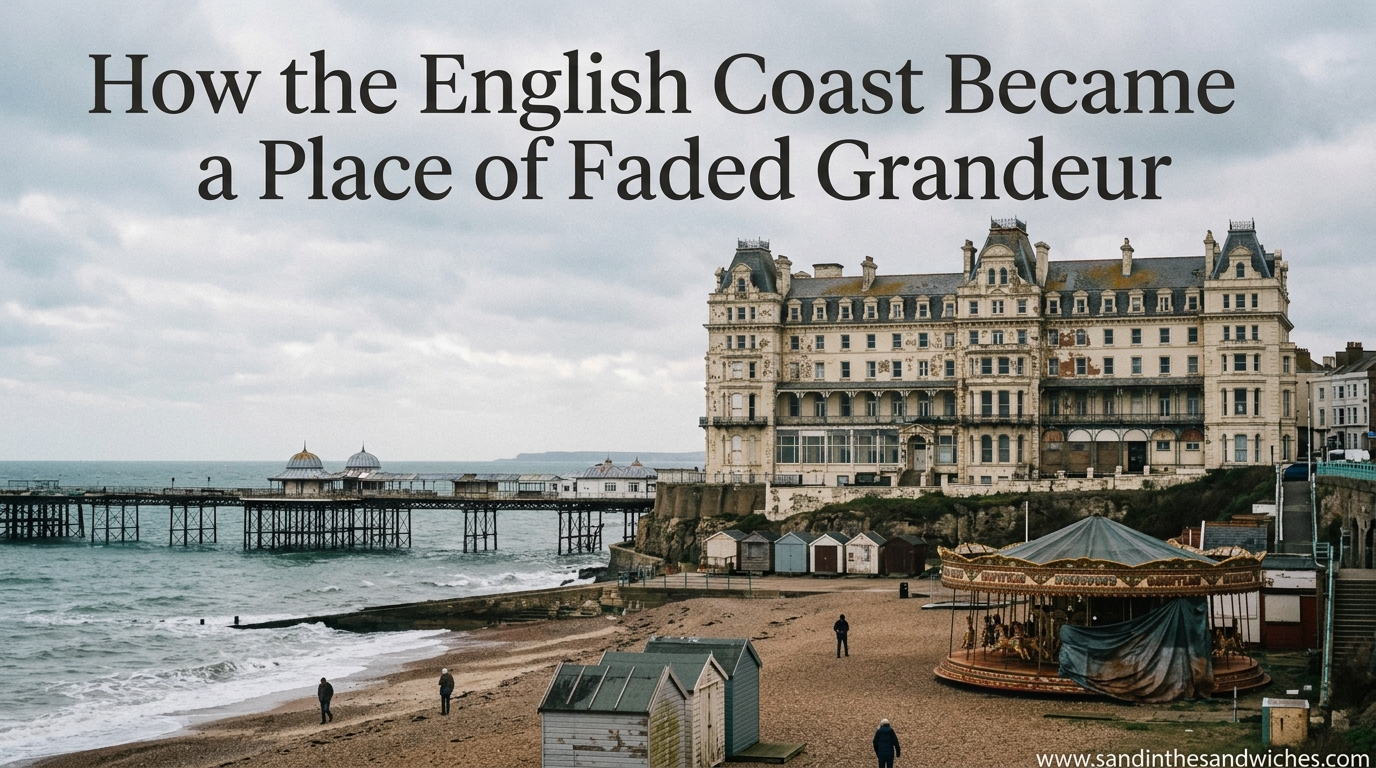
There is a particular kind of melancholy that hangs over an English seaside town out of season. The wind snaps at a peeling promenade shelter. A funfair sits silent, its paint blistering in the salt air. Somewhere a seagull cries over an empty crescent of Regency stucco, once grand, now cracked and stained by decades of damp.
This is the texture of faded grandeur, a phrase that has become inseparable from the British coastline. It describes the strange collision of former glory and present neglect that defines so many of our coastal resorts, from Margate to Morecambe, from Skegness to Scarborough.
How the English coast became a place of faded grandeur is one of the most revealing stories in modern British social history. It is a story about railways and jumbo jets, about class and climate, about the slow death of an industry and the stubborn love a nation still holds for the sea. In this article I trace that arc from the Victorian golden age, through the package-holiday revolution of the 1960s, to the fragile signs of revival that dot the coastline in 2026.
Table of Contents
How the English coast became a place of faded grandeur
The phrase “faded grandeur” does a lot of quiet work in British cultural conversation. It is the polite, affectionate shorthand we use when describing a once-elegant hotel now divided into bedsits, or a Victorian pier shuttered halfway along its length, its pavilion boarded up.
To understand how the English coast became a place of faded grandeur, you have to accept that the decline was never a single event. It was the slow accumulation of overlapping blows: the rise of cheap flights, the closure of branch railways, the collapse of heavy industry, the distortion of local housing markets, and a national shift in taste that drew holidaymakers toward guaranteed sun.
What makes the story so poignant is that the English coast was, for more than a century, genuinely grand. These towns were not built to be modest. They were built to impress.
The Victorian Golden Age: When the Coast Became Britain’s Playground
The English seaside resort was, in many ways, a Victorian invention. Scarborough is widely credited as the first recognisably modern seaside resort in the world, dating its spa and sea-bathing culture back to 1626, when a Mrs Farrow discovered a stream of acidic water running down a cliff and into the sea. By the 18th century, the town had begun attracting the sort of genteel visitors who had previously taken the waters at Bath.
The real explosion came with the railways. From the 1840s onwards, lines snaked out from industrial cities to the coast, carrying millions of working people who had never before been able to afford a holiday. Blackpool, Brighton, Margate, Weston-super-Mare, Great Yarmouth: each in turn became a destination on an almost industrial scale.
Towns reinvented themselves to meet the demand. Piers stretched out over the water, doubling as promenades and entertainment venues. Grand hotels rose along the seafront, their Regency and Victorian facades designed to remind visitors of continental resorts. Pavilions, winter gardens, ballrooms and bandstands turned the seaside into a year-round cultural calendar.
By the late 1940s, the English coast was welcoming an extraordinary volume of visitors. Estimates suggest around five million holidaymakers took their annual week at the seaside in the immediate post-war years. The holiday was a national ritual, complete with sticks of rock, Punch and Judy shows, donkey rides, potted shrimp, and evening trips to the theatre or the amusement arcade.
The Turning Point: Package Holidays and the Flight to the Sun
The decline of the English coast is often dated to a single spring day. On 5 May 1962, the first fare-paying flight of a new British airline called Euravia took off from Gatwick. It carried holidaymakers on an inclusive package tour to the Continent. Euravia would later become Britannia Airways, and the model it pioneered would reshape British leisure for half a century.
Within a generation, the package holiday had rewritten the rules. Why spend a wet August week in a Margate boarding house when, for a similar price, you could fly to the Costa del Sol and wake up to guaranteed sunshine?
The shift was brutal and quick. By the 1970s and 1980s, traditional English seaside resorts were losing visitors in droves. Hotels closed. Guest houses converted into residential care homes or Houses in Multiple Occupation. Amusement parks struggled to maintain their rides. The first faint dusting of faded grandeur began to settle over towns that had been built for crowds that no longer came.
Crucially, this did not happen in other European countries to nearly the same extent. French, Italian and Spanish coastal resorts suffered their own ups and downs, but they never faced the same total collapse of domestic tourism, partly because their domestic markets were sustained by stronger regional attachment, warmer weather, and shorter travel distances to alternative beaches.
The Beeching Axe: When the Trains Stopped Running
The railways had made the English coast. Their withdrawal nearly broke it.
In 1963, Dr Richard Beeching published his report “The Reshaping of Britain’s Railways”, which proposed closing thousands of miles of track and hundreds of stations deemed uneconomic. The cuts that followed, known ever after as the Beeching Axe, fell heavily on coastal branch lines.
Towns that had depended on a direct railway link to industrial northern or Midlands cities suddenly found themselves cut off. The Pines Express and dozens of holiday specials disappeared. Visitors who could once step off a train and onto the promenade now faced a long, awkward drive along A-roads, often in traffic.
The impact was not felt immediately, but it compounded over decades. Coastal towns that lost their trains also lost the habit of being visited. Combined with the rise of the motorway network and the lure of cheap flights, the Beeching Axe helped strand many seaside resorts at the literal end of the line.
Town by Town: Case Studies in Coastal Decline
Jaywick: The Most Deprived Settlement in England
Few places crystallise the story of faded grandeur quite like Jaywick, near Clacton in Essex. Originally laid out in the 1930s as a holiday village of chalets and plotlands for working-class Londoners, it never quite made the transition to a permanent, thriving settlement. Today parts of Jaywick repeatedly top indices of multiple deprivation in England.
Reddit users and travel writers alike describe the same dissonance when they visit: a stunning stretch of coastline, a sense that this was once somewhere people yearned to be, and a present marked by poverty, poor housing and limited opportunity.
Skegness: Still Trading, Still Struggling
Skegness, in Lincolnshire, has fared differently. The Jolly Fisherman logo and the town’s famous bracing air still pull in millions of day-trippers and holidaymakers, drawn largely from the East Midlands and the industrial North. Butlin’s flagship holiday camp remains a major employer, and the seafront still heaves on a hot August bank holiday.
Yet beneath the surface, the same pressures are at work: low wages, seasonal employment, an ageing population, and a high street that has seen better days. Skegness endures, but on margins that would have astonished its Victorian founders.
Blackpool: The Resort That Refuses to Lie Down
Blackpool is perhaps the most complex case of all. At its peak it drew visitors in numbers that rivalled any resort in Europe. The Tower, the Illuminations, the ballrooms, the Pleasure Beach: this was a town engineered for joy on an industrial scale.
Blackpool still attracts enormous crowds, but it also carries some of the heaviest social challenges of any English local authority, including concentrations of deprivation, pressures on health services, and a transient population that places strain on housing and social infrastructure. The grandeur has not entirely faded here, but it coexists, sometimes uncomfortably, with deep need.
Margate: Faded, Then Found Again
Margate is the comeback story everyone cites. For years it was the shorthand for coastal decline: a town of empty shops, crumbling guest houses and visible homelessness. Then, in 2011, the Turner Contemporary gallery opened on the seafront. Dreamland, the historic amusement park, was reborn. Artists and London commuters began to move in.
The regeneration is real, and it is sometimes uneven, but it shows what is possible when cultural investment meets a town that still has its bones, its beach and its light.
Bournemouth: A Different Trajectory
Not every resort declined equally. Bournemouth, with its Regency pedigree, its chines and its pine-rich gardens, has charted a different course. A diversified economy, a major conference trade, a large university and a steady flow of retirement migration have kept it comparatively prosperous, even as neighbouring Boscombe has struggled with many of the problems seen further along the coast.
Five Reasons the English Coast Fell Behind
Researchers at the London School of Economics, writing in 2024, set out a five-factor framework that helps explain why English seaside towns have proven so hard to revive. Their analysis has shaped two House of Lords reports, in 2019 and 2023, on the future of coastal communities.
- Low wages and low-productivity work. Coastal economies are disproportionately reliant on care, hospitality and retail, sectors defined by low pay, long hours and sharp seasonality. When the tourists go home in September, the work dries up.
- An ageing population and retirement migration. Seaside towns have attracted retirees for generations, which brings stability but also concentrates demand on health and social care while hollowing out the working-age tax base.
- Low educational achievement and aspiration. Many coastal towns underperform on attainment and progression to higher education, partly because the most ambitious young people leave for cities and do not return.
- A dysfunctional housing market. The same town can suffer simultaneously from a glut of cheap bedsits and Houses in Multiple Occupation, and a shortage of family homes because of second homes, holiday lets and Airbnb. This is the housing paradox at the heart of faded grandeur.
- A concentration of vulnerable people. Coastal towns have historically absorbed vulnerable populations, including those placed in former guest houses by local authorities, which places additional pressure on already stretched services.
Together, these factors create what researchers call a “wicked problem”, a tangle of causes and effects that no single policy lever can untangle. The English coast has its own equivalent of the American rust belt, sometimes described as the “salt fringe”, running along the edges of the nation.
The Class and Culture of the British Seaside
One dimension that is often underplayed in discussions of faded grandeur is class. The English seaside was always a deeply classed space. Different resorts catered to different social strata, and the architecture, entertainment and even the food reflected that.
Butlin’s holiday camps, founded by Billy Butlin in 1936, brought a particular kind of organised mass leisure to the coast. Variety shows, knobbly knees contests, redcoat entertainers and chalet rows formed a culture that was proudly working-class and beloved by millions.
Piers hosted everyone from Punch and Judy men to the Beatles. Ballrooms staged tea dances that drew crowds in their thousands. The seaside music industry, from end-of-the-pier shows to summer seasons in Blackpool and Scarborough, was a genuine engine of British entertainment.
When the visitors vanished, much of this cultural infrastructure vanished with them. But the affection did not. Nostalgia for the British seaside remains powerful, and it is one of the few assets these towns can reliably trade on.
Recovery and Revival: Signs of New Life on the Coast
The story of the English coast is not only a story of decline. In 2026 there are genuine, if fragile, signs of revival.
The pandemic and the rise of remote working have rewritten the calculus of coastal living. Towns that were once too far from the office now find themselves within reach of a new wave of home workers, freelancers and creative businesses. Staycations, boosted by the weakness of the pound and the cost of foreign travel, have brought domestic visitors back in numbers not seen for a generation.
Major cultural projects are leading the way. The Turner Contemporary in Margate, the East Quay in Watchet, and the planned Eden Project North in Morecambe all point toward a model of regeneration built on architecture, art and a sense of place. The Campus for Future Living in Mablethorpe is training a new generation of coastal professionals in health and care.
Some towns have bucked the trend entirely. Whitby, St Ives, Padstow and Salcombe are thriving on a mix of heritage tourism, food culture and second-home spending, though this brings its own controversy about who the coast is really for. The question for 2026 and beyond is whether the revival can spread beyond the beauty spots and reach the towns that have been waiting longest for their turn.
FAQs
Why are British seaside towns so run down?
British seaside towns fell into decline from the 1960s onwards as cheap package holidays to Mediterranean destinations drew away holidaymakers. Railway closures under the Beeching Axe cut off many resorts, while a reliance on low-paid seasonal work, an ageing population and a distorted housing market made recovery difficult.
What is the oldest seaside town in the UK?
Scarborough is widely regarded as the oldest recognisably modern seaside resort in the UK, with its spa and sea-bathing culture dating back to 1626, when a local woman named Mrs Farrow discovered a stream of acidic water running down the cliff into the sea.
Why are UK seaside towns so deprived?
Coastal deprivation is driven by five overlapping factors identified by LSE researchers: low wages in hospitality and care, an ageing population, low educational attainment, a dysfunctional housing market split between cheap bedsits and second homes, and a concentration of vulnerable residents who place extra pressure on services.
When did the tourist trade die in British seaside resorts?
The turning point is often dated to 5 May 1962, when the first fare-paying package holiday flight of Euravia, later Britannia Airways, left Gatwick for the Continent. Decline accelerated through the 1970s and 1980s as cheap flights to guaranteed sunshine drew millions of British holidaymakers abroad.
What is the nicest seaside town in the UK?
Beauty is subjective, but towns such as St Ives in Cornwall, Whitby in North Yorkshire, Tenby in Pembrokeshire and Southwold in Suffolk are frequently cited among the nicest, combining heritage architecture, working harbours and strong cultural and food scenes.
Conclusion
The English coast became a place of faded grandeur through no single failure but through the slow piling up of cheap flights, lost railways, low wages, distorted housing and a national change of heart about where holidays should happen. Yet the affection endures. In 2026, piers are being restored, galleries are drawing crowds, and a new generation is rediscovering the strange, stubborn beauty of the British seaside. The grandeur may be faded, but it has not gone.