
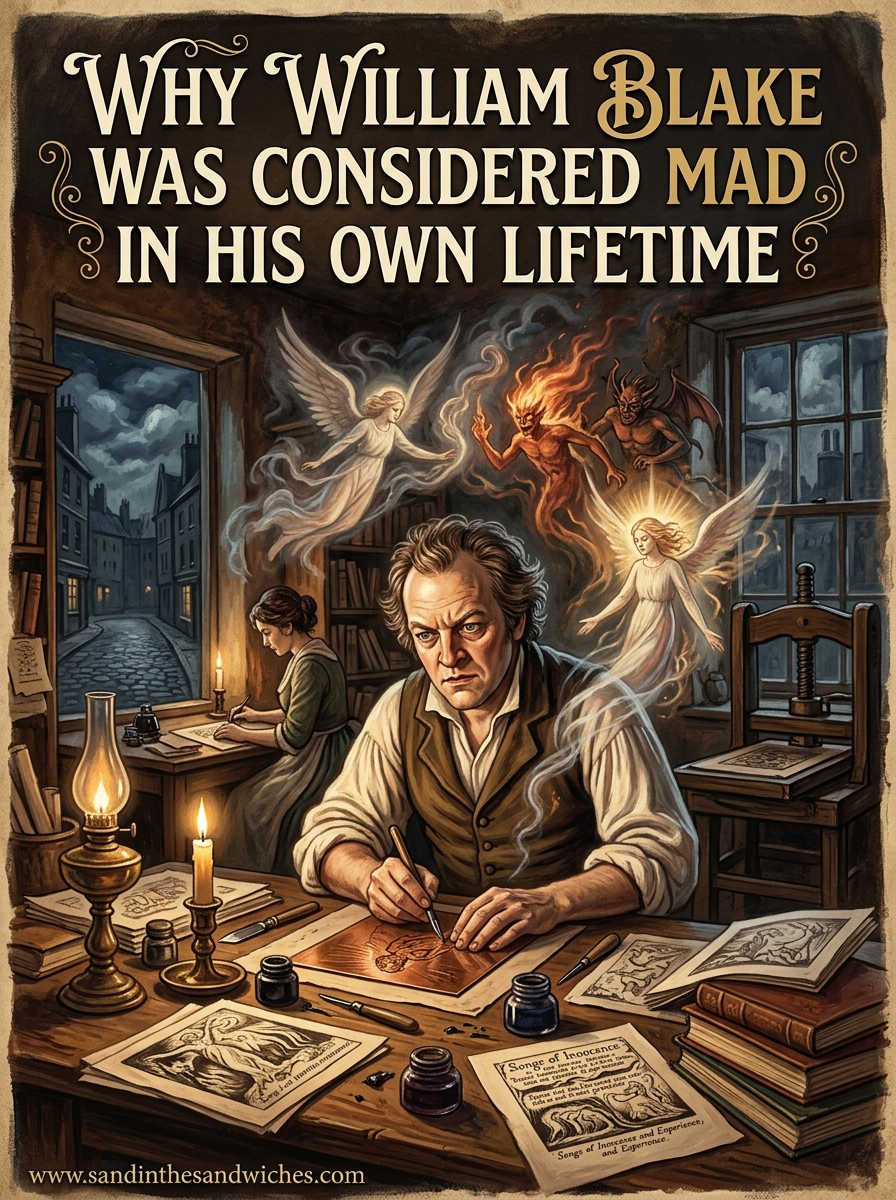
William Blake was considered mad by his contemporaries for his idiosyncratic views, mystical visions, radical politics, and fierce rejection of organized religion. The English poet, painter, and engraver claimed to see angels, converse with dead prophets, and receive dictation from spiritual beings. In late 18th-century England, these claims combined with his anticlerical writings and political radicalism to create a widespread perception of insanity that haunted him until his death in 1827.
When I first encountered Blake’s work, I expected to find a clear medical explanation for why people called him mad. What I found instead was a much more complicated story. The question of why William Blake was considered mad in his own lifetime cannot be answered with a single cause. It was the collision of four forces: his visionary experiences from childhood, his unorthodox religious beliefs, his dangerous political sympathies during revolutionary times, and the simple fact that his art and poetry were so far ahead of their audience that nobody knew what to do with them.
Poverty amplified every one of these factors. An eccentric genius with money could be dismissed as colorful. A poor engraver claiming divine visitation was simply crazy. Understanding why Blake’s reputation suffered so severely during his life reveals not just his personal story but also how societies treat those who see the world differently. His posthumous recognition as one of the greatest figures of the Romantic Age makes that earlier dismissal all the more striking.
Table of Contents
Why William Blake Was Considered Mad in His Own Lifetime: Childhood Visions
The roots of Blake’s reputation for madness began in childhood. Around the age of four, he later told friends, he saw God’s face pressed against a window. A few years later, he claimed to witness the prophet Ezekiel sitting beneath a tree in a field. These were not passing fancies. Blake maintained throughout his life that his visions were as real to him as anything perceived through the physical senses.
What made these experiences unusual was not just their content but Blake’s absolute refusal to treat them metaphorically. He did not say he had a vivid imagination or a spiritual sensibility. He insisted, plainly and repeatedly, that he saw these things with his eyes. When he described angels perching in trees during a walk across Peckham Rye, he meant it literally. To most listeners, this was either delusion or deliberate provocation.
His parents’ response is revealing. Rather than sending him away or silencing him, they recognized that their son had an extraordinary sensibility and chose not to discourage it. His mother had already lost one son who may have rebelled against strict religious discipline. The Blake household, while poor, allowed young William’s visions to flourish unchecked. This tolerance shaped a man who never learned to hide or soften his experiences.
The problem is that childhood visions alone were not enough to make someone seem insane in 18th-century England. Religious enthusiasm and prophetic claims had a long history in English culture. Methodism itself had emerged from similar emotional intensity. Blake’s visions became damning evidence of madness only when combined with everything else: the anticlerical fury, the political radicalism, the bizarre artwork, and the social isolation that defined his adult life.
Idiosyncratic Religious Views That Shocked Contemporaries
Blake’s religious beliefs were perhaps the single most powerful engine behind his reputation for madness. He was not merely skeptical of organized religion. He was openly hostile to it, calling the church a vehicle of spiritual oppression and portraying priests as agents of control rather than salvation. In an era when religious conformity was tied to social respectability, this stance was deeply alienating.
He rejected the God of the Old Testament as a tyrant, a figure he named Urizen in his personal mythology. Urizen represented law, restriction, and false reason. Against Urizen, Blake set figures like Orc, the spirit of rebellion, and Los, the poetic imagination. This was not a decorative mythology. Blake constructed an entire cosmology across his prophetic books that mapped onto his understanding of human psychology, politics, and spiritual liberation.
Contemporary readers found these prophetic works nearly impenetrable. Works like The Book of Urizen, The Four Zoas, and Jerusalem were dense, strange, and entirely without precedent. Even sympathetic readers struggled. Charles Lamb, who admired Blake, called his symbolic system difficult to penetrate. Those less sympathetic simply concluded that the author had lost his reason.
His anticlerical attitude extended into everyday life. Blake refused to attend church services regularly, which in itself marked him as suspect. He claimed that true religion existed in imagination and creative expression, not in ritual or institution. For a society that treated church attendance as a basic marker of sanity and citizenship, this position was proof that something was deeply wrong with him.
The irony is that Blake was intensely religious. He read the Bible constantly, knew it better than most clergymen, and considered his art a form of divine service. His criticism of religion was not that of an atheist but of a mystic who believed institutional Christianity had betrayed its own spiritual core. This distinction was lost on most contemporaries, who saw only a man attacking the foundations of social order.
Radical Politics During Dangerous Times
Blake lived through one of the most politically volatile periods in English history. The French Revolution erupted in 1789, the same year he published Songs of Innocence. The Reign of Terror that followed, combined with fears of homegrown revolution, turned England into a society gripped by political paranoia. The government passed laws restricting free speech, monitoring radical meetings, and prosecuting dissent.
In this atmosphere, Blake’s politics were genuinely dangerous. He openly sympathized with the revolutionary cause in its early phases. He knew radical thinkers of the day and moved in circles the authorities watched closely. His poem The French Revolution celebrated the storming of the Bastille. In America a Prophecy, he cast the American Revolution as a cosmic struggle between tyranny and liberation.
The most consequential incident came in 1803, when Blake was living in Felpham and working for the poet William Hayley. A soldier named Private John Schofield intruded on Blake’s garden, and words were exchanged. Blake allegedly cursed the king and declared that Napoleon would conquer England. Schofield reported him, and Blake was charged with sedition and assault.
The trial that followed could have ended Blake’s life. Sedition was a serious charge, and the testimony of a soldier carried significant weight. Blake was acquitted, partly because Hayley helped arrange legal defense and partly because Schofield’s account was deemed unreliable. But the incident cemented Blake’s reputation as not merely eccentric but politically dangerous, a man whose loyalties were suspect and whose judgment could not be trusted.
Political radicalism and perceived madness reinforced each other. A man who heard voices and saw visions, who rejected the church, and who sympathized with revolution fit a template of dangerous irrationality. The political climate gave contemporaries permission to dismiss everything Blake said as the product of a disordered mind.
His Artistic Method Seemed Incomprehensible
Blake’s creative process itself contributed to his reputation. He invented a technique called illuminated printing, in which he wrote text and drew images backward on copper plates using acid-resistant varnish, then etched the plates and printed them by hand. He then hand-colored each page with watercolor. The result was a fusion of poetry and visual art unlike anything being produced in England.
This was not just an unusual method. It was a rejection of the entire economic model of publishing. Blake refused to work with commercial publishers on terms he found degrading. He printed his own books in tiny editions, sold them himself, and lived in near-poverty as a result. To contemporaries, a man who turned down paid engraving work to produce books nobody could understand looked like someone courting destitution through sheer irrationality.
Worse, Blake claimed that his artistic method had spiritual origins. He said that his dead brother Robert appeared to him in a vision and taught him the illuminated printing technique. He claimed that Michelangelo and Raphael guided his hand. He insisted that the figures in his art were drawn from visions, not from models or imagination in the conventional sense.
Even fellow artists found these claims baffling. The Royal Academy, the gatekeeper of artistic respectability in England, did not know what to make of him. Blake was a trained engraver, skilled in conventional technique, but his original work fell outside every recognized category. It was too strange to be accepted as fine art, too elaborate to be dismissed as amateur doodling.
The practical consequence was that Blake’s technical skill went underappreciated during his lifetime. He was respected as an engraver who could reproduce other artists’ work but dismissed as an original artist. The idea that his visionary paintings and prophetic books constituted a coherent body of work was not seriously entertained until decades after his death.
What Contemporaries Actually Said About Him
The evidence that Blake was labeled mad comes from specific, documented statements by people who knew him or knew his work. William Wordsworth reportedly called Blake and a fellow visionary “plainly crazy” in conversation, though he later reconsidered. Wordsworth’s initial reaction is telling because Wordsworth was no enemy of imagination or unconventional thought. If even he found Blake difficult to accept, the broader cultural verdict is easy to imagine.
John Ruskin, one of the most influential art critics of the 19th century, had a more measured view. Ruskin recognized Blake’s artistic talent but struggled with the prophetic works, calling them evidence of a diseased imagination in some passages while praising his draftsmanship in others. This split assessment, admiring the artist while distrusting the visionary, became the dominant pattern among those who engaged with Blake at all.
The diarist Henry Crabb Robinson, who visited Blake and recorded their conversations, treated him with affectionate skepticism. Robinson clearly found Blake fascinating and likeable but could not bring himself to take the visions literally. His accounts read like those of a man describing an endearing eccentric rather than a serious thinker.
Allan Cunningham, in his biographical writings, referred to Blake with a mixture of respect and pity. He admired the artwork but framed Blake’s visionary claims as symptoms of a troubled mind. This condescending tone, treating Blake as a tragic figure whose talent was compromised by mental disturbance, became a standard way of discussing him for much of the 19th century.
Poverty deepened all of this. Blake was never wealthy, and his later years were marked by genuine financial hardship. A prosperous eccentric can be called a genius ahead of his time. A poor man claiming to see angels is a lunatic. The class dynamics of Regency England meant that Blake’s outsider status was inseparable from his economic position. He lacked the social standing that might have buffered him against the madman label.
How Modern Psychology Views Blake’s Experiences
Modern readers inevitably ask whether Blake was actually mentally ill. It is a fair question, and scholars have approached it from several angles. Some have suggested that his visions resemble symptoms of conditions now recognized in clinical psychology, including various forms of hallucination associated with mood disorders or temporal lobe phenomena. The consistency and vividness of his reported experiences, sustained over decades, goes beyond simple metaphor.
Others caution strongly against retrospective diagnosis. Blake functioned at a high level throughout his life. He maintained a long marriage, sustained friendships, completed ambitious creative projects on schedule, and navigated complex legal and financial challenges. His work shows extraordinary organizational coherence, with recurring themes, sustained arguments, and a developed symbolic system that took decades to construct. These are not the hallmarks of a disordered mind in the clinical sense.
Northrop Frye’s landmark study Fearful Symmetry, published in 1947, was instrumental in reframing Blake’s work as a coherent philosophical and artistic system rather than the ravings of a madman. Frye demonstrated that the prophetic books follow an intelligible structure with consistent logic. Once you understand Blake’s vocabulary and mythology, his work becomes readable rather than opaque. This was the breakthrough that allowed Blake to be taken seriously as a thinker.
It is also worth noting that visionary experience has a long lineage in Western culture. Joan of Arc heard voices. Ezekiel and the authors of the Book of Revelation described visions that would be clinically significant if reported today. The line between mystical experience and mental illness is culturally constructed, and that line was drawn very differently in Blake’s era than in our own. Calling Blake mad says as much about the culture doing the labeling as it does about the man himself.
What contemporary scholars increasingly recognize is that Blake may have had experiences that we would now classify as anomalous but that he integrated those experiences into a productive creative life. The question is not whether his perceptions were unusual. They clearly were. The question is whether unusual perception necessarily equals pathology. In Blake’s case, the evidence suggests a man who lived with vivid non-ordinary experiences and built one of the most original bodies of work in English literature around them.
FAQs
Why was William Blake considered mad?
William Blake was considered mad because he claimed to experience vivid visions of angels, prophets, and historical figures from childhood onward, rejected organized religion with anticlerical hostility, sympathized with revolutionary politics during a paranoid era, and produced artwork and prophetic poetry that contemporaries found incomprehensible. His poverty and social isolation amplified the perception.
Did William Blake go mad?
There is no clear evidence that William Blake suffered from a debilitating mental illness. He maintained stable relationships, completed ambitious creative projects over decades, and constructed a coherent philosophical system in his work. Modern scholars generally view his visions as genuine non-ordinary experiences that he integrated creatively, though some have speculated about possible neurological or psychological conditions.
Was William Blake famous during his lifetime?
No. William Blake was largely unrecognized during his lifetime. He was known in limited artistic circles as a skilled engraver, but his original poetry and visual art were dismissed or ignored. He lived in near-poverty for much of his life and sold very few copies of his illuminated books. His reputation as a major literary and artistic figure developed decades after his death in 1827.
What did Carl Jung say about William Blake?
Carl Jung studied William Blake’s work and recognized Blake as an artist who had direct contact with the collective unconscious. Jung saw Blake’s visions and mythology as expressions of deep archetypal material, comparing his experiences to phenomena that depth psychology encounters in its own work. Jung did not dismiss Blake as mad but treated his visionary output as psychologically significant.
Conclusion: A Visionary Reclaimed
The reasons why William Blake was considered mad in his own lifetime are not mysterious once you examine them together. His childhood visions established a pattern of non-ordinary perception that never wavered. His anticlerical religious views alienated the institutions that defined sanity in his society. His radical politics made him dangerous in an era of revolutionary fear. His unprecedented artistic method baffled everyone who encountered it. And his poverty denied him the social standing that might have shielded him from the madman label.
What changed after his death was not Blake but the culture judging him. The Romantic movement, which Blake helped seed, gradually legitimized the kind of visionary imagination he embodied. Northrop Frye’s scholarship decoded the prophetic books. Modern psychology developed frameworks for understanding experiences that earlier eras simply called insanity. Each of these shifts made Blake look less like a madman and more like a figure who had been systematically misunderstood.
The story of why William Blake was considered mad in his own lifetime is ultimately a story about how societies handle those who refuse to conform. Blake never softened his visions, never abandoned his mythology, never apologized for his politics or his art. He paid for that integrity with decades of dismissal and poverty. The fact that we now read him as one of the great voices in English literature does not erase that cost. It simply confirms what he insisted all along: that the visions were real, that the work mattered, and that the world would eventually catch up.
If you want to understand Blake for yourself, start with Songs of Innocence and Experience and then move into the shorter prophetic works like The Marriage of Heaven and Hell. The symbolic system becomes clearer with each reading. The madness label does not survive sustained contact with the work itself.