
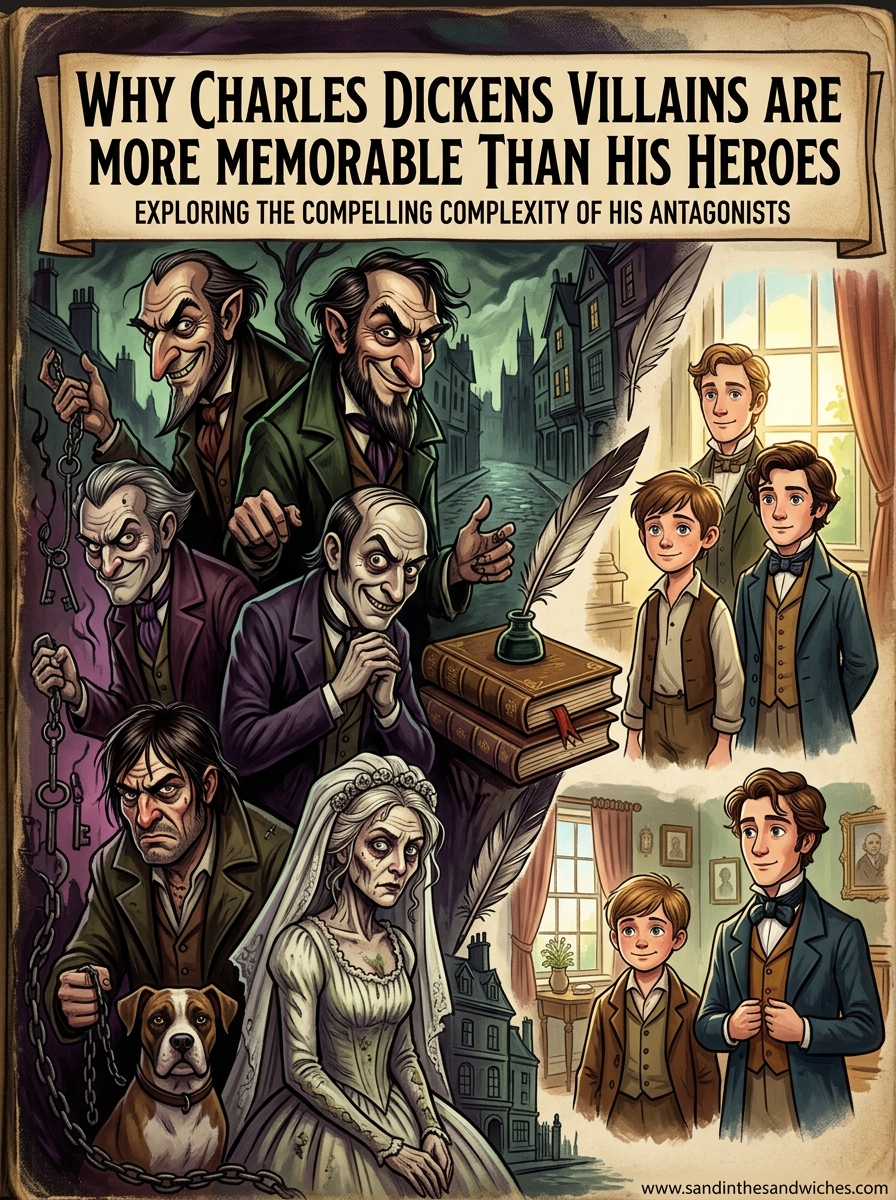
Ask anyone to name a Charles Dickens character, and you will almost certainly hear a villain before you hear a hero. Fagin. Uriah Heep. Miss Havisham. Bill Sikes. These names carry a weight that Oliver Twist, David Copperfield, and even Pip cannot quite match in the cultural imagination. The question of why Charles Dickens villains are more memorable than his heroes is not just a matter of personal preference. It reveals something fundamental about how Dickens constructed character, how he understood human nature, and how the Victorian novel format shaped what readers remember.
Dickens created roughly 650 named characters across his fifteen novels, and literary critics have spent over a century debating which ones endure. The answer, consistently, points toward his antagonists. These characters burst off the page with an energy and specificity that his protagonists rarely achieve. They have catchphrases. They have grotesque physical features. They have psychological wounds that explain their cruelty. Most importantly, they have a singularity of purpose that makes them impossible to forget.
The heroes, by contrast, often serve as lenses through which we view the more interesting people around them. Oliver Twist asks for more gruel, but Fagin runs the entire operation. David Copperfield narrates his life story, but Uriah Heep drives the conflict. Pip falls in love, but Miss Havisham engineered the entire emotional trap. The pattern is clear and consistent across Dickens’s body of work, and understanding it requires examining the literary techniques, historical conditions, and psychological principles that made his villains immortal.
Table of Contents
The Flat Character Theory: Why Dickens Villains Stick
The most useful framework for understanding Dickens’s character design comes from E. M. Forster’s 1927 work, Aspects of the Novel. Forster divided fictional characters into two categories: flat characters and rounded characters. Flat characters are built around a single idea or quality. They are easily recognized when they appear, and Forster himself pointed to Dickens as the supreme practitioner of this type. Rounded characters, by contrast, develop and surprise us. They have the complexity of real human beings.
Here is the paradox that Forster identified: flat characters are often more memorable than rounded ones. Forster wrote that Dickens’s characters are recognized by the reader with equal clarity whether they appear for the first or the fiftieth time. Their traits never waver. Their behavior is always predictable in the best possible way. We know exactly what to expect from Fagin because Fagin is always Fagin. This consistency creates a groove in the reader’s memory that rounded, evolving characters struggle to match.
Dickens applied this technique differently to villains and heroes, whether consciously or not. His villains are almost always flat characters defined by a single dominant trait. Uriah Heep is the personification of false humility. Fagin is moral corruption in human form. Bill Sikes is brute violence without conscience. Each villain can be described in a single phrase, and that phrase captures the entire character. This is exactly what Forster meant when he said flat characters are “constructed round a single idea or quality.”
Dickens’s heroes, on the other hand, attempt to be rounded. They grow. They change. They reflect on their experiences. But this very complexity makes them harder to hold in memory. A character who evolves cannot be reduced to a single phrase, and reducibility is the engine of memorability. Oliver Twist is kind, innocent, orphaned, brave, passive, moral, and passive again. Which of those traits defines him? None of them, individually, with the force that “false humility” defines Uriah Heep.
Forster himself noted that Dickens’s flat characters achieve something extraordinary: they are instantly recalled by readers without any effort. This is why a villain like Quilp from The Old Curiosity Shop, a minor character in the Dickens canon, remains vivid in memory while the novel’s protagonist, Little Nell, has become something of a literary afterthought despite the enormous emotional response she generated among Victorian readers.
Exaggeration and the Single Dominant Trait
Dickens did not merely write flat characters. He wrote exaggerated flat characters, and this exaggeration is a core reason his villains eclipse his heroes. Exaggeration takes a recognizable human trait and amplifies it until it becomes almost grotesque. Villainy, by its nature, offers richer material for exaggeration than virtue does. You can exaggerate greed, cruelty, hypocrisy, and deceit into theatrical spectacles. Virtue, when exaggerated, tends to become cloying or unbelievable.
Consider how Dickens links physical appearance to moral character. His villains wear their corruption on their bodies. Fagin is described with physical repulsiveness that mirrors his moral degeneracy. Uriah Heep’s writhing, jerking body language signals his untrustworthiness before he speaks a word. Quilp is a dwarf whose physical proportions match his moral distortion. This technique, linking the physical to the moral, gives readers a visual shortcut to character that bypasses intellectual processing entirely. You do not need to analyze Fagin to understand he is dangerous. You simply need to see him.
Catchphrases and verbal tics serve a similar function. Uriah Heep’s constant repetition of being “umble” is perhaps the most famous example in all of Dickens. Every time Heep says the word, the irony deepens because the reader knows his humility is completely false. This verbal tic does triple duty: it reveals character, it creates dramatic irony, and it etches itself into the reader’s memory. Say “umble” to anyone who has read David Copperfield, and they will know exactly who you mean.
Dickens’s heroes almost never receive this treatment. Oliver Twist does not have a catchphrase. David Copperfield does not have a physical tic that signals his character. Pip’s defining quality, his snobbery and subsequent shame, is an internal psychological state rather than an external, theatrical display. The result is that heroes live inside the reader’s mind as thoughts and emotions. Villains live inside the reader’s mind as vivid, almost cartoonish images. Images are easier to recall than thoughts.
This is also why minor villains and comic rogues are sometimes more memorable than major protagonists. Seth Pecksniff from Martin Chuzzlewit is a master class in exaggerated hypocrisy. His name itself functions as a characterization device. Dickens was famous for giving characters names that told you everything you needed to know about them, and he reserved his most inventive and memorable naming for his villains and comic characters. Heroes received plain names: Oliver, David, Pip, Arthur. Villains received names that were miniature portraits: Heep, Sikes, Quilp, Pecksniff, Gradgrind, Bumble.
How Serialization Shaped Memorable Villains
One factor that no competing analysis adequately addresses is how Dickens’s publishing format influenced character design. Dickens published most of his novels in monthly serial installments, a format that demanded characters who could make an immediate impression. A reader who picked up the latest monthly number needed to recognize returning characters instantly, without flipping back through previous installments. Flat, exaggerated characters served this practical purpose brilliantly.
Villains were particularly well-suited to the serialization format because they created the cliffhangers, tensions, and dramatic stakes that kept readers buying the next installment. Bill Sikes murdering Nancy. Uriah Heep scheming to destroy the Wickfield family. Miss Havisham manipulating Pip and Estella. These were the dramatic engines that powered each monthly number. Without compelling villains driving the plot forward, readers might have lost interest between installments.
Heroes, in this system, functioned as stable ground. The reader needed a sympathetic figure to follow through the chaos, someone whose decency provided relief from the villainy. But stability is the enemy of memorability. A character who provides relief is forgotten the moment relief is felt. A character who creates tension is remembered as long as the tension lasts, which in a serialized novel can span months or years of reading.
Dickens also had to compete with himself from installment to installment. Each monthly number needed a memorable moment, and villains reliably provided them. The theatricality of villainy, the set-piece scenes of scheming and cruelty, gave Dickens the dramatic material he needed to sustain reader engagement across long publication schedules. This commercial and structural pressure reinforced his natural tendency toward vivid, exaggerated antagonists.
The Villains Who Stole the Show
To understand why Charles Dickens villains are more memorable than his heroes, we need to examine the specific techniques he used with his most enduring antagonists. Each villain represents a different approach to creating an unforgettable character, and together they form a complete toolkit of villainous characterization.
Uriah Heep: The Architecture of False Humility
Uriah Heep from David Copperfield is perhaps the most analyzed villain in the Dickens canon, and for good reason. Dickens built Heep from a single organizing principle: the performance of humility to mask ruthless ambition. Every physical description, every line of dialogue, and every plot development serves this principle. Heep is the most complete realization of the flat villain technique in all of Dickens’s work.
Dickens describes Heep with physical repulsiveness that mirrors his moral state. He has a “cadaverous” face, a “red-mouthed” grin, and a body that constantly writhes and twists. His hands are cold and clammy. His eyes never make direct contact. Every aspect of his physical presence signals untrustworthiness to the reader, even as his words protest his humility. This gap between appearance and speech is the engine of Heep’s memorability.
His constant self-description as “umble” is the verbal tic that seals his place in literary memory. The word appears dozens of times in the novel, and each repetition deepens the reader’s awareness of its falseness. Heep says he is humble while plotting to seize control of his employer’s business and destroy anyone who stands in his way. The dramatic irony created by this single repeated word does more characterization work than pages of interior monologue could achieve.
The Guardian called Heep “the smarmiest creep” in literature, and that epithet captures something essential about his design. He is not a villain who threatens physical violence. He is a villain who contaminates trust, exploits kindness, and uses social conventions of politeness as weapons. This makes him a more psychologically realistic villain than the theatrical criminals in Dickens’s earlier work, and his realism makes him harder to forget.
Fagin: Moral Degeneracy Made Visible
Fagin from Oliver Twist represents Dickens’s early approach to villain characterization, one rooted in physical description and moral externality. Dickens describes Fagin as a “very old shrivelled Jew” with a “villainous-looking and repulsive face” and matted red hair. Standing over a fire, toasting a fork with sausages, Fagin resembles a conventional devil figure from medieval morality plays. This visual coding makes his moral nature immediately and viscerally clear.
Fagin’s memorability comes from the specificity of his corruption. He does not simply steal. He trains children to steal. He corrupts the innocent, and this specific form of villainy, the corruption of youth, resonates with primal human revulsion. Fagin is the character who makes Oliver Twist a novel about lost innocence rather than a simple adventure story. Without him, the novel loses its moral center entirely.
The controversy surrounding Fagin’s portrayal, which draws heavily on anti-Semitic stereotypes of the period, has itself contributed to his notoriety. Dickens revised later editions of the novel to remove many of the explicit Jewish references, but the character’s origins remain part of the critical conversation. This ongoing debate keeps Fagin in the critical discourse in a way that Oliver Twist, the novel’s hero, has never achieved.
It is worth noting that Fagin dominates Oliver Twist far more than Oliver does. Oliver is present in many scenes, but Fagin drives the action. Fagin plans, schemes, manipulates, and threatens. Oliver observes, suffers, and is rescued. The power imbalance between villain and hero in this novel is so pronounced that readers often remember Fagin as the main character despite the title bearing Oliver’s name.
Miss Havisham: The Power of Symbolic Conception
Miss Havisham from Great Expectations represents a different kind of Dickens villain entirely. She is not a criminal. She is not physically violent. She is not morally degenerate in the way Fagin or Sikes is. Instead, she is a figure of gothic psychological horror, a woman frozen in time by betrayal, dressed in her wedding gown for decades, surrounded by the rotting remnants of a feast that was never eaten.
Dickens described her with extraordinary visual power. She wears a wedding dress, a bridal flower in her hair, and one shoe on her foot. Her surroundings, the dark, shuttered Satis House with its stopped clocks and decayed wedding feast, are as much a part of her character as her personality. Miss Havisham is not just a character. She is an image, a symbol, a living tableaux of grief and revenge.
This symbolic quality is what makes her arguably the most memorable character Dickens ever created. As one critic noted, Miss Havisham is not really a character in the conventional sense. She is a conception, a personification of jilted love and the destructive power of bitterness. This symbolic approach to character gives her a universality that more realistic characters lack. Every reader understands betrayal. Every reader can imagine the desire to stop time at the moment of greatest pain.
Her role as antagonist is also unusual. She does not oppose Pip through malice in the traditional sense. She uses him as a tool, raising Estella to break men’s hearts as revenge for her own broken heart. This makes Miss Havisham a more complex and psychologically interesting villain than the criminals of Oliver Twist. Her villainy is born of suffering rather than innate evil, and this complexity makes her linger in the mind long after the novel is finished.
Bill Sikes: Pure Unredeemable Evil
Bill Sikes from Oliver Twist represents Dickens’s most uncompromising villain: a figure of pure, unexplained violence with no redeeming qualities whatsoever. Unlike Fagin, who schemes and plans, Sikes simply destroys. His dog, Bull’s-eye, mirrors his master’s brutish nature. His girlfriend, Nancy, loves him despite his cruelty, and he repays her devotion by beating her to death in one of the most harrowing murder scenes in Victorian literature.
Sikes’s memorability comes from his unredeemable nature. Dickens wrote many villains who achieve redemption or at least generate sympathy. Scrooge is the most famous example. Even Fagin has moments of vulnerability in his final scenes. But Sikes has no such moments. He is violence incarnate, and his death scene, accidentally hanging himself while trying to escape a mob, provides one of the most striking visual images in all of Dickens.
The contrast with Oliver could not be starker. Oliver is pure innocence. Sikes is pure violence. But Sikes is the character who generates emotional response. Readers do not remember Oliver for being good. They remember Sikes for being terrifying. This captures the central dynamic of Dickens’s character design: virtue is forgettable, vice is not.
Why Dickens Heroes Fade Into the Background
The question of why Charles Dickens villains are more memorable than his heroes ultimately requires examining what his heroes lack. This is the dimension that no competing analysis directly addresses, and it is the key to understanding the full picture.
Oliver Twist is the most obvious example. Oliver is a passive protagonist. Things happen to him. He is born in a workhouse, sent to an undertaker, kidnapped by Fagin’s gang, shot during a burglary, rescued by Mr. Brownlow, kidnapped again, and finally rescued for good. At no point in this sequence does Oliver make a decisive choice that drives the plot forward. His famous request for more gruel is the closest he comes to agency, and even that is a simple act of desperation rather than a strategic decision.
Readers on literary forums consistently note this dynamic. Heroes like Oliver Twist can feel passive and one-dimensional, functioning more as windows through which we view the more colorful characters around them. David Copperfield, despite narrating his own story and showing real psychological complexity, stops developing in the second half of his novel. The most interesting events in David Copperfield involve Uriah Heep, Steerforth, and the Micawbers, not David himself.
Pip from Great Expectations is Dickens’s most complex hero, and he comes closest to matching his villains in memorability. Pip has genuine psychological depth, a real character arc, and specific flaws that make him interesting. His snobbery toward Joe, his embarrassment at his origins, and his growth through suffering give him a rounded quality that Oliver and David lack. But even Pip is overshadowed by Miss Havisham, Magwitch, and Estella in the popular imagination.
The structural reason for this is that Dickens’s heroes serve a narrative function that limits their memorability. They are witnesses. They observe the strange, vivid, grotesque world around them and provide the reader with a stable point of identification. But a witness is, by definition, less interesting than the events being witnessed. Oliver watches Fagin’s world. David watches Heep’s scheming. Pip watches Miss Havisham’s decay. The heroes are the camera. The villains are what the camera sees.
There is also a commercial dimension to this. Dickens’s original readers, buying monthly installments, wanted spectacle. Virtue is not spectacular. A good person being good is pleasant but unremarkable. A villain scheming, betraying, and destroying is inherently dramatic. Dickens understood his audience, and he gave them what they wanted: characters who generated strong emotions, and the strongest emotions come from transgression, not from virtue.
This does not mean Dickens’s heroes are badly written. They are written for a different purpose. Their stability and decency provide the moral framework within which the villains’ extravagance becomes meaningful. Without Oliver’s innocence, Fagin’s corruption has nothing to corrupt. Without Pip’s vulnerability, Miss Havisham’s manipulation has nothing to manipulate. The heroes and villains are designed to function together, but only the villains were designed to be remembered individually.
The Psychology of Why We Remember the Wicked
Beyond literary technique, there is a psychological reason why Dickens villains outshine his heroes in our memory. Human cognition exhibits a well-documented negativity bias. We remember threats more vividly than positive experiences. We attend more closely to transgression than to virtue. This bias, which evolved to help early humans survive in dangerous environments, means that villains naturally capture more cognitive resources than heroes do.
Dickens intuited this principle a century before cognitive psychology formalized it. His villains are designed to trigger threat responses in the reader. Fagin threatens innocence. Sikes threatens physical safety. Heep threatens social trust. Miss Havisham threatens emotional stability. Each villain represents a different category of danger, and the brain processes each category with heightened attention and deeper encoding into long-term memory.
Dickens’s villains also function as projections of Victorian social anxieties. Fagin embodies fears about urban crime and immigrant communities. Heep embodies fears about social climbing and false appearances. Sikes embodies fears about uncontrollable violence in an era before professional police forces. Miss Havisham embodies fears about what happens when social conventions of marriage and gender break down. By tapping into these real cultural fears, Dickens gave his villains a resonance that transcended the page.
Finally, there is the forbidden pleasure of reading about evil. Villains give readers permission to explore dark impulses from a safe distance. We do not admire Fagin, but we are fascinated by him. We do not like Sikes, but we cannot look away from him. This fascination, the desire to understand what drives someone to do terrible things, is one of the most powerful forces in reading. Dickens’s heroes give us someone to root for. His villains give us someone to think about.
FAQs
What are two memorable characters created by Charles Dickens?
Two of the most memorable characters created by Charles Dickens are Uriah Heep from David Copperfield and Miss Havisham from Great Expectations. Both are villains, which reflects the broader pattern of Dickens’s antagonists being more culturally enduring than his protagonists.
How does Dickens describe Uriah Heep?
Dickens describes Uriah Heep as having a cadaverous face, a red-mouthed grin, and a body that constantly writhes and jerks. Heep has cold, clammy hands, avoids direct eye contact, and repeatedly describes himself as ‘umble,’ using false humility to mask his ruthless ambition.
How does Charles Dickens describe Miss Havisham?
Dickens describes Miss Havisham as an elderly woman wearing a faded wedding dress with a bridal flower in her hair and one shoe on her foot. She lives in the dark, shuttered Satis House surrounded by stopped clocks and a decayed wedding feast, frozen in the moment she was jilted at the altar.
What does Miss Havisham symbolize?
Miss Havisham symbolizes the destructive power of bitterness and unresolved grief. She represents what happens when betrayal consumes a person entirely, freezing them in time and turning their pain outward as revenge. Her stopped clocks and rotting wedding feast make her a living symbol of time halted by emotional devastation.
Is Miss Havisham an antagonist?
Yes, Miss Havisham functions as an antagonist in Great Expectations, though she is not a conventional villain. She manipulates Pip and raises Estella specifically to break men’s hearts as revenge for her own betrayal. Her antagonism is psychological rather than criminal, making her a more complex villain than characters like Fagin or Bill Sikes.
Who is the most iconic Dickens character?
The most iconic Dickens character is widely considered to be Ebenezer Scrooge from A Christmas Carol, though among villains specifically, Uriah Heep, Fagin, and Miss Havisham are consistently ranked as the most memorable. Their vivid physical descriptions, catchphrases, and exaggerated traits give them a staying power that Dickens’s heroes rarely achieve.
Conclusion
The question of why Charles Dickens villains are more memorable than his heroes has a layered answer. At the level of technique, Dickens built his villains as flat characters organized around single, exaggerated traits, complete with catchphrases, distinctive physical descriptions, and names that function as miniature character studies. At the level of structure, his serialized publishing format rewarded instantly recognizable characters who could generate dramatic tension across monthly installments. At the level of psychology, his villains tapped into the negativity bias of human cognition, capturing more attention and deeper memory encoding than his virtuous heroes could achieve.
His heroes were not failures of characterization. They were designed for a different purpose: to serve as stable, sympathetic witnesses to the extraordinary world around them. Oliver, David, and Pip give readers someone to identify with. But identification and memorability are different things. We identify with the heroes, but we remember the villains. We walk in Oliver’s shoes, but we cannot forget Fagin’s face.
Dickens understood something essential about storytelling that remains true in 2026: characters are defined by their extremes, not their middles. Virtue is a middle. Villainy is an extreme. And extremes, whether in literature or in life, are what stick in the mind. The next time someone asks you to name a Dickens character, notice which one comes first. It will almost certainly be a villain, and there is a very good reason for that.