
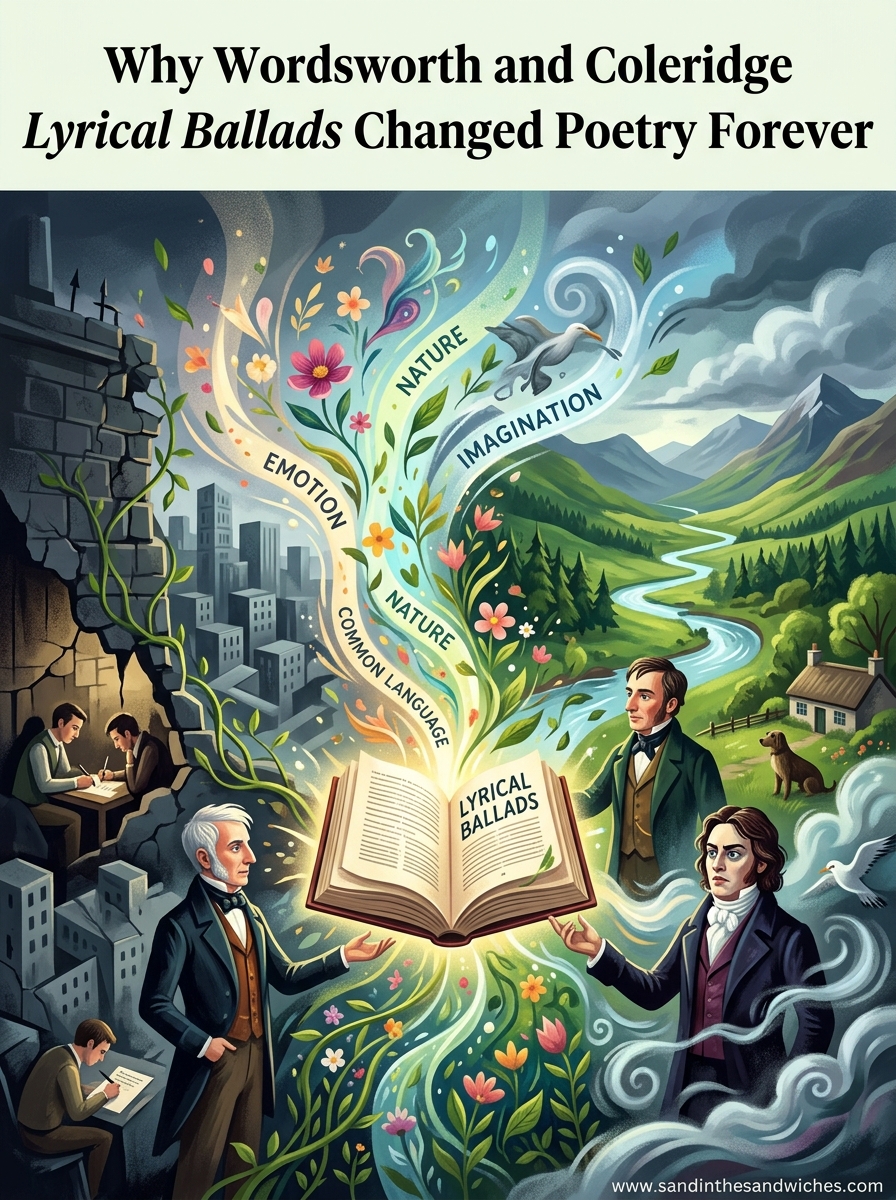
When a slim, anonymous volume of poems appeared in Bristol in 1798, almost nobody realized they were holding the most important poetry collection in English literary history. William Wordsworth and Samuel Taylor Coleridge had quietly published Lyrical Ballads, and in doing so, they detonated a revolution that would reshape how poetry was written, read, and understood for the next two centuries and beyond.
The reason Wordsworth and Coleridge’s Lyrical Ballads changed poetry forever is simple: it rejected the ornate, artificial style of 18th-century verse and replaced it with the language of ordinary people, the drama of everyday life, and the raw authority of personal emotion. Before this collection, poetry was expected to sound elevated and distant. After it, poetry could sound like you.
Our team has spent years studying this collection, reading the poems alongside the 18th-century works they were rebelling against, and tracing their influence through Victorian, Modernist, and even contemporary poetry. What follows is a deep dive into exactly how and why this single book altered the trajectory of English literature.
Table of Contents
What Was Poetry Like Before Lyrical Ballads?
To understand why Lyrical Ballads was revolutionary, you have to know what it was revolting against. Eighteenth-century English poetry was dominated by the neoclassical tradition. Poets like Alexander Pope and Thomas Gray wrote in a style that prized polish, wit, and strict adherence to established forms.
The hallmark of this era was poetic diction, an elevated, artificial vocabulary that nobody ever actually spoke. Poems used inverted word order, Latinate phrases, and conventional phrases like “watery plain” for the sea or “finny tribe” for fish. The goal was refinement, not authenticity.
Form mattered enormously. The heroic couplet, rhyming pairs of iambic pentameter lines, was the gold standard. Poetry was expected to follow rigid rules of meter, rhyme, and structure. Subjects were drawn from classical mythology, aristocratic life, or abstract moral philosophy.
Common people, rural labor, and personal emotion were generally considered unworthy of serious poetry. If a shepherd appeared in a poem, it was an idealized, pastoral figure from an imaginary Arcadia, not a real person with mud on their boots. Poetry had become, as Wordsworth himself put it, “ornate, formulaic, and phony.”
By the 1790s, the literary establishment was comfortable. It did not see a crisis. But two young poets in the west of England did.
The Collaboration That Started a Revolution
Wordsworth and Coleridge first met in 1795 and became, by their own account, almost immediate friends and intellectual partners. By 1797, Wordsworth and his sister Dorothy had moved to Alfoxden House in Somerset, close enough to Coleridge’s home at Nether Stowey that the two men could walk to visit each other daily.
Those walks became legendary. The poets discussed philosophy, politics, the French Revolution, and, above all, the state of English poetry. They agreed that contemporary verse had grown stale and lifeless. They believed it had become divorced from real human experience.
Out of those conversations came a plan. The two poets would publish a joint collection that demonstrated a new kind of poetry. They divided the labor according to their strengths. Coleridge would handle the supernatural, using imaginative power to make miraculous events feel psychologically real. Wordsworth would handle the ordinary, taking commonplace events and people and revealing the wonder hidden inside them.
Dorothy Wordsworth’s role in this collaboration deserves more attention than it typically receives. Her journals from the Alfoxden period show her recording natural details, overheard conversations, and rural scenes that her brother later transformed into poetry. She was, in many ways, the quiet eye through which Wordsworth observed the world.
The collection was published anonymously in September 1798 by the Bristol publisher Joseph Cottle. It sold modestly at first. Reviews were mixed, sometimes hostile. But the seeds had been planted.
Why Wordsworth and Coleridge Lyrical Ballads Changed Poetry Forever: Five Revolutionary Shifts
The collection introduced changes that, taken together, amount to nothing less than the birth of Romantic poetry. Here are the five most significant ways it broke with the past.
1. The rejection of poetic diction. Wordsworth deliberately stripped away the artificial vocabulary that had accumulated around poetry for decades. No more “finny tribes” or “watery plains.” He proposed using what he called “the real language of men,” the actual speech of ordinary people. This was a direct attack on the literary establishment.
2. Ordinary people as poetic subjects. Instead of gods, heroes, and aristocrats, Lyrical Ballads featured rustic characters: leech-gatherers, idiot boys, female vagrants, old hunters, and abandoned mothers. These were people who had never before been considered worthy of serious poetic treatment. Wordsworth argued that rural people, living close to nature, possessed an emotional authenticity that urban sophisticates had lost.
3. Emotion as the engine of poetry. The collection introduced the idea that poetry springs from what Wordsworth famously called the “spontaneous overflow of powerful feelings.” This was a radical departure. Neoclassical poets saw poetry as an intellectual exercise, a display of craft and wit. Wordsworth placed emotion at the center, arguing that genuine feeling was the essential raw material of all great poetry.
4. Nature as a spiritual force. In 18th-century poetry, nature was usually decorative backdrop. In Lyrical Ballads, nature became a living presence, a moral guide, and a source of spiritual truth. Wordsworth treated the natural world as a teacher, a healer, and a mirror of the human soul. This conception of nature would become the defining characteristic of the entire Romantic movement.
5. Personal voice and the individual imagination. The poems spoke in a first-person voice that felt genuinely personal rather than adopting a generic poet-persona. The poet’s own perceptions, memories, and imagination became legitimate subject matter. This opened the door for the intensely personal, confessional poetry that would follow for the next two hundred years.
The Preface: A Manifesto Disguised as an Introduction
The first edition of Lyrical Ballads (1798) appeared with only a brief advertisement. But when the second edition was published in 1800, Wordsworth added an extended Preface that would become one of the most influential critical documents in English literature.
The Preface to Lyrical Ballads functioned as a manifesto. In it, Wordsworth laid out his theory of what poetry should be and why the old approach had failed. He defined poetry as “the spontaneous overflow of powerful feelings” that “takes its origin from emotion recollected in tranquility.”
He argued that the language of poetry should not differ from the language of good prose. He attacked the artificial poetic diction of his predecessors and contemporaries as a barrier between poetry and readers. He made the case that ordinary language, when used with genuine feeling, could produce verse more powerful than anything written in the old elevated style.
This was not universally popular. Critics like Francis Jeffrey attacked Wordsworth for lowering the dignity of poetry. But the Preface gave the emerging Romantic movement its intellectual foundation. It provided a theoretical justification for treating common life and common speech as fit material for the highest art.
The Preface grew longer with each edition. The 1802 version expanded on the nature of the poet, calling the poet “a man speaking to men” but one endowed with greater than usual sensibility. It remains required reading for anyone studying Romanticism or the history of literary criticism.
Key Poems That Defined the Collection
The 1798 edition contained 23 poems. The most famous, and the one that opened the volume, was Coleridge’s “The Rime of the Ancient Mariner.”
This poem embodies Coleridge’s side of the collaboration. It tells a supernatural story: a sailor who shoots an albatross and suffers terrifying supernatural punishment. The language is archaic and ballad-like, but the psychological depth is entirely new. The Mariner’s guilt, isolation, and eventual redemption feel disturbingly real despite the fantastic events.
Wordsworth’s contributions took the opposite approach. “Lines Composed a Few Miles Above Tintern Abbey” is perhaps his greatest achievement in the collection. Written in blank verse, it traces the speaker’s evolving relationship with nature over five years of absence. It moves from youthful sensory pleasure to mature philosophical reflection, all in language so natural it barely sounds like poetry at all.
“We Are Seven” demonstrates Wordsworth’s commitment to simple subjects. It records a conversation between the poet and a young girl who insists that she and her siblings are seven, even though two have died. The poem does not correct her. It respects her emotional logic and reveals something profound about how children understand death.
“The Idiot Boy” was one of the most controversial poems in the collection. Critics were appalled that Wordsworth would make a mentally disabled boy the hero of a serious poem. But this was exactly the point. Wordsworth was insisting that every human life contained material worthy of poetry.
Other notable poems include “The Thorn,” “Goody Blake and Harry Gill,” “Simon Lee,” and “The Female Vagrant.” Together, they form a gallery of rural life rendered with unprecedented honesty and compassion.
18th-Century Poetry vs Romantic Poetry: A Side-by-Side Contrast
The shift Lyrical Ballads initiated becomes clearest when you place the old and new approaches side by side.
Language: 18th-century poetry used elevated, Latinate poetic diction with inversions and conventional phrases. Romantic poetry used the plain speech of ordinary conversation, what Wordsworth called “the real language of men.”
Subject matter: Neoclassical poetry focused on classical myths, aristocratic life, and abstract moral themes. Romantic poetry focused on rustic characters, rural life, childhood, madness, poverty, and personal memory.
Purpose: 18th-century poetry aimed to instruct, to display wit, and to perfect established forms. Romantic poetry aimed to express authentic emotion, to evoke sympathy, and to make readers feel rather than merely admire.
Relationship to nature: Earlier poetry treated nature as decorative setting or pastoral fantasy. Lyrical Ballads treated nature as a living, spiritual presence and a source of moral and psychological truth.
Form: While Lyrical Ballads did not abandon traditional meter and rhyme entirely (many poems use ballad stanza or blank verse), it loosened the grip of rigid forms like the heroic couplet and opened the door to greater formal flexibility.
The Lasting Legacy: How Lyrical Ballads Shaped Modern Poetry
The influence of Lyrical Ballads did not end with the Romantic period. It created a chain reaction that is still being felt in 2026.
John Keats, Percy Bysshe Shelley, and Lord Byron all wrote in the world that Lyrical Ballads opened. The Victorian poets, especially Alfred Lord Tennyson and Robert Browning, inherited Wordsworth’s commitment to common speech and psychological depth. Browning’s dramatic monologues, with their ordinary speakers and unsettling revelations, are unthinkable without Wordsworth’s experiments in “ordinary language.”
The Modernist poets of the early 20th century also owed a debt they rarely acknowledged. When T. S. Eliot insisted that modern poetry should use the language of actual speech, he was echoing Wordsworth’s Preface. When William Carlos Williams wrote about wheelbarrows and plums, he was extending Wordsworth’s argument that anything could be a poetic subject.
Contemporary poetry continues the tradition. The free verse movement, confessional poetry, and the current emphasis on diverse voices and everyday experiences all trace their lineage back to the moment when Wordsworth and Coleridge decided that a leech-gatherer was as worthy of a poem as a Greek hero.
One Reddit user from a literature forum described Lyrical Ballads as “poetry’s punk moment,” a comparison that captures something essential. Like punk rock in the 1970s, Lyrical Ballads said that you did not need formal training, elevated language, or establishment approval to make art that mattered. You just needed honesty and something real to say.
For students and readers today, the collection remains the best gateway into understanding how modern poetry came to be. Read a few pages of Pope, then read Lyrical Ballads, and you will feel the ground shift under your feet.
FAQs
How did Wordsworth and Coleridge theories of poetry differ?
Wordsworth believed poetry should use the ordinary language of common people and focus on everyday rural life, revealing wonder in the commonplace. Coleridge believed poetry should use imaginative power to make supernatural and extraordinary events feel psychologically real. Wordsworth grounded the real in the ordinary; Coleridge elevated the ordinary through the supernatural. Together, their complementary approaches formed the two pillars of early Romanticism.
Why has poetry changed over time?
Poetry changes because each generation rejects the conventions of the previous one. Lyrical Ballads (1798) was a major turning point because Wordsworth and Coleridge deliberately broke the rules of 18th-century neoclassical poetry, replacing artificial diction and heroic couplets with natural speech, personal emotion, and everyday subjects. Every major shift since, from Modernism to free verse to contemporary spoken word, follows the same pattern of rebellion against established norms.
How did William Wordsworth change the perception of poetry?
Wordsworth changed poetry by redefining what it was about and who it was for. He argued that poetry should use the language ordinary people actually speak. He proved that common rural life, childhood memories, nature, and personal emotion were worthy subjects for serious verse. His definition of poetry as the spontaneous overflow of powerful feelings recollected in tranquility shifted the focus from craft and wit to authentic human experience.
What was Coleridge’s disagreement with Wordsworth?
Coleridge later disagreed with Wordsworth’s rigid insistence that poetry must use only the language of rustic country people. In his work Biographia Literaria, Coleridge argued that the language of poetry should be a purified version of language shaped by the imagination, not a literal copy of peasant speech. He also felt that Wordsworth’s theory was too narrow and that some of the poems in Lyrical Ballads were too plain and prosaic.
What are the main themes of Lyrical Ballads?
The main themes of Lyrical Ballads include nature as a spiritual and moral force, the dignity and emotional depth of ordinary rural people, the power of memory and childhood experience, the supernatural and the imagination, social sympathy for the poor and marginalized, and the idea that everyday life contains profound meaning. Together these themes launched the English Romantic movement.
What happened between Wordsworth and Coleridge?
Wordsworth and Coleridge met in 1795, became close friends and collaborators, and published Lyrical Ballads together in 1798. Their friendship deepened during the Somerset years of 1797 to 1798. Over time, however, personal tensions, Coleridge’s health and addiction struggles, political disagreements, and theoretical differences about poetry caused a cooling of the relationship. They never fully reconciled, though Coleridge always acknowledged Wordsworth’s genius.
Conclusion
Understanding why Wordsworth and Coleridge’s Lyrical Ballads changed poetry forever comes down to a single, radical idea: that ordinary life, ordinary people, and ordinary language are worthy of the highest art. By rejecting artificial poetic diction, embracing emotion and nature, and insisting on the spiritual significance of common experience, the two poets launched the Romantic movement and permanently expanded what poetry could do.
The collection proved that a leech-gatherer, a lonely mariner, a child counting her siblings, or a traveler standing above a river could all carry the weight of serious verse. Every poet who has written in plain speech about real life since 1798 is, knowingly or not, walking through a door that Wordsworth and Coleridge opened.
If you want to experience the revolution yourself, start with “Tintern Abbey” and “The Rime of the Ancient Mariner.” Read them slowly, preferably after sampling a page or two of Pope. You will feel the difference in your bones.