
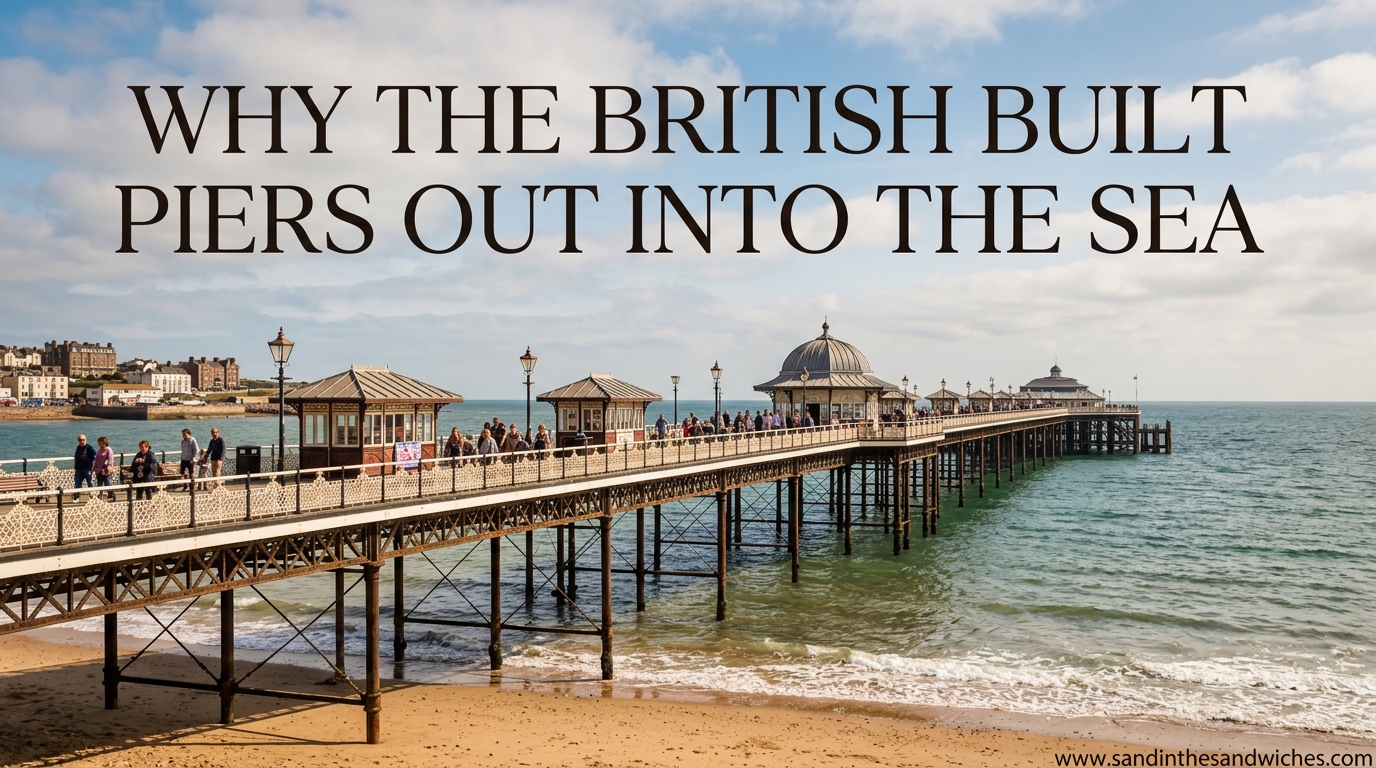
Why the British built piers out into the sea comes down to one clear reason: in 1814, the first purpose-built pleasure pier opened at Ryde on the Isle of Wight to solve a practical problem, letting passengers walk out to waiting paddle steamers without having to wade through tidal mud. From that single structure grew a national obsession with Victorian engineering, seaside holidays, and the now-iconic experience of “walking on water” that defines British coastal culture to this day.
I have always been fascinated by the fact that no other country built piers the way Britain did. Walk along the south coast and you can still see the iron skeletons stretching into the surf, survivors of fires, storms, and two world wars. These are not working docks. They are not breakwaters. They were built so ordinary people could enjoy the sea.
By the end of this guide, you will understand the engineering, the social pressures, and the cultural romance that turned a small Island transport experiment into a defining feature of British seaside resorts.
Table of Contents
How the British Built Piers: Victorian Origins at Ryde
The story of why the British built piers out into the sea begins with a single wooden landing stage at Ryde in 1814. Local builders constructed the original Ryde Pier as a simple timber walkway, long enough to reach deep water where paddle steamers could dock regardless of the tide. The pier was not meant to be beautiful. It was meant to be useful.
Within a decade, the idea had spread. The Chain Pier at Brighton opened in 1823, an iron suspension structure inspired by the new Marlow Bridge. The Trinity Chain Pier at Leith followed in 1821. These were working piers, practical pieces of transport infrastructure, but the British public quickly discovered something unexpected. Walking out over the water, with the waves breaking beneath your feet, felt extraordinary.
By the 1840s, new pier construction was accelerating. The Victorian middle classes had discovered the seaside, and the railway revolution was about to bring them in their thousands.
The Steamer Connection and the Need for Deep Water
To understand why the British built piers out into the sea, you have to understand the limits of early Victorian steamers. Paddle steamers of the early 19th century needed deep water to dock safely. Many British seaside towns sit on shallow, tidal coasts, where the sea retreats hundreds of yards at low tide. A steamer simply could not reach the shore.
Piers solved this. By extending a walkway out into the sea, engineers could give steamers a reliable berth in deep water, while passengers walked the rest of the way. The steamers could load and unload on schedule, and the pier became a vital piece of transport infrastructure for the growing network of coastal ferry services.
Why Piers Were Built: Transportation and the Steamer Connection
Why the British built piers out into the sea is fundamentally a transport story. The first piers were not leisure destinations. They were jetties, plain and simple, designed to solve a logistical problem that railways alone could not fix.
In 1845, the South Eastern Railway reached Folkestone, and within a decade, almost every south coast town had a rail link. Suddenly, day-trippers from London could reach the sea in hours. A single Bank Holiday could bring 50,000 visitors to a single resort. The piers had to grow to handle the crowds.
Railways, Day-Trippers, and the Seaside Boom
Railway expansion changed British piers forever. Before the trains, only the wealthy could afford a proper seaside holiday. After the trains, working-class families could save up for a “Wakes Week” or a Bank Holiday trip to the coast. The pier became the focal point of this new mass tourism.
Pier companies saw the opportunity. Between 1860 and 1914, more than 80 pleasure piers were built around the British Isles. Most of them were funded by private companies hoping to profit from steamer traffic, concert admissions, and the new appetite for seaside entertainment.
The numbers are striking. By 1914, Britain had more seaside piers than the rest of the world combined. No other nation built piers on this scale, and the reason is rooted in Britain’s unusual combination of geography, industrial capacity, and a national railway system that funneled millions of urban workers toward the coast.
How Victorian Engineers Built Piers Out Into the Sea
How the British built piers out into the sea is almost as interesting as why. The first piers were timber, and they rotted quickly in saltwater. By the 1860s, a new generation of engineers was experimenting with iron, and one name stands above the rest: Eugenius Birch.
Birch patented the screw pile in 1858, a hollow iron column with a wide screw thread at the base. Workers could drive these piles deep into the seabed using muscle power and a capstan, and the structure would support an iron deck that could withstand the worst of British weather. Birch’s design made the modern pleasure pier possible.
The Screw Pile Revolution
Before the screw pile, building in tidal waters was a nightmare. Workers had to work between tides, often in freezing water, driving wooden piles with hammers. It was slow, dangerous, and expensive. The screw pile changed everything.
Birch designed Birnbeck Pier (1867), the first screw-pile pier in Britain, and followed it with piers at Clevedon (1869), Brighton West Pier (1866), and many others. Southend Pier, the longest pleasure pier in the world at 1.34 miles, was rebuilt on screw piles in 1889. Each structure was a small engineering marvel, designed to flex with the waves rather than fight them.
The materials mattered too. Cast iron was strong, but it corroded in salt water. Victorian engineers wrapped piles in concrete, painted them in tar, and designed access points for inspection and repair. Many of these original piers are still standing more than 130 years later.
From Transport to Pleasure: The Entertainment Boom
Why the British built piers out into the sea shifted dramatically in the late 19th century. Steamers were no longer the main attraction. The pier itself had become the destination, and pier owners raced to add entertainment features that would keep visitors spending money.
Bandstands, pavilions, theatres, and amusement arcades sprouted along the deck. Skegness Pier got a ballroom. Blackpool’s three piers added every kind of ride and arcade imaginable. Eastbourne Pier got a camera obscura. By 1900, a British pleasure pier was less a jetty and more a small floating city.
The “Walking on Water” Experience
The writer William Makepeace Thackeray captured the magic perfectly when he described walking out on a pier as a sensation of “walking on water.” For a Victorian visitor who had never seen the sea before, the experience was transformative. The fresh salt air, prescribed by doctors for everything from tuberculosis to melancholy, became known as “ozone” and was sold as a tonic in its own right.
Victorians flocked to piers to breathe it in. They promenaded in their Sunday best, listened to brass bands, and stared out at passing ships. For the price of a penny toll, anyone could enjoy the sensation, and millions did.
The Famous Piers That Survived
Some British piers have become cultural icons. Brighton Palace Pier, originally opened in 1899, still draws millions of visitors every year. Southend Pier, the world’s longest pleasure pier, is a Grade II listed structure. Blackpool’s three piers are central to the town’s identity. Clevedon Pier, a masterpiece of slender ironwork, is one of the most photographed structures in the West Country.
These survivors share a few things in common. They were well-built, well-maintained, and they adapted to changing tastes. Modern British piers host wedding receptions, escape rooms, trampoline parks, and craft beer festivals. The bones are Victorian, but the experience is thoroughly modern.
The Decline of British Piers: Fires, Wars, and Change
Why the British built piers out into the sea is only half the story. The other half is what happened next. By the mid-20th century, British piers were in serious trouble.
Fire was the great destroyer. Brighton’s West Pier burned in 2003, three years after the deck had finally collapsed into the sea. The Grand Pier at Weston-super-Mare burned in 1930 and again in 2008. Eastbourne Pier caught fire in 2014. Fire has destroyed more British piers than storms and war combined, in part because so much of the structure was timber, and in part because early electrical systems were often jury-rigged.
War and Weather
World War II was brutal to British piers. Many were requisitioned by the military, with parts removed to prevent enemy landings. Others were hit by German bombing. Several never reopened. The War had barely ended before a new threat appeared: the package holiday.
By the 1970s, cheap flights to Spain had replaced the British seaside holiday for millions of working-class families. The day-trippers dried up. Many pier companies went bankrupt, and the structures themselves fell into disrepair. By 1980, more than a dozen once-famous British piers had been demolished or had collapsed into the sea.
The Lost Piers
It is worth pausing to remember the lost ones. Saltburn Pier was demolished in 1898, only 29 years after it was built. Skegness Pier lost its pavilion to fire in 1959 and the rest went with it. The pier at Hunstanton survived only until 1978. The pier at Aberystwyth was damaged by storms in 1938 and never rebuilt.
Each loss is a small piece of British heritage gone forever. According to the National Piers Society, more than 20 piers have been lost in the last century, and only around 60 survive today.
British Piers Today: Preservation and Modern Significance
Why the British built piers out into the sea still matters, because the answer to that question explains why so many piers are still standing in 2026. The surviving piers are protected as listed buildings, maintained by charitable trusts, and championed by the National Piers Society, which was founded in 1979 to save them from the wrecker’s ball.
Several piers hold Grade II or Grade I listed status, which makes demolition extremely difficult. Clevedon Pier is Grade I. Brighton Palace Pier, Southend Pier, and others are Grade II. Listing alone does not pay for restoration, but it does buy time. Local fundraising, Heritage Lottery grants, and visitor revenue have brought many piers back from the brink.
A Living Piece of British Culture
Walk along the British coast in 2026 and you can see why these structures still matter. Families still stroll out to the end of the pier. Couples still take selfies at sunset. The bandstand at Eastbourne still hosts concerts. The arcades at Blackpool still light up the night.
For the British seaside town, the pier is not just a tourist attraction. It is an identity. It is the reason the town exists, the symbol of its heyday, and a working piece of Victorian engineering that is still doing the job it was built to do, more than 200 years after that first wooden walkway at Ryde.
So why did the British build piers out into the sea? Because they had to. They had steamers but no deep water. They had railways but no holiday resorts. They had a working class hungry for fresh air. The pier was the elegant Victorian answer to a very modern problem, and it worked.
Frequently Asked Questions
What was the original purpose of UK piers?
The original purpose of UK piers was to provide transport infrastructure for paddle steamers, allowing passengers to walk out to deep water where ships could dock regardless of the tide. The first pier at Ryde on the Isle of Wight was built in 1814 for exactly this reason. Pleasure and promenading came later, once the public discovered how enjoyable walking out over the sea could be.
How did they build piers in the sea?
Victorian engineers built piers in the sea by driving iron or timber piles into the seabed and laying a deck on top. The breakthrough came with Eugenius Birch’s screw pile design in 1858, which used a threaded iron column that workers could screw deep into the seabed using a capstan. This method was far faster and more durable than traditional pile-driving, and it allowed piers to be built in tidal waters that would have been impossible to work by hand.
Who invented seaside piers?
No single person invented seaside piers. The first pleasure pier was built at Ryde on the Isle of Wight in 1814 as a community project, while the Chain Pier at Brighton followed in 1823. The modern iron pier is generally credited to Eugenius Birch, whose screw pile design made pier construction practical on a large scale. The explosion of pier building in the 1860s and 1870s was driven by railway expansion and the rise of mass seaside tourism.
Why does the UK have so many piers?
The UK has so many piers because of a unique combination of geography, industrial capacity, and railway expansion. British coastal towns are often shallow and tidal, so steamers needed piers to reach deep water. Britain’s 19th-century industrial base could mass-produce the iron and steel needed. The Victorian railway network brought millions of day-trippers to the coast, creating demand for promenades and entertainment. By 1914, Britain had more pleasure piers than the rest of the world combined.
Final Thoughts on Why the British Built Piers Out Into the Sea
Why the British built piers out into the sea is a story of practical engineering, social change, and a national love affair with the seaside. From a single timber walkway at Ryde in 1814 to the iron pleasure palaces of the Edwardian era, British piers grew from transport infrastructure into cultural icons.
Next time you visit the British coast, walk out on a pier. Feel the iron beneath your feet, listen to the gulls, and remember that you are standing on a piece of Victorian engineering that was built to solve a problem, and ended up defining a country.