
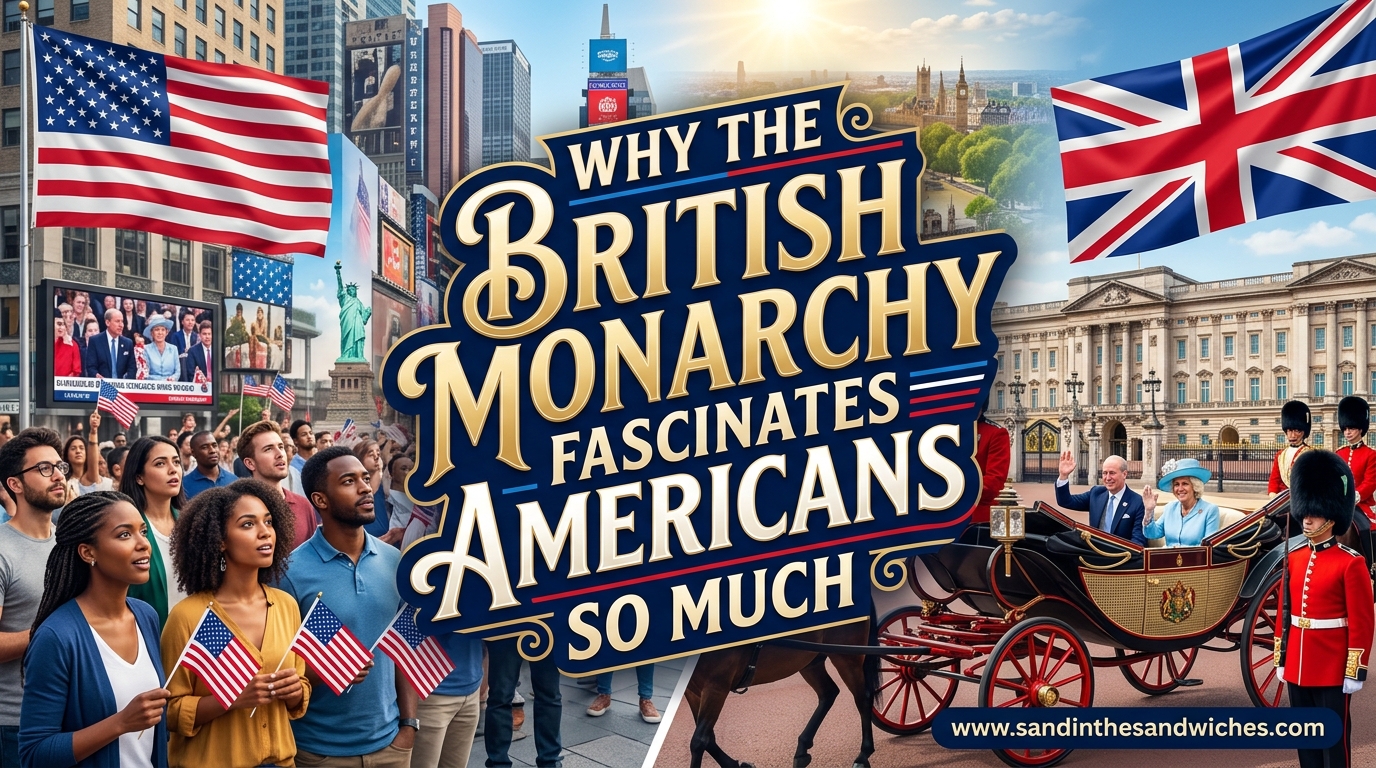
Americans fought a revolution to be rid of kings. We wrote a Constitution that forbids titles of nobility. We pride ourselves on a society built, at least in theory, on the idea that no one is born above anyone else. And yet, when a British royal gets married, has a baby, or simply appears on a balcony in a fancy hat, tens of millions of Americans drop everything to watch.
That paradox sits at the heart of why the British monarchy fascinates Americans so much. Roughly 29.2 million Americans tuned in for Prince Harry and Meghan Markle’s wedding in 2018. The Crown spent weeks atop the Netflix most-watched list. Wall Street traders bowed their heads in silence when Queen Elizabeth II died. Members of Congress, the same body that declared independence from her ancestor, sang her praises on the floor.
Something deeper than celebrity gossip is at work here. The British royal family fills a space in American culture that nothing else quite occupies. There is no American equivalent of a hereditary head of state draped in a thousand years of accumulated ritual. There is no American palace where a living fairy tale unfolds in real time. And there is no American institution that combines wealth, glamour, history, and family melodrama in quite the same irresistible package.
In this article, I want to walk through the reasons behind this fascination. Some of them are obvious. Others are buried so deep in American history and childhood conditioning that we barely notice them. Together, they explain why a country that rejected the Crown in 1776 has spent the last 250 years quietly unable to look away from it.
Table of Contents
Quick Answer
Americans are fascinated by the British monarchy because it combines four forces nothing in American life can match: childhood conditioning through fairy tales and Disney films, the visual spectacle of ceremony and pageantry, the guilt-free celebrity drama of a real royal family, and a nostalgic longing for a British connection that the United States formally rejected in 1776 but never emotionally let go of. Scholar Elizabeth Freeman puts it simply: Americans can admire the monarchy “in a guilt-free way because they’re not ours.”
Why the British Monarchy Fascinates Americans So Much: A Multi-Layered Answer
There is no single reason the British monarchy fascinates Americans. Ask five different people and you will get five different answers. Some will talk about the dresses and the hats. Others will mention history, or Princess Diana, or the simple pleasure of watching a family argue in public. The honest answer is that the fascination has layers, and each layer pulls a different kind of American in.
When I started researching this, I noticed that most explanations focus on just one layer. Some writers blame Disney. Others point to colonial history. A few just say Americans love a good soap opera. All of them are right, but none of them alone tells the whole story.
Here are the five layers that, woven together, explain the enduring American obsession with the British royal family:
- Childhood conditioning through fairy tales, Disney films, and storybook royalty
- The spectacle of pomp and pageantry with no American equivalent
- The guilt-free celebrity soap opera of a real family living a real drama
- The colonial nostalgia for a British connection that was severed in 1776
- The modern media machine of Netflix, TikTok, and 24-hour royal coverage
Each of these layers deserves its own look. And each, on its own, would be enough to explain a modest American interest in royalty. Stacked together, they explain something closer to an obsession.
It Starts in Childhood: The Fairy Tale Effect
The deepest root of American royal fascination is planted before any of us can remember. From the moment American children are old enough to sit through a story, they are saturated with kings, queens, princes, and princesses. The mythology of royalty is baked into American childhood at a level so fundamental that we rarely question it.
Think about the stories. There is King Arthur and the Knights of the Round Table. There is C.S. Lewis’s Narnia, ruled by noble kings and queens. There is Mark Twain’s The Prince and the Pauper, the Frog Prince, Sleeping Beauty’s castle, and a dozen other tales in which royalty represents the ultimate fantasy: that worthiness, beauty, and goodness can be recognized and rewarded with a crown.
Then there is Disney. The Disney princess industrial complex is, in a very real sense, the largest pro-monarchy propaganda campaign in human history. Generation after generation of American children has grown up watching Cinderella, Snow White, Ariel, Belle, Jasmine, Tiana, Moana, and Elsa. The core fantasy, repeated dozens of times, is the same: an ordinary person (often a commoner) is revealed to be special and is elevated into royalty.
This matters because it wires the American imagination to see the British monarchy not as a foreign political institution but as a fairy tale made flesh. When an American watches a real royal wedding, they are not really processing it as a geopolitical event. They are processing it as the storybook coming true. The tiara, the carriage, the prince, the commoner who becomes a duchess. It is Cinderella, except the cameras are real.
A Los Angeles Times columnist put it well when reflecting on Queen Elizabeth II’s death: even though Americans “divorced ourselves from the crown nearly 250 years ago, we’ve clung desperately to the mythical idea of royalty, to the legends, the stories, the glamor.” He’s right. The clinging starts in the crib.
Notice the specific recurring plots in these childhood stories. The first is the commoner who becomes royal, which trains Americans to see royal elevation as a vindication of personal worth. The second is the royal who becomes ordinary, like The Prince and the Pauper or Roman Holiday, which trains Americans to believe that royals are “just like us” underneath. Both plots make the monarchy feel emotionally accessible to a republic that has no royals of its own.
None of this is accidental. American children’s literature inherited its royal obsession directly from its British and European roots. The fairy tales that Disney adapted are mostly German and French. The Arthurian legends are British. The pauper-and-prince trope is American only in Mark Twain’s hands. The collective effect is that Americans grow up fluent in the language of royalty long before they ever encounter the actual British monarchy as a news story.
The Spectacle of Pomp and Pageantry
The second layer is visual, and it is the one most often named by royal fans when you ask them directly. The British monarchy does spectacle better than any institution on earth, and Americans, whose own political rituals are comparatively plain, find that spectacle magnetic.
Consider what a royal event actually looks like. A coronation at Westminster Abbey features a crown glittering with jewels, robes of crimson velvet, an archbishop chanting ancient words, and a congregation of peers in medieval-style finery. Trooping the Colour brings out hundreds of soldiers in bearskin hats, marching bands, and cavalry on immaculately groomed horses. A state opening of Parliament involves a monarch riding in a gilded carriage drawn by horses, escorted by household cavalry in plumed helmets.
There is nothing remotely like this in American civic life. The American equivalent of a national ceremony is an inauguration, which is impressive in its own way but visually restrained. There are no crowns, no thrones, no hereditary peers, no centuries-old rituals performed in garments that look like they came out of a museum. The State of the Union is a speech in a suit. A royal coronation is a multi-hour theatrical production staged inside a 750-year-old church.
That visual gap matters more than people realize. Humans are wired to respond to grandeur. We are drawn to gold, to ceremony, to the sight of people dressed in extraordinary clothing performing extraordinary rituals. The British monarchy has spent centuries perfecting this aesthetic, and it has few modern competitors. The Pope has it. The Japanese imperial family has a version of it. But for sheer visibility and media reach, the British monarchy is in a category of its own.
Then there are the smaller, addictive details. The fascinators at royal weddings. The tiaras loaned from the royal collection. The color-coordinated outfits worn by the princesses. The changing of the guard at Buckingham Palace. Each of these is a small piece of visual theater, and each one photographs beautifully, which in 2026 is the only metric that really matters.
As one Associated Press analysis noted, the monarchy functions for many Americans as a kind of “Holy Grail” of wealth, power, glamour, and charisma. That framing captures something real. The spectacle is not just about beauty. It is about the spectacle of a way of life that seems impossibly distant from ordinary American experience, and that distance is precisely what makes it so watchable.
The Guilt-Free Celebrity Soap Opera
The third layer is the one that has exploded in the last decade, and it is where the monarchy stops being a museum piece and becomes a living, breathing, gossip-generating entertainment franchise. The British royal family is, for many Americans, the world’s longest-running reality show.
The soap opera appeal is obvious once you look for it. You have a powerful but aging patriarch in King Charles. You have a dutiful heir in Prince William and a glamorous wife in Catherine, Princess of Wales. You have the rebel brother in Prince Harry, who married an American actress and walked away from the whole thing. You have the lingering ghost of Princess Diana, whose death in 1997 broke American hearts in a way few royal events ever have. You have generations of scandal, romance, betrayal, and reconciliation, all playing out inside institutions older than the United States itself.
The numbers tell the story of how big this audience is. Roughly 29.2 million Americans watched the Harry and Meghan wedding live in 2018. The Oprah interview with the couple in 2021 drew over 17 million viewers in the United States alone. The Crown, Netflix’s dramatization of Queen Elizabeth II’s reign, became one of the streaming service’s most-watched original series ever, with American audiences making up a huge share of its viewership.
What makes the royal soap opera so appealing, though, is not just the drama. It is the fact that, unlike American celebrity drama, it carries no political stakes. When the Kardashians fight, or when a Hollywood marriage implodes, the entertainment is real but there is no larger meaning attached. When members of the British royal family feud, the drama carries the weight of a thousand years of history, constitutional significance, and global diplomacy. It feels important, even when it is not.
At the same time, the stakes for an American viewer are essentially zero. Whether Harry and Meghan reconcile with the Windsors or not, American taxes do not change. American laws do not change. American foreign policy does not change. This is the “guilt-free fascination” that scholar Elizabeth Freeman identified. Americans can invest enormous emotional energy into the royal family precisely because nothing they do actually affects American lives. It is entertainment with the volume of significance turned all the way up and the volume of consequence turned all the way down.
The modern media machine has amplified this layer dramatically. Twenty years ago, royal gossip came filtered through People magazine and the occasional tabloid. Today it is everywhere. Instagram accounts dedicated to royal fashion have millions of followers. TikTok creators make careers out of analyzing royal body language. Netflix spins royal history into prestige drama. Podcasts dissect every royal appearance in real time. The result is that the soap opera never stops, and Americans who dip in even casually find themselves caught up in a continuously updated narrative.
A Connection That Never Truly Was: The Colonial Roots
The fourth layer goes deeper than childhood stories or modern media, and it is the one most Americans never consciously think about. The United States was, for most of its colonial period, deeply devoted to the British Crown. The rejection of monarchy in 1776 was real, but it did not erase two centuries of psychological attachment. In a sense, Americans have been missing a connection they were never quite able to fully break.
Historians who study colonial America describe a society obsessed with the monarchy to a degree that surprises modern readers. Colonists celebrated royal birthdays with public feasts and toasts. They toasted the king in taverns. They imported portraits of the royal family and hung them in their homes. They named their children after monarchs. London, for many colonists, was the cultural capital of America, even if they had never been there.
One striking case study comes from 1781, when the future King William IV, then known as Prince William Henry, visited New York during the Revolutionary War. The historian Vaughn Scribner has documented how even Americans in the middle of fighting the British Crown turned out in droves to see a real-live prince. Taverns threw parties. Newspapers printed glowing profiles. Ordinary colonists who had every reason to hate the monarchy lined up to catch a glimpse of royal glamour.
This pattern, Scribner argues, reveals something important. American fascination with the British monarchy is not a modern media invention. It is a continuation of a colonial-era obsession that the Revolution interrupted but never fully killed. The Revolution severed the political relationship. It did not sever the psychological one.
Part of what fuels the fascination, then, is nostalgia for a relationship that never quite became what colonists wanted it to be. Colonial Americans wanted to feel like full partners in the British Empire. They wanted London to treat them as equals. When that did not happen, they declared independence. But the longing for that imagined partnership, the fantasy of being genuinely connected to the Crown, did not disappear. It simply went underground and resurfaced in new forms.
This is why events like Meghan Markle’s entry into the royal family land so differently in America than they do in Britain. When an American woman married a British prince, it felt, to many Americans, like the colonial fantasy finally coming true. The long-lost connection was being restored. The revolution was, in some small symbolic way, being healed. No one articulated it in those terms, but the emotional response made no sense without that deeper history.
It is worth being honest about the darker side of this nostalgia. The British monarchy, throughout its history, has been inseparable from empire, conquest, the transatlantic slave trade, and the colonization of indigenous lands around the world. Some Americans, particularly those whose communities were shaped by that history, feel the monarchy represents oppression rather than fairy tales. Forum discussions on Reddit repeatedly surface this tension. The fascination is real, but so is the discomfort, and any honest account has to hold both.
The Special Relationship and the Modern Media Machine
The fifth layer brings us to the present. The British monarchy does not just live in childhood memories or colonial ghosts. It lives on American screens, in American newspapers, and in American cultural conversation, sustained by a media ecosystem designed to keep the fascination alive.
Start with what diplomats call the Special Relationship. The United States and the United Kingdom have maintained one of the closest political, military, and cultural alliances of the last century. American and British troops have fought side by side in two world wars and numerous conflicts since. The intelligence sharing between the two countries is the deepest of any such partnership in the world. This political closeness creates a background hum of Anglo-American familiarity that makes the monarchy feel, to Americans, like a family matter rather than a foreign one.
When Queen Elizabeth II died in 2022, the reaction in the United States was telling. President Biden ordered flags to fly at half-staff. Members of Congress, Republican and Democrat alike, issued reverent statements. Wall Street observed a moment of silence. None of this would have happened for the death of a monarch from any other country. The British monarchy occupies a unique emotional space in American public life, and the Special Relationship is a big part of why.
But the political relationship is just the foundation. What really supercharges American fascination in 2026 is the media machine built on top of it. The modern royal-industrial complex is enormous, and American companies are major players in it.
Netflix turned the monarchy into prestige television with The Crown, which ran for six seasons and racked up billions of viewing hours. Streaming services greenlit royal documentaries at a furious pace. American tabloids, from People to US Weekly, devote regular cover space to royal news. Social media platforms, especially Instagram and TikTok, have spawned entire ecosystems of royal-focused creators who reach audiences in the tens of millions.
None of this existed a generation ago. Twenty-five years ago, American royal coverage was a niche corner of the magazine rack. Today it is a continuous, algorithmically optimized content stream that reaches anyone with a phone. The result is that even Americans who are not actively interested in the monarchy encounter royal content constantly, and a meaningful percentage of them get pulled in.
This is the biggest gap in how previous writers have explained the American royal obsession. Older explanations focused on timeless psychology: fairy tales, pageantry, nostalgia. All true. But they missed the fact that the modern scale of American fascination is, to a significant degree, manufactured. The media machine has learned that royal content performs extraordinarily well with American audiences, and so it produces more of it, which creates more fascination, which creates more demand, in a self-reinforcing loop. The British monarchy fascinates Americans in part because American media companies have figured out that fascination is very, very profitable.
American Royalty Substitutes and Generational Shifts
Two more pieces of the puzzle are worth mentioning, and both are angles almost no previous coverage has explored. The first is the question of substitutes. The second is the question of generations.
On substitutes: Americans have always tried to create their own royalty. Because the country has no real monarchy, Americans elevate the closest available alternatives into the same emotional role. Political dynasties like the Adamses, the Roosevelts, the Kennedys, and the Bushes have all functioned, at times, as American quasi-royal families. Hollywood dynasties, from the Barrymores to the Coppolas to the Smiths, do the same. The Kardashian-Jenner family built an empire on the explicit model of royalty, with Kim Kardashian openly citing Princess Diana as an influence.
What this suggests is that the desire for royalty is not uniquely about the British. It is about a human appetite for glamour, dynasty, and inherited status that the American republic formally refuses to satisfy. Americans who cannot have a king will create one out of a president, a movie star, or a reality television family. But these substitutes are never quite enough, because none of them have the one thing the British monarchy has: a thousand years of unbroken history and a constitutional role that gives the pageantry actual weight.
On generations: the fascination is not uniform across age groups. Older Americans, who grew up during Queen Elizabeth II’s seven-decade reign and who remember Princess Diana vividly, tend to feel the deepest attachment. The Queen was a constant presence in American life for so long that, for many older Americans, she felt almost like a shared global grandmother.
Younger Americans are a more complicated picture. Millennials, raised on Disney princesses and The Crown, often retain the fairy tale programming but engage with the monarchy more as entertainment than as reverence. Gen Z, growing up in a media environment saturated with royal content but also with sharp critiques of empire, colonialism, and inherited privilege, is more skeptical. Forum discussions on Reddit repeatedly surface younger voices questioning whether the fascination is even appropriate, given the monarchy’s historical baggage.
Whether American fascination with the British monarchy is growing or declining depends entirely on which Americans you ask. The numbers suggest it is shifting rather than disappearing. The royal soap opera audience skews younger than it used to, thanks to Netflix and TikTok. But the traditional reverence audience, the Americans who genuinely feel affection for the institution, is aging. The monarchy’s hold on American attention is not dying, but it is changing shape, and where it lands over the next generation is an open question.
What Americans Believe About the Royals vs. Reality
Part of the fascination is built on a gap between what Americans imagine the monarchy to be and what it actually is. The fairy tale version and the constitutional reality are quite different, and holding both in your head at once is part of what keeps the monarchy endlessly interesting to American audiences.
Here is a quick breakdown of where American imagination and British reality diverge.
- Belief: The monarchy runs the country. Reality: The monarch reigns but does not rule. Real power sits with Parliament and the Prime Minister. The King’s role is almost entirely ceremonial.
- Belief: Royals live a carefree life of pure luxury. Reality: Senior royals carry out hundreds of official engagements a year, follow strict protocols, and have very little privacy.
- Belief: The royal family costs British taxpayers a fortune. Reality: The Sovereign Grant is roughly offset by the profits of the Crown Estate, which the monarch surrenders to the government in exchange for a percentage. The net cost to taxpayers is debated but relatively small.
- Belief: Being royal is all tiaras and palaces. Reality: Junior royals often struggle financially, and even senior royals live under intense public scrutiny that many find suffocating.
- Belief: Americans care more than the British do. Reality: British public opinion is divided, with significant republican sentiment, but engagement remains high. American interest, while loud, is more superficial and entertainment-driven.
- Belief: The monarchy is purely an ancient tradition. Reality: Many “ancient” royal rituals, including much of the coronation pageantry Americans love, were invented or heavily revised in the 19th and 20th centuries.
These gaps are not a flaw in the fascination. They are part of the engine. The monarchy stays interesting precisely because it lives in the tension between myth and reality, and Americans, watching from 3,000 miles away, get to enjoy the myth without having to deal with the political reality.
FAQs
Why do Americans like the British monarchy?
Americans like the British monarchy because it combines childhood fairy tale conditioning, spectacular ceremony with no American equivalent, guilt-free celebrity drama, and a nostalgic colonial-era connection to Britain that was severed in 1776 but never emotionally broken. Because the monarchy is not American, fans can enjoy the glamour and soap opera without any political consequences.
Who is the most unpopular royal family member?
Prince Andrew has consistently ranked as the most unpopular member of the British royal family in polling, particularly after his association with Jeffrey Epstein and the resulting legal and public fallout. Other members who score low in some surveys include Prince Harry and Meghan Markle, especially among British respondents, though American rankings often differ.
Who is the most respected royal family in the world?
The British royal family is widely considered the most respected and globally prominent monarchy, thanks to the UK’s historical reach, the Commonwealth, and unmatched international media coverage. Other respected royal families include the Dutch, Swedish, and Japanese imperial families, but none match the British monarchy’s global name recognition or cultural footprint.
Who is richer, Elon Musk or the Royal Family?
Elon Musk is significantly richer than the British royal family. Musk’s net worth has fluctuated in the hundreds of billions of dollars, while the British monarchy’s total wealth, including the Crown Estate, the Duchy of Lancaster, and private assets, is estimated at roughly $20 to $30 billion. Much of that wealth is tied up in assets that cannot be sold, and the Sovereign Grant, the public funding that supports royal duties, is around $100 million per year.
Conclusion: A Fascination That Outlived the Revolution
So why does the British monarchy fascinate Americans so much? Because it is not one thing. It is a fairy tale we were raised on, a spectacle we cannot replicate, a soap opera with no real stakes, a colonial ghost we never fully exorcised, and a media franchise engineered to hold our attention. Strip any single layer away and the fascination would still survive. Stack them all together and you get an obsession durable enough to outlast a 250-year-old revolution.
My read is that the fascination is not going anywhere soon, but it is changing. The old reverence, the genuine affection older Americans felt for Queen Elizabeth II, is fading with her generation. What is replacing it is something younger, more ironic, and more entertainment-driven. Americans in 2026 are less likely to bow their heads for a monarch and more likely to binge a streaming series about one. But they are still watching.
The monarchy’s hold on the American imagination has survived the Revolutionary War, the War of 1812, two world wars, the end of empire, and the death of its most beloved modern sovereign. It will survive TikTok and Gen Z skepticism too. The country that rejected the Crown in 1776 never quite stopped looking at it, and on the evidence of the last 250 years, it probably never will.