
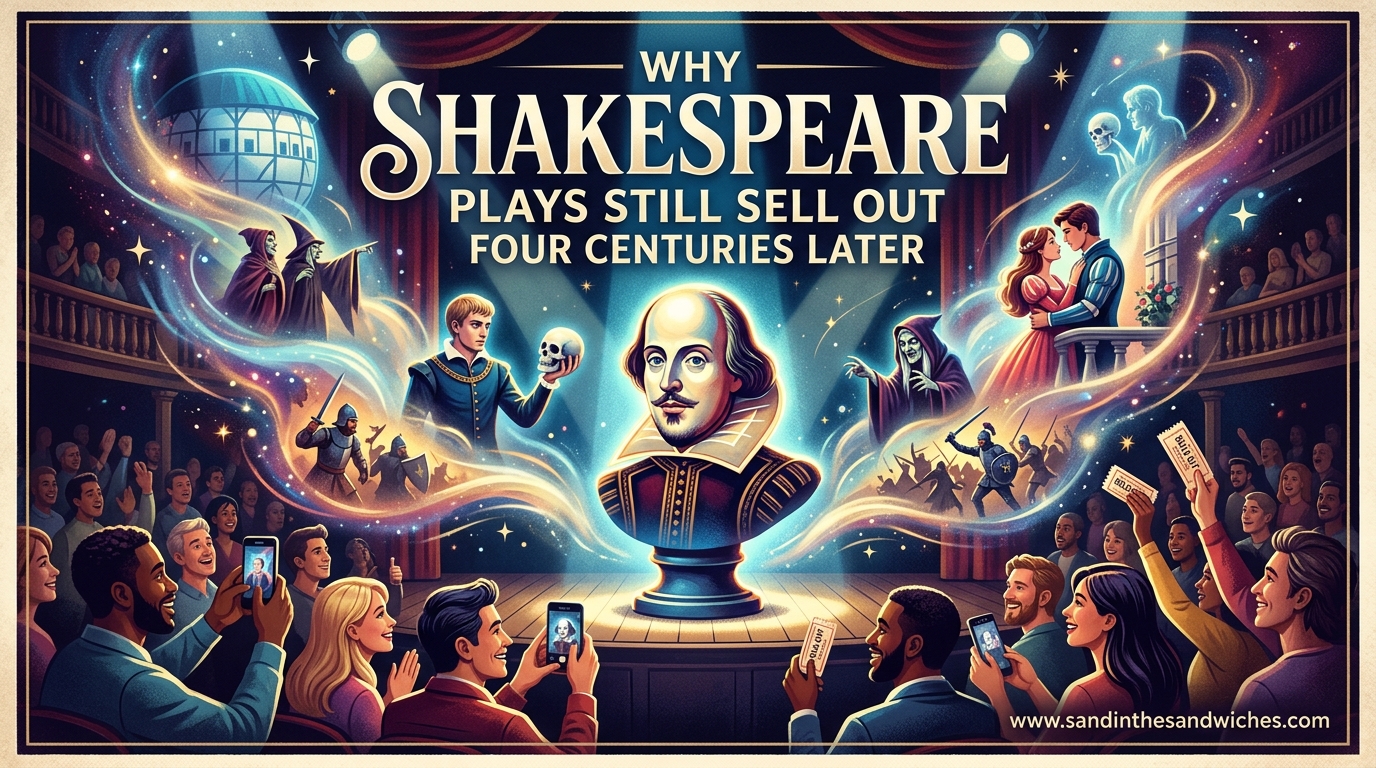
When Ben Jonson wrote that Shakespeare “was not of an age, but for all time,” he was making a bold prediction about a playwright who had been dead for only a few years. Four hundred years later, that prediction has proved more accurate than Jonson could have imagined. The question of why Shakespeare plays still sell out four centuries later is not just academic trivia. It touches something fundamental about how stories, language, and human experience intersect across generations.
Every year, theaters from London’s West End to a small community playhouse in rural Kansas fill seats for Hamlet, Macbeth, and A Midsummer Night’s Dream. Schools still assign Romeo and Juliet. Film directors still mine the plays for adaptations. The reasons behind this enduring popularity are surprisingly concrete. They sit in the themes Shakespeare chose, the language he built, the characters he drew, and the stagecraft he pioneered. When you break it all down, the answer to why Shakespeare still sells out becomes clear.
Table of Contents
Universal Themes That Never Age
The single most cited reason Shakespeare remains relevant is his grip on universal human themes. Love, jealousy, ambition, grief, revenge, guilt, and the fear of death are not bound to any century. They are the constants of being human. Romeo and Juliet is not really about two teenagers in Verona. It is about the reckless intensity of first love and the damage done when families refuse to let go of old grudges. That setup plays just as well in 2026 as it did in 1595.
Othello turns on jealousy and manipulation, emotions that have not evolved since the Renaissance. Macbeth dissects the corrupting pull of unchecked ambition, a theme that lands differently in every political era but never stops landing. King Lear asks what we owe our parents, our children, and ourselves as we age. These are not period concerns. They are life concerns.
What gives Shakespeare his reach is the way he refuses easy answers. The plays do not moralize. They sit inside the mess of being human and let the audience draw their own conclusions. That openness is why every generation finds something new in the same text. A 20-year-old reading Hamlet in 2026 encounters a different play than a 60-year-old rereading it. The script has not changed. The reader has.
The Language We Still Speak Every Day
Shakespeare did not just write plays. He reshaped the English language. Estimates vary, but scholars credit him with coining or popularizing over 1,700 words still in common use. When you say someone “vanished into thin air,” you are quoting Othello. When you call a situation a “wild goose chase,” you are quoting Romeo and Juliet. “Break the ice,” “heart on my sleeve,” “love is blind,” “fair play,” “dead as a doornail” — all Shakespeare.
Most native English speakers use Shakespearean phrases every week without knowing it. That invisible presence in daily speech keeps the work alive in a way that no marketing campaign could ever replicate. You do not have to read a single play to be speaking Shakespeare’s English. The language has saturated the culture so completely that it has become the culture.
Then there is the craft. Shakespeare wrote largely in iambic pentameter, a rhythmic pattern that mirrors the human heartbeat. Lines like “To be, or not to be, that is the question” stick in the memory not because they are clever but because they are physically rhythmic. The body recognizes the cadence before the mind parses the meaning. That musicality is why a well-delivered soliloquy still sends chills through a modern audience that has never opened a copy of the First Folio.
Characters With Real Psychological Depth
Long before Freud, long before modern psychology existed as a discipline, Shakespeare was writing characters with interior lives. Hamlet does not just grieve his father. He interrogates his own grief, second-guesses his motives, and stalls on action because he cannot stop thinking. That is not a plot device. That is a portrait of a mind at war with itself.
Lady Macbeth is not a simple villain. She is a woman who talks herself into cruelty, then is undone by the guilt of having succeeded. Her sleepwalking scene is one of the most accurate depictions of trauma in all of Western literature, written nearly 400 years before psychologists had a clinical name for it. Iago in Othello destroys a man’s life with no clear motive, and the play refuses to explain him away. He is simply, terrifyingly, the way some people are.
These characters feel modern because Shakespeare treated them as human beings rather than as vehicles for plot. They contradict themselves. They rationalize. They lie to themselves and then believe the lie. When you watch a Shakespeare performance, you are not watching archetypes move through a story. You are watching recognizable people make recognizable mistakes. That recognition is what makes the plays feel current no matter the costumes or the setting.
Theatrical Adaptability Across Centuries
One underrated reason Shakespeare still sells tickets is how brilliantly his plays bend to new contexts. The scripts were written for a bare stage with no scenery, minimal props, and an audience that included everyone from apprentices to nobility. That minimalism is now a feature, not a bug. A production of Julius Caesar set in a modern political newsroom works. A Tempest staged with aerial acrobatics works. A Romeo and Juliet with the Montagues and Capulets reimagined as rival street gangs, as in West Side Story, became its own classic.
This adaptability has kept Shakespeare alive in cinema, in diverse casting experiments, in translations into dozens of languages, and in productions staged everywhere from maximum-security prisons to Broadway. The plays survive heavy reinterpretation because the bones of each story are strong enough to carry any costume. You can strip a Shakespeare play down to two actors and a folding chair, or you can spend 100 million dollars on a film version. Both can work.
That range matters commercially. It means a director with a bold vision can find a fresh angle on Hamlet for the fiftieth time and still sell out a run. The text is fixed, but the staging is infinite. No other body of dramatic work offers that combination at that scale.
How Shakespeare Became a Cultural Brand
Shakespeare’s enduring popularity is also a story of preservation and marketing. The First Folio, published in 1623 by his fellow actors John Heminges and Henry Condell, collected 36 of his plays in a single volume. Without that book, roughly half of the plays we know today, including Macbeth and The Tempest, might have been lost. The Folio turned Shakespeare from a working playwright into a literary property.
By the 19th century, Shakespeare had become a genuine obsession across all social classes, not just the educated elite. Theaters on the American frontier staged his works. Working-class audiences in London packed the galleries to watch tragedians perform Hamlet. He was popular entertainment before he was high art, and that broad base helped cement his place in the culture.
His reach even extends into outer space. The moons of Uranus are named after characters from Shakespeare and from the work of Alexander Pope. Titania, Oberon, Puck, Miranda, Cordelia, Ophelia — they are all up there, circling a planet, because the astronomer William Herschel and his son John Herschel loved the Bard enough to take his characters off the stage and put them in the sky. That is the level of cultural saturation we are dealing with.
Addressing the High Art Criticism
There is a counter-narrative worth addressing. Plenty of people, including devoted theatergoers, feel Shakespeare has been turned into a gatekeeping symbol — a marker of elite taste used to exclude rather than include. This is a fair criticism of how Shakespeare is sometimes taught and sometimes staged. It is not a fair criticism of the work itself.
The plays were written for a mass audience that included apprentices, sailors, merchants, and tradespeople. The groundlings who stood in the pit at the Globe were not aristocrats. They were working people who laughed at the jokes, hissed at the villains, and demanded a good show. Shakespeare wrote for them. The language is dense to us now because English has changed, not because the plays were ever intended as inaccessible.
Reddit threads on r/shakespeare and r/Broadway regularly make this point. Users who first encountered the plays through a dull high school unit often rediscover them later through a good stage production or film and realize the work was never the problem. The problem was the delivery. The plays were written to be performed, not diagrammed. The best way to understand why Shakespeare still sells out is to see one done well. The text does the rest.
Why Shakespeare Still Matters in 2026
The reasons we still read, perform, and sell out Shakespeare in 2026 are the same reasons we did a century ago, just sharper. His plays pose the questions humans cannot stop asking. What do we owe the people we love? What does power do to the people who chase it? How do we live with the things we have done? What is a life worth?
No generation has finished answering those questions, which is why no generation has been able to retire Shakespeare. He did not invent the human condition. He just noticed it more clearly than almost anyone before or since, and he wrote it down in language so durable it has not worn out yet. Four centuries later, the seats still fill because the questions still matter.
FAQs
Why does Shakespeare’s work continue to be popular over four hundred years after his work was published?
Shakespeare remains popular because his plays explore universal human themes such as love, jealousy, ambition, grief, and revenge that transcend any single era. He also reshaped the English language with over 1,700 words and phrases still in daily use, and he wrote characters with psychological depth that feel recognizable to modern audiences. As Ben Jonson wrote, he was ‘not of an age, but for all time.’
Why are Shakespeare plays still popular today?
Shakespeare plays remain popular today because they are endlessly adaptable to modern settings, address questions every generation faces, and feature characters that feel psychologically real. The plays work on a bare stage or a Hollywood budget, translate across cultures, and continue to inspire new film, stage, and literary adaptations that keep drawing audiences.
Was Shakespeare LGBTQ?
There is no definitive historical evidence about Shakespeare’s sexuality. His 154 sonnets include many addressed to a ‘Fair Youth’ and express deep romantic affection toward a male figure, which some scholars read as evidence of same-sex attraction. However, applying modern sexual identity labels to a 16th-century figure is complicated, and scholars continue to debate the biographical versus literary reading of the sonnets.
Why is it forbidden to say Macbeth inside a theater?
Saying the name ‘Macbeth’ inside a theater is considered bad luck, a superstition that dates back centuries. The play has a long history of accidents, injuries, and even deaths during performances, which helped build its cursed reputation. Actors instead refer to it as ‘the Scottish Play’ and use cleansing rituals, such as spinning around three times or quoting from another Shakespeare play, if someone accidentally says the name backstage.
Conclusion
The reasons why Shakespeare plays still sell out four centuries later are not mysterious. They are universal themes that never age, a language that lives inside every English speaker’s daily speech, characters with minds as complicated as our own, and a stagecraft designed to adapt to any era or budget. Add four centuries of preservation, branding, and cultural saturation, and you have a body of work that simply has no equivalent in any other language or century.
Jonson was right. Shakespeare was not of an age. He is for all time, which is exactly why the seats still fill in 2026 and will almost certainly keep filling long after.