
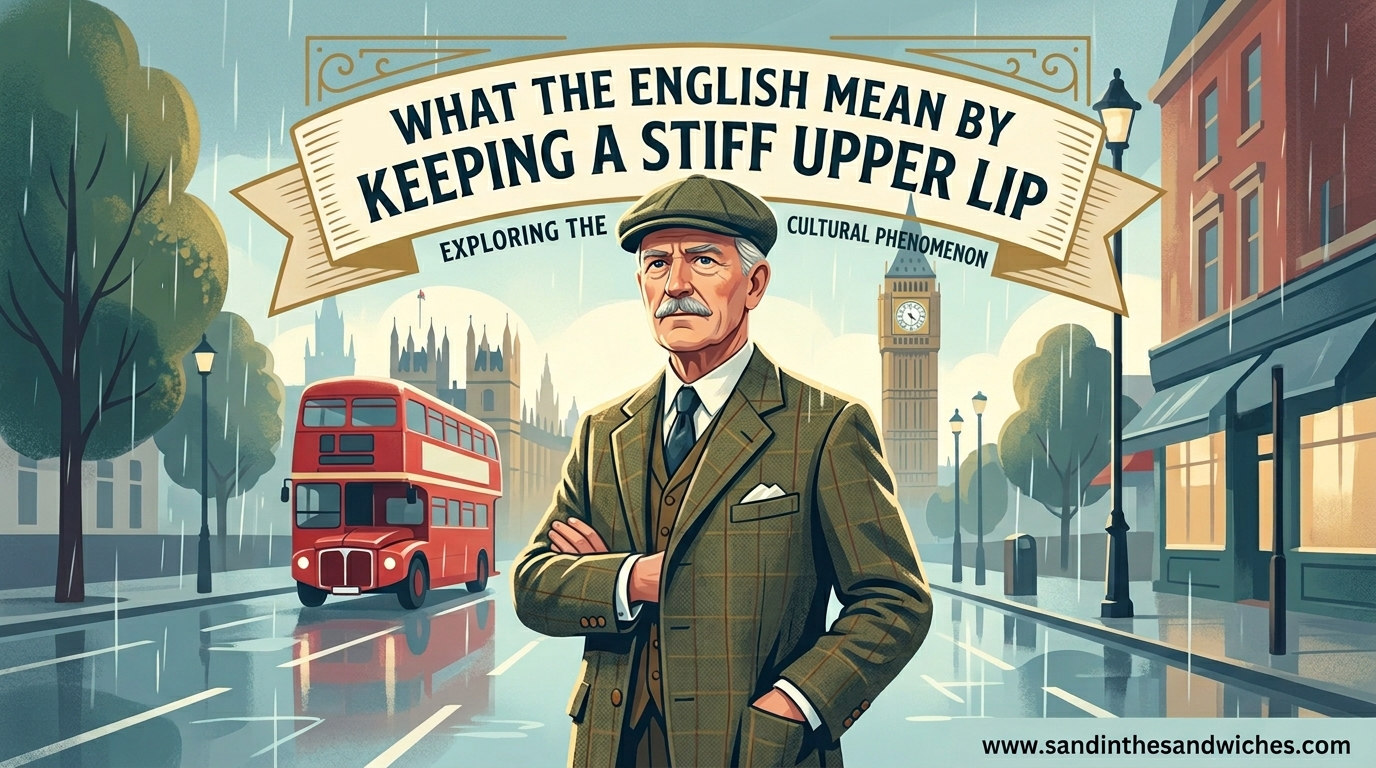
Keeping a stiff upper lip means showing fortitude and self-restraint when facing hardship or upsetting events, without displaying emotions outwardly. It is one of the most recognisable British cultural traits, often described as a kind of quiet courage that asks people to carry on regardless of circumstances.
I’ll walk you through exactly what the English mean by keeping a stiff upper lip, where the phrase came from, why it became so central to British identity, and whether it still applies in 2026. By the end, you’ll understand the idiom, the culture behind it, and how it differs from similar ideas around the world.
Table of Contents
What Does Stiff Upper Lip Mean in England?
In England, a stiff upper lip describes someone who stays composed and uncomplaining during difficult or painful situations. The Cambridge Dictionary puts it plainly: “Someone who has a stiff upper lip does not show their feelings when they are upset.”
Imagine a person receiving terrible news at work and simply carrying on with their task. That response, calm, controlled, almost detached, is what the English call a stiff upper lip. It blends stoicism with emotional restraint.
The phrase usually appears with the verb “keep” rather than “have.” You keep a stiff upper lip, suggesting an active choice rather than a fixed personality trait. Example: “Despite the diagnosis, she kept a stiff upper lip and continued caring for her family.”
The Core Qualities Behind the Phrase
Four qualities sit at the heart of the expression:
- Fortitude – the ability to endure hardship without complaint
- Self-restraint – holding back tears, anger, or fear
- Composure – appearing calm even when shaken inside
- Resilience – pushing forward rather than dwelling on difficulty
Together, these qualities form what many people outside Britain picture as the stereotypical English response to crisis.
Where Did the Expression ‘Keep a Stiff Upper Lip’ Come From?
The phrase first appeared in American English in the early 1800s before crossing the Atlantic. Early written uses appear in letters and journals from the 1810s and 1820s, often describing soldiers or sailors trying to hold themselves together during battle or storms.
Charles Dickens helped popularise the British version. By the mid-19th century, the phrase had taken root in English literature and was associated with Victorian ideals of character, duty, and emotional control. Public school stories and imperial adventure tales reinforced the image of the unflappable English gentleman.
The expression gained wider use during the World Wars, when British propaganda emphasised calm endurance as a national virtue. Posters, newspapers, and broadcasts all played up the idea that keeping a stiff upper lip was part of being British.
The Physiology Behind the Trembling Lip
The “upper lip” detail is not random. When humans feel fear, grief, or strong emotion, the muscles around the mouth tighten and the lip often trembles visibly. A “stiff” upper lip is one that does not quiver, no matter what the person feels inside.
That visible tremble is what makes the phrase so vivid. The whole point is that others can see your distress if you fail to control it. Keeping the lip still is a quiet, observable form of bravery that anyone watching can recognise.
Stiff Upper Lip in British Culture and Society
The stiff upper lip is more than a saying; it is a cultural habit shaped by British history. Victorian values placed enormous emphasis on self-discipline, public decency, and not making a scene. Emotional restraint was taught as a virtue from childhood.
The English public school system reinforced this. Boarding schools like Eton, Harrow, and Rugby trained boys to suppress emotion, endure physical discomfort, and accept discipline without complaint. Sports, especially cricket, added another layer, with players expected to take hard hits and continue playing.
The phrase also became tied to British identity during the height of the Empire. Colonial officers, diplomats, and explorers were expected to show composure in dangerous or unfamiliar situations. Failure to do so was seen as a personal weakness and a national embarrassment.
How It Differs From Stoicism
People often confuse the stiff upper lip with classical stoicism, but they are not identical. Stoicism, drawn from ancient Greek and Roman philosophy, aims to master emotions through reason and accept what cannot be changed.
The British version is more practical and less philosophical. It is not about believing emotions are illusions; it is about not showing them publicly. A stoic tries to feel less; an Englishman with a stiff upper lip tries to feel normally but keep it private.
Famous Examples of Stiff Upper Lip in British History
British history is full of stories where the stiff upper lip became a national symbol. Here are some of the most cited examples:
- The Duke of Wellington at Waterloo (1815) – reportedly remained composed despite heavy casualties and uncertain odds
- The Titanic crew (1912) – musicians played on as the ship sank, a story that became legendary
- The Blitz (1940–1941) – Londoners continued daily routines while bombs fell on the city
- The Battle of Britain (1940) – pilots and civilians alike maintained morale under sustained attack
- Margaret Thatcher (1979–1990) – political symbol of unyielding resolve, both admired and mocked for it
These examples are not always historically accurate in every detail, but they show how the trait became part of national storytelling.
Is the Stiff Upper Lip Still Relevant Today?
Short answer: it is fading, but not gone. A 2012 BBC report questioned whether the stiff upper lip was disappearing, citing surveys showing younger Britons were more open about feelings, anxiety, and mental health.
The 2012 London Olympics opening ceremony, directed by Danny Boyle, deliberately mixed stiff-upper-lip imagery with modern, emotional Britain. That balance reflects where the country stands in 2026: proud of historical reserve, but increasingly comfortable with vulnerability.
British men, in particular, have seen the largest shift. Campaigns around mental health, from “Heads Together” to workplace wellbeing programmes, encourage emotional openness. Yet many older Britons, and people in service professions like the military and medicine, still rely on the old habit.
The Stereotype and the Criticism
Some argue the stiff upper lip was never truly national and was always a stereotype. Foreign visitors to Britain have long noted that ordinary people cry, complain, and argue just as much as anyone else. The “reserved Brit” is partly a literary invention.
Others argue the trait has done real harm. Suppressing emotions can delay help-seeking, especially for men dealing with depression or grief. Modern psychology generally favours acknowledgment over suppression, even while recognising the value of resilience.
Similar Concepts in Other Cultures
Britain is not the only culture that values emotional restraint in hardship. Comparable concepts exist worldwide:
- Gaman (Japan) – enduring the unbearable with dignity and patience
- Sisu (Finland) – extraordinary courage and determination in the face of extreme adversity
- Sabr (Arabic/Islamic tradition) – patient perseverance, especially through suffering
- Wabi-sabi (Japan) – finding beauty in imperfection and impermanence
Each captures a piece of what the British stiff upper lip aims for, though the cultural flavours differ. Sisu, for instance, leans more towards grit and action; Gaman leans towards quiet acceptance.
Conclusion
What the English mean by keeping a stiff upper lip is simple: staying composed and not showing distress when life gets hard. It is a habit of self-restraint, dressed up as national character, shaped by Victorian discipline, public schooling, and the wars of the 20th century.
In 2026, the trait is harder to spot than it used to be. Younger Britons speak more openly about feelings, and mental health awareness has shifted the cultural dial. Yet the phrase still captures something recognisably English: a stubborn refusal to make a fuss, even when the world is falling apart.
Whether you see it as admirable resilience or emotional suppression, the stiff upper lip remains one of the clearest windows into how the English see themselves.
Frequently Asked Questions
What does keeping a stiff upper lip mean?
Keeping a stiff upper lip means staying composed and not showing your emotions when you are upset, frightened, or facing hardship. It describes a deliberate effort to appear calm and untroubled, even when you feel anything but.
Where did the expression ‘keep a stiff upper lip’ come from?
The phrase first appeared in American English in the early 1800s and grew popular in Britain through Victorian literature and 20th-century wartime culture. Charles Dickens and the two World Wars helped turn it into a recognisable British trait.
Why do British people have a stiff upper lip?
The trait grew out of Victorian values, English public school education, and the experience of empire and major wars. Generations were taught to value self-restraint, composure, and not complaining publicly, especially in moments of crisis.
What are famous examples of stiff upper lip in history?
Often-cited examples include the Duke of Wellington at Waterloo, the Titanic musicians playing as the ship sank, Londoners during the Blitz, and RAF pilots in the Battle of Britain. These stories helped cement the phrase as a national symbol.
Is the stiff upper lip still relevant in modern Britain?
The trait is fading but not gone. Younger Britons are more open about feelings and mental health, yet many older generations and service professions still value emotional restraint. The phrase remains a useful shorthand for a recognisable English habit.