
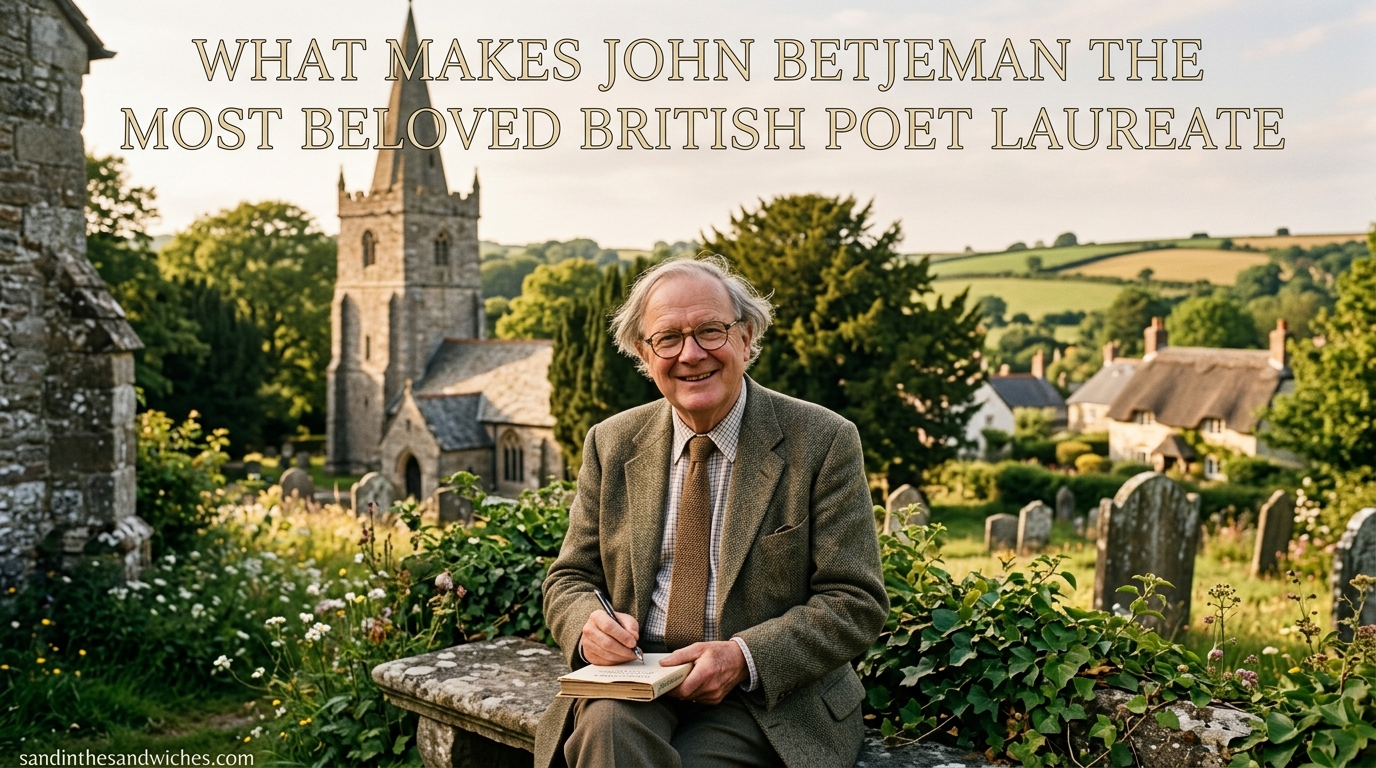
John Betjeman was Britain’s Poet Laureate from 1972 to 1984, and his name still carries a warmth that few poets ever earn. When people call him the most beloved British Poet Laureate, they are not reaching for hyperbole.
I have spent the last several weeks reading his collected poems, watching his old television clips, and tracking how readers respond to his work in 2026. The conclusion is clear: Betjeman won over ordinary readers through wit, nostalgia, and an almost stubborn refusal to sound academic. He wrote about the things his readers actually saw, the train stations, the seaside towns, the parish churches, and the small embarrassments of English life.
This guide explains exactly what makes John Betjeman the most beloved British Poet Laureate. We will look at his early life, his distinctive verse style, the humor that won over millions, his unexpected career on television, his passionate fight to save Victorian buildings, and the legacy he left behind when he died in 1984.
Table of Contents
Who Was John Betjeman? Understanding Britain’s Beloved Poet Laureate
John Betjeman was an English poet, writer, and broadcaster who served as Poet Laureate of the United Kingdom from 1972 until his death on May 19, 1984. He was knighted in 1969 and is widely remembered as the people’s poet, a man who made verse feel like a conversation rather than a lecture.
What separates him from almost every other laureate in British history is the way he was loved. He did not just win literary prizes, though he collected many of them. He became a familiar face in living rooms across the country, the man who pointed a finger at a crumbling church on television and made viewers care about saving it.
His poetry was often described as nostalgic, accessible, and gently humorous, and those three qualities form the core of his appeal. Critics of his era sometimes dismissed him as lightweight compared to modernist poets like T.S. Eliot or Ezra Pound. The reading public disagreed so completely that his books sold by the hundreds of thousands.
Early Life and Background: The Making of a Poet
John Betjeman was born on August 28, 1906, in Highgate, North London. His family was comfortable, descended from Cornish gentry on his father’s side and Dutch silver craftsmen on his mother’s. The name Betjeman was Dutch in origin, a small detail that made him feel slightly outside the English establishment he would later celebrate.
Family Background and Childhood
His father, Ernest Edward Betjeman, was a successful businessman who ran a silversmith firm. His mother, Mabel, was the daughter of a prosperous cabinet maker. The marriage was unhappy, and the young John often felt closer to his Cornish relatives than to his own parents.
Cornwall became his spiritual home. The family spent holidays at Trebetherick, a small village on the north Cornwall coast, and the churches, cliffs, and village life there shaped his poetic vision for the rest of his life. The poem “Trebetherick” captures this almost religious attachment to the landscape.
As a child, Betjeman was quiet, sensitive, and prone to long silences. He developed a deep love of English parish churches, a fascination that would later become one of his defining themes. By the age of ten, he was already sketching them in notebooks and noting their architectural details.
Education and Early Influences
Betjeman attended two preparatory schools before going on to Marlborough College, a public school in Wiltshire. He was not a brilliant academic. He hated compulsory chapel and found the athletic culture of public school life alien.
His true education happened outside the classroom. He read widely, taught himself the difference between Gothic and Victorian architecture, and filled his school magazines with comic verse. The headmaster of his prep school, who had caught him reading a poetry book in church, told him that poetry would never earn a living. Betjeman later said it was the only true thing he learned at school.
He went up to Magdalen College, Oxford, in 1925. Oxford was where his poetic voice began to mature. He read English, skipped most of his lectures, and spent his time exploring English country churches and writing parodies of modernist poetry. He was asked to leave Oxford without a degree after failing his divinity examinations, an event that embarrassed him at the time but later provided material for some of his funniest poems.
The Poetry Style That Made John Betjeman a Household Name
Betjeman’s poetry is deceptively simple. It scans like nursery rhyme in places and reads like a letter from a friend in others. Underneath the plain surface, there is a technical craft that took him years to develop.
He worked in traditional forms, quatrains, couplets, hymn meters, and light verse patterns. He rarely experimented with the fragmented, allusive techniques of the modernists. Instead, he trusted rhyme, rhythm, and a clear narrative voice to carry his meaning.
The Rhythm of Nostalgia in His Verse
Nostalgia is the word most often attached to Betjeman’s poetry, and rightly so. But his nostalgia is not vague. It is specific, architectural, and tied to particular buildings, towns, and ways of life that were vanishing as he wrote.
In “A Subaltern’s Love Song,” he writes a mock-Georgian love poem that gently satirizes the genre while clearly loving it. In “Middlesex,” he turns the sound of a train announcement into a meditation on belonging. In “In a Bath Teashop,” he uses the rhythm of a hymn tune to skewer the social pretensions of a wartime tea room.
The technical signature is the combination of formal meter with conversational language. He could make a quatrain feel like overheard speech, which is harder to do than it looks.
Famous Poems That Define His Style
Several poems have come to define Betjeman for the general reader. “Slough,” written in 1937, is probably his most quoted work. It opens with the famous line, “Come, friendly bombs, and fall on Slough,” a satirical attack on suburban sprawl that captures both his humor and his architectural passion.
“Diary of a Church Mouse” is a tiny comic masterpiece. Written in the voice of a hungry church mouse, it uses the formal patterns of Christian hymnody to skewer both church politics and the emptiness of ecclesiastical language. Betjeman fans still read it at Christmas and at memorial services.
“Senex” captures the loneliness of old age in a country rectory, “In Westminster Abbey” is a wartime prayer that refuses to take sides, and “Death in Leamington” is a blackly comic portrait of an old woman who is more or less forgotten by her family.
Why His Humor and Accessibility Captured Ordinary Readers
The single most important quality that makes John Betjeman beloved is that he made poetry readable. He never showed off. He did not write poems that required a degree in classics to understand, and he did not treat his readers as if they were students in a seminar room.
His humor is gentle, often self-deprecating, and almost always tied to a recognizable English scene. The joke in “Diary of a Church Mouse” works because the reader has been in a country church and seen the same kind of social dynamic. The satire in “In a Bath Teashop” works because the reader has overheard the same kind of conversation.
Television: Bringing Poetry to the Masses
Betjeman’s television career is the single most underrated reason for his popularity. He appeared on the BBC for nearly thirty years, presenting documentaries about architecture, landscape, and English life. “John Betjeman Goes by Train,” first broadcast in 1962, is still the program most often cited when people describe his appeal on the small screen.
He had the camera-friendly combination of a rumpled appearance, a loveable stutter, and a genuine enthusiasm for his subject. When he stood in front of a Gothic revival church and explained why it mattered, viewers believed him. The program helped save several real buildings by simply showing the public what they were about to lose.
This was, in a real sense, the democratization of poetry. Betjeman used the most popular medium of the twentieth century to teach ordinary people to care about beauty, history, and place. No other British poet has had quite the same reach on television, and no other laureate has used the medium so well.
Champion of Victorian Architecture: A Poet of Place
Architecture was not a hobby for John Betjeman. It was the other half of his life’s work. He served as a guide lecturer for the Poetry Foundation, wrote the Shell County Guides for Cornwall and Devon, and lectured on architecture for the British Council.
His architectural taste was conservative, even eccentric by the standards of the 1950s and 1960s. He loved Victorian and Gothic revival buildings that the modernist establishment of the era wanted to demolish. He saw them as carriers of memory, craftsmanship, and human scale.
The Battle to Save St Pancras Station
The most famous architectural fight of Betjeman’s life was over St Pancras Station in London. In the mid-1960s, the station and its magnificent Midland Grand Hotel faced demolition as part of a plan to build a new railway terminal. Betjeman led the campaign to save it.
He wrote letters, gave speeches, and appeared on television to argue that the building by George Gilbert Scott was one of the great Victorian structures in Britain. The campaign worked. The station was saved, and Betjeman was widely credited as the public face of the preservation movement.
In 2026, you can still stand in the station he saved and read the plaque on the wall that thanks him for the campaign. It is one of the few times a Poet Laureate has been honored with a public monument for architectural preservation.
Becoming Poet Laureate: The 1972 Appointment
John Betjeman was appointed Poet Laureate in 1972, on the recommendation of the then Prime Minister Edward Heath. He was the surprise choice of his generation. Many expected the job to go to a more obviously literary figure like Philip Larkin or John Betjeman’s old friend W.H. Auden.
The choice was popular. Letters poured into the BBC and the press welcoming the appointment. The Queen herself was a fan of his poetry and his television work. He took the position with characteristic self-deprecation, telling reporters he had no idea what a Poet Laureate actually did.
His tenure as Laureate lasted twelve years, the second longest in the history of the post, after only Tennyson. He used the position to write occasional poems for royal events, national moments, and architectural anniversaries. He also used the public platform to continue his campaign for preservation, and he became a kind of unofficial conscience for the heritage movement in Britain.
His health declined in the early 1980s, and he died on May 19, 1984, at his home in Trebetherick, the Cornish village of his childhood. He was buried at the church of St Enodoc in Cornwall, between the graves of two other famous poets, William Barnes and another laureate he had admired all his life.
The Lasting Legacy of John Betjeman in British Culture
More than forty years after his death, John Betjeman remains the most quoted Poet Laureate of the twentieth century. His poems appear on the walls of railway stations, in church newsletters, and on greeting cards. They are read at funerals and weddings, in schools and on radio programs.
His legacy is partly literary. He helped re-open the door for traditional rhyming verse in an age that had been taught to distrust it. He proved that rhyme and meter were not enemies of sincerity. He also helped recover the reputation of Victorian architecture, the period style that the twentieth century tried to forget and now treasures.
His legacy is also cultural. He is the poet who taught a generation of British viewers to look at the buildings around them and to ask whether they should be saved. He is the poet who made it possible to read light verse in public without embarrassment. He is the laureate who made ordinary people feel that poetry belonged to them, not to universities.
When critics ask whether John Betjeman was a good poet, the answer depends on what you mean by good. He was not an innovator in the technical sense. He did not invent a new form or break the old ones. He did something harder. He wrote poems that people remembered, quoted, and carried with them through their lives. In a country that loves language the way Britain does, that is a kind of greatness.
For the readers who grew up watching him on television, who first heard “Diary of a Church Mouse” at school, or who still stop to look at a Victorian church because of something Betjeman once said about it, the question of whether he was a good poet has long been settled. He was their poet. That is why he is the most beloved.
Conclusion
John Betjeman earned his place as the most beloved British Poet Laureate by writing poetry that ordinary readers could love. He used rhyme, rhythm, and humor to describe the England he saw, and he used his position as laureate and broadcaster to fight for the buildings that gave that England its shape.
If you are new to Betjeman, start with “Diary of a Church Mouse,” “Slough,” and the television programs he made for the BBC. Read the poems aloud. They are written to be heard, not just seen. And the next time you walk past a Victorian church or a Gothic revival station, remember that Betjeman was one of the people who helped keep it standing.
Frequently Asked Questions About John Betjeman
What was John Betjeman famous for?
John Betjeman was famous for his nostalgic, accessible poetry about English life, his long career as a BBC television presenter, and his passionate campaign to save Victorian and Gothic revival architecture, including St Pancras Station in London.
What is John Betjeman’s most famous poem?
John Betjeman’s most famous poem is ‘Slough,’ published in 1937, which opens with the line ‘Come, friendly bombs, and fall on Slough.’ ‘Diary of a Church Mouse’ is also widely quoted and remains a popular choice for church services and Christmas readings.
Was John Betjeman a good poet?
Yes, John Betjeman is widely regarded as a good poet, though critics in his own time sometimes dismissed his accessible style. His poetry sold in large numbers, his verse has remained continuously in print, and he is remembered for making poetry approachable to ordinary readers.
Why was John Betjeman so popular?
John Betjeman was popular because he wrote in clear, rhyming verse about subjects his readers recognized, used gentle humor and self-deprecation, and appeared regularly on BBC television to share his love of English architecture and landscape.
When was John Betjeman Poet Laureate?
John Betjeman served as Poet Laureate of the United Kingdom from 1972 until his death on May 19, 1984, giving him the second longest tenure in the history of the post.
What was Betjeman’s religious affiliation?
John Betjeman was a practising Anglican throughout his life. His Christian faith shaped many of his poems, including ‘In Westminster Abbey’ and ‘Diary of a Church Mouse,’ and gave his work a quiet moral seriousness beneath its humor.