
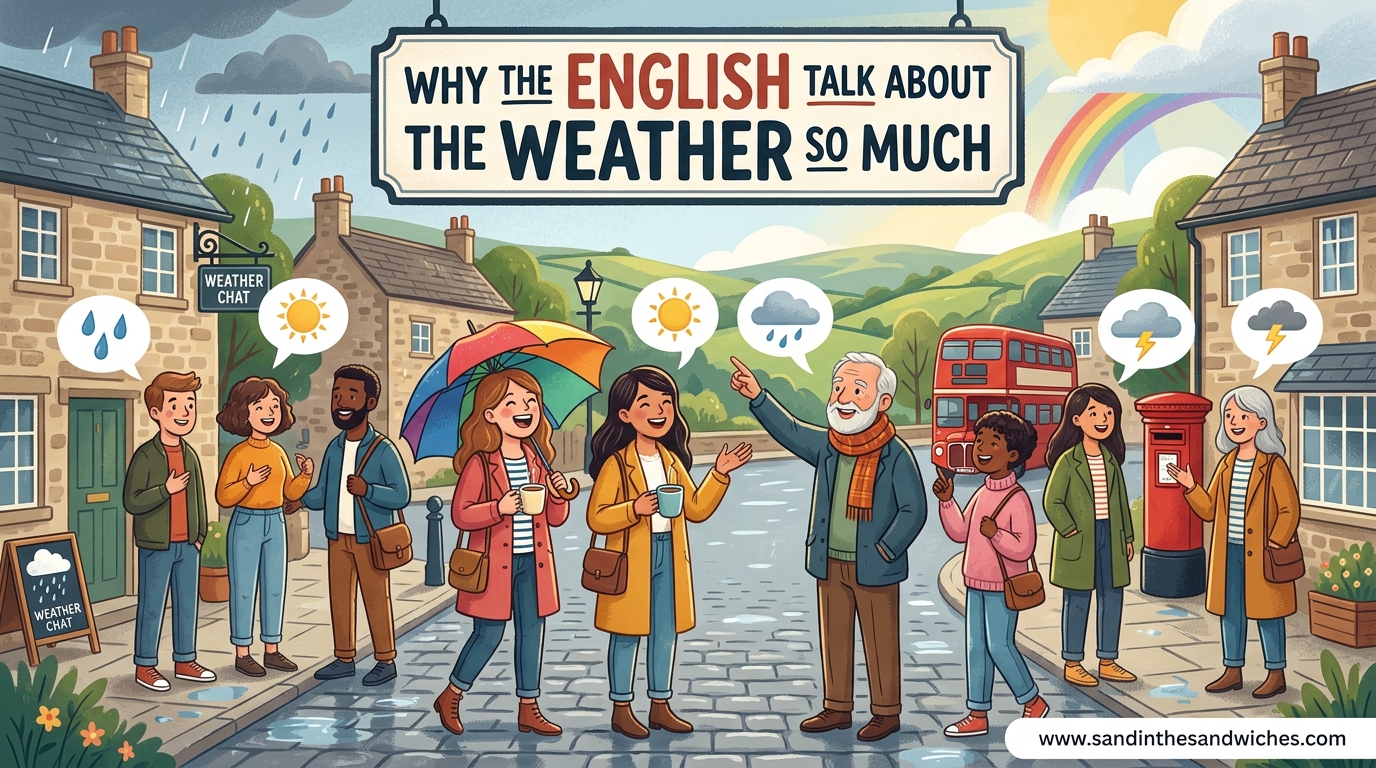
Walk into any British pub, queue, or office kitchen and within 30 seconds someone will say something about the weather. According to a 2018 Bristol Airport study, 94% of British adults admit to having discussed the weather in the past six hours, and the average person spends nearly ten minutes a day doing it. That adds up to around four and a half months of a British life spent chatting about clouds, rain, and “a bit of drizzle later.”
So why the English talk about the weather so much? The short answer is that Britain sits at a meteorological crossroads where six different air masses collide, and its culture evolved a unique form of social lubrication that uses weather as the safest possible shared topic. Read on for the meteorological, psychological, and cultural reasons behind one of Britain’s most famous habits.
Table of Contents
Why Do British People Talk About the Weather So Much?
The English talk about the weather so much because it solves a tricky social problem. Britain is a crowded island with strong privacy norms, and weather offers a universally safe topic that anyone can join without overstepping. As social anthropologist Kate Fox writes in Watching the English, weather talk is “a kind of code that we have evolved to help us overcome social inhibitions and actually talk to one another.”
It is also a topic that never runs dry. The British Isles experience unusually variable conditions because of their position between several major weather systems, which means there is always something new to say. A morning of blue skies can turn into a wet afternoon, and a sunny weekend often follows a wet week. That unpredictability gives people a renewable supply of conversational material.
Why British Weather Is Genuinely Worth Talking About
British weather is famously changeable, and there is a real meteorological reason for it. The UK sits at a meeting point of six different air masses, which is more than almost any other country in the world. These include tropical maritime air from the southwest, tropical continental air from the south, polar maritime air from the northwest, polar continental air from the east, Arctic maritime air from the north, and Arctic continental air from the northeast. Each brings different temperature, humidity, and cloud conditions.
The result is a country where four seasons can occur in a single afternoon. Add the warm influence of the Gulf Stream, which keeps winters milder than they would otherwise be at that latitude, and you get a place where weather genuinely surprises people. The Met Office’s Professor Douglas Parker has noted that this constant battle between air masses is exactly what makes the UK so interesting from a forecasting perspective.
When the weather is genuinely chaotic, talking about it is not filler. It is a real attempt to make sense of an environment that often does not behave as expected. A British summer can deliver 30°C heat one week and 14°C grey skies the next, so even the locals find it hard to predict. That shared confusion is part of the bonding.
The Social Lubrication Theory Explained
Social lubrication is the idea that some topics exist specifically to ease awkwardness between strangers. Weather is the British version of this, and it is older than you might think. Psychologist Trevor Harley of the University of Dundee has pointed out that talking about the weather is so automatic in Britain that it functions much like primate grooming. In the animal kingdom, grooming helps build trust between individuals who need to cooperate. In British life, a quick comment about the rain does the same thing for humans.
This is why a passing “bit wet out there, isn’t it” between strangers on a pavement is not really about the rain. It is a low-risk way of acknowledging another person and signalling friendliness without demanding a real conversation. The same exchange in some other countries might feel forced or even rude, but in Britain it is considered polite. Ignoring the weather in a queue can actually come across as cold.
Fox has also noted that weather talk allows people to express shared complaints safely. A British person complaining about the weather is not really asking for sympathy. They are performing a small cultural ritual that confirms they belong to the same group as the listener.
Face Theory: The Psychology Behind Weather Talk
Face theory comes from the work of sociolinguists Penelope Brown and Stephen Levinson, and it helps explain why the English chose weather as their safe topic. The theory distinguishes between positive face, the desire to be liked and approved, and negative face, the desire not to be imposed upon. Good manners balance both.
Asking a stranger about the weather respects their negative face. You are not asking for personal information or a real opinion on something controversial. At the same time, it acknowledges their positive face, because you are showing friendly interest. This is why personal questions like “what do you do” or “where are you from” can feel intrusive in Britain, while “lovely day, isn’t it” feels warm. The weather is one of the few topics that is genuinely safe for almost everyone.
This is also why British people can spend an entire bus ride discussing whether the forecast was right. They are not really arguing about meteorology. They are practising the British art of polite connection.
How Other Cultures Approach Weather Conversation
Weather talk is not unique to Britain, but the intensity is. In Japan, conversation tends to start with comments on the season, the cherry blossoms, or the humidity. It is gentler and more poetic than the British version, which leans into complaint. In Switzerland and Finland, weather is discussed in practical terms, often with reference to commuting and outdoor activities, but it does not have the same ritualised quality.
What makes the British version stand out is the combination of two things. First, the weather is genuinely unpredictable, so there is always something to say. Second, British culture places a high value on reserve, which makes a neutral, shared topic essential. In sunnier countries with similar reserve, like parts of southern Europe, people can talk about food, family, or football instead. Britain has limited reliable options, so weather wins by default.
It is also worth noting that in countries with extreme weather, like the American Midwest or South Asia, weather talk is often urgent and safety-driven. British weather talk is the opposite. It is almost always low stakes, which is part of why it works as a social tool.
How British Weather Talk Has Evolved
Weather talk did not always dominate British small talk. Historians trace the habit back to the 17th and 18th centuries, when coffee houses and taverns became centres of public life. Because news was slow and conversation was the main entertainment, discussing the day’s weather was a natural way to begin. The habit stuck, and by the Victorian era the phrase “to talk about the weather” had become a polite stereotype.
British English is also full of weather idioms that reinforce the pattern. People say they are “under the weather” when ill, “snowed under” when busy, and “save for a rainy day” when preparing. There is even “every cloud has a silver lining” and “it never rains but it pours.” This rich vocabulary means weather talk feels natural at any level of formality.
More recently, social media has changed the pattern. The Met Office and BBC Weather both have large followings, and a sudden cold snap or heatwave can trend on Twitter within minutes. The ritual of opening a conversation with weather has simply moved online. A shared meme about a wet weekend is just the digital version of the same small talk.
Practical Phrases for Joining Weather Talk
For visitors and English learners, joining weather talk is easier than it sounds. A few safe openers include “lovely day, isn’t it,” “looks like rain later,” and “bit chilly this morning, isn’t it.” These all invite a short, friendly reply without requiring a deep opinion. Another common move is to question the forecast, with phrases like “they said it would be sunny, but here we are” or “supposed to brighten up by the afternoon.”
Complaints are also welcome. “Typical British summer” or “when will this rain stop” are crowd-pleasers that almost always get a laugh or a nod. The key is to keep it light. Weather talk is meant to be a doorway, not the room itself. Once you have exchanged a few sentences, the other person will usually move the conversation on to whatever they actually want to discuss.
FAQs
Why do British people talk about the weather so much?
The English talk about the weather so much because Britain experiences unusually variable weather and British culture values reserve. Weather provides a universally safe topic that lets people connect without asking personal questions. Social anthropologist Kate Fox describes it as a code that helps overcome social inhibitions.
Why is British weather so unpredictable?
British weather is unpredictable because the UK sits at a meeting point of six different air masses, including tropical maritime, polar maritime, and Arctic maritime air. The warm Gulf Stream also keeps conditions mild but changeable. This is why four seasons can occur in a single day in Britain.
Why do Brits complain about the weather instead of praising it?
Complaining is a low-risk way to bond with strangers. By sharing a small grievance, British people signal that they belong to the same group as the listener. It is a social ritual rather than a real demand for sympathy, which is why a cheerful complaint often gets a friendly reply.
Why do Brits complain about the heat?
Brits complain about the heat because hot weather is rare and most buildings are not designed for it. Older homes, stone cottages, and Victorian terraces hold warmth, while public transport often lacks air conditioning. A 30°C day can feel like a national crisis simply because the country is built for cooler climates.
Do people in other countries talk about the weather as much as the English?
Most cultures mention the weather, but the English do it more often and with more ritual. In Japan, conversation often starts with the season. In Switzerland and Finland, weather talk is practical. The British version stands out because it combines genuinely unpredictable weather with a cultural need for a safe, neutral topic.
Final Thoughts on the British Weather Obsession
So why the English talk about the weather so much? It is not really a single answer. It is the mix of an island with six air masses, a culture that prizes reserve, and a national mood that prefers gentle complaint to direct personal questions. Weather is the one thing every British person can mention without offending, misjudging, or being asked to explain themselves.
Next time you hear a Brit mutter about the drizzle, remember that it is doing real social work. It is the handshake of a culture that likes to stay polite, even in a downpour. For anyone moving to the UK or learning British English, mastering a few weather phrases is one of the easiest ways to feel at home fast.