
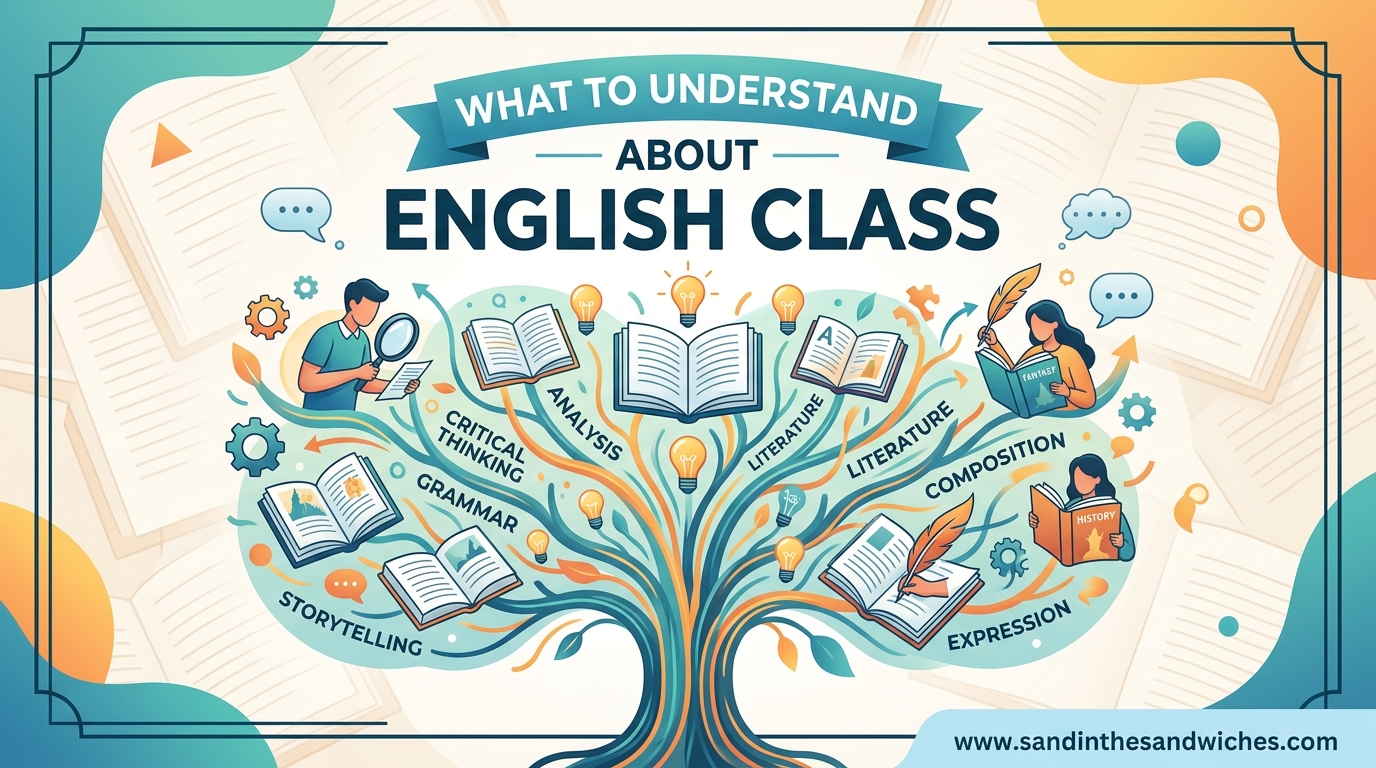
I picked up Middlemarch at twenty-two and stalled by page forty. The sentences ran longer than anything I’d read before, and the references to entailments, drawing rooms, and Dissenters landed like closed doors. What I needed wasn’t more willpower. I needed the skills English class is designed to teach. If you’re staring down a British novel and wondering whether you’re missing something, this guide is for you.
British novels span roughly 1,500 years of language, class systems, and cultural assumptions. Reading them without preparation is like walking into a foreign country without a phrasebook. English class exists to give you that phrasebook. Below is what to understand about English class before reading British novels, so the experience becomes rewarding instead of intimidating.
Table of Contents
What to understand about English class before reading British novels
English class teaches literary analysis skills that transform reading British novels from passive entertainment into active intellectual engagement. These skills include identifying themes, recognizing literary devices, and understanding historical context. Without them, even strong readers miss what makes a British novel worth finishing.
Three skills from English class matter most when you approach British literature. First, you learn to read closely instead of casually. Second, you build a vocabulary for naming what you notice. Third, you place texts inside their historical moment. Together, these turn a dense Victorian paragraph into a conversation across centuries rather than an obstacle course.
I teach British literature to first-year students, and the same pattern shows up every semester. Students who arrive comfortable with literary devices and historical context breeze through Dickens. Students who don’t, stall. The good news is that the skills can be learned in a weekend, and once you have them, every British novel gets easier.
Key literary devices every reader should recognize
Literary devices are the tools authors use to build meaning beyond plot. English class spends weeks on them because they’re the shorthand every critic and reader uses to talk about a novel. Once you can spot them, the entire reading experience accelerates.
Here are the devices you’ll meet most often in British novels.
- Metaphor and simile: Comparisons that shape how you visualize an idea. George Eliot’s Middlemarch opens by comparing Saint Teresa’s influence to a “scroll of illuminated manuscript.”
- Symbolism: Objects or images carrying meaning beyond themselves. The yellow drawing room in The Great Gatsby (American, but widely taught) signals old money, just as Pemberley’s estate in Pride and Prejudice signals Darcy’s class.
- Irony (verbal, situational, and dramatic): A gap between what is said and what is meant. Jane Austen built Pride and Prejudice on dramatic irony, where readers know Darcy loves Elizabeth before she does.
- Foreshadowing: Hints about what comes next. The strange ship Dracula‘s Jonathan Harker notes on his journey into Transylvania signals his entrapment.
- Motif: A recurring element that reinforces a theme. Birds appear throughout Jane Eyre, echoing Jane’s longing for freedom.
- Imagery: Sensory language that grounds abstract ideas. The moors in Wuthering Heights aren’t scenery. They’re the emotional weather of the novel.
You don’t need to memorize definitions. You need to notice when a sentence is doing more than telling you what happened. That noticing is what English class trains.
Close reading: the skill English class teaches first
Close reading means paying slow, careful attention to a short passage. English class teaches it because British novels reward it. A single paragraph in a Virginia Woolf novel can carry an entire emotional arc, and you only catch it if you slow down.
The classic instruction is simple. Read with a pencil. Mark what surprises you. Mark what confuses you. Mark what feels important even when you can’t say why. Cornell College’s study tips recommend spending about five minutes per page when reading novels for class. That pace is the difference between finishing a book and actually reading it.
During close reading, look for six elements.
- Description: What does the narrator linger on, and what does the narrator skip?
- Imagery: Which senses are engaged, and to what effect?
- Syntax: Are sentences long and flowing, or short and clipped? Why?
- Semantics: Which words feel unusual or chosen specifically?
- Character development: How does a character’s view shift within a passage?
- Theme: What bigger idea does this passage ask you to consider?
Close reading is uncomfortable at first. It feels slow. But it’s the single skill that separates students who enjoy British novels from students who resent them.
How to annotate a British novel without slowing down
Annotation is the habit of writing brief notes in the margins as you read. English class insists on it because it forces you to react in real time. Two systems work well for British novels.
The margin system uses a pencil and your instinct. Mark anything that confuses you with a question mark. Mark anything that feels significant with an exclamation mark. Underline striking phrases. Don’t summarize the plot. Note your reactions. Over hundreds of pages, your marginalia becomes a map of your own thinking.
The notecard system works better for characters and plot threads. Keep a stack of index cards as you read. On each, write the name of a character, a recurring symbol, or a theme. Add a brief quote whenever the card’s subject appears. By the end of the novel, you have a deck you can shuffle to trace any thread through the book.
Both systems share a purpose. They force you to commit to an interpretation while it’s fresh. Without them, you finish a 500-page novel and remember only the ending. With them, you remember the whole architecture.
Understanding historical and cultural context
British novels assume a reader who knows things about Britain that most modern readers don’t take for granted. English class spends significant time on context because the novels were written by, for, and about people embedded in specific moments.
Four areas of context show up constantly.
- Class and social rank: Regency and Victorian novels hinge on who has money, who has title, and who is “in trade.” Pride and Prejudice cannot be read without grasping the shame Elizabeth’s family feels about trade versus landed income.
- Empire and colonialism: Many 19th and 20th century British novels refer to India, Africa, and the Caribbean. E. M. Forster’s A Passage to India makes empire its central subject.
- Religion and Dissent: The Church of England, Nonconformists, Catholics, and Evangelicals shape plot and character. Middlemarch‘s Dorothea marries Mr. Casaubon partly because of her Evangelical faith.
- Gender expectations: Until the late 20th century, British novels are largely about constrained choices for women. Knowing what a woman could and could not do legally sharpens every page.
Context doesn’t require a degree in history. It requires a habit of asking, “What would this scene have meant to someone reading it in 1813?” That question unlocks the novel.
Language differences: Old English, Middle English, and Early Modern English
British novels span multiple stages of the English language. Older texts use vocabulary, grammar, and sentence structures that look unfamiliar. English class teaches you how to read past the strangeness.
Anglo-Saxon and Old English works like Beowulf are essentially a different language. Most readers meet them in modern translation, and that’s appropriate. Middle English, the language of Chaucer’s Canterbury Tales, requires some study but rewards it. Early Modern English, the language of Shakespeare and the King James Bible, looks familiar but uses words like “thee,” “thou,” “hath,” and “whence” in patterns modern English dropped.
Three habits help with archaic language. First, read a few pages aloud. Pronunciation recovers meaning the eye misses. Second, keep a running glossary in the back of your book. Look up every word you don’t recognize twice. Third, read an annotated edition when available. Scholarly editions explain references inline so you don’t lose momentum.
British novels from the Victorian era don’t use archaic words, but their sentences are long. Bleak House opens with a paragraph that runs nearly 300 words. Don’t panic. Read in chunks. Let the sentence complete before deciding whether you understood it. The length is a feature, not a bug, and English class teaches you to read it patiently.
Genre conventions across British literary periods
British novels follow different conventions depending on when they were written. Knowing the period sets your expectations. English class usually organizes curricula by period for this reason.
Romantic novels (roughly 1780-1830) emphasize emotion, nature, the individual, and the sublime. Austen and the early Brontës work here. Victorian novels (roughly 1830-1900) emphasize social realism, class, industrialization, and morality. Dickens, Eliot, and Hardy work here. Modernist novels (roughly 1900-1945) experiment with form, stream of consciousness, and fragmentation. Woolf, Joyce, and Forster work here. Postcolonial novels (post-1945) reckon with empire, migration, and identity. Salman Rushdie and Kazuo Ishiguro work here.
You don’t need a timeline memorized. You need to know which period a novel belongs to so you can read it the way its first readers did.
Practical reading strategies for British novels
Once you understand the skills English class teaches, the actual practice gets easier. Here is a step-by-step approach I’ve used with students and on my own reading shelf.
Step 1: Skim the first chapter. Don’t try to understand everything. Note the setting, the narrator’s voice, and the social world. This scan tells you what kind of novel you’re holding.
Step 2: Read the next 50 pages slowly with a pencil. This is the popular “Rule of 50.” If you haven’t engaged by page 50, you can set the book aside. If you have, the rest will follow.
Step 3: Read five minutes per page on average. Some pages take thirty seconds. Others take ten minutes. The slower pages are usually the important ones.
Step 4: Pause after each chapter to write three sentences in a notebook. What changed. What surprised you. What confused you. This becomes your study guide.
Step 5: Use supplementary resources. Crash Course Literature videos, SparkNotes chapter summaries, and filmed adaptations all help. Watching the 2005 Pride and Prejudice before tackling the novel isn’t cheating. It’s preparation.
Step 6: Re-read difficult passages aloud. Many readers report that reading aloud recovers meaning the silent eye misses. This trick works especially well with Victorian and Modernist prose.
Step 7: Discuss the book while reading it. Book clubs, online forums, or a single friend reading alongside you dramatically improve comprehension. Saying what you think forces you to clarify what you think.
These steps are not new. They are what English class has always taught, simply organized for self-directed reading.
Reading also carries well-documented benefits beyond the classroom. Studies from the University of Sussex found that reading for as little as six minutes can reduce stress levels by up to 68 percent, more than listening to music or walking. British novels, dense as they can be, offer that benefit in larger doses than most modern fiction. The skills English class teaches you simply make the dose easier to swallow.
FAQs
Is British literature a hard class?
British literature can be challenging, but the difficulty comes from context, archaic language, and dense sentences rather than from reading level itself. Students who arrive familiar with literary devices, historical context, and close reading techniques usually find it manageable. The challenge is mostly about preparation, not intelligence.
What is the 3 book rule?
The 3 book rule suggests that if you don’t enjoy a book after the first 50 pages, or after roughly the first three chapters of a typical novel, you can set it aside without guilt. It’s a community guideline that gives readers permission to abandon books that aren’t working. The rule recognizes that not every book is for every reader, and that finishing a book you hate is rarely worth the time.
How to read a novel for English class?
Read with a pencil, mark what confuses and surprises you, and spend roughly five minutes per page. After each chapter, write three sentences: what changed, what surprised you, what confused you. Use SparkNotes or Crash Course videos for context before reading, not as a replacement for reading. Discuss the novel with classmates while you read to clarify your thinking.
Does reading books lower cortisol?
Yes. Research from the University of Sussex found that reading for as little as six minutes can reduce stress levels by up to 68 percent, more than listening to music or going for a walk. Reading lowers cortisol and slows heart rate. British novels, often long and immersive, can offer these benefits in larger doses than shorter contemporary fiction.
Final thoughts
English class and British novels are designed to meet each other. The class teaches you the vocabulary, habits, and patience that British literature requires. The novels reward that preparation with stories that have shaped literature for centuries.
Pick up the British novel that has been waiting on your shelf. Read the first fifty pages with a pencil. Keep a notebook. Watch one Crash Course video. The skills English class taught you are still there. Use them, and the book opens.