
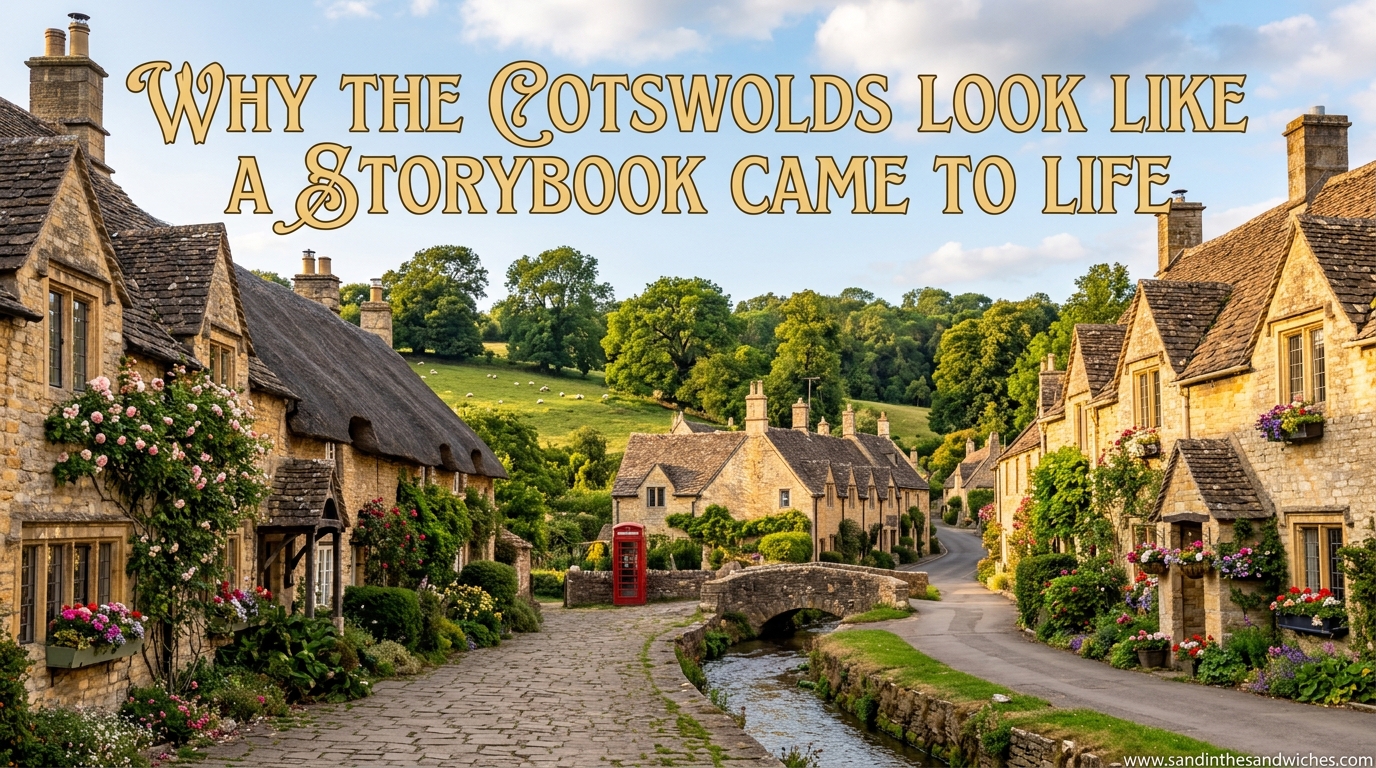
The Cotswolds look like a storybook came to life because of golden Jurassic limestone, medieval wool-trade villages preserved for centuries, and a landscape of rolling green hills dotted with stone cottages, rambling roses, and winding lanes that have barely changed in 500 years.
I have driven through these villages at golden hour, and the honey-coloured stone walls genuinely seem to glow. The first time I parked in Castle Combe and walked down to the market cross, I half expected a fairy-tale character to step out of a cottage door. That reaction is not accidental. It is the result of geology, medieval economics, and unusually strict preservation laws all working together.
In this article I want to explain exactly why the Cotswolds look like a storybook came to life. We will dig into the golden limestone beneath the soil, the wool merchants who paid for those chocolate-box cottages, why the villages stayed frozen in time, which villages to actually visit, and how to photograph them without a hundred tourists in your frame.
If you have ever wondered why Americans in particular describe this corner of England as “chocolate-box Britain,” or why Bridgerton and Downton Abbey keep coming back to film here, the answer is below.
Table of Contents
The Golden Limestone: Geology Behind the Storybook Glow
If I had to pick one reason the Cotswolds look like a storybook came to life, it would be the stone. Almost every building, wall, and bridge in the region is made from the same honey-coloured limestone, and that single material is what holds the whole visual identity together.
The story starts around 170 million years ago, during the Jurassic period, when this part of Britain sat under a warm shallow sea. Tiny shell fragments and calcium carbonate rolled back and forth on the seabed, building up into small round grains called ooids. Those ooids cemented together into what geologists now call Cotswold stone, an oolitic limestone that runs in a band from Dorset up through the Cotswolds to Yorkshire.
The golden colour comes from iron oxide. Trace amounts of iron in the original sediment oxidise over geological time and tint the limestone in shades that range from pale cream near Bath to a deep buttery amber further north. This is why villages only a few miles apart can look subtly different. The stone was quarried locally, so each settlement reflects the exact geological layer beneath it.
Cotswold stone also has a property that builders loved: thermal mass. The limestone absorbs heat during the day and slowly releases it at night, which kept medieval cottages warmer in winter and cooler in summer. That practical quality is partly why the building tradition stuck for so many centuries.
There is a third quality worth knowing about. Cotswold stone weathers beautifully. Rather than crumbling or staining, the surface slowly develops a soft silver-gold patina as rain and wind wear down the surface. This is why a 400-year-old cottage wall looks softer and more integrated into the landscape than a new build. The stone was designed by geology to age gracefully, which is part of the reason the villages feel timeless rather than merely old.
When the low afternoon sun hits a freshly raked Cotswold wall, the iron-oxide tint literally appears to glow. This is not poetic licence. It is the same optical effect you see on sandstone cliffs at sunset. The combination of warm-toned stone and slanted English light is what gives the villages their fairy-tale shimmer, and it is the single biggest reason the Cotswolds look like a storybook came to life rather than just another pretty English region.
Medieval Wool Merchants Built a Fairy Tale
Pretty stone alone does not explain the storybook effect. Plenty of English regions have attractive local stone. What makes the Cotswolds different is that medieval merchants had the money and ambition to build on a scale normally reserved for towns, but in the middle of rural villages.
Between roughly 1300 and 1600, the Cotswolds produced some of the finest wool in Europe. The native Cotswold sheep, sometimes called the Cotswold Lion for its long curled fleece, produced fibres that Italian and Flemish weavers paid premium prices for. Monasteries and large estates grew rich exporting that wool, and the wealth poured into the local villages.
The trade was so valuable that several English monarchs taxed it directly. The “Cotswold Lion” fleece was so prized that a single sack could be worth more than a year’s wages for a skilled craftsman. Italian merchants set up permanent agents in London just to handle Cotswold wool shipments, and some of the great Florentine banking families, including the Medicis, were deeply involved in financing the trade.
That money built the features we now read as “storybook.” The enormous wool churches in places like Northleach, Cirencester, and Chipping Campden were funded by wool merchants who wanted to display their piety and their bank balance at the same time. The carved symbols on the outside of these churches often include sheep, wool sacks, and merchant marks, literally advertising the trade that paid for them.
The same merchants built themselves handsome stone houses with mullioned windows, dovecotes, and sheltered courtyards. Weavers’ cottages sprang up along the streams, with long upper-storey windows to let in light for the looms. The stone bridges, market crosses, and toll houses that now look like film props were all functional infrastructure built with wool money.
The word “Cotswold” itself is debated, but the most widely accepted etymology combines “cot,” meaning sheep shelter, with “wold,” meaning rolling open hill. So the name of the place literally translates to something close to “sheep shelter hills.” I think that is worth knowing before you visit, because it explains why almost every village has sheep pasture running right up to the back gardens.
Then the wool trade collapsed. Cheaper imported wool and the rise of northern industrial towns drained the Cotswolds of money through the 1700s and 1800s. And here is the strange twist: that economic decline is exactly why the villages were preserved. There was no money to rebuild, modernise, or knock anything down. The medieval and Tudor stone houses just sat there, slowly weathering, while the rest of England industrialised.
By the time the Arts and Crafts movement rediscovered the Cotswolds in the late 1800s, the region was effectively a time capsule. William Morris moved to Kelmscott Manor, C. R. Ashbee set up his Guild of Handicraft in Chipping Campden, and a generation of artists and writers fell in love with the unspoiled villages. They reinvented the Cotswolds as a rural ideal, which is more or less how the rest of the world still sees them today.
Why the Villages Stayed Frozen in Time
The storybook effect depends on the villages looking untouched, and that did not happen by accident either. After the Arts and Crafts rediscovery, a series of legal protections locked the look in place.
In 1966 the Cotswolds was designated an Area of Outstanding Natural Beauty, covering nearly 800 square miles across five counties. That status brings strict planning controls. New buildings have to use local Cotswold stone, often from specific quarries, with slate or stone-tiled roofs and traditional window proportions. You cannot simply build a modern brick box in the middle of Bibury.
On top of that, there are over 3,000 listed buildings in the Cotswolds, many of them Grade II or Grade II star, which means even changing a door colour or replacing a window requires consent. Some entire village streets are preserved as conservation areas where the colour of your rendering and the style of your guttering are regulated.
There was also a geographic element. The Cotswolds missed the worst of the Industrial Revolution because there were no coalfields, no major rivers for heavy industry, and no railway mainlines cutting through the heart of the villages. Towns like Stroud and Cheltenham grew, but the smaller wool villages were bypassed. By the time modern developers arrived, the planning protections were already in force.
The result is that when you walk into a village like Lower Slaughter or Stanton, you are looking at buildings that have barely been altered in 400 years. That level of preservation is rare anywhere in the world, and it is a huge part of why the Cotswolds look like a storybook came to life rather than just a heritage-themed tourist area.
It is also worth noting that the planning system can be controversial. Local residents sometimes struggle to afford homes in villages that are popular with second-home buyers, and there is genuine tension between preserving the look and keeping the communities alive. That tension does not change the visual effect, but it is part of the real story behind the postcard.
The Most Picturesque Villages That Look Like Storybook Pages
You can feel the storybook quality across most of the Cotswolds, but a handful of villages take it to another level. These are the ones I would send a first-time visitor to, with honest notes on crowds because the forum chatter on this is real.
Bibury and Arlington Row
Bibury is the most photographed village in the Cotswolds, and possibly in all of England. The famous Arlington Row, a sequence of 14th-century weavers’ cottages, was once on the inside cover of every UK passport issued in the country. William Morris called Bibury “the most beautiful village in England,” and the row of golden stone cottages reflected in the River Coln is the single image most people picture when they think of the Cotswolds.
The honest caveat: Bibury gets extremely crowded from mid-morning onwards, especially in summer. I would only visit before 9am or after 5pm if you want the place to yourself. The cottages are privately owned, so treat them as someone’s home rather than a film set.
Castle Combe
Castle Combe regularly wins “prettiest village in England” polls, and walking down the main street into the market cross square for the first time is genuinely disorienting. It looks more like a film set than a real place, even though real people live there. The 14th-century market cross, the stone rooftops, and the Bybrook River running along the bottom of the valley create a near-perfect composition.
Castle Combe has been used as a filming location for Steven Spielberg’s War Horse, the original Dolce and Gabbana Light Blue perfume advert, and multiple period dramas. Arrive early. The main street is narrow and the car park fills fast.
Bourton-on-the-Water
Bourton-on-the-Water is nicknamed the “Venice of the Cotswolds” because of the low stone bridges crossing the shallow River Windrush that runs straight down the high street. Children paddle in the river in summer, ducks queue up under the bridges, and the whole place feels engineered for postcards. It is busier and more tourist-oriented than the smaller villages, but the architecture is still pure Cotswold stone.
Stow-on-the-Wold and the Tolkien Door
Stow-on-the-Wold is a market town rather than a village, and it sits at the highest point in the Cotswolds. The big draw here is the north door of St Edward’s Church, flanked by two ancient yew trees that frame it like something out of Middle-earth. It is widely believed to have inspired Tolkien’s description of the Doors of Durin in The Lord of the Rings. Tolkien would have known the Cotswolds well, and the resemblance is hard to dismiss.
Stow is also famous for its exposed position on the Fosse Way, the old Roman road, and for the fierce Civil War battle fought here in 1646. The market cross and the old toll house are both intact, and the town is packed with antique shops, tea rooms, and old coaching inns that look exactly as they would have done two centuries ago.
Upper and Lower Slaughter
Upper and Lower Slaughter are two small villages connected by a footpath along a stream. They are quieter than Bibury and Castle Combe, partly because there is less parking and fewer shops. The old flour mill at Lower Slaughter, complete with its working water wheel, looks exactly like an illustration from a children’s book. If you want the storybook feeling without the crowds, this is where I would head first.
Chipping Campden and the Guild of Handicraft
Chipping Campden is one of the best-preserved wool towns in the Cotswolds. The long terraced High Street, built almost entirely from the local golden stone, was laid out in the 14th century and still defines the town. C. R. Ashbee moved his Guild of Handicraft here from London’s East End in 1902, bringing silversmiths, printers, and furniture makers with him. That Arts and Crafts legacy is still visible in the workshops and galleries along the street.
The wool church of St James, with its 120-foot tower, is one of the finest in the Cotswolds. The historic market hall in the centre of the High Street, built in 1627, is open to the public and gives you a sense of how the town would have looked at the height of the wool trade.
Storybook Connections: Tolkien, Downton Abbey and Bridgerton
One of the reasons the Cotswolds look like a storybook came to life is that they keep showing up in actual stories. The region has been used as a backdrop for some of the most popular books, films, and TV shows of the last century, which reinforces the visual association in people’s minds.
The Tolkien connection at Stow-on-the-Wold is the best-known literary link, but there are others. J. M. Barrie visited the Cotswolds and the area features in his lesser-known work. Jane Austen set parts of her world within easy reach of this part of England. More recently, writers like Kate Morton and Lucinda Riley have used Cotswold-style villages as the settings for their modern gothic novels.
On screen, the Cotswolds has been background to Downton Abbey, with the fictional village of Downton filmed at Bampton in Oxfordshire on the eastern edge of the region. Bridgerton used the village of Cymparsing and various Cotswold manor houses for its colour-saturated version of Regency England. The Holiday, with Cameron Diaz and Kate Winslet, was filmed at the village of Shere in the Surrey Hills, but the visual shorthand is pure Cotswold. Even Disney’s Cruella used Cotswold locations.
The reason Hollywood and the BBC keep coming back is simple. The Cotswolds are the most concentrated dose of “quintessential English countryside” you can find within ninety minutes of London. The villages already look like film sets because of the stone, the planning rules, and the preservation, so location scouts do not need to dress them.
This creates a feedback loop. People watch Bridgerton, assume the Cotswolds are exactly that beautiful in real life, visit, find that they are, take photos, and the storybook reputation reinforces itself. The forum posts I read while researching this were remarkably consistent: first-time visitors, especially Americans, describe the region as “stepping into a postcard” or “like Downton Abbey in real life.”
Photography Tips for Capturing Storybook Cotswolds
If you want to come back with photos that actually look like the storybook images you have seen online, the timing matters more than the camera. Here is what I would plan around, based on multiple trips and the consistent advice from photographers and locals in travel forums.
First, the golden stone is designed for golden hour. The honey-coloured limestone literally glows in the hour after sunrise and the hour before sunset, because the warm light bounces off the iron-oxide tint and amplifies it. In flat midday light the same buildings look pleasant but not magical. If you only have one day in a village, plan to be there either early or late.
Second, beat the crowds by going early. Bibury in particular is unrecognisable at 8am versus 11am. I would aim to be parked and walking by 7:30am in summer. Several forum regulars said the same thing independently, which suggests it is the single most reliable tip for the area.
Third, think about seasons. May is when the rambling roses climb over the cottage fronts, which is peak storybook material. Late September and October give you softer light and the autumn colour against golden stone. Winter, especially a frosty morning with low sun, can be extraordinary and almost completely crowd-free. Avoid August if you possibly can; it is the busiest month and the light is harsh.
Fourth, get off the main villages. The famous names are famous for a reason, but photographers who know the area tend to shoot places like Stanton, Painswick, Snowshill, and Guiting Power. These have the same stone, the same preservation, and a fraction of the foot traffic. Painswick in particular, with its yew trees in the churchyard, has a slightly darker, more gothic storybook feel that some people prefer to the chocolate-box look.
On lenses and angles: a 35mm or 50mm prime is ideal for street-level village shots. Bring a wide-angle for the tight village squares, where you will be backing yourself into walls. Look down for reflections in the rivers at Bourton and Lower Slaughter. Look up for the chimney pots and stone slate roofs against the sky, which is a classic storybook framing.
Finally, do not over-stage. The storybook feel of the Cotswolds is partly that real people live there, hang their washing out, and grow geraniums in window boxes. The slightly imperfect, lived-in quality is what stops the villages feeling like a theme park, and it is what your photos should try to capture.
The Honest Truth: What Travel Forums Actually Say
Most articles about the Cotswolds read like tourist board copy, so I want to be straight with you about the less photogenic side. Travel forums like r/uktravel and r/Cotswolds are full of visitors who came back slightly disappointed, and their feedback is worth hearing before you book.
The single most common complaint is crowds. Bibury, Bourton-on-the-Water, and Castle Combe can feel packed in summer, with coach tours arriving from mid-morning. Several Reddit users described arriving at Arlington Row at lunchtime and finding it impossible to take a photo without strangers in the frame. The fix is simple and worth repeating: go before 9am, or after 5pm, or in the shoulder seasons.
The second complaint is that some villages feel “too perfect” or “almost artificial.” This is a fair reaction, and it is partly the fault of the preservation rules. When every building looks identical and there is not a satellite dish or modern shopfront to be seen, it can start to feel like a film set rather than a community. If that bothers you, the answer is to visit the less-touristed villages, where the same architecture exists alongside working farms, ordinary houses, and actual local life.
The third complaint is cost. Pubs, tea rooms, and accommodation in the most popular villages are priced for tourists, and not always fairly. Forum regulars consistently recommend staying in towns like Cirencester, Stroud, or Cheltenham and driving into the smaller villages for day trips. You get better value and a more varied experience.
The fourth complaint is that “there is nothing to do.” This one I think is unfair, because the Cotswolds are not designed to entertain you in the theme-park sense. The point is walking, looking, drinking tea, and lingering in pubs. If you want adrenaline, go elsewhere. If you want a slow, photogenic, deeply English few days, this is one of the best places in the world for it.
The consistent advice from experienced visitors is to manage your expectations, plan for early starts, and treat the famous villages as a small part of a larger, quieter region that rewards exploration. The storybook Cotswolds absolutely exist, but they are best found at 7:30am in a village you have never heard of.
FAQs
What makes the Cotswolds look like a storybook came to life?
The Cotswolds look like a storybook came to life because every building is made from the same golden Jurassic limestone that glows in low light, the villages were built with medieval wool-trade wealth and never significantly altered, and strict Area of Outstanding Natural Beauty planning rules have preserved the look for decades.
Why is Cotswold stone golden?
Cotswold stone is an oolitic limestone formed on a warm Jurassic seabed around 170 million years ago. Trace amounts of iron oxide in the original sediment give the stone its honey colour, which ranges from pale cream near Bath to a deep buttery amber further north depending on the geological layer.
What is the most photographed village in the Cotswolds?
Bibury is the most photographed village in the Cotswolds, and is regularly cited as the most photographed in all of England. The 14th-century weavers’ cottages of Arlington Row, reflected in the River Coln, were used inside UK passports for years.
Why are the Cotswolds so wealthy?
The Cotswolds were historically the richest wool-producing region in medieval England, exporting premium fleece to Italian and Flemish weavers. That wealth paid for the large wool churches, merchant houses, and stone bridges that still define the villages today.
What does Cotswold mean in English?
Cotswold is generally interpreted as a combination of ‘cot,’ meaning sheep shelter, and ‘wold,’ meaning rolling open hill. The name translates roughly to ‘sheep shelter hills,’ which reflects the medieval wool trade that built the region.
Where is the storybook vacation spot in England?
The Cotswolds, covering parts of Gloucestershire, Oxfordshire, Warwickshire, Wiltshire, and Worcestershire, is the storybook vacation spot most visitors associate with picture-perfect England. Villages like Bibury, Castle Combe, and Bourton-on-the-Water are the classic examples.
Conclusion
The reason the Cotswolds look like a storybook came to life is not just one thing. It is the golden Jurassic limestone that glows in low light, the medieval wool merchants who poured their money into stone churches and merchant houses, the centuries of economic decline that accidentally preserved the villages, and the modern planning laws that refuse to let them change.
Stack on top of that the film crews, the Tolkien door at Stow-on-the-Wold, the rambling roses in May, and the deep English instinct to drink tea in a 600-year-old building, and you get the strongest concentration of fairy-tale England anywhere in the country.
If you are planning a visit, pick two or three villages rather than trying to rush around ten, go early in the morning, and give yourself at least one golden hour. That is when the Cotswolds look like a storybook came to life in the most literal, optical sense, and once you have seen the stone glow at sunset you will understand why the reputation has stuck for so long.