
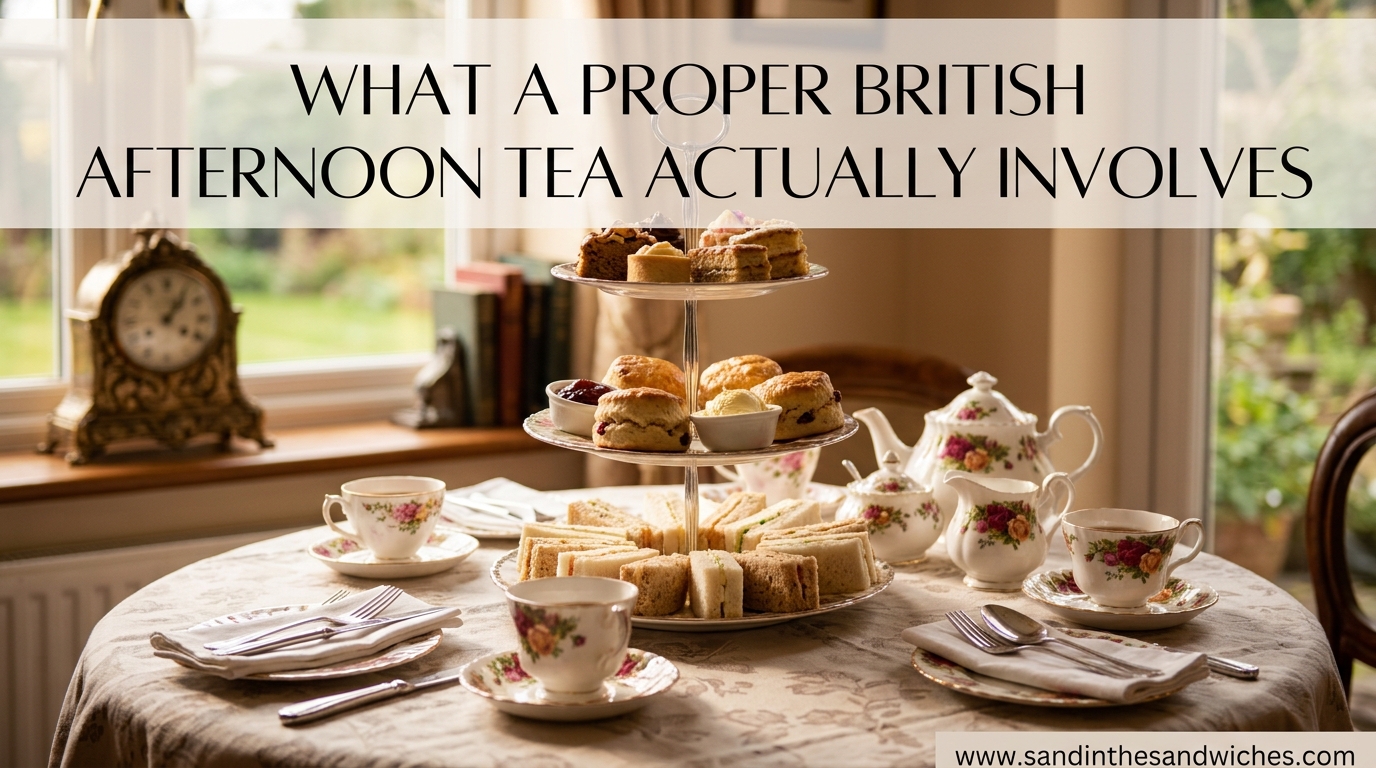
A proper British afternoon tea is a light, structured meal served between 3:30 and 5 PM, built around three courses of finger sandwiches, warm scones with clotted cream, and small sweet cakes, all paired with a pot of properly steeped loose-leaf tea. I have sat through dozens of these with friends, family, and hotel pastry chefs, and the experience is far more codified than most visitors realise.
The good news is that none of it is difficult. You do not need a manor house, a tiara, or a set of heirloom china to do it properly. You do need a few specific items on the table, a clear order of service, and a working knowledge of which fork to use (hint: usually your fingers).
In this guide I will walk you through what a proper British afternoon tea actually involves, where the tradition came from, what is served, and how to behave if you are attending one for the first time.
Table of Contents
Where did British afternoon tea come from
British afternoon tea was invented by Anna Maria Stanhope, the 7th Duchess of Bedford, in the 1840s to bridge the long gap between a sparse lunch and a late evening dinner. The Duchess found herself hungry and listless around four in the afternoon and began asking for tea, bread, butter, and cake to be brought to her private rooms.
She soon started inviting friends to join her. The ritual caught on, spread through upper-class drawing rooms, and by the late Victorian era had become a fully formed social institution. Queen Victoria is often credited with giving the custom royal approval, and by the Edwardian period the tiered cake stand, bone china, and starched linen had become standard.
It is worth pausing on one detail. The tradition is barely 180 years old. It feels ancient, but it is younger than the sandwich itself. Most of the “rules” we associate with afternoon tea were codified in tea rooms and grand hotels between 1880 and 1920, not in the mists of medieval England.
Why it stuck
Gas lighting and later electric light made late dinners possible, but the late lunch to late dinner gap remained awkward. Afternoon tea solved it socially as much as practically. It gave upper-class women a respectable reason to gather in the afternoon, and it gave the rising middle class a chance to imitate aristocracy by visiting the new tea rooms popping up in cities across Britain.
By 1900, places like the Aerated Bread Company and later Lyons Corner Houses were serving thousands of afternoon teas a day. The custom was no longer a private drawing room ritual. It was a national habit.
What a proper British afternoon tea actually involves
A proper British afternoon tea involves three courses served on a tiered stand, accompanied by a pot of loose-leaf tea, and eaten in a relaxed, low table setting. It is not a meal in the sense of a sit-down dinner. It is a structured light meal designed to tide you over until supper.
The timing is part of the ritual. Most hotels serve afternoon tea between 3:00 and 4:30 PM. A traditional home version is laid out at four o’clock. The whole thing lasts about 90 minutes, and you leave comfortably full rather than stuffed.
The setting is informal but considered. A three-tiered cake stand sits in the centre of a low table, set with a teapot, milk jug, sugar basin, hot water jug, and individual cups, saucers, and teaspoons. A linen napkin goes on your lap. Finger bowls and small plates sit to your left and right.
You start with the bottom tier (sandwiches), move up to scones, and finish with the sweets on the top tier. That bottom-to-top order matters. It is not optional.
The three courses of a proper British afternoon tea
The three courses of a proper British afternoon tea are savouries, scones, and sweets, each served in a deliberate order from the bottom tier of the cake stand to the top. This sequence is the single most important rule of the meal.
First course: savouries and finger sandwiches
The first course is always savoury. The sandwiches are small, crustless, and eaten with the fingers. Expect a variety of around five to seven different fillings on a traditional spread, with one or two of each per person.
Common fillings include:
- Cucumber and butter (the classic, often with pepper or chive)
- Egg mayonnaise and cress
- Coronation chicken (a cold chicken curry invented for Queen Elizabeth’s 1953 coronation)
- Smoked salmon and cream cheese
- Roast beef and horseradish
- Ham and English mustard
- Cheese and pickle
Bread choices matter. White, wholemeal, and sometimes granary. The crusts are always removed, and the sandwiches are cut into fingers (long thin rectangles), triangles, or neat rounds depending on the venue.
Second course: scones with clotted cream and jam
The middle tier holds warm scones, usually plain and fruit, served with a small dish of strawberry jam and a ramekin of clotted cream. Clotted cream is a thick, yellow, slightly nutty cream made by slowly heating full-cream milk. It is not something you can easily substitute with whipped cream.
The great scone debate is whether the jam or the cream goes first. In Devon, cream goes on the scone first, then jam. In Cornwall, jam goes on first, then cream. Both are correct in their own region. Outside the Westcountry, most people just do whatever feels natural.
To eat one, split the scone in half with your fingers (not a knife), spread cream and jam on each half, and eat in small bites. Use a small plate and a teaspoon. Do not cut it like a cake.
Third course: sweets and cakes
The top tier is the prettiest tier. Expect an assortment of miniature patisserie, often with a strong leaning toward British classics. The selection typically includes three to five of the following:
- Victoria sponge (a light sponge filled with jam and cream)
- Battenberg cake (pink and yellow sponge wrapped in marzipan)
- Lemon drizzle cake
- Macarons
- Petit fours
- Miniature tartlets (often fruit or chocolate)
- Chocolate éclairs or profiteroles
Use a cake fork if one is provided, otherwise a small dessert fork. If only a teaspoon is at hand, use that. Do not be afraid to ask for a second slice of anything you particularly like. The top tier is the generous one.
Choosing and brewing the tea
The tea itself matters as much as the food. A proper British afternoon tea uses loose-leaf tea brewed in a warmed pot, with the right water temperature and a measured steeping time.
Common choices include:
- English Breakfast tea (a robust black tea blend, the most common choice)
- Earl Grey (black tea flavoured with bergamot oil)
- Darjeeling (a lighter, more delicate black tea, sometimes called the “champagne of teas”)
- Assam (malty and strong, often blended into Breakfast tea)
- Afternoon Tea blend (a custom medium-strength black tea sold by many tea merchants)
How to brew it properly
To brew a proper pot of tea, warm the pot with hot water, empty it, add one rounded teaspoon of loose leaf per cup plus one for the pot, then pour over freshly boiled water that has cooled for about 30 seconds. Black tea likes water just off the boil (around 95 degrees Celsius), not water that has been boiled for several minutes and gone flat.
Steep for three to five minutes. No longer. Over-steeped black tea turns bitter and tannic, which is the single most common mistake in home tea service. Use a tea strainer when pouring, and never squeeze the pot.
The milk question divides households. The Edwardian practice of pouring milk into the cup first was to protect fine bone china from cracking. Today the order is mostly a matter of taste, but most Brits pour milk in last so they can judge the colour as they go. Lemon is fine for Earl Grey and Darjeeling, never for an Assam blend.
Etiquette dos and don’ts for proper British afternoon tea
The etiquette of a proper British afternoon tea is mostly common sense with a few specific rules that catch first-timers out. Here are the three rules that matter most, plus a handful of smaller dos and don’ts.
Three core rules of afternoon tea etiquette:
- Eat the courses in order, from the bottom tier to the top.
- Use your fingers for sandwiches and scones, a fork for cake.
- Never extend your little finger while holding the cup. Hold the handle with your thumb, index, and middle finger only.
More things to know
Unfold your napkin and place it on your lap as soon as you sit down. If you need to leave the table, place the napkin on your chair, not on the table.
Pinkie extension is considered bad form. It is a Hollywood invention, not a British one. The same goes for a slow, regal sip. Drink at a normal pace. No one is watching.
Do not stir the tea with a noisy, clinking motion. Stir gently back and forth, never in circles, and do not leave the spoon in the cup. Place it on the saucer behind the cup.
Slurping is not a sign of appreciation in Britain. Sip quietly. This is one place where the Japanese custom does not transfer.
If you are hosting, offer a second pot of tea before the conversation winds down. Afternoon tea without a refill feels rushed.
Afternoon tea vs high tea vs cream tea
Afternoon tea, high tea, and cream tea are three different British traditions, and the names are often used interchangeably by visitors, which drives tea professionals quietly mad. Knowing the difference matters if you want to book the right experience.
- Afternoon tea: the light, three-course meal described above, served on a low table in the afternoon. Originally a private ritual for the upper classes.
- High tea: a working-class evening meal eaten at a high table after work, traditionally including meat, bread, cheese, and a pot of tea. The “high” refers to the height of the table, not the social status of the diner.
- Cream tea: a much simpler affair, just scones, clotted cream, jam, and tea. Common in Devon and Cornwall, often served as a snack rather than a full meal.
Most hotels and tearooms in Britain sell what they call “afternoon tea,” which is the first item on this list. If a venue advertises “high tea,” it usually means the same as afternoon tea in modern usage, but historically that is not what it was.
Do British people actually still do this
Most British people do not sit down to a formal afternoon tea on a regular basis. For the average household it is a special-occasion event, a birthday, a Mother’s Day treat, a Christmas gathering, or a hotel visit. Daily tea in real British homes is a quick mug of builder’s tea with milk, often while standing at the kitchen counter.
That said, the formal version is far from a relic. Hotel afternoon teas in London and the major cities are often booked out weeks in advance. The Ritz, The Savoy, Claridge’s, The Langham, and Sketch all serve thousands of covers a week. Tea rooms in towns like Harrogate, Bath, and the Cornish coast do steady business year round.
If you are visiting Britain, afternoon tea is one of the more accessible “proper” experiences. It is more photogenic than fish and chips, more relaxed than a West End show, and you do not need to dress up beyond smart casual. Just book ahead, arrive hungry, and work from the bottom of the cake stand up.
Frequently asked questions
Do Brits actually do afternoon tea?
Most British people only have formal afternoon tea on special occasions, like birthdays, Mother’s Day, or a hotel treat. Daily tea in real British homes is a quick mug of builder’s tea. Formal afternoon tea is more common in hotels, tea rooms, and as a weekend treat than as a daily habit.
What are three rules for afternoon tea?
The three core rules are: eat the courses from the bottom tier to the top, use your fingers for sandwiches and scones, and never extend your little finger when holding the cup. Stir gently, never in circles, and do not leave the spoon in the cup.
What is included in a traditional English afternoon tea?
A traditional English afternoon tea includes a pot of loose-leaf black tea, finger sandwiches with a variety of savoury fillings, warm scones with clotted cream and jam, and a selection of small cakes and pastries. The food is served on a three-tiered cake stand, in that order, with the savouries on the bottom and the sweets on top.
What can you give a diabetic at afternoon tea?
Offer the savoury course without restriction, sugar-free scones or scones served with a smaller portion of jam, cheese or smoked salmon sandwiches, and sugar-free or reduced-sugar cake options like almond flour sponges or dark chocolate treats. Stevia-sweetened meringues and cream-heavy options like clotted cream on its own are also low in sugar.
Final thoughts on proper British afternoon tea
A proper British afternoon tea is less about pretension and more about structure. The three courses, the tiered stand, the brewed tea, and the loose handful of etiquette rules are there to make the experience feel deliberate without feeling stiff. Once you have done it once, the whole thing clicks.
If you want to try it at home, start with a small cake stand, a pot of English Breakfast, and three simple savouries. If you want the full experience, book a hotel tea a month in advance, go hungry, and work from the bottom of the stand to the top. Either way, you will leave with a much clearer sense of what makes a proper British afternoon tea, and why it has stuck around for nearly 180 years.