
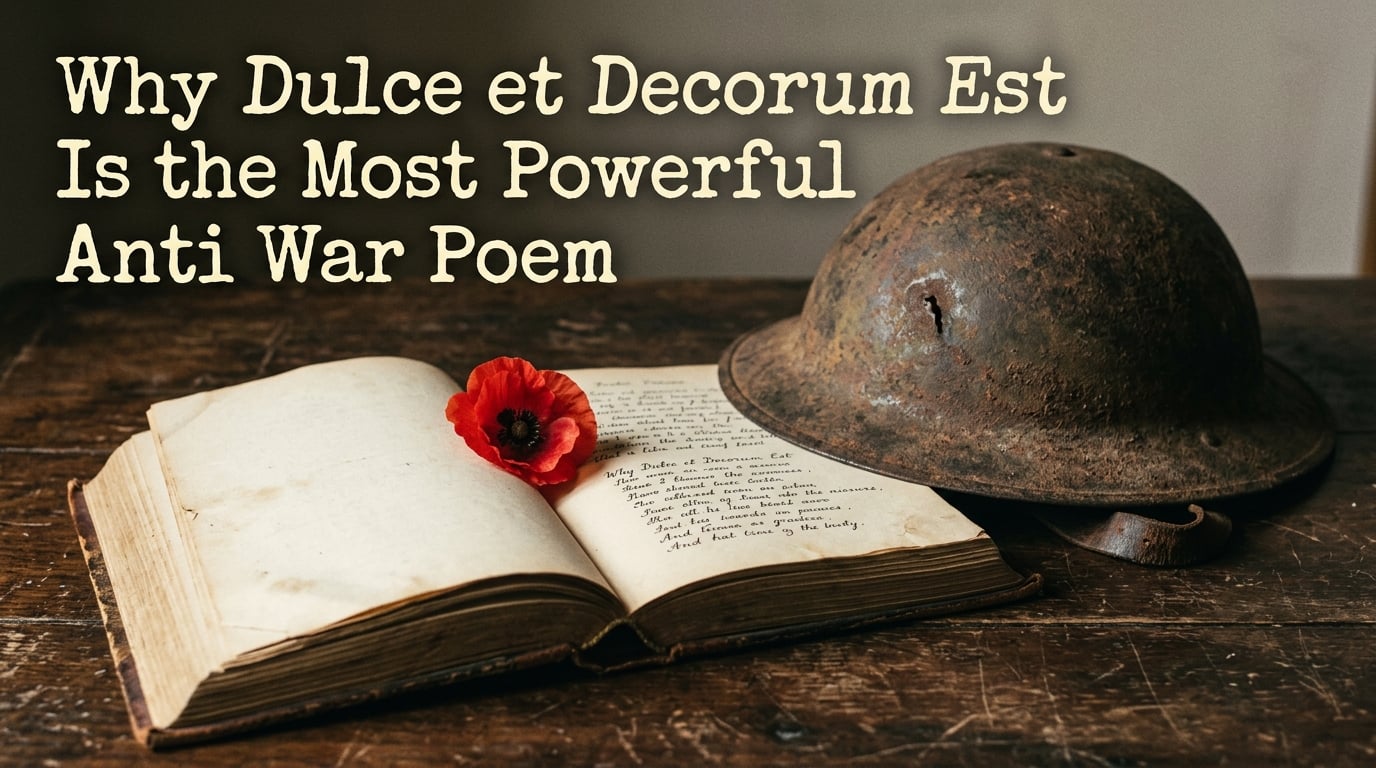
When Wilfred Owen sat down in a Scottish war hospital in 1917 to revise a poem about a chlorine gas attack, he could not have known he was about to write what millions of readers would call the most powerful anti-war poem ever written. “Dulce et Decorum Est” did something no political speech or newspaper editorial could do. It dragged the reader into a trench, forced them to watch a man drown in his own lungs, and then asked a simple, devastating question: would you still tell children that dying for your country is sweet?
The answer, Owen insists, is no. The Latin title translates to “It is sweet and fitting to die for one’s country,” and the poem spends 28 lines demolishing that idea forever.
What makes this piece so effective is not just the graphic content. It is the combination of first-hand testimony, masterful literary craft, and moral fury directed at a single, identifiable lie. In this guide, we break down exactly why “Dulce et Decorum Est” stands above every other piece of World War I poetry and why it still hits readers like a fist more than a century later.
Table of Contents
Why Dulce et Decorum Est Is the Most Powerful Anti War Poem Ever Written
“Dulce et Decorum Est” earns its place as the most powerful anti-war poem ever written because it attacks propaganda with evidence the propagandists cannot refute. Owen was not a philosopher speculating about war from a comfortable study. He was a British infantry officer who fought in the trenches, survived gas attacks, and was diagnosed with shell shock. Every image in the poem comes from lived experience.
The poem’s power comes from three forces working together.
First, there is the authenticity of the witness. When Owen describes men “marching asleep” or a soldier’s “white eyes writhing in his face,” he is reporting what he actually saw. Readers sense this truth immediately, and it gives every line the weight of testimony rather than opinion.
Second, there is the precision of the imagery. Owen does not say “war is bad.” He shows you blood “gargling from the froth-corrupted lungs” of a man who took six seconds too long to put on his gas mask. The specifics do the persuading.
Third, there is the targeted anger. The poem is not a general lament about the tragedy of war. It is aimed directly at a specific lie, the Horace quotation used by governments and newspapers to recruit young men. Owen calls it “The old Lie,” capitalizing the word to make sure no reader misses the accusation.
As Reddit users in r/Poetry and r/books have noted repeatedly, no other war poem lands with this combination of personal authority and rhetorical fury. “In Flanders Fields” mourns the dead but still encourages the fight to continue. Sassoon’s work is angry but more abstract. Owen’s poem is angry, specific, and biographically undeniable.
The Historical Context Behind Dulce et Decorum Est
To understand why this poem carries such force, you have to know where and when it was written. World War I introduced mechanized slaughter on a scale no one had imagined possible. Machine guns, artillery barrages, and poison gas turned battlefields into industrial killing floors.
Trench warfare on the Western Front meant soldiers lived for months in mud-filled ditches, surrounded by rats, dead bodies, and the constant threat of random death. Conditions were so bad that thousands of men were treated for shell shock, what we now call post-traumatic stress disorder. Owen was one of them.
Wilfred Owen enlisted in 1915 and arrived in France in early 1917. Within weeks he experienced combat so intense that he was diagnosed with shell shock and sent to Craiglockhart War Hospital in Edinburgh. There he met fellow poet Siegfried Sassoon, who encouraged him to channel his trauma into verse.
The poem itself was originally drafted as a private letter warning against enlisting. Owen even considered dedicating it to a pro-war propagandist, Jessie Pope, who wrote jingoistic recruitment poetry for newspapers. He later removed the dedication but kept the confrontational tone.
This context matters because it explains why the poem feels like a warning shouted at a specific person rather than a meditation. Owen was not writing literature for its own sake. He was trying to stop a machine that was grinding up men he knew personally.
Tragically, Owen himself was killed in action on November 4, 1918, exactly one week before the Armistice that ended the war. His mother received the telegram announcing his death on November 11, the day the church bells were ringing to celebrate peace. That biographical fact has given the poem an additional layer of emotional weight that no amount of literary analysis can manufacture.
The Gas Attack Scene: Visceral Imagery That Burns Into Memory
The heart of the poem is the gas attack in the second stanza. This is the section most readers remember years after reading it, and for good reason. Owen compressed an atrocity into eight lines that function almost like a horror film sequence.
The first stanza lulls the reader into the exhaustion of trench life. The soldiers are “Bent double, like old beggars under sacks,” “knock-kneed,” and “coughing like hags.” They are not the clean, heroic figures of recruitment posters. They are broken men shambling toward rest.
Then the gas shells hit and the rhythm breaks completely.
“Gas! GAS! Quick, boys!” The exclamation and the repetition fracture the slow, dragging meter of the first stanza. This is Owen using form to mirror content. The reader, like the soldiers, is jolted into panic.
Most of the men get their masks on. One does not. And Owen does not look away from what happens next. He describes the man “flound’ring” in the gas “as under a green sea,” drowning on dry land. The green imagery is literal, chlorine and phosgene gas clouds were visibly greenish, but it also creates a surreal nightmare quality.
The third stanza is only two lines long, but it may be the most disturbing moment in English war poetry. Owen writes that the image of the dying man comes back to him “In all my dreams.” This is a soldier with shell shock telling you that the trauma never leaves. The shortness of the stanza itself feels like a breath caught in a nightmare.
The final stanza forces the reader into the scene. “If in some smothering dreams you too could pace / Behind the wagon that we flung him in.” Notice the verb “flung.” The man is not placed gently. He is thrown into a wagon because there is no time for dignity.
Owen then describes the dead man’s face in clinical detail: “white eyes writhing in his face,” blood “gargling from the froth-corrupted lungs, / Obscene as cancer, bitter as the cud.” This is not poetry that decorates death. It is poetry that makes you smell and taste it.
The Old Lie: Owen’s Condemnation of Pro Patria Mori
The poem’s title and final lines come from the Roman poet Horace’s Odes: “Dulce et decorum est pro patria mori,” meaning “It is sweet and fitting to die for one’s country.” For centuries, this phrase was used to glorify military sacrifice and encourage young men to enlist.
Owen’s genius is in turning the phrase into a weapon against itself. After 24 lines of graphic horror, he invites the reader to repeat this slogan to someone who has actually seen what war does to a human body. “My friend, you would not tell with such high zest / To children ardent for some desperate glory, / The old Lie: Dulce et decorum est / Pro patria mori.”
Notice that Owen capitalizes “Lie.” It is not a small mistake or a difference of opinion. It is a deliberate falsehood, told on purpose, by people who know better, to manipulate the young.
The phrase “desperate glory” is also carefully chosen. It acknowledges that young men want glory, but reframes that desire as “desperate,” meaning reckless and born of ignorance. Owen does not insult the soldiers. He pities them and attacks the people lying to them.
The word “zest” does heavy lifting too. It means enthusiastic relish. Owen is saying that the people who repeat the old lie do so with cheerful energy, and that energy is obscene when you have seen the reality behind it.
This is why so many people in forum discussions describe the poem as “visceral” and “gruesome.” The horror of the imagery is in service of a moral argument. Owen is not being graphic for shock value. He is being graphic because anything less would let the lie survive.
Many students and first-time readers find the Latin phrase confusing because they are unfamiliar with Horace. But once you understand the translation and the centuries of military tradition behind it, the poem’s final lines land like a courtroom verdict. Owen has spent the poem presenting evidence, and now he delivers the closing argument.
Literary Techniques That Make the Poem Unforgettable
Part of what separates “Dulce et Decorum Est” from lesser anti-war writing is Owen’s technical mastery. Every formal choice reinforces the emotional impact.
The meter shifts to mirror experience. The first stanza uses a heavy, dragging iambic rhythm that physically feels like exhausted marching. The gas attack stanza breaks into shorter, faster lines. The final stanza returns to a measured but grim pace, like a funeral march or a closing statement.
Half-rhyme creates unease. Instead of clean rhymes, Owen often uses slant or half-rhymes, pairs like “sludge” and “trudge,” or “boots” and “hoots.” These near-misses create a subtle feeling of wrongness. The rhyme scheme promises resolution but never quite delivers, exactly like war.
Cacophony forces discomfort. Words like “gargling,” “writhing,” “guttering,” and “choking” are hard to say smoothly. They require effort from the mouth, and that physical effort mirrors the struggle of the dying soldier. Owen uses the sound of language as a tool of empathy.
Similes make the incomprehensible tangible. The dying man is “like a man in fire or lime” and “under a green sea.” Owen reaches for comparisons the reader can actually imagine because the literal event is beyond normal experience. These similes are bridges from the reader’s world to the soldier’s.
Enjambment creates breathless urgency. Several lines run over without punctuation, pulling the reader forward without a pause. This mimics both the panic of the gas attack and the relentlessness of traumatic memory.
The second-person address breaks the fourth wall. When Owen writes “If you could hear” and “you too could pace,” he is talking directly to you. The poem stops being about Owen’s experience and becomes about your complicity if you continue to believe the lie.
Together, these techniques explain why the poem has what literary critics call “staying power.” It is not just that the content is powerful. The craft ensures that the content enters the reader’s body, not just their mind.
Dulce et Decorum Est vs The Soldier: Propaganda Meets Reality
To fully appreciate Owen’s poem, it helps to place it next to its ideological opposite. Rupert Brooke’s “The Soldier,” written in 1914, represents the romanticized view of war that Owen was reacting against.
Brooke’s poem opens: “If I should die, think only this of me: / That there’s some corner of a foreign field / That is for ever England.” It is beautiful, dignified, and serene. Dying for England, in Brooke’s vision, sanctifies the ground itself.
Owen’s poem answers this vision with a corpse whose “incurable sores on innocent tongues” make a mockery of sanctity. Where Brooke sees a “corner of a foreign field” transformed into holy ground, Owen sees a wagon carrying a man whose lungs are dissolving.
Brooke describes the soldier as “A body of England’s, breathing English air, / Washed by the rivers, blest by suns of home.” Owen describes a body choking on green gas in the mud.
The contrast is not accidental. Both poems were written during the same war, but they represent two completely different truths. Brooke’s truth is the one printed in newspapers and read at rallies. Owen’s truth is the one hidden in field hospitals and trenches.
Brooke himself never saw sustained combat. He died of an infected mosquito bite on a troop ship before reaching Gallipoli. Owen, who saw months of front-line fighting, knew that Brooke’s vision was not just incomplete but actively dangerous because it was used to recruit men into a slaughter Brooke himself never experienced.
This is why Owen directly addresses people who would tell “with such high zest” the old lie. He is talking about the Brookes of the world, the newspaper poets, the recruitment officers, and anyone who sells glory without having smelled rotting flesh.
Why This Poem Still Matters in 2026
More than a century after it was written, “Dulce et Decorum Est” continues to be taught in schools, quoted at memorials, and invoked in anti-war discussions around the world. Its relevance has not faded because the lie it attacks has not died.
Every generation produces new versions of the old lie. Different words, same function. Politicians still invoke patriotism to justify conflict. Recruitment still uses glory and adventure as selling points. Young people still enlist with images of heroism that do not include the words “froth-corrupted lungs.”
English professors and literature teachers continue to use this poem specifically to teach the contrast between propaganda and the reality of war. In classroom after classroom, students who have never read a war poem encounter Owen’s imagery and understand immediately why words matter.
Modern anti-war movements frequently return to Owen’s language because his central insight remains true: if you cannot honestly describe what happens to the human body in war, you have no business telling anyone it is sweet to die. The poem provides a standard against which every patriotic slogan can be tested.
The poem also speaks to anyone who has experienced trauma and been told to be silent about it. Owen’s refusal to look away from horror, his insistence on describing it in detail, validates the experience of survivors of all kinds of violence, not just war.
On forums like Reddit’s r/Poetry and r/books, readers consistently identify this as “the most effective anti-war poem ever written,” often citing the specific graphic detail as the reason it cannot be dismissed or forgotten. That consensus, built independently by thousands of readers over decades, confirms that Owen achieved exactly what he set out to do.
FAQs
Is Dulce et Decorum an anti-war poem?
Yes. Dulce et Decorum Est is one of the most famous anti-war poems ever written. Wilfred Owen graphically depicts a chlorine gas attack during World War I and then directly attacks the patriotic lie that dying for your country is sweet and fitting. The poem was specifically written to counter pro-war propaganda.
Who is considered the greatest war poet in the English language?
Wilfred Owen is widely regarded as the greatest war poet in the English language. His firsthand combat experience, combined with his technical skill and moral clarity, produced poems that defined how the English-speaking world remembers World War I. Dulce et Decorum Est is his most celebrated work.
How is Dulce et Decorum Est compared to The Soldier?
Dulce et Decorum Est and The Soldier represent opposite views of war. Rupert Brooke’s The Soldier romanticizes death in battle as a holy sacrifice that sanctifies foreign soil. Owen’s poem answers this with graphic images of a soldier drowning in poison gas, arguing that anyone who has seen such a death could never repeat the lie that it is sweet to die for your country.
What does the anti-war poem mean?
The anti-war poem Dulce et Decorum Est means that the famous claim it is sweet and fitting to die for one’s country is a deliberate lie. Owen uses the horrific death of a soldier in a gas attack as evidence, and challenges the reader to repeat the patriotic slogan only after witnessing the reality of what war does to the human body.
Conclusion
“Dulce et Decorum Est” remains the most powerful anti-war poem ever written because it combines testimony, craft, and moral courage into 28 lines that no counterargument can survive. Owen wrote from inside the experience, used every tool of language to make that experience inescapable, and aimed the result at a specific lie that still circulates today. If you want to understand why Dulce et Decorum Est is the most powerful anti war poem ever written, read it aloud once and then try, honestly, to repeat the old lie.