
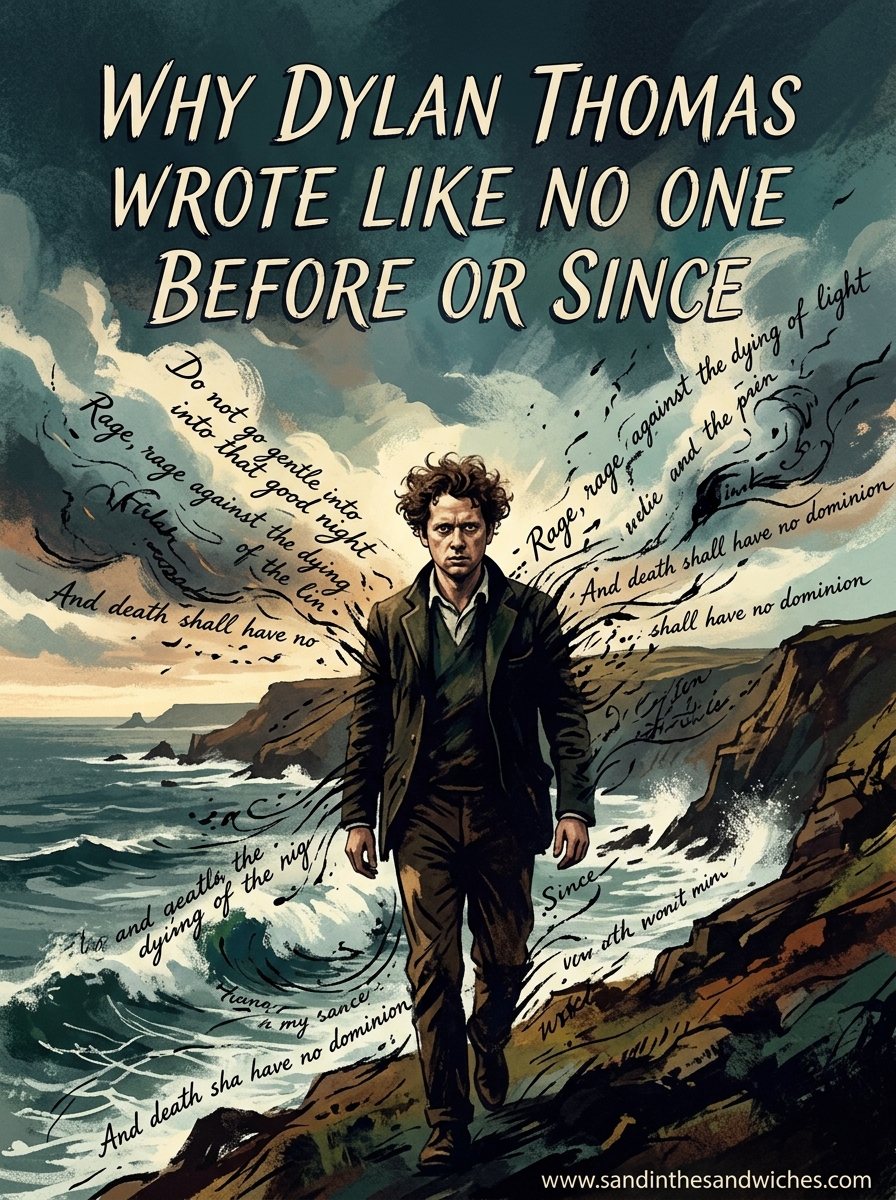
Dylan Thomas wrote like no one before or since because he treated the English language as a musical instrument first and a communication tool second. His poems are built from sound outward, with alliteration, assonance, internal rhyme, and approximate rhyme generating meaning rather than decorating it. No other 20th-century poet fused Romantic emotional intensity with such technical verbal exuberance, and fewer still rooted their work so deeply in the Welsh bardic tradition while refusing to join any literary movement at all.
I have spent years reading, performing, and studying Thomas’s work, and the more I return to poems like “Fern Hill” and “Do not go gentle into that good night,” the more I understand that his originality is not accidental. It is the product of a deliberate philosophy about what poetry should do to the human body and ear. This article breaks down exactly why Dylan Thomas wrote like no one before or since, examining the sound-first philosophy, technical mastery, cosmic symbolism, Welsh roots, and defiant independence that made his voice impossible to imitate.
Whether you are encountering Thomas for the first time or returning to his work after decades, understanding the architecture behind his strangeness changes how every line feels in your mouth.
Table of Contents
The Short Answer
Dylan Thomas wrote like no one before or since because he made sound the engine of meaning rather than its passenger. He layered alliteration, assonance, internal rhyme, approximate rhyme, and accentual syllabic rhythms so densely that his poems function as verbal symphonies, not just texts. He drew on a private symbolic universe linking the human body to the cosmos, rooted everything in the Welsh landscape and bardic oral tradition, and flatly refused to align with any literary school, from Auden’s group to the later Movement poets. The result is a body of work that is simultaneously Romantic, modernist, and utterly uncategorizable, where the experience of hearing the words matters as much as, or more than, decoding their literal sense.
The Sound-First Philosophy: How Thomas Made Music From Words
When people ask what was Dylan Thomas’s style of writing, the answer begins with a single principle: sound came first. Thomas himself described his process in terms that would have been familiar to the ancient Welsh bards, saying that he worked from the “sound, shape, and colour of words” and allowed meaning to follow. This is not a metaphor. It is a literal description of how he composed.
Where most poets, even great ones, begin with an idea or image and then find words to express it, Thomas often began with the sonic properties of words themselves, their vowels and consonants, their rhythms and weight, and allowed those properties to generate images and ideas. The Poetry Foundation describes this as a style where “sound was as important as sense.” The Poetry Society goes further, comparing his approach to James Joyce’s, noting that both writers were “obsessed with words, with their sound and rhythm and especially with their possibilities for multiple meanings.”
This sound-first approach explains why Thomas’s poems feel different on the page than they do when read aloud. On the page, they can look dense, obscure, even impenetrable. But spoken aloud, they release a music that transforms the experience entirely. Many readers on poetry forums describe this exact moment of revelation. They struggled with a Thomas poem silently, then heard a recording of Thomas himself reading it, and suddenly the poem made emotional sense even where its literal meaning remained slippery.
Thomas’s BBC radio work amplified this quality enormously. Beginning in the 1930s and continuing through the 1940s and early 1950s, he became one of the BBC’s most distinctive broadcasting voices. His radio plays, readings, and talks reached millions of listeners who experienced his poetry as performance rather than text. Under Milk Wood, his “play for voices,” represents the culmination of this approach. It was designed to be heard, not read, and its power lies entirely in the orchestration of voices, rhythms, and sonic textures.
The sound-first philosophy also explains why Thomas has proven so impossible to imitate successfully. You can copy a poet who builds from meaning outward by adopting their themes or imagery. But you cannot easily copy a poet who builds from sound outward, because that requires an ear so finely tuned that it can hear the difference between vowels the way a composer hears the difference between notes. Thomas had that ear, and it is the foundation of everything that makes his writing unique.
Technical Mastery: The Sound Devices That Built a New Language
Understanding Thomas’s technical toolkit is essential to understanding why his poetry sounds like nothing else. He did not invent these devices, but he used them with a density and intensity that no English-language poet had ever attempted before and none has matched since. Here are the five sound techniques that define his style.
1. Alliteration. The repetition of initial consonant sounds is as old as English poetry itself, traceable to Beowulf and the Anglo-Saxon tradition. Thomas revived alliteration with a ferocity that connects directly to his Welsh bardic inheritance. In “Fern Hill,” the phrase “green and golden” repeats throughout, and lines like “the foxes on the hills barked clearly and cold” chain consonant sounds together in chains that feel almost physical in the mouth. The effect is incantatory, pulling the poem forward by sonic momentum rather than logical argument.
2. Assonance. The repetition of vowel sounds within words creates a subtler, more liquid music than alliteration. Thomas used assonance to bind lines together internally, creating vowel echoes that reverberate beneath the surface of the poem. In “And death shall have no dominion,” the long vowels in “hands” and “stars” and “winds” create a resonant, bell-like quality that sustains the poem’s defiance across its three tercets.
3. Internal rhyme. Most English poets place rhyme at the end of lines. Thomas embedded rhyme throughout his lines, creating a cascading echo effect. A single Thomas line might contain three or four internal rhymes, each one pulling the reader’s ear in a slightly different direction. This technique contributes to the density and richness that some readers find intoxicating and others find overwhelming.
4. Approximate rhyme. Also called near rhyme, slant rhyme, or half rhyme, approximate rhyme uses words that share some but not all phonetic sounds. Thomas used approximate rhyme to create a sense of almost-resolution, of meaning hovering just out of reach. This is one of the reasons his poems feel simultaneously musical and unsettled. The ear keeps expecting a completion that never quite arrives.
5. Accentual syllabic rhythm. This is perhaps the most technically sophisticated aspect of Thomas’s style. Traditional English verse uses iambic rhythm, a pattern of unstressed-stressed syllables that creates a predictable forward motion. Thomas wrote in what critic William T. Moynihan identified as accentual syllabic rhythm, a more flexible system that allows for spondees (two stressed syllables in a row), trochaic substitutions, and other disruptions of iambic expectancy. The result is a rhythm that feels alive and unpredictable, closer to natural speech than to metronomic verse, but more musical than prose.
These five techniques do not work in isolation. Thomas layered them simultaneously, so that a single couplet might contain alliteration, assonance, internal rhyme, approximate rhyme, and rhythmic variation all at once. This layering is what creates the overwhelming sonic richness that characterizes his best work. It is also what makes his poems so difficult to paraphrase. You can summarize the meaning of “Do not go gentle into that good night” in a sentence, but you cannot reproduce what it sounds like, and for Thomas, the sound is the meaning.
Reddit poetry communities consistently identify this sonic density as the quality that sets Thomas apart. Users describe his “lyrical ability and ear for sound and rhythm” as unmatched, and many report that reading him aloud transforms their understanding of individual poems. The difficulty readers experience with Thomas on the page often dissolves when the poems are spoken, which is exactly what the sound-first philosophy predicts.
The Imaginary Cosmos: Microcosm, Macrocosm, and Symbolism
Thomas’s uniqueness is not purely a matter of sound technique. He also built his poems within a symbolic universe that was entirely his own. The Poetry Foundation identifies this as a “preconceived symbolism” system in which the human body carries cosmic significance. Thomas was working within an ancient tradition, the microcosm-macrocosm correspondence, in which the small things of the world mirror the large things, and the human body mirrors the universe itself.
In Thomas’s poetry, blood is not just blood. It is the sea, the tide, the life force of the planet. Bone is not just bone. It is rock, cliff, the geological skeleton of the earth. Breath is wind, and wind is spirit. This is why his imagery can feel simultaneously intimate and cosmic. When he writes about a single human body, he is also writing about the entire natural world, and when he writes about the natural world, he is also writing about the body.
This symbolic system gives Thomas’s poetry its characteristic quality of richness and difficulty at once. Every image does double or triple duty. “The force that through the green fuse drives the flower” is not just about a flower. The “force” is life itself, sexual energy, biological drive, and the green fuse is both the stem of the flower and the fuse of a bomb and the vascular system of a living body. The poem packs these meanings into ten syllables through sheer sonic and symbolic compression.
The Deaths and Entrances collection, published in 1946 and widely considered Thomas’s masterpiece, represents the fullest realization of this symbolic system. Poems like “A Refusal to Mourn the Death, by Fire, of a Child in London” and “Fern Hill” deploy the microcosm-macrocosm correspondence with devastating emotional effect. A child’s death becomes an event of cosmic proportions, and a childhood memory becomes a vision of paradise and loss.
Critics have debated for decades whether Thomas’s symbolism is religious, pagan, mystical, or humanistic agnostic. The evidence supports all of these readings simultaneously, which is itself a mark of his originality. He drew on Christian imagery, Welsh mythology, sexual symbolism, and the natural world without committing to any single framework. This refusal to be pinned down theologically mirrors his refusal to be pinned down literarily.
The Welsh Voice: Landscape, Language, and Bardic Roots
Thomas was born in Swansea, Wales, in 1914 and grew up in a Welsh-speaking cultural environment, though he wrote exclusively in English. His father, David John Thomas, was an English literature teacher who had mastered Welsh and who filled the household with the sounds of both languages. This bilingual upbringing shaped Dylan Thomas’s ear in ways that are impossible to overstate.
The Welsh language has a musical quality that comes from its stress patterns, its consonant clusters, and its tradition of cynghanedd, a complex system of alliteration and internal rhyme that dates to the medieval Welsh bards. Thomas absorbed these patterns as a child, and they surface throughout his English-language poetry in the form of unusually dense alliteration, unexpected internal rhymes, and a rhythmic drive that feels closer to oral performance than to written literature.
The Welsh bardic tradition also gave Thomas a model for what a poet should be. The bards were public performers, not private scribblers. They composed for the ear, not the eye. They treated poetry as a communal event, something that happened between a voice and an audience, not something that happened silently on a page. Thomas carried this model into the 20th century, becoming one of the first poets to build an international reputation through live performance and radio broadcasts.
Where did Dylan Thomas do most of his writing? The answer is Laugharne (pronounced “Larn”), a small seaside town in Carmarthenshire, Wales, where Thomas lived on and off from 1938 until his death in 1953. The Laugharne landscape, with its estuary, its cocklebeds, its gulls, and its slow tidal rhythms, seeped into the poems with a specificity that readers can still trace today. The Dylan Thomas Walk in Laugharne takes visitors past the boathouse where he wrote, the shed where he worked, and the castle grounds where he walked. Many readers describe visiting Laugharne as a near-pilgrimage that transforms their understanding of the poems.
The Poetry Society essay on Thomas draws a striking parallel between the Welsh landscape of Laugharne and the Caribbean landscape that later influenced poets like Derek Walcott. Both environments combine sea, sky, and a living oral tradition, and both produced poets who understood that landscape is not just scenery but a generative force in the making of language.
Thomas’s Welsh identity also positioned him outside the English literary establishment in ways that fueled his originality. He was not part of the Oxford or Cambridge set. He did not move in the same circles as Auden, Spender, or Day-Lewis. He was a Welsh outsider writing in English from the margins of British literary culture, and that marginal position gave him the freedom to develop a voice that no metropolitan literary movement could contain.
Why Dylan Thomas Wrote Like No One Before or Since: A Style That Defies Categorization
The question of what makes Dylan Thomas’s poetry unique can be answered by looking at what he refused to be. Throughout his career, literary critics and fellow poets tried to place him in various categories, and he fit none of them. This resistance to categorization is not a side effect of his style. It is the style itself.
Here are the key reasons Thomas’s writing resists comparison:
1. He was too Romantic for the modernists. While T. S. Eliot was writing about spiritual barrenness and cultural collapse in “The Waste Land,” Thomas was writing about green gardens, childhood innocence, and the natural life force. He believed in the power of imagination and emotion in a way that the modernists, who prized irony and detachment, found almost embarrassingly sincere. Yet Thomas was not simply reviving Romanticism. His technical experimentation was as radical as anything the modernists attempted.
2. He was too technically radical for the neo-Romantics. In the 1940s, a group of English poets sometimes called the New Apocalyptics or neo-Romantics embraced emotion, imagery, and the irrational. Thomas shared some of their concerns but operated on a technical level far beyond what most of them attempted. His sound engineering was too precise, too controlled, and too layered for poets who favored spontaneous overflow over verbal architecture.
3. He was too lyrical for the Movement poets. In the 1950s, poets like Philip Larkin and Donald Davie rejected the verbal exuberance of Thomas in favor of plain speech, clarity, and anti-romanticism. They saw Thomas as a cautionary tale of style without substance. But this rejection itself testifies to Thomas’s uniqueness. The Movement poets defined themselves against him precisely because he was so unlike anything they wanted to be.
4. He was too accessible in performance for the academy. Academic critics often dismissed Thomas as a popular entertainer, a bardic ranter whose readings were more performance than poetry. This criticism missed the point entirely. Thomas’s performative approach was not a degradation of poetry but a return to its oral roots. The fact that he could fill auditoriums and command radio audiences was not evidence of shallowness but of a communicative power that academic poets lacked.
5. He drew on too many traditions to belong to any one. Thomas absorbed the Welsh bardic tradition, English Romanticism, James Joyce’s verbal experimentation, the King James Bible, Shakespeare, the metaphysical poets, and Welsh nonconformist hymnody. No single tradition can claim him. He is a synthesis that no other poet has replicated because no other poet has combined exactly these influences in exactly this way.
The result is a body of work that occupies a category of one. You can trace influences on Thomas, and you can trace his influence on others, but you cannot place him in a school or movement. He wrote like no one before or since because he belonged to no tradition completely and every tradition partially.
The Sound Versus Sense Debate: What Critics Have Said
From the moment Thomas published his first collection, Eighteen Poems, in 1934, critics were divided about whether his sound-driven approach was genius or excess. The debate has never fully resolved, and understanding it is key to understanding why Thomas’s poetry produces such extreme reactions.
On the side of praise, Edith Sitwell famously wrote that Thomas’s poems had “a beauty and a power that I have not seen equaled in the poetry of our time.” She recognized immediately that what others called obscurity was actually a new kind of musical density that rewarded patient, repeated reading. Sitwell understood that Thomas was not being deliberately difficult for its own sake. He was pushing the English language into territory it had not previously occupied.
On the side of criticism, some reviewers accused Thomas of “muddle-headedness,” of using sound to mask a lack of coherent thought, and of producing “overweighted imagery” that collapsed under its own verbal weight. These critics argued that a poem should communicate a clear meaning, and that if readers could not paraphrase what a poem was saying, the poem had failed.
Critic William T. Moynihan defended Thomas by arguing that his poems operate according to a coherent system of accentual syllabic rhythm and preconceived symbolism that becomes visible once you understand the underlying architecture. According to Moynihan, the obscurity is not a flaw but a feature. Thomas demands active participation from the reader, who must learn to hear the poems rather than simply decode them.
Other critics, including Walford Davies and John Goodby, have argued that Thomas’s apparent obscurity dissolves when his Welsh context is taken into account. What sounds impenetrable to an English or American ear may carry clear resonances for a reader familiar with Welsh language patterns, Welsh hymnody, and the Welsh bardic tradition. This does not mean Thomas is easy. It means he is difficult for specific, recoverable reasons.
The sound versus sense debate ultimately rests on a false binary. For Thomas, sound and sense are not opposed. Sound generates sense. The meaning of a Thomas poem is not something that exists independently of its sound and then gets dressed up in musical language. The meaning is produced by the sound. Change a vowel, shift a stress, substitute one consonant for another, and the meaning changes. This is why attempts to paraphrase Thomas always feel reductive. They strip away the very dimension in which the meaning lives.
Forum discussions reveal that many readers experience this directly. They report that Thomas’s poems “almost make sense” on first reading, then deepen with every subsequent encounter. Some describe this as frustrating. Others describe it as the quality that keeps them coming back. The poems reward repetition in a way that transparently clear poems do not, because each rereading reveals new connections between sound and sense that were inaudible before.
The Lasting Echo: How Thomas Changed Poetry Forever
Dylan Thomas died in New York City on November 9, 1953, at the age of 39. His death, which followed days of heavy drinking and a medical collapse, cemented the legend of the doomed Romantic poet. But the work outlived the myth, and his influence has echoed through poetry in ways that continue to surprise.
Perhaps the most unexpected legacy of Thomas is his influence on Caribbean and postcolonial poetry. The Poetry Society essay documents how poets including Derek Walcott, V. S. Naipaul, Samuel Selvon, and Neville Dawes all engaged deeply with Thomas’s work. Walcott, who won the Nobel Prize for Literature in 1992, absorbed Thomas’s sonic approach and applied it to the Caribbean landscape, creating a fusion of Welsh musicality and West Indian oral tradition that produced some of the most original English-language poetry of the late 20th century.
The connection between Thomas and Caribbean poetry is not as improbable as it might first appear. Both Welsh and Caribbean literary traditions share a relationship to the English language that is complicated by colonial history. Both traditions possess rich oral cultures in which performance, music, and communal storytelling are central. Thomas’s demonstration that English could be bent, stretched, and musicalized to serve a non-metropolitan voice gave postcolonial writers permission to do the same thing with their own linguistic inheritances.
Closer to home, Thomas’s influence on Welsh poetry has been absolute. As one critic put it, Thomas “bestriders modern Welsh poetry like a chubby-cheeked, shabby-blazered colossus.” Every Welsh poet who has come after him has had to reckon with his legacy, either by building on it or by defining themselves against it. The National Poet of Wales tradition, the continued vitality of the Eisteddfod, and the international profile of contemporary Welsh poetry all owe something to Thomas’s example.
Thomas’s BBC radio work also left a permanent mark on how poetry reaches audiences. He helped pioneer the idea that poetry is a performing art, not just a literary one. Today, the explosion of poetry slams, spoken word events, poetry podcasts, and online poetry performances all descends in part from the model Thomas established in the 1940s and early 1950s, when he turned BBC radio into a platform for the human speaking voice delivering poems with full bardic force.
Under Milk Wood, completed just before his death and broadcast posthumously, remains his most performed work. It is a “play for voices” that takes the listener inside the dreams, waking thoughts, and secret lives of the inhabitants of a small Welsh seaside town called Llareggub. The play demonstrates everything Thomas had learned about sound, character, and the poetry of everyday speech. It is arguably the closest he came to making his sound-first philosophy accessible to a general audience without sacrificing any of its richness.
His legacy also persists in the sheer longevity of his reputation. Seventy years after his death, Thomas remains one of the few 20th-century poets whose work is known to general readers, not just academics. “Do not go gentle into that good night” is recited at funerals, quoted in films, and taught in schools around the world. “Fern Hill” remains one of the most beloved poems in the English language. This popular endurance is itself a form of proof that Thomas’s sound-first approach communicates something that purely intellectual poetry does not.
Five Poems That Show Thomas at His Most Original
If you want to hear why Dylan Thomas wrote like no one before or since, these five poems are the best place to start. Each one demonstrates a different facet of his unique voice, and all of them reward being read aloud.
“Do not go gentle into that good night” (1951). This villanelle, written for Thomas’s dying father, is his most famous poem and a masterclass in formal constraint producing emotional force. The villanelle form, with its two repeating lines cycling through five tercets and a final quatrain, is one of the most demanding in English poetry. Thomas uses the repetition not as a mechanical exercise but as a mounting emotional crescendo. The approximate rhymes of “night” and “day” and “light” create a sense of flickering, of a flame that refuses to go out.
“Fern Hill” (1946). Six stanzas of sustained lyrical memory, “Fern Hill” recreates the experience of childhood as a state of timeless green grace. The alliteration and assonance in lines like “Time let me hail and climb / Golden in the heydays of his eyes” create a verbal tapestry that is simultaneously exuberant and elegiac. The poem’s final turn, from innocence to the knowledge of mortality, is one of the most powerful in all of English poetry.
“And death shall have no dominion” (1933). Written when Thomas was just 19, this poem announces themes that would occupy him for the rest of his life. Its three tercets build a defiance of death through cosmic imagery and Biblical cadence. The title line, drawn from Romans 6:9, becomes a refrain that gains force with each repetition. The poem demonstrates Thomas’s ability to combine religious language with natural imagery in a way that transcends any single theology.
“In my craft or sullen art” (1946). This poem is Thomas’s ars poetica, his statement of what poetry is and does. He describes his craft as practiced “in the still night / When only the moon rages / And the lovers lie abed / With all their griefs in their arms.” The poem defines poetry as a solitary, almost heroic labor performed for no reward and no audience except “the lovers” who do not care about it. The irony is that the poem itself is so beautiful that it contradicts its own premise of futility.
“Poem in October” (1946). A meditation on Thomas’s thirtieth birthday, this poem retraces a walk from the seafront up into the hills above Laugharne. It moves through layers of memory and perception, blending the present moment with childhood recollection and autumn imagery with suggestions of spring. The poem is a miniature of Thomas’s entire method, combining autobiographical specificity, sonic richness, symbolic depth, and emotional precision in a way that no other poet could replicate.
FAQs
What was Dylan Thomas’s style of writing?
Dylan Thomas’s style is defined by a sound-first philosophy in which alliteration, assonance, internal rhyme, approximate rhyme, and accentual syllabic rhythm generate meaning rather than decorate it. His poems are built from the sonic properties of words outward, creating a musical verbal density that has no parallel in 20th-century English poetry.
What makes Dylan Thomas’s poetry unique?
Dylan Thomas’s poetry is unique because it combines five qualities no other poet has fused simultaneously: extreme sonic density from layered sound devices, a private symbolic system linking the human body to the cosmos, deep roots in Welsh bardic oral tradition, Romantic emotional intensity paired with modernist technical experimentation, and a flat refusal to align with any literary movement or school.
Where did Dylan Thomas do most of his writing?
Dylan Thomas did most of his significant writing in Laugharne, a small seaside town in Carmarthenshire, Wales, where he lived on and off from 1938 until his death in 1953. The Laugharne landscape, including the Taf estuary, the boathouse, and the surrounding hills, deeply shaped poems like Fern Hill and Poem in October.
Was Dylan Thomas a big drinker?
Yes, Dylan Thomas was known for heavy drinking throughout his adult life, and it contributed to his reputation as a wild, romantic figure. His drinking played a role in his deteriorating health and was a factor in the medical collapse that led to his death on November 9, 1953, at age 39 in New York City.
What did Dylan Thomas say before he died?
According to various accounts, Dylan Thomas’s last words were either ‘I’ve had 18 straight whiskeys, I think that’s the record’ or simply ‘I’ve had 18 straight whiskeys.’ The exact quote and number vary across sources, and some historians consider the claim embellished, but the statement has become part of the Thomas legend.
Conclusion: A Voice That Still Defies Imitation
Dylan Thomas wrote like no one before or since because he built poetry from sound outward, layered technical devices with unprecedented density, created a private symbolic cosmos linking body and universe, drew on Welsh bardic roots that no other English-language poet shared, and refused to join any literary movement that would have constrained him. The result is a body of work that remains impossible to categorize, imitate, or exhaust.
If you are approaching Thomas for the first time, start with the five poems above and read them aloud. Do not worry about decoding every image on the first pass. Let the sound wash over you. Trust that meaning will accumulate through repetition, because that is exactly how the poems were designed to work. If you are returning to Thomas after years away, try reading him with the Welsh context in mind. The bardic tradition, the landscape of Laugharne, and the bilingual ear that shaped every line may open dimensions you had not heard before.
Thomas himself said it best: “A good poem is a contribution to reality.” His poems contribute something that no other poet’s work contributes, a sound and a feeling and a way of being inside language that exists nowhere else. That is why, more than seventy years after his death, we are still trying to explain what he did. And that is why the explanation, no matter how detailed, will always be less than the experience of hearing the poems themselves.