
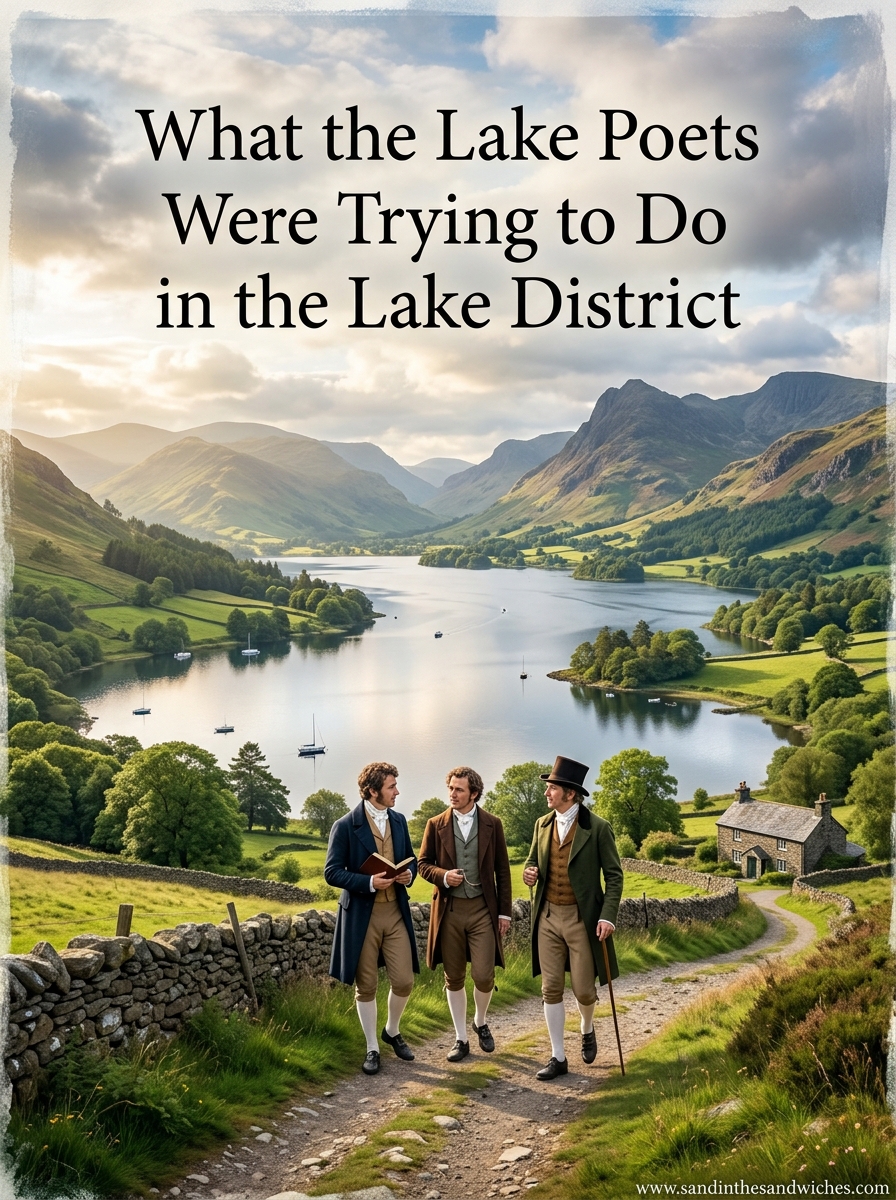
When you stand on the shore of Grasmere on a grey October morning, watching mist curl off the water like something alive, you start to understand why a small group of poets abandoned city life for this corner of England over two centuries ago. The landscape itself seems to demand a different kind of attention. It asks you to slow down, to notice, to feel something you might not have words for yet.
That search for words, and for an entirely new way of using them, is what brought William Wordsworth, Samuel Taylor Coleridge, and Robert Southey to the Lake District in the late 1790s. Together, they became known as the Lake Poets, a label that sounds gentle and affectionate today but started out as a literary insult. In this article, I want to explore what the Lake Poets were trying to do in the Lake District, not just as a backdrop for pretty verse, but as the physical and spiritual setting for one of the most ambitious revolutions in the history of English literature.
Their goals went far beyond writing about mountains and lakes. They were trying to tear down an entire system of poetic convention, replace it with something rooted in ordinary human experience, and prove that the natural world, not just the classical traditions of ancient Greece and Rome, could be the foundation of serious art. They largely succeeded, and the ripples of that success are still shaping how we think about nature, creativity, and the purpose of literature in 2026.
Table of Contents
Who Were the Lake Poets?
The Lake Poets were a group of three English poets who lived and wrote in the Lake District during the first half of the nineteenth century. The core members were William Wordsworth, Samuel Taylor Coleridge, and Robert Southey. All three chose to make their homes among the fells, lakes, and valleys of Cumbria, a decision that was unusual at the time and central to their literary identity.
Wordsworth was born in Cockermouth, on the edge of the Lake District, so his move to Grasmere in 1799 was a homecoming of sorts. Coleridge, his closest friend and collaborator, moved to Keswick in 1800 to be near Wordsworth after their groundbreaking work on Lyrical Ballads. Southey, Coleridge’s brother-in-law, settled at Greta Hall in Keswick around the same time and remained there for the rest of his life.
What united these three men was not a formal movement or a signed manifesto. It was a shared set of beliefs about what poetry should do and who it should speak to. They lived within walking distance of each other, shared manuscripts, argued about philosophy, and drew creative energy from the same landscape. Dorothy Wordsworth, William’s sister, kept journals at Dove Cottage that captured the daily textures of their life in the Lakes, and those journals became source material for some of the most famous poems in the English language.
The Lake Poets were not the only writers drawn to the region. Thomas De Quincey, John Wilson, and other literary figures visited or settled nearby, expanding the circle. But it is the original three who gave the group its identity and its lasting influence on English literature.
What the Lake Poets Were Trying to Do in the Lake District
This is the question that most accounts of the Lake Poets skirt around. They tell you who these men were, where they lived, and what they wrote. But they rarely stop to ask, directly: what were the Lake Poets trying to do in the Lake District? What were they trying to accomplish, and why did they believe the Lakes were essential to that project?
The answer has several layers, and each one matters.
Overthrow the Rules of Augustan Poetry
First and most fundamentally, the Lake Poets were trying to overthrow the dominant poetic style of the eighteenth century. The poetry of the Augustan age, exemplified by writers like Alexander Pope, was formal, witty, and heavily regulated. It relied on strict metrical patterns, elaborate classical allusions, and a tone of detached intellectual sophistication. It was poetry written for and by the educated elite, and it treated ordinary life as something beneath serious literary attention.
The Lake Poets saw this tradition as exhausted. Wordsworth called the reigning poetic diction “gaudy and inane phraseology” and argued that it had cut poetry off from real human feeling. Coleridge agreed, and their collaboration on Lyrical Ballads in 1798 was a deliberate act of literary rebellion. They wanted to prove that you could write great poetry without the apparatus of classical convention.
Write in the Language of Real People
The second goal follows directly from the first. Wordsworth declared, in the Preface to the 1800 edition of Lyrical Ballads, that poetry should be written in “the real language of men.” Not the artificial language of literary tradition, but the actual words that people used to communicate with each other in daily life.
This was a radical claim in 1800. It meant that a poem about a leech-gatherer or a wandering beggar could be as serious and artistically valuable as a poem about Greek heroes or Roman statesmen. It meant that a poet did not need to elevate their subject through ornate diction. The subject itself, if treated with genuine feeling and careful observation, was already enough.
The Lake District was essential to this project because it was where Wordsworth found his subjects. The rural poor of Cumbria, the shepherds, the solitary wanderers, the old men and women living on the margins of society, these became the protagonists of his poetry. He believed they possessed a dignity and a depth of feeling that urban, cosmopolitan poetry had overlooked.
Make Nature the Central Subject of Art
The third goal was to establish nature, not as a decorative background, but as the central subject and spiritual force of poetry. This is perhaps the most famous aspect of what the Lake Poets were trying to do, and the Lake District was inseparable from it. The landscape was not just scenery. It was a living presence that shaped consciousness, healed emotional wounds, and connected the individual mind to something larger than itself.
Wordsworth’s poem “Tintern Abbey” captures this idea with stunning clarity. He describes how the natural world, remembered in moments of solitude, can restore the spirit and provide access to a state of consciousness that transcends ordinary perception. The specific landscape he describes is the Wye Valley, but the philosophy behind it was tested and refined during his years in the Lake District, where he walked miles every day, often composing verse as he went.
Coleridge’s approach was different. He was less interested in nature as moral teacher and more interested in nature as a mirror for the imagination. His contributions to Lyrical Ballads, including “The Rime of the Ancient Mariner” and “Kubla Khan,” explore the supernatural, the dreamlike, and the strange. But even Coleridge acknowledged that the Lake District landscape fired his imagination in ways no other place could.
Elevate Ordinary People as Worthy of Poetry
The fourth goal ties the others together. By writing in plain language about rural life and ordinary people, set against a landscape that was itself considered unremarkable by the standards of classical aesthetics, the Lake Poets were making a democratic argument about who and what deserved to be taken seriously in art.
This was not just an aesthetic choice. It was a political one. In the aftermath of the French Revolution, questions about the dignity and rights of common people were the most urgent questions in Europe. The Lake Poets’ early work was deeply influenced by revolutionary ideals, and their decision to write about shepherds, beggars, and rural laborers was, in its own way, a literary extension of those ideals.
The Romantic Movement and the Lake Poets’ Mission
To fully understand what the Lake Poets were trying to do in the Lake District, you have to place them within the broader Romantic movement. Romanticism was not a single organized movement with a clear manifesto. It was a shifting set of ideas and impulses that emerged across Europe in the late eighteenth and early nineteenth centuries, reacting against the rationalism of the Enlightenment and the social upheavals of the Industrial Revolution.
In England, the Romantic movement is often dated from the 1798 publication of Lyrical Ballads. That collection, jointly produced by Wordsworth and Coleridge, is widely regarded as the opening shot of English Romanticism. It rejected the formal constraints and intellectual detachment of Augustan poetry in favor of emotional immediacy, individual experience, and the imaginative apprehension of the natural world.
The Lake Poets’ contribution to this movement was distinctive because of their physical location. While other Romantic poets, like Byron, Shelley, and Keats, operated in a wider European context, the Lake Poets were rooted in one specific landscape. They were the homegrown, domestic wing of English Romanticism, and their deep attachment to the Lake District gave their work a sense of place that was unusual even by Romantic standards.
The Romantic movement placed enormous emphasis on the imagination as the supreme human faculty. Wordsworth defined poetry as “the spontaneous overflow of powerful feelings” that takes its origin “from emotion recollected in tranquility.” This definition was a direct challenge to the Enlightenment view that reason was the highest form of cognition. The Lake Poets were arguing that feeling, intuition, and imaginative insight were not inferior to rational analysis. They were, in fact, the paths to the deepest truths about human experience.
The Lake District was not incidental to this argument. Its landscape, dramatic but not overwhelming, beautiful but not merely decorative, seemed perfectly calibrated to produce the kind of contemplative, emotionally charged experience that Romantic poetry celebrated. Wordsworth called the Lakes “the fairest portion of this chosen earth,” and he meant it not just as a compliment to the scenery but as a claim about the region’s unique capacity to nourish the moral and imaginative life.
Wordsworth’s Vision for Poetry
William Wordsworth was the intellectual engine of the Lake Poets, and his vision for what poetry could and should do was the most fully developed of the three. His 1800 Preface to Lyrical Ballads is effectively the founding document of English Romantic criticism, and it lays out his goals with remarkable clarity.
Wordsworth argued that poetry had become alienated from ordinary human life. The elaborate diction, rigid forms, and classical allusions of Augustan verse had created a gap between poetry and the actual experience of living. He wanted to close that gap. He wanted to write poems that a person with no formal literary education could understand and feel moved by, because the language would be the same language they already spoke.
His famous definition of poetry as “the spontaneous overflow of powerful feelings” is often quoted, but the second half of that definition matters just as much. The overflow, he said, “takes its origin from emotion recollected in tranquility.” This means that poetry is not just raw emotion vomited onto the page. It is emotion that has been reflected upon, processed, and shaped by the contemplative mind. The Lake District, with its silence and solitude, was the ideal setting for this kind of reflective recollection.
Wordsworth lived at Dove Cottage in Grasmere from 1799 to 1808, a period that produced some of his greatest work, including most of the poems that would eventually become The Prelude. He later moved to Rydal Mount, a few miles away, where he lived until his death in 1850. In 1810, he published A Guide through the District of the Lakes, a prose work that described the region’s geography, history, and aesthetic qualities. The Guide was partly a practical travel book, but it was also a philosophical argument about the relationship between landscape and human well-being.
In the Guide, Wordsworth expressed concern about the impact of tourism and industrial development on the Lake District. He argued that the region’s beauty was fragile and that uncontrolled development would destroy the very qualities that made it special. This makes Wordsworth, writing in 1810, one of the earliest voices for what we would now call environmental conservation.
His vision extended beyond aesthetics into ethics. He believed that sustained contact with nature produced moral improvement, that people who lived close to the natural world were more empathetic, more grounded, and more spiritually alive than those cut off from it by urban life. This was not just romantic sentiment. It was a serious philosophical claim, rooted in his own experience and observation, and it animated everything he tried to do as a poet.
Coleridge’s Contribution to the Lake Poets’ Project
Samuel Taylor Coleridge was the most intellectually voracious of the Lake Poets, and his contribution to their shared project was both creative and philosophical. While Wordsworth focused on the ordinary and the everyday, Coleridge gravitated toward the extraordinary, the supernatural, and the psychologically complex.
His poems in Lyrical Ballads were explicitly assigned the task of dealing with the “supernatural or at least romantic.” “The Rime of the Ancient Mariner,” the opening poem of the collection, is a hallucinatory tale of guilt, punishment, and spiritual redemption set on a doomed ship. It uses archaic language deliberately, creating a sense of otherworldliness that contrasts sharply with the plain diction of Wordsworth’s contributions.
But Coleridge’s most important contribution to the Lake Poets’ mission was theoretical. His Biographia Literaria, published in 1817, is one of the most important works of literary criticism in English. In it, he develops a sophisticated theory of the imagination, distinguishing between “fancy” (mere mechanical combination of images) and “imagination” (the creative power that gives form to experience itself).
Coleridge eventually moved away from the Lake District, settling in London and later in Highgate, where he continued to write and lecture. His relationship with Wordsworth cooled after 1810, partly due to personal tensions and partly due to philosophical disagreements about the direction of their work. But the years they spent together in the Lakes, from roughly 1797 to 1810, were the crucible in which English Romanticism was forged.
What Coleridge was trying to do in the Lake District was not so different from what Wordsworth was trying to do. He wanted to free poetry from mechanical convention and reconnect it with the living power of the imagination. He simply approached that goal from a different angle, one that emphasized strangeness, mystery, and the depths of the unconscious mind rather than the moral lessons of rural life.
Robert Southey and the Poet Laureate’s Role
Robert Southey is the least remembered of the three Lake Poets today, but during his lifetime he was arguably the most famous. He was appointed Poet Laureate in 1813, a position he held until his death in 1843, and his historical epics and biographical writings were widely read and admired in the nineteenth century.
Southey lived at Greta Hall in Keswick from 1803 until his death. The house, which overlooked the mountains and was close to both Wordsworth and Coleridge, became a literary hub. Southey was extraordinarily prolific, producing poetry, history, biography, and political journalism at a rate that astonished his contemporaries.
His role in the Lake Poets’ project was partly literary and partly institutional. As Poet Laureate, he represented the establishment face of Romanticism, a role that sometimes put him at odds with the more radical younger Romantics like Byron and Shelley. But Southey’s early work was deeply influenced by the same revolutionary ideals that shaped Wordsworth and Coleridge. His poem “The Battle of Blenheim” is a devastating critique of war and its human cost, written in plain language with a bitter ironic edge.
Southey was also the most domestically settled of the three. While Wordsworth walked the fells and Coleridge traveled restlessly, Southey maintained a disciplined writing routine at Greta Hall, surrounded by family. His steadiness provided a kind of anchor for the group, and his home served as a gathering place for the wider literary circle that formed around the Lake Poets.
What Southey was trying to do in the Lake District was, in some ways, the most straightforward of the three. He wanted to live as a professional writer, supported by his pen, in a place that inspired him. He believed that literature should educate and improve its readers, and he devoted enormous energy to historical and biographical works that he hoped would serve that purpose. His reputation declined sharply after his death, but his role in establishing the Lake District as a literary center was significant.
Why the Term ‘Lake Poets’ Was Originally an Insult
One of the most surprising things about the term “Lake Poets” is that it was coined as a term of derision. The label was popularized by Francis Jeffrey, the influential editor of the Edinburgh Review, who used it in a series of savage reviews published in the early 1800s.
Jeffrey was hostile to the Romantic movement generally and to Wordsworth’s poetry specifically. He viewed the Lake Poets as a clique of self-important provincials who had retreated to a remote corner of England and convinced themselves that their pretentious, deliberately unsophisticated verse represented a literary revolution. His review of Wordsworth’s 1807 Poems in Two Volumes opened with the famous line: “This will never do.”
The term “Lake Poets” was meant to be dismissive. By grouping Wordsworth, Coleridge, and Southey together under a geographic label, Jeffrey was implying that their work was not worth distinguishing between individually and that their shared location was their most defining characteristic. He was suggesting that they were a local school, a regional curiosity, rather than a movement of genuine literary significance.
The irony, of course, is that the label stuck. The Lake Poets eventually embraced it, or at least accepted it, and over time it lost its derogatory connotations entirely. Today, being called a Lake Poet is a badge of honor, a sign that these writers were part of something genuinely transformative in English literature. The fact that the term began as an insult is a reminder of how controversial their project was in its own time, and how completely they ultimately triumphed over their critics.
Jeffrey’s opposition was not purely aesthetic. He also objected to the Lake Poets’ early political sympathies. Wordsworth, Coleridge, and Southey had all been enthusiastic supporters of the French Revolution in their youth, and their radical politics were well known. Jeffrey, writing from a Whig perspective, found their conservative turn in later years hypocritical but also found their early radicalism dangerous. The term “Lake Poets” carried political as well as literary baggage, and the debate over the label was partly a debate over the proper relationship between art and politics.
The Lake Poets’ Political and Social Goals
The political dimension of what the Lake Poets were trying to do in the Lake District is often underexplored, which is a mistake, because it was central to their early project. All three poets were deeply affected by the French Revolution and the wave of democratic hope it unleashed across Europe in the 1790s.
Wordsworth spent a transformative year in France in 1791-1792, where he fathered a daughter with Annette Vallon and developed passionate revolutionary sympathies. He returned to England a committed republican, and his early poetry is saturated with political themes. The original draft of The Prelude, which he began in 1798, contains extended passages about his revolutionary hopes and his subsequent disillusionment as the Revolution turned violent and Napoleon rose to power.
Coleridge was equally radical in his youth. He and Southey even planned to establish a utopian community in America, which they called “Pantisocracy,” based on shared property and democratic governance. The plan collapsed before it was implemented, but it reveals how seriously these men took the idea of building a better society.
What the Lake Poets were trying to do politically in the Lake District was to create a kind of alternative model of community. They wanted to live according to their principles, close to nature, in a place where the values of simplicity, mutual support, and democratic equality could be tested. The Lake District, far from the centers of political and economic power, seemed like the right place to attempt this.
All three poets became more conservative as they aged. Wordsworth accepted a government sinecure and eventually opposed reform. Southey became an outspoken Tory. Coleridge developed a complex philosophical conservatism rooted in his study of German idealism. This political evolution has often been held against them, by their contemporaries and by later critics. Byron mocked Wordsworth and Southey for selling out their youthful ideals.
But their earlier work had already done its political work. The poems they wrote in the Lake District in the first decade of the nineteenth century, poems about ordinary people living lives of quiet dignity, had changed the literary landscape. They had made it possible to write seriously about the experiences of the rural poor, and they had established the idea that literature has a responsibility to engage with the real conditions of human life.
The Lake Poets also engaged with the social and economic changes transforming rural England during their lifetimes. The enclosure movement, which fenced off common land and displaced rural communities, was a particular concern. Wordsworth’s poetry repeatedly returns to the theme of people displaced from the land, forced into poverty or exile by economic forces beyond their control. His sympathy for these people was not abstract. He knew them personally, walked among them in the Lakes, and recorded their stories in his verse.
Dorothy Wordsworth and the Wider Circle
Any account of what the Lake Poets were trying to do that focuses only on the three men is incomplete. Dorothy Wordsworth was not just a supporting figure. She was an essential part of the project, and her contributions have only recently begun to receive the attention they deserve.
Dorothy lived with William at Dove Cottage and kept detailed journals recording the weather, the landscape, and the daily events of their life in the Lakes. These journals are literary masterpieces in their own right, written in prose of extraordinary precision and beauty. They are also the source material for many of Wordsworth’s most famous poems. The image of daffodils “tossing their heads in sprightly dance” that opens “I Wandered Lonely as a Cloud” comes directly from Dorothy’s journal entry describing a walk along Ullswater.
Dorothy’s role in the Lake Poets’ project was, in a sense, the foundational one. She was the observer, the recorder, the person who paid closest attention to the texture of daily experience in the Lake District. Her journals provided the raw material that Wordsworth transformed into poetry, and her sensitivity to the natural world shaped his own perception in ways that are impossible to disentangle.
Thomas De Quincey, best known for Confessions of an English Opium-Eater, was another important figure in the Lake Poets’ circle. He first visited the Lake District as a teenager, having been inspired by reading Lyrical Ballads, and eventually settled at Wordsworth’s former home in Grasmere. De Quincey’s writings about the Lake Poets, collected in Recollections of the Lake Poets, provide some of the most vivid firsthand accounts of Wordsworth, Coleridge, and Southey as personalities rather than as literary figures.
Other visitors and residents expanded the circle. John Wilson, a young Scottish writer who later became professor of moral philosophy at Edinburgh, was a frequent visitor. Walter Scott made the journey from the Borders. The Lake District, under the Lake Poets’ influence, became a literary destination, a place where writers came to pay tribute, seek inspiration, and argue about the future of English literature.
What this wider circle reveals is that the Lake Poets were not working in isolation. They were the center of a network, a community of writers and thinkers who were united by a shared set of concerns about the direction of literature, the impact of industrialization, and the relationship between human beings and the natural world. The Lake District gave this community a physical home, and that home, in turn, gave the Romantic movement in England a center of gravity.
The Lasting Legacy of the Lake Poets
The Lake Poets succeeded in their primary goals beyond anything they could have imagined. They wanted to revolutionize English poetry, and they did. The conventions of Augustan verse that they fought against are now historical curiosities. The plain language, emotional immediacy, and focus on ordinary experience that they championed have become the default mode of serious poetry in English.
But their legacy extends well beyond literature. Wordsworth’s concern about the impact of development on the Lake District, expressed in his 1810 Guide, makes him one of the founding figures of the modern conservation movement. His argument that natural beauty has intrinsic value, independent of its economic usefulness, was radical in 1810 and remains the philosophical foundation of environmental protection in 2026.
The Lake District itself became a UNESCO World Heritage Site in 2017, recognized partly for its natural beauty and partly for its cultural significance. The designation specifically cited the influence of the Lake Poets, acknowledging that the region’s identity as a landscape of artistic and spiritual significance was shaped by Wordsworth, Coleridge, and Southey.
There is a deep irony in this legacy. The Lake Poets wanted to preserve the Lake District from the depredations of tourism and industrialization. Their writings, by celebrating the region’s beauty, made it one of the most visited natural areas in Britain. Dove Cottage alone receives tens of thousands of visitors each year. The very success of their literary project contributed to the kind of development they feared.
But the Lake Poets’ influence on how we think about nature and place has also produced countervailing forces. The conservation movement they helped inspire has fought to protect the Lake District from overdevelopment. The National Trust, founded in 1895, owns large portions of the Lake District and manages them for public benefit. The Lake District National Park, established in 1951, provides legal protection for the landscape. These institutions are, in a real sense, the practical descendants of Wordsworth’s vision.
The Lake Poets have also had an outsized cultural influence. Their image of the Lake District as a place of spiritual renewal, a refuge from the noise and ugliness of modern urban life, has become a permanent part of British cultural identity. When people in 2026 talk about “getting away to the Lakes,” they are, knowingly or not, echoing an idea that Wordsworth and his circle first articulated over two centuries ago.
Even popular culture has felt the impact. Taylor Swift’s song “The Lakes,” from her 2020 album Folklore, directly references the Romantic poets and the idea of retreating to the Lake District as a place of artistic and personal renewal. The line “take me to the lakes where all the poets went to die” captures, in compressed form, the mythic status the Lake Poets have achieved. It also reveals how thoroughly their vision of the Lakes as a place of creative and spiritual significance has permeated the cultural imagination.
The Lake Poets were trying to change the world, and in a quieter but no less real way than they intended, they did. Not through political revolution, which they ultimately abandoned, but through language. They showed that poetry written about ordinary things, in ordinary words, by people who paid close attention to the world around them, could carry more emotional and philosophical weight than all the elaborate formal verse of the preceding century. That is what they were trying to do in the Lake District, and that is what they accomplished.
FAQs
Why did poets go to the Lake District?
Poets went to the Lake District because it offered the combination of natural beauty, solitude, and inspiration they needed for their revolutionary approach to poetry. Wordsworth, Coleridge, and Southey believed that sustained contact with nature was essential for creative and moral development, and the Lake District’s landscape was uniquely suited to produce the contemplative, emotionally charged experience their poetry celebrated. The region was also affordable compared to London, allowing these writers to live on modest incomes.
Who were the Lake District poets?
The Lake District poets, commonly called the Lake Poets, were three English poets who lived and wrote in the Lake District in the early nineteenth century: William Wordsworth (1770-1850), Samuel Taylor Coleridge (1772-1834), and Robert Southey (1774-1843). They were joined by a wider circle of writers including Dorothy Wordsworth, Thomas De Quincey, and John Wilson, who either lived in or frequently visited the region.
What did Wordsworth say about the Lake District?
Wordsworth called the Lake District ‘the fairest portion of this chosen earth.’ In his 1810 Guide through the District of the Lakes, he described the region’s geography and aesthetic qualities while also arguing that its beauty was fragile and needed protection from uncontrolled development. He believed that living close to the natural world produced moral improvement and spiritual depth, and he chose to spend most of his life in the Lakes, first at Dove Cottage in Grasmere and later at Rydal Mount.
Which poet is associated with the Lake District?
The poet most closely associated with the Lake District is William Wordsworth, who was born in Cockermouth on the edge of the Lake District and lived at Dove Cottage in Grasmere and later at Rydal Mount for most of his adult life. Samuel Taylor Coleridge and Robert Southey are also strongly associated with the region, as all three are known together as the Lake Poets.
How many Lake Poets were there?
The Lake Poets consisted of three core members: William Wordsworth, Samuel Taylor Coleridge, and Robert Southey. However, the wider circle included Dorothy Wordsworth, Thomas De Quincey, John Wilson, and several other writers who either lived in or frequently visited the Lake District. The term ‘Lake Poets’ specifically refers to the original three, while the broader group is sometimes called the Lake School.
What did the Lake Poets believe about poetry?
The Lake Poets believed that poetry should be written in the plain language of ordinary speech, that it should focus on common people and everyday experiences rather than classical subjects, and that nature was a source of moral and spiritual truth. Wordsworth famously defined poetry as ‘the spontaneous overflow of powerful feelings’ originating from ’emotion recollected in tranquility.’ They rejected the elaborate diction and rigid conventions of eighteenth-century Augustan poetry in favor of emotional immediacy and imaginative freedom.
Conclusion: What the Lake Poets Were Trying to Do Still Matters
Understanding what the Lake Poets were trying to do in the Lake District means looking past the familiar image of Romantic poets wandering the fells in search of pretty scenery. Their project was far more ambitious. They were trying to dismantle a whole tradition of literary artifice and replace it with a poetry rooted in real language, real emotion, and the real experiences of ordinary people. They chose the Lake District as their base because its landscape offered the raw material for that project, a place where the relationship between human beings and the natural world was immediate, unavoidable, and endlessly generative.
They succeeded. The poetic conventions they fought against are long gone. The values they championed, plain speech, emotional honesty, attention to the natural world, respect for ordinary lives, are so deeply embedded in our literary culture that we often forget they ever needed championing. And their concern for the natural environment, expressed most clearly in Wordsworth’s Guide to the Lakes, reads today like an early draft of the arguments that drive the conservation movement in 2026.
If you want to understand the Lake Poets, the best thing you can do is read their work and then go to the Lake District. Walk the paths Wordsworth walked. Sit by the shores where Dorothy composed her journal entries. Read Coleridge’s “Frost at Midnight” in the landscape that produced it. You will find that what the Lake Poets were trying to do in the Lake District is not just a historical question. It is a living one, as urgent and as relevant now as it was when they first arrived among the fells more than two centuries ago.